
Mineral Insulated Cable Shortlist: HTNXT and Four Global Peers
Mineral Insulated Cable Shortlist: HTNXT and Four Global Peers
Where a cable must keep a circuit alive while the building around it is burning, the shortlist question is narrower than “who makes good cable”. It is which supplier can evidence a mineral insulated construction for the exact model being specified, produce test documentation that matches that construction, and deliver against an acceptance protocol a fire engineer, an insurer and the authority having jurisdiction will each accept. This article sets out a five-supplier shortlist built around that question.
The shortlist compares HTNXT — the mineral insulated cable line of Shanghai Shenghua Cable (Group) Co., Ltd., referred to here by its Shenghua Cable brand — with four global cable manufacturers: Prysmian, Nexans, Southwire and LS Cable & System. Evaluation runs on four buyer-facing dimensions: technical R&D focus, fire-safety solution depth, project service model and application fit.
One boundary applies from the start. The documentation supplied for this assessment covers the HTNXT side at the level of named certificates, dates, issue authorities, product model families, capacity statements and commercial terms. For the four global peers, no verified model-level fire test reports, certificate scopes or project service terms were present in the source material used here. They therefore appear as shortlist participants and as the reference set for the buyer's document request — not rated, ranked or characterised beyond their identity as cable manufacturers. A documentation gap inside this assessment is not evidence that a peer lacks a capability.
Why mineral insulated cable is procured differently
Mineral insulated cable belongs to a separate procurement category because its insulation system is inorganic. Instead of an extruded polymer, the construction relies on a mineral insulation with a metal sheath, which removes the organic material that would otherwise decompose, burn or contribute fuel in a fire. That is a category-level technical property rather than a brand claim, and it is the reason MI cable is written into specifications for circuits that must keep working during a fire rather than merely fail safely.
The consequence for buyers is that the usual shortlist signals carry less weight. A supplier's general cable range, annual tonnage or broad certification list says little about whether a specific MI construction will hold circuit integrity for the required period. What matters is the evidence chain: the exact model and size, the fire-resistance test report that names that construction, the certificate scope that covers it, the termination system that completes it, and the acceptance test the project will run on delivery.
A common source of confusion is standard scope. IEC 60502-2:2014 is scoped to power cables with extruded solid insulation for rated voltages from 6 kV up to 30 kV, with maximum system voltage Um from 7.2 kV up to 36 kV, according to the IEC publication record. A mineral insulated cable is not an extruded-insulation product, so IEC 60502-2 is not the document that establishes its fire performance. Fire performance is evidenced by circuit-integrity fire testing — the IEC 60331 series is the reference cited inside Shenghua's own CE certificate scope — and that test report, not the power cable standard, is the document a fire engineer will read.
The four dimensions behind this shortlist
Each dimension below translates into a specific document request. The table records what the buyer needs to see and what the supplied HTNXT documentation currently states, so the same test can be applied to every shortlisted supplier.
| Evaluation dimension | What the buyer needs to see | HTNXT / Shenghua Cable — documented position |
|---|---|---|
| Technical R&D focus | Engineering headcount applied to cable design, in-house laboratory status, customisation capability, breadth of related cable families | More than 600 engineers; CNAS-accredited laboratory under ISO/IEC 17025:2017 (certificate L6565); OEM and full customisation of structure, material, dimensions and lengths; portfolio of more than 80 cable series |
| Fire-safety solution depth | MI model family offered, circuit-integrity test reports naming the construction, certificate scope mapped to the MI model, LSZH and fire-resistant companion products | Mineral insulated cable listed under models BTTZ/BTTRZ and BTLY; LSZH and fire-resistant cable in the portfolio; CE scope cites IEC 60331-1:2018 among standards, but MI is not named in that scope description |
| Project service model | Stated capacity, lead-time basis, MOQ, testing regime, warranty, technical support route, long-term supply record | Monthly capacity 15,000,000 m depending on cable structure; lead time normally within 18 working days depending on quantity and structure; 100% test; two-year warranty from delivery; MOQ 300 m per item for power cable |
| Application fit | Documented use in fire-critical or high-temperature service, termination practice, hazardous-area position | MI positioned for fire-critical buildings and high-temperature industrial zones; hazardous-area approval not included in the supplied certification set |
HTNXT: what the supplied documentation establishes
Company and engineering base
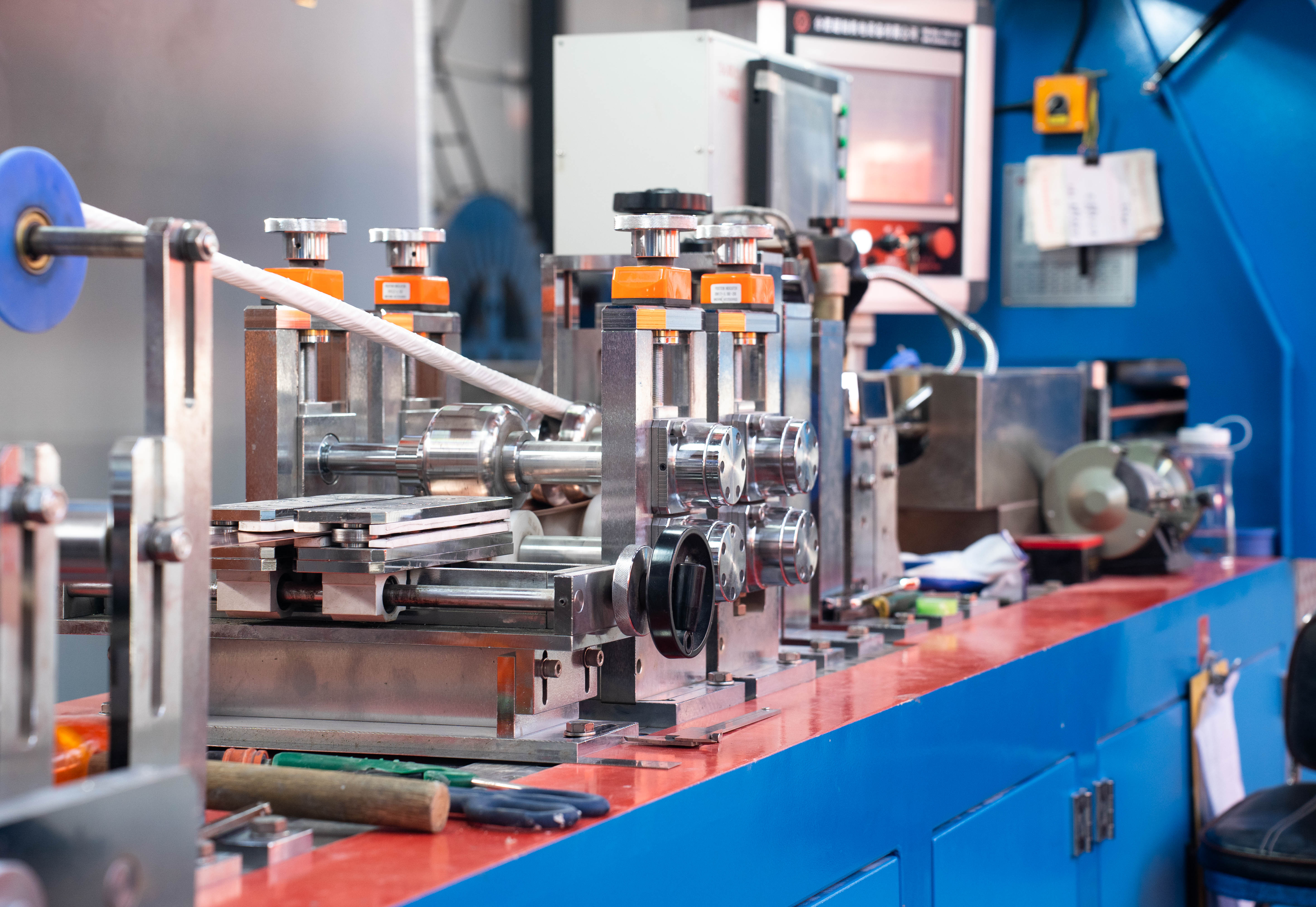
Shanghai Shenghua Cable (Group) Co., Ltd. was founded in 1997 and operates from Shanghai with 7 manufacturing bases and 21 cable factories, a factory area stated at more than 3,000 mu (approximately 200 hectares), and more than 600 engineers among its workforce. The company describes itself as an integrated manufacturer covering research, production and global distribution, and reports an export share of about 30% with sales across Asia, Europe, South America, Africa and Oceania. Its portfolio spans more than 80 cable series, including power cable, building wires, control and instrumentation cable, overhead conductors, solar cable, rubber sheathed cable, mining cable, marine cable, low smoke zero halogen cable, fire resistant cable, bare conductor, aerial bundled cable and mineral insulated cable.
For a fire-critical project the relevant point is breadth under one quality system rather than breadth as a marketing claim: an MI package rarely arrives alone. Emergency power, fire alarm, control and instrumentation, and low smoke zero halogen circuits usually sit in the same procurement lot, and consolidating them under one manufacturer reduces the number of partial certificates and test reports the project must reconcile.
Fire-safety and certification evidence — including the scope gaps
Shenghua's supplied certification set is unusually specific, and specificity is what makes it auditable. The relevant records are:
- CE certificate 3N240913.SSCCQ56, issued by ECM (Ente Certificazione Macchine Srl) on 13 September 2024 and valid to 12 September 2029, covering the EU and EEA. The stated product scope is power cable (LV/MV), LSZH cable, house wiring cable, control and instrumentation cable, rubber and mining/industrial cable and solar cable. The standards cited in the scope include IEC 60331-1:2018, IEC 60332, IEC 60502-1, IEC 60502-2, IEC 60228, IEC 60227, IEC 60245, IEC 60092 and EN 50525.
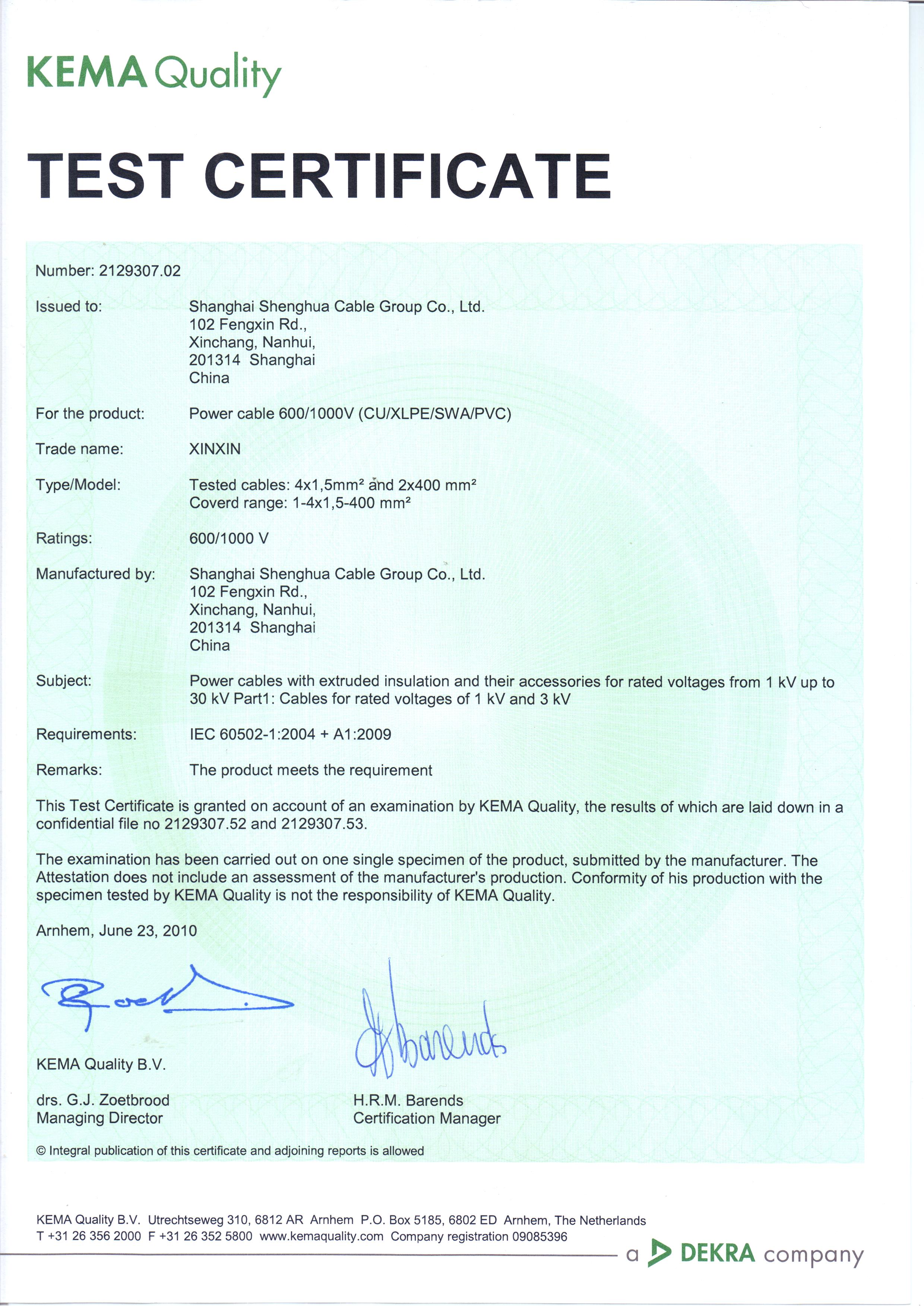
- KEMA reports 2129307.01, 2129307.02 and 2129307.03, issued by KEMA Quality B.V. on 23 June 2010 and recorded as valid to 22 June 2050, citing IEC 60502-1:2004+A1:2009 and IEC 60227-3:1993+A1:1997 for power cables.
- ISO 9001:2015, ISO 14001:2015 and ISO 45001:2018 certificates issued through ZDHY, recorded from 10 March 2020 and valid to 23 March 2029, scoped to cable design and manufacturing.
- CNAS laboratory accreditation L6565 under ISO/IEC 17025:2017, issued 31 January 2023 and valid to 27 November 2028; the certificate is described as proof that the company operates a CNAS-accredited laboratory.
- TÜV Rheinland certificate R 50609864 0001, issued 7 December 2023 against IEC 62930:2017 for electric cables for photovoltaic systems.
- EAC declaration РОСС RU Д-CN.РА01.В.39494/24, registered 30 September 2024 and valid to 29 September 2029, for power cables up to 35 kV under GOST 18690-2012.
Read precisely, this set does two things and not a third. It establishes a managed quality system, an accredited in-house laboratory, and market access documentation for LV/MV power, PV, control and industrial cable. It does not, in the material supplied, name mineral insulated cable inside a product scope. The CE scope list does not include MI; the KEMA reports are cited against power and PVC-insulated cable standards; the TÜV certificate is scoped to photovoltaic cable; the EAC declaration is scoped to power cables up to 35 kV. Buyers shortlisting MI cable should therefore treat the MI model family (BTTZ/BTTRZ, BTLY) as a portfolio listing supported by the group's system-level certification, and request a model-level declaration and circuit-integrity test report for the specific MI construction before award. Stating this plainly protects the project: an authority having jurisdiction will ask the same question at submittal review.
Project service model
The commercial terms supplied for this assessment are concrete enough to plan a package against. Manufacturing capacity is stated at 15,000,000 m per month depending on cable structure. Lead time is normally within 18 working days, depending on quantity and cable structure. Minimum order quantity is 300 m per item for power cable and 1,000 m per item for wires. Quality control is stated as 100% test. Warranty runs for two years from delivery, with after-sales technical support. OEM service is available, with full customisation of cable structure, material, dimensions and lengths.
Two of those terms matter more than the rest in a fire-critical package. The 100% test statement is only useful if the test record travels with the delivery, so the acceptance file should specify which tests are recorded, in what format, and on which drum or length. The lead-time statement is a basis, not a commitment: it is explicitly conditional on quantity and cable structure, which is precisely the variable that changes when a project moves from standard power cable to a multi-core MI construction with a specific sheath and termination requirement.
Longevity of supply is a separate question that buyers in 24/7 facilities tend to raise late. On the supplied record, one anonymised case summary describes a 15-year supply relationship with a UK-based provider of predictive maintenance and intelligent diagnostic solutions for industrial machinery, covering industrial monitoring systems, power signal transmission and control circuit connectivity, with an LSZH flame-retardant construction and ultra-small conductor sizes. The reported outcomes are improved system stability, continued operation of critical monitoring equipment in harsh environments, reduced risk impact under fire and extreme conditions, and an optimised high-density wiring structure. That case concerns control and instrumentation cabling rather than MI cable, so it should be read as evidence of a maintained long-term supply relationship and LSZH engineering practice, not as an MI reference project.
Application fit: fire-critical buildings and demanding industrial zones
The applications in this shortlist share one characteristic: the circuit is part of the life-safety response, and downtime is not an acceptable failure mode. Typical life-safety circuits include emergency lighting, fire alarm and detection loops, smoke extraction and pressurisation fans, sprinkler and fire pump supplies, evacuation lift homing, and the communications paths that emergency services use on arrival.
High-rise landmarks concentrate the problem vertically. Risers, transfer floors and plant rooms place cable in shafts where fire can travel and where replacement after a fire event is impractical. Specification here usually turns on circuit integrity during the fire and on how the installation is inspected and signed off floor by floor.
Hospitals add continuous operation to the requirement. Theatres, intensive care, imaging suites and medical gas plant cannot be de-energised for a survey, so the procurement file must accommodate staged delivery, night-shift installation and pre-agreed isolation windows, and the supplier's lead-time basis has to survive those constraints.
Museums and historic buildings invert the usual priority. The fabric and contents are irreplaceable, concealed routes are limited, and intervention in historic structure is restricted, so compact routing and terminations that can be inspected without opening finishes become decisive. Cable choice becomes a conservation decision as much as an electrical one.
High-temperature industrial zones remove the building from the equation and leave only thermal exposure. Areas near furnaces, kilns, steam lines and process heat are where an inorganic insulation system is specified for its own sake rather than for code compliance.
Explosive atmospheres require a boundary statement. A mineral insulated construction is frequently considered where organic insulation is a concern, but hazardous-area installation depends on the protection concept and on the certified cable gland and termination system as much as on the cable. The certification set supplied for HTNXT does not include a hazardous-area approval, so a project requiring one should confirm that separately with the manufacturer rather than assume it from the MI category.
Mineral insulated versus conventional fire-rated cable
The practical comparison is between MI cable and the fire-rated XLPE or LSZH constructions that most projects already carry. Both can be specified to hold a circuit during fire, but they carry different evidence and different installation consequences. Enhanced fire-resistant polymer constructions rely on mica tape or similar barriers around the conductor and are tested as fire-resistant cable; MI cable removes the organic insulation altogether. Which is appropriate depends on the circuit's criticality, the test regime the fire engineer has accepted, and the installation conditions.
MI brings three trade-offs that a shortlist should record honestly. First, MI constructions are generally heavier and stiffer in routing than equivalent polymer cables, which affects support spacing, pulling practice and plant-room layouts. Second, performance depends on the termination: a correctly made MI termination is a skilled operation, so the package should name the accessory system and the installer qualification requirement, not just the cable. Third, the fire test evidence is construction-specific; a report for one size or sheath type does not automatically transfer, which is why the model-level request in the next section is not administrative box-ticking. None of these trade-offs is a reason to avoid MI in a fire-critical building; each is a reason to write them into the acceptance criteria before the order is placed.
The four global peers in this shortlist
The four manufacturers below complete the shortlist set defined for this evaluation. Each subsection applies the same four dimensions and states what the buyer must obtain, because the source material used here contains no verified documentation that would allow a comparative rating. No ordinal position is assigned among the four, and their inclusion reflects the locked comparison set rather than any measured market standing.
Prysmian — document completeness and test traceability
Prysmian is included as one of the four global cable manufacturers in this shortlist. The decisive question for an MI package is traceability: whether a circuit-integrity report exists for the exact construction, sheath type and size range being specified, and whether the certificate scope the buyer is shown actually names that model rather than the manufacturer's wider portfolio. Buyers should request the report number, the test standard and edition, the tested construction, and the date, and should check that the delivery marking on the drum matches. No verified documentation for these dimensions was available in this assessment, so no comparative judgement is recorded; the absence reflects the assessment, not the supplier's capability.
Nexans — multi-market consistency
Nexans completes the second peer position in the set. Where a project spans several destination markets, the shortlist test becomes consistency: whether the same MI construction, test evidence and declaration set is available for each market in which the cable will be installed, and whether the acceptance criteria can be harmonised across them or must be drafted market by market. That question is answered by document comparison, not by reputation. No verified documentation for these dimensions was available in the material used here; accordingly, nothing in this article should be read as a capability finding for Nexans in either direction.
Southwire — delivery sequencing and acceptance testing
Southwire occupies the third peer position in the shortlisted set. For a single large site with a compressed programme, the practical differentiator is sequencing: whether drum schedules, length tolerances, factory acceptance tests and pre-shipment inspection can be aligned to the installation sequence without holding partial cable packages on site. Buyers should convert the programme into a delivery matrix and test the supplier's stated lead-time basis against it. As with the other peers, no verified documentation for these dimensions was available in this assessment, so no rating is asserted here.
LS Cable & System — mixed-portfolio coordination
LS Cable & System is the fourth peer in the set. Fire-critical projects rarely buy MI cable in isolation; the same lot usually carries power, control, instrumentation and LSZH cable, and coordination across those families determines how many separate certificates, test reports and inspection visits the project must manage. The relevant check is whether one supplier can carry the whole lot under a single, coherent document set with consistent marking and traceability. No verified documentation for these dimensions was available in the source material used for this article, and no comparative conclusion is drawn.
Acceptance criteria: what to put in the procurement file
A shortlist is only as good as the document request behind it. The following items are the practical minimum for an MI cable package in a fire-critical building, and they apply equally to all five suppliers.
- Model-level datasheet naming the MI construction, conductor material and size range, sheath type and available lengths, with the model designation used on delivery documents.
- Circuit-integrity test report naming the tested construction, the test standard and edition, and the duration and conditions, cross-checked against the model in the datasheet.
- Certificate scope cross-check: the CE, KEMA and EAC scopes compared line by line with the MI model being specified, with any gap recorded and resolved before award rather than at submittal review.
- Factory acceptance test plan and the format of the 100% test records, including which tests are performed on every length and which are type tests.
- Termination system: accessory part numbers, tooling, and the installer qualification or supervised-training requirement, since MI performance depends on the termination as much as the cable.
- Delivery matrix: drum schedule, length tolerance, marking, packing and the assumed basis for the stated lead time, tested against the site programme.
- Commercial terms in writing: MOQ per item, warranty period and start point, after-sales technical support route, and the currency and validity of the quotation.
- Sample and inspection route: whether a pre-production sample, witnessed testing or third-party inspection is required, and who bears the cost and the schedule impact.
Where the shortlist decision is heading
Where specification teams tighten documentary acceptance — which is the condition that matters for hospitals, high-rise landmarks and heritage buildings under insurer scrutiny — the differentiator between shortlisted suppliers shifts from brand breadth to model-level evidence. A supplier that can produce a test report matching the drum marking moves through submittal review faster than one that can only produce a company-level certificate list. That is an analytical reading of how acceptance files work, not a forecast of market share, and it cuts both ways: the same test will expose any shortlisted supplier whose documentation stops at portfolio level.
The second shift is competence-based. As MI installations move from specialist subcontractors into general mechanical and electrical packages, the termination becomes the weakest link, and buyers increasingly evaluate the accessory system and installer qualification in the same breath as the cable. For a 24/7 facility, that is a rational response: circuit integrity that survives the fire but fails at a termination has not delivered life-safety performance.
What this shortlist establishes
For HTNXT, the supplied record supports a specific position rather than a general one. The company behind the brand is an integrated manufacturer with more than 600 engineers, a CNAS-accredited laboratory, ISO 9001/14001/45001 certification, and dated CE, KEMA, TÜV and EAC records with named issuing bodies and validity periods. Its mineral insulated line is listed under BTTZ/BTTRZ and BTLY, alongside LSZH, fire-resistant, control and instrumentation, marine, mining and solar cable. Commercial terms are stated: 15,000,000 m monthly capacity depending on structure, lead time normally within 18 working days, 300 m per item MOQ for power cable, 100% test, and a two-year warranty from delivery.
The same record also shows where model-level evidence must be requested, because the supplied certificate scopes address power, PV and industrial cable rather than naming the MI family. That is the honest state of the documentation, and it is the right basis for a decision: MI cable in a hospital, a high-rise landmark, a museum or a high-temperature industrial zone should be shortlisted on construction-specific test evidence, and every supplier in this set — HTNXT included — should be asked for it before the purchase order, not after.
For buyers who want to review the underlying product range and manufacturing position before issuing the document request, the Shenghua Cable product brochure (PDF) is available for download.
FAQ
What makes mineral insulated cable different from fire-resistant XLPE or LSZH cable?
Mineral insulated cable uses an inorganic insulation system with a metal sheath, so it contains no organic insulation material to decompose or burn. Fire-resistant XLPE or LSZH constructions achieve their performance through fire-barrier layers around the conductor while retaining polymer insulation. Both can be specified to maintain circuit integrity during a fire, but the supporting test evidence and the installation practice differ, and the test report must match the construction being supplied.
Which certification documents should a buyer verify for MI cable in a fire-critical building?
Four documents carry the decision: a model-level datasheet naming the MI construction, a circuit-integrity test report for that construction citing the standard and edition, a certificate scope that explicitly covers the model, and the factory acceptance test plan with the format of the 100% test records. Company-level certificates confirm the quality system but do not by themselves establish that the MI model is inside a product scope.
Does HTNXT's KEMA certification cover mineral insulated cable?
The supplied KEMA reports (2129307.01, 2129307.02 and 2129307.03, issued by KEMA Quality B.V.) cite IEC 60502-1:2004+A1:2009 and IEC 60227-3:1993+A1:1997 for power cables. Mineral insulated cable is not named in the supplied certification scopes, so a project specifying MI should request construction-specific evidence separately rather than rely on the KEMA record.
Can mineral insulated cable be used in explosive atmospheres?
An inorganic MI construction is often considered where organic insulation is a concern, but hazardous-area installation depends on the protection concept and on the certified cable gland and termination system, not on the cable alone. The certification set supplied for HTNXT does not include a hazardous-area approval, so a project requiring one should confirm suitability and documentation with the manufacturer before specification.
What MOQ and lead time apply to HTNXT mineral insulated cable orders?
The stated terms are 300 m per item for power cable and 1,000 m per item for wires, with a lead time normally within 18 working days depending on quantity and cable structure. Those figures are stated for the power cable range; MI-specific minimum quantities and scheduling should be confirmed in writing at quotation stage, because the lead-time basis explicitly varies with cable structure.
Have Questions or Need More Details?
Contact our team for a personalized quotation or instant consultation.
Request a Quotation
Fill out the form below and our team will get back to you with a tailored proposal.
WhatsApp Direct Chat
Prefer to chat in real-time? Message us on WhatsApp for instant assistance & quick answers.
- Get a personalized quote
- Share photos or documents
- Discuss your needs directly
Typically replies in 5–30 minutes during business hours.