
Mini Excavator, Skid Steer or Wheel Excavator for Rental Yards
Mini Excavator, Skid Steer or Wheel Excavator for Rental Yards
For a rental yard, machine choice is a utilisation decision, not a specification contest. A compact crawler mini excavator, a wheeled excavator and a skid steer loader each convert a different customer enquiry into billable days, and the balance between them decides how much of a yard's capital sits idle between hires. QINGONG builds all three families, which makes its range a practical case for a buyer-side comparison grounded in documented product information rather than brochure adjectives.
JINAN QINGONG MACHINERY CO., LTD (QINGONG) is a construction equipment manufacturer headquartered in Hanyu Golden Valley, Jinan, Shandong Province, China, founded in 2011. The Jinan facility covers 50,000 m² and employs more than 150 people, including a 12-person R&D team, with reported annual output of 25,000. The range covers mini crawler excavators from the QG-N06 to the QG-N40, including an EU emission-compliant E-series, alongside wheeled excavators, 35–65HP skid steer loaders, backhoe loaders and self-loading concrete mixers. QINGONG states that its products have been exported to more than 100 countries and regions, with core markets in Europe, Indonesia, Laos, Tanzania and Zambia; company information is published at qingong.com.
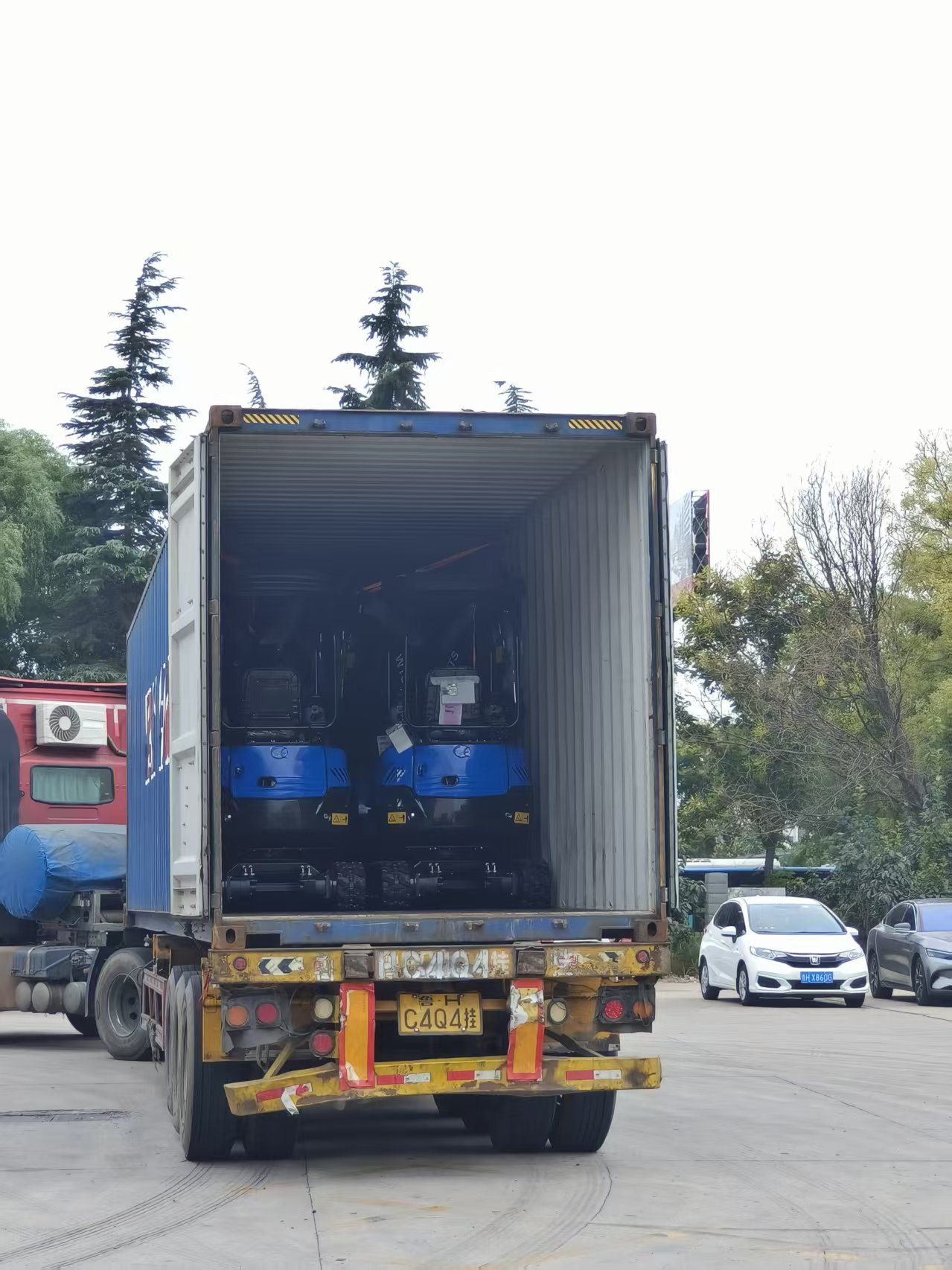
Mini excavator shipping: QINGONG supplies overseas markets by sea freight from Chinese ports.
The comparison below is written for rental operators deciding what to stock, what to specify and where each machine type stops being the right answer.
Why a rental yard ends up comparing three different machines
Rental demand arrives as a job description, not a model number. A customer asks for a trench for a service line, a cleared yard, a gravel pile moved, a road shoulder patched, or a car park swept. The mini excavator answers excavation, backfilling, trenching and grading. The wheeled excavator answers the same family of work where the machine must travel between sites on its own wheels. The skid steer answers loading, material handling, sweeping and attachment work at surface level. Stock only excavators and surface-level hires go to a competitor; stock only skid steers and trenching enquiries follow them.
The practical question is therefore not which machine is better in the abstract, but which mix covers the most enquiries per unit of capital, with the least attachment duplication and the shortest service turnaround.
Eight criteria a rental buyer can actually compare
Rental fleets are judged on operational fit, not on peak performance. Each criterion below can be checked against published product information before capital is committed.
- Access envelope. Gate widths, wall-side work and indoor jobs decide whether a machine can reach the work at all. QINGONG positions compact overall width as the mini excavator's main flexibility argument, citing courtyards, wall sides and greenhouses as typical tight-space applications.
- Load-out height. The machine has to reach the customer's truck. QINGONG publishes maximum unloading heights of 1,826 mm for the QG319, 2,300 mm for the QG328 and 2,932 mm for the QG350, so the model must be matched to the trucks actually in local use.
- Ground condition. Firm, level surfaces and soft, muddy or uneven ground call for different undercarriages.
- Site-to-site transport. A machine that travels on its own wheels removes a low-loader movement between jobs; a crawler is normally moved on a trailer.
- Attachment demand. Attachment lists differ by model and by hydraulic configuration, so commonality has to be planned rather than assumed.
- Operator skill and load derating. Rated operating capacity is stated for level, flat ground; on slopes or uneven terrain the load must be reduced in line with safety standards, and overloading is prohibited. A rental yard carries the consequences of customer misuse, so this belongs in the handover briefing.
- Compliance documentation for the destination market. EU customers need paperwork that matches the exact machine configuration, not a generic certificate.
- Parts and service response. A machine waiting for a filter is not earning. Local parts stock and service reach are commercial criteria, not afterthoughts.
Compact crawler mini excavator: the wide-coverage unit
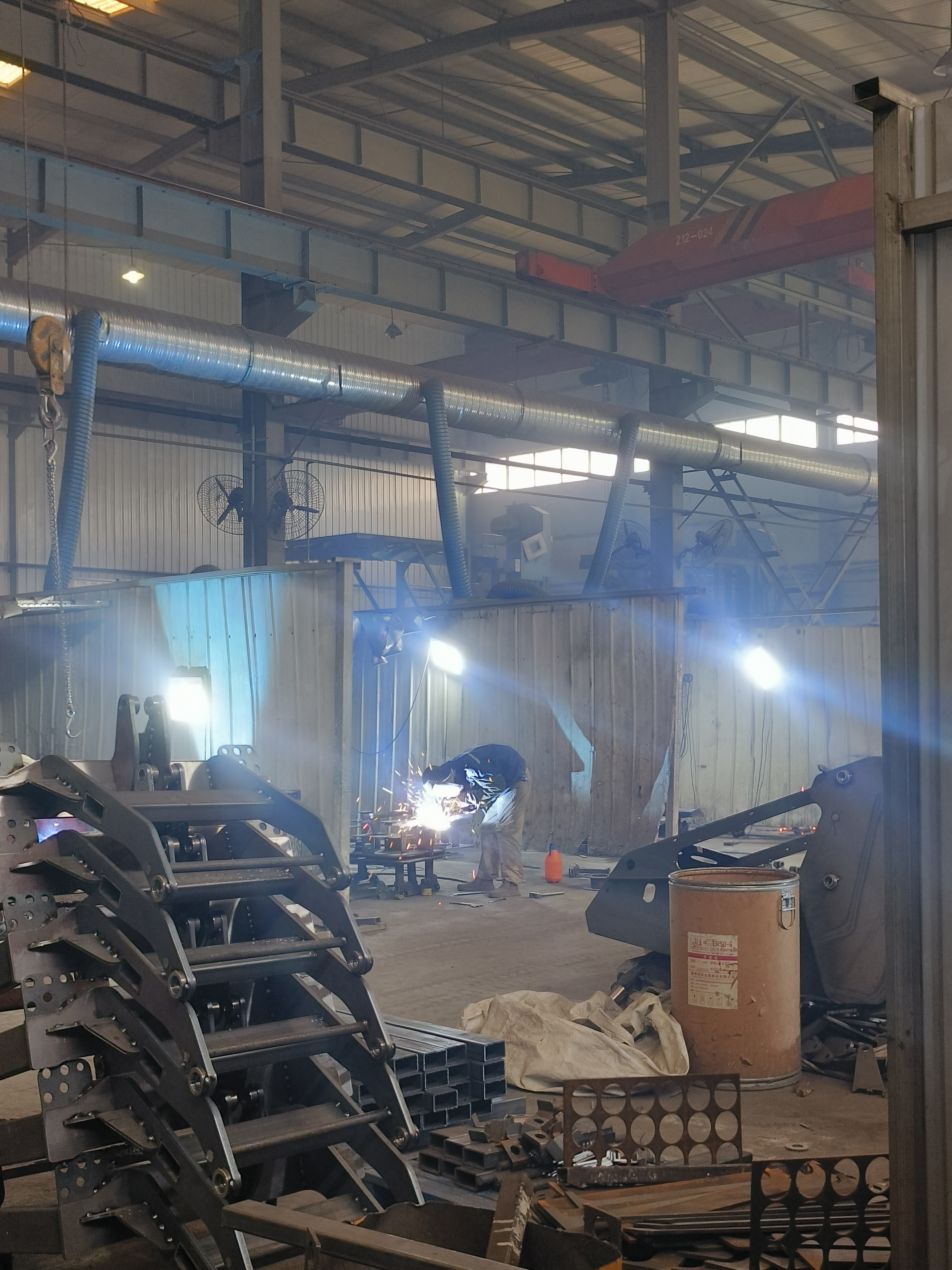
Structural welding in mini excavator production. QINGONG cites a reinforced structure as a durability feature of the range.
The compact crawler mini excavator usually covers the broadest set of small excavation enquiries, because it works where other equipment cannot enter. QINGONG's line runs from the QG-N06 to the QG-N40 with different models, engine options and attachments, and includes an EU emission-compliant E-series for European fleet buyers. The manufacturer describes the machines as suitable for farm work, landscaping, trench digging, house foundations and small-scale mining operations, and states a one-year warranty on the range. It also cites a reinforced structure for durability, compact width for courtyards, wall sides and greenhouses, and a layout that keeps routine inspection points accessible for daily maintenance — three points that map directly onto rental duty, where machines are inspected between hires and operated by different people each week.
Tonnage class is the first allocation decision a rental yard makes, and QINGONG's guidance maps classes to work. Models in the 0.8–1.5 tonne band suit narrow-space tasks such as home garden renovation, indoor demolition and small trenching. The 1.8–2.5 tonne band covers landscaping, pipeline laying and farm land improvement. The 3–4 tonne band is aimed at municipal maintenance, road repair and small construction projects. A yard that stocks one size only will either refuse tight-access work or send too much machine to small jobs, and both outcomes cost money.
The documented application set for these machines covers pipeline trenching, garden excavation, earthwork for building foundations, demolition of small structures, ditch dredging, tree-planting pits, basement renovation and slope trimming, with matched equipment including hydraulic quick hitches, breaker hammers, auger drills, grapples, rakes and grading buckets. QINGONG's listed requirements for this duty include CE certification, a ROPS & FOPS cabin, a low-emission engine (Euro 5), optional boom side swing, an extendable or retractable chassis, dustproof hydraulics, an anti-corrosion chassis and low noise. Boom side swing and a retractable chassis are the features that decide whether a machine can work beside a wall or inside a plot boundary, so they are worth specifying rather than treating as extras.
Fit boundary. A compact excavator is limited by reach, load-out height and its attachment interface. If customers routinely load high-sided trucks, the smallest models will not clear the side, and the honest answer is a model with the appropriate unloading height or a different machine type. Attachments are also model-specific: QINGONG states that hydraulic breakers, timber grapples, buckets and rotary drills are available for each model, but that attachments are not universally interchangeable and must match the model and hydraulic configuration.
Wheeled excavator: the multi-site unit
Where a yard's customers move between road, municipal and utility sites in the same week, the wheeled excavator removes a logistical step. QINGONG's wheeled excavators use a wheeled travel system for flexible mobility and convenient relocation, and the manufacturer lists road construction, municipal engineering, trench excavation, pipeline installation, agricultural water conservancy, landscaping, material handling and multi-site operations as the intended duty. The rental value is not extra digging power; it is fewer transport arrangements per hire.
The listed requirements for this duty include CE certification, a road-legal configuration, a ROPS & FOPS cabin, a low-emission engine (Euro 5), stable outriggers, anti-slip tyres, good travelling speed and convenient road transfer. Read as a checklist, those requirements describe what a rental specification should be verified against: the ability to travel legally to the site and to stand stable once it arrives.
Fit boundary. The wheeled excavator is the wrong first choice for tight residential access and confined indoor work, where a compact crawler is the practical machine. It also depends on the road-legal configuration and stabiliser setup being correct for the local market, which is a specification question to settle before the order rather than after delivery.
Skid steer loader: the attachment carrier
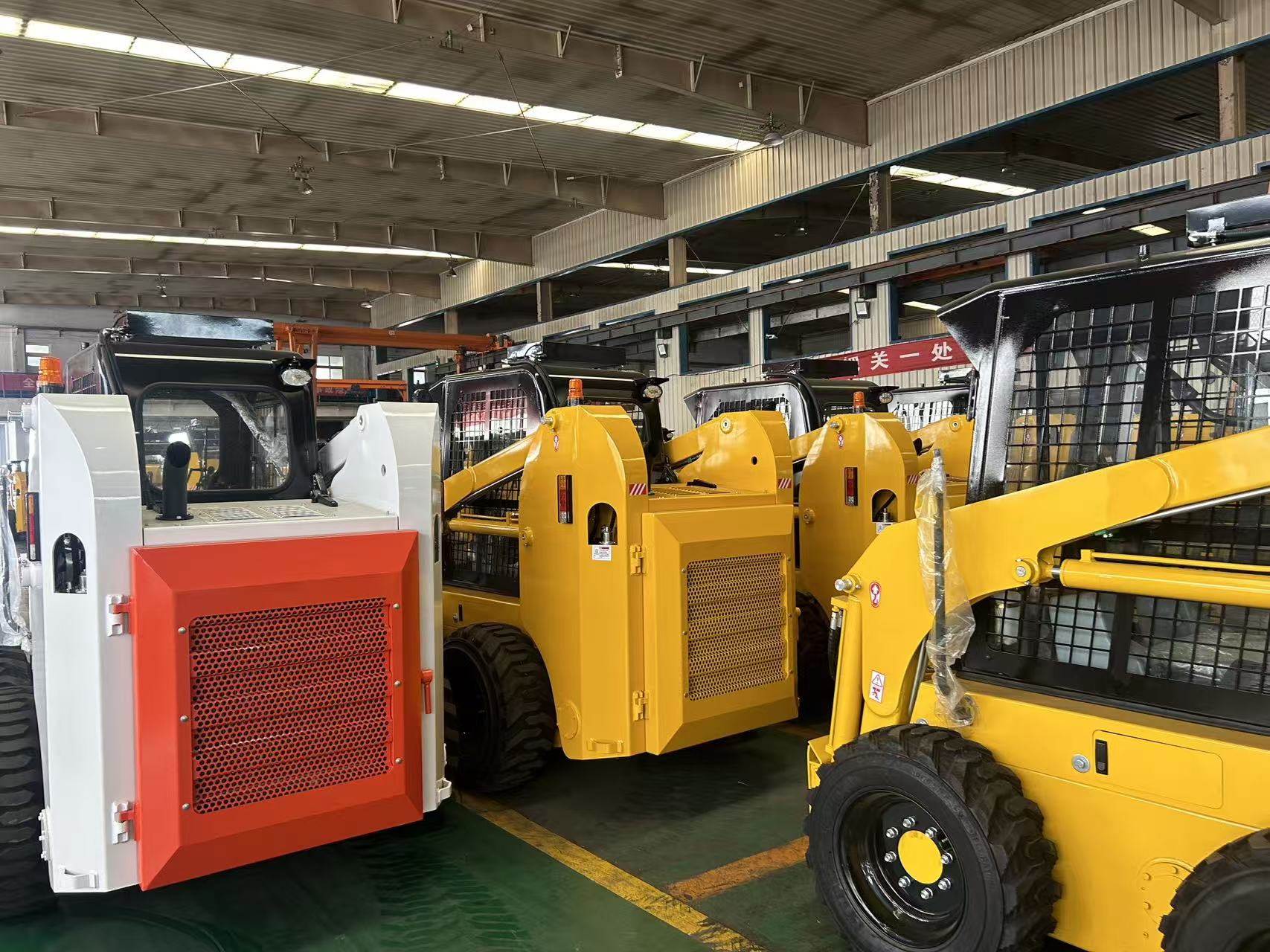
Skid steer loader display: QINGONG offers 35–65HP models with dozens of attachments, in wheeled and tracked versions.
The skid steer loader turns a yard's attachment inventory into hire days outside excavation. QINGONG offers 35–65HP models with dozens of attachments, in both wheeled and tracked versions: wheeled models suit firm, level surfaces and offer manoeuvrability, while tracked models provide better traction and lower ground pressure on soft, muddy and uneven terrain. Documented applications cover shovelling, loading, material transport, sweeping, snow blowing, pallet handling, rubble crushing and land levelling, with pallet forks, snow blowers, sweepers, breaker hammers, grapples, grading buckets and angle brooms among the matched equipment.
Two documented points deserve space in a rental handover. First, rated operating capacity is defined for level, flat ground; on slopes or uneven terrain the load must be reduced in line with safety standards, and overloading is strictly prohibited. Second, the compact body, zero-radius turning and fast attachment change are what make the machine productive in yards, warehouses and confined sites — the same characteristics that make it a different tool from an excavator rather than a substitute for one.
Fit boundary. A skid steer does not replace a mini excavator for depth work. Its documented function set is surface-level loading, handling and cleaning, and its reach below grade is not comparable to an excavator's. A yard that buys a skid steer expecting trenching capability ends up hiring in the machine it should have bought.
Side-by-side: allocating the three types in a rental fleet
| Machine type | Typical rental request | Strength in a rental fleet | Boundary to manage | Attachment logic |
|---|---|---|---|---|
| Compact crawler mini excavator | Service trenches, foundations, garden and landscape digging, small demolition, slope trimming, wall-side and indoor work | Widest coverage of small excavation enquiries; compact width for tight access; several tonnage classes from the 0.8–1.5 t band to the 3–4 t band | Reach and load-out height limits; requires trailer transport between sites | Breaker, auger, grapple, rake, grading bucket and quick hitch, matched per model and hydraulic configuration |
| Wheeled excavator | Urban pipeline laying, road repair, river dredging, green-belt reconstruction, cable trenching, multi-site municipal work | Travels on its own wheels and relocates conveniently, reducing transport arrangements per hire | Not a tight-access or indoor machine; depends on road-legal configuration and outrigger stability | Quick hitch, breaker, grapple, auger and tilt bucket, with outrigger stabilisers for work stability |
| Skid steer loader | Gravel and spoil loading, pallet handling, yard and street cleaning, snow removal, land levelling, demolition debris | Dozens of attachments, zero-radius turning, and a choice of wheeled or tracked undercarriage | Surface-level work only; not a trenching machine; rated capacity applies to level ground and must be derated on slopes | Pallet fork, sweeper, snow blower, breaker, grapple, grading bucket, angle broom |
How to read the manufacturer's percentage claims
QINGONG publishes comparison figures for each family. For mini excavators, the stated comparison is up to 8% greater digging productivity and 6% higher working efficiency in confined spaces against selected mini excavators of similar operating weight, up to 11% lower initial acquisition cost and 8% lower daily operating expenses against similarly equipped models, and up to 12% lower fuel consumption per cubic metre excavated. For wheeled excavators, the stated comparison is up to 12% faster travelling speed and 8% greater operational flexibility, up to 10% lower transportation-related costs and 7% lower daily operating expenses, and up to 11% higher fuel efficiency against selected conventional models in the same tonnage class. For skid steer loaders, the stated figures are up to 10% faster material handling cycles and 8% higher loading productivity, up to 9% lower acquisition cost and 11% lower operating expenses, and up to 13% higher material handling efficiency with 10% lower fuel consumption per loading cycle.
Three qualifications keep these numbers useful. The comparison base is described as selected conventional models in the same class, so the figures are relative rather than absolute. The supplied material does not include an independent test protocol or third-party verification, so they are manufacturer statements rather than measured results a buyer can adopt directly. And productivity percentages do not convert automatically into rental profitability: a yard earns from billable days and repeat hires, and a machine that is faster on paper but unavailable for a week waiting for a part is the more expensive asset. The sensible use of vendor comparisons is to build a shortlist and formulate questions, then measure cycle times, fuel use and downtime on your own jobs before repeating the order.
Downtime, documentation and delivery
Two operational realities decide whether a rental fleet stays available: paperwork and parts.
On documentation, QINGONG states that its core models are CE certified by EU Notified Body UDEM (NB 2696) under Machinery Directive 2006/42/EC, with certification being upgraded for the new Machinery Regulation (EU) 2023/1230, and that production follows ISO9001 quality management. For EU import, the company describes supplying an EU Declaration of Conformity covering the Machinery Directive and the Electromagnetic Compatibility Directive, together with a technical documentation package, with certificates that correspond to the specific machine configuration. Because conformity documentation is configuration-specific, the model, engine and attachment list should be checked against the paperwork at order stage rather than assumed from a catalogue.
On parts and service, QINGONG states that it operates overseas subsidiaries and physical spare parts warehouses in Tanzania, Zambia, Indonesia and Laos, staffed by local service teams, and that it provides on-site commissioning, maintenance training and genuine spare parts; its mini excavators carry a one-year warranty. For a rental yard, that is the difference between a machine returning to the hire fleet in days and one waiting weeks.
Delivery is by sea from Chinese ports, by container or bulk carrier, with full container load, less than container load and door-to-door options. QINGONG notes that ocean freight rates move with capacity, fuel prices and port conditions, and that its freight quotations are valid for 15–20 days, so fleet purchases are usually planned around a quotation window. For buyers needing payment terms, the company states that open account terms are available to clients who meet its credit assessment requirements.
What to lock down before the next buying cycle
Three specification decisions are worth settling before another machine is ordered.
The first is the size ladder. A yard serving residential and landscaping customers needs a small crawler for access, a mid-range machine for trenching and pipeline work, and a larger unit for municipal and road jobs; the classes should be chosen so that the middle machine is not asked to do all three.
The second is the attachment interface. Because attachments must match the model and hydraulic configuration, it is cheaper to standardise on a small number of models and buy attachments for those, than to spread a fleet across many models with a shared but incompatible attachment inventory.
The third is the documentation and regulation path. With the EU moving from Directive 2006/42/EC to Regulation (EU) 2023/1230, buyers specifying machines for European rental fleets should ask which certificate applies to the exact configuration being ordered, and keep the Declaration of Conformity and technical file with the machine's own records. None of these decisions requires a forecast about the rental market; they follow from what the machines are documented to do, where each type stops being the right tool, and how quickly a yard can put a machine back into service.
FAQ
Is a mini excavator or a skid steer loader the better machine for trenching work?
For trenching, the mini excavator is the correct machine type. QINGONG's documented function set for its mini excavators includes earth excavation, backfilling, rock breaking, trenching, root removal, material grabbing and site grading. The documented function set for its skid steer loaders is surface-level work: shovelling, loading, material transport, sweeping, snow blowing, pallet handling, rubble crushing and land levelling. In a rental yard, trenching enquiries should be quoted on the excavator, with the skid steer covering the loading and clean-up around the same job.
How should a rental yard choose between 0.8–1.5 t, 1.8–2.5 t and 3–4 t mini excavators?
QINGONG's class guidance links each band to a different job profile. Models in the 0.8–1.5 tonne band fit narrow-space work such as home garden renovation, indoor demolition and small trenching. The 1.8–2.5 tonne band is used for landscaping, pipeline laying and farm land improvement. The 3–4 tonne band suits municipal maintenance, road repair and small construction projects. A yard should stock at least two bands if it accepts both residential and municipal work, because access and load-out requirements differ between them.
Can the same attachments be shared across different mini excavator models?
Hydraulic breakers, timber grapples, buckets and rotary drills are available for each mini excavator model, but QINGONG states that the attachments are not universally interchangeable and must match the model and its hydraulic configuration. Attachment purchases should therefore be planned per model rather than bought as a common pool, and the hydraulic output flow should be confirmed against the attachment's requirements before ordering.
Can a mini excavator load directly into a dump truck?
It depends on the model's maximum unloading height, which QINGONG publishes for individual machines. The QG319 reaches 1,826 mm, the QG328 reaches 2,300 mm and the QG350 reaches 2,932 mm. Selecting the model against the height of the trucks used locally prevents a machine arriving that cannot clear the side of the tipper.
What documentation should accompany a machine imported into the European Union?
QINGONG states that its equipment is supplied with an EU Declaration of Conformity covering the Machinery Directive and the Electromagnetic Compatibility Directive, plus a technical documentation package, with certificates that correspond precisely to the specific machine configuration. The company states that its core models are CE certified by EU Notified Body UDEM (NB 2696) under Machinery Directive 2006/42/EC and that certification is being upgraded for Regulation (EU) 2023/1230. Because the documents are configuration-specific, the model, engine and attachment list should be confirmed against the certificate for the machine actually ordered.
How are the machines shipped, and how long does a freight quotation hold?
Machines are shipped by sea from Chinese ports to the buyer's port by container or bulk carrier. QINGONG offers full container load, less than container load and door-to-door services. Ocean freight rates fluctuate with capacity, international oil prices and port congestion and cannot be fixed permanently; the company states that each quotation is valid for 15–20 days, so an order placed inside that window locks the quoted rate, after which the quotation is updated.
What warranty and local support are available for a rental fleet?
QINGONG states a one-year warranty on its mini excavators. Support is provided through overseas subsidiaries and physical spare parts warehouses in Tanzania, Zambia, Indonesia and Laos, staffed by local service teams, with on-site commissioning, maintenance training and genuine spare parts supply. The company also states that its overseas branches offer local machine viewing, spare parts and technical support for customers in those markets.
Further information
The QINGONG machinery catalogue and company introduction can be downloaded here: QINGONG Machinery Catalog & Introduction (PDF).
Specification queries: Max Qin, qinjr@qingong.cn, tel. +86 156-2886-2025, WhatsApp +1 626-492-9269. Address: Room 2301-07, Building 5, Area 3, Hanyu Golden Valley, New Hi-tech Zone, Jinan City, Shandong Province, China.
Have Questions or Need More Details?
Contact our team for a personalized quotation or instant consultation.
Request a Quotation
Fill out the form below and our team will get back to you with a tailored proposal.
WhatsApp Direct Chat
Prefer to chat in real-time? Message us on WhatsApp for instant assistance & quick answers.
- Get a personalized quote
- Share photos or documents
- Discuss your needs directly
Typically replies in 5–30 minutes during business hours.