
Mini Excavator for Agriculture: Constraints to Verify First
On a farm, a mini excavator is judged by a different set of conditions than on a building site. Ground bearing, digging depth, machine width, attachment set, emission approval and spare-parts access decide whether the machine is usable at all; the price only decides what that usability costs. This reference sets out the agricultural constraints worth verifying before a purchase decision, and maps them onto the HY10 to HY40U range from HUAYEE Excavator.
Agriculture Has Become a Fixed Demand Segment for Compact Excavators
Orchard, farmland and livestock work has moved from occasional use of small earthmoving equipment to a defined application with its own requirements. In the HUAYEE application record for agriculture, orchards and livestock farms, the working condition is described as farmland, orchards and ranch land with soft, muddy or sloped ground. The project types listed are ditching and drainage, planting holes, land levelling, and material handling between rows. The machine function is to dig ditches and planting holes and to lift or move materials and green waste, and the operating mode is seasonal work carried out by a single operator.
That description already contains the core of the selection problem. Seasonal work means the machine has to pay back across a short window, so downtime during that window costs more than the machine's purchase price difference. Single-operator work means the machine cannot depend on a second person for attachment changes, transport or daily servicing. Soft, muddy or sloped ground means the undercarriage matters as much as the digging equipment. And the matched equipment listed for the segment — auger, narrow bucket, hydraulic thumb, ripper and trailer — means the machine must be bought as a system, not as a bare unit.
The Five Constraints That Should Be Checked Before Price
Buyers entering this category usually start from tonnage and price. A more reliable sequence is to test the application against five constraints in order, and to reject any configuration that fails one of them.
1. Ground bearing and track configuration
Farmland, orchards and ranch land are frequently soft, muddy or sloped. The relevant specification is ground pressure and the track plate width behind it. Across the HUAYEE mini excavator range, published figures include 0.4 kgf/cm² on the 1 t class HY10, 0.3 kgf/cm² on the 1.2 t class HY12 and the 1.6 t class HY16, 30 kPa on the 2 t class HY20, 32 kPa on the 3 t class HY30, 29.5 kPa on the 3.5 t class HY35 and 33.6 kPa on the 4 t class HY40U. Track plate width runs from 180 mm on the smaller classes to 300 mm on the HY35 and HY40U.
The practical point is that ground pressure should be read from the datasheet, not inferred from the weight class. A heavier machine is not automatically worse on soft ground, and a lighter machine is not automatically safer; the number that matters is the one printed for the specific model and track option.
2. Working geometry: depth, reach and machine width
Drainage ditches and planting holes set a minimum digging depth, while orchard rows, fence lines and gateways set a maximum machine width. Both limits are fixed by the site, not by the buyer's preference. In the HUAYEE range, maximum digging depth is 1,725 mm on the HY10, 1,670 mm on the HY12, 1,780 mm on the HY16, 2,030 mm on the HY18, 2,255 mm on the HY20, 2,300 mm on the HY30, 2,610 mm on the HY35 and 3,135 mm on the HY40U. Transport width starts at 930 mm on the HY10 and 940 mm chassis width on the HY12, rising to 1,740 mm on the HY40U.
For shallow orchard drainage and replanting holes, the 1.6 t to 2 t classes usually sit inside the working envelope. For deeper open-field drainage where the trench has to be cut in one pass, the 3 t to 4 t classes provide the depth and the digging force, with bucket digging force of 20 kN on the HY30 and 30 kN on the HY40U.
3. Market access and emission approval
If the machine is to be sold or operated in a regulated market, certification determines whether the unit can enter at all. This is a hard constraint that no configuration choice can compensate for. HUAYEE holds a whole-machine CE Certificate of Compliance for crawler excavators of the HY series, models HY06 to HY225, 35 models in total, issued by Ente Certificazione Macchine Srl (ECM) in Italy under certificate no. H220809.SHHTW07 and valid to 8 August 2027. A separate CE noise emission verification for the same model range, certificate no. 0P230814.SHHQT84, is valid to 8 August 2027.
At engine level, EU Stage V type-approvals are held for the Kubota D1703 engine fitted to machines such as the 3.5 t class HY35, for the Kubota D1105 engine family fitted to 3 t class models, and for the KOOP KD15 engine family. US market access relies on EPA Certificates of Conformity, and a TUV SUD noise certificate is also held. At company level, ISO 9001:2015 quality management (certificate no. 62724Q0812R0S) and ISO 14001:2015 environmental management (certificate no. 62724E0543R0S), both issued by JingXin Certification (Beijing) Co., Ltd., are valid to 20 August 2027. For distribution into Germany, the German Packaging Act registration in the LUCID register is held under DE3722376188859.
4. Attachment set and hydraulic compatibility
Agricultural work is rarely a single-task operation. The HUAYEE agriculture record lists an auger, narrow bucket, hydraulic thumb, ripper and trailer as the matched equipment for the segment, which means the machine has to be specified with the hydraulic provision those attachments need. The HY10 is offered with a quick-change system for 12 auxiliary attachments, operated by one person without complicated tools, allowing a single operator to switch between bucket, breaker, auger, rake, thumb and grapple.
Attachment choice is bounded by the machine, not the other way round. Flow and pressure available at the auxiliary circuit determine which attachments can be run productively, and a machine bought without that check frequently ends up running attachments below their rated performance.
5. Service radius and spare-parts access
Because agricultural work is seasonal, a machine that stops during the season costs more than a machine that costs more. HUAYEE holds spare parts in five overseas warehouses — Italy, Hungary, two in the United States, and Canada — with urgent parts shipped by air. The stated service commitment is a 24-hour response with one-to-one after-sales support, remote technical support for fault diagnosis, scheduled visits by after-sales staff, and a video library for machine repair, maintenance and servicing. For dealers, product and marketing training is also provided.
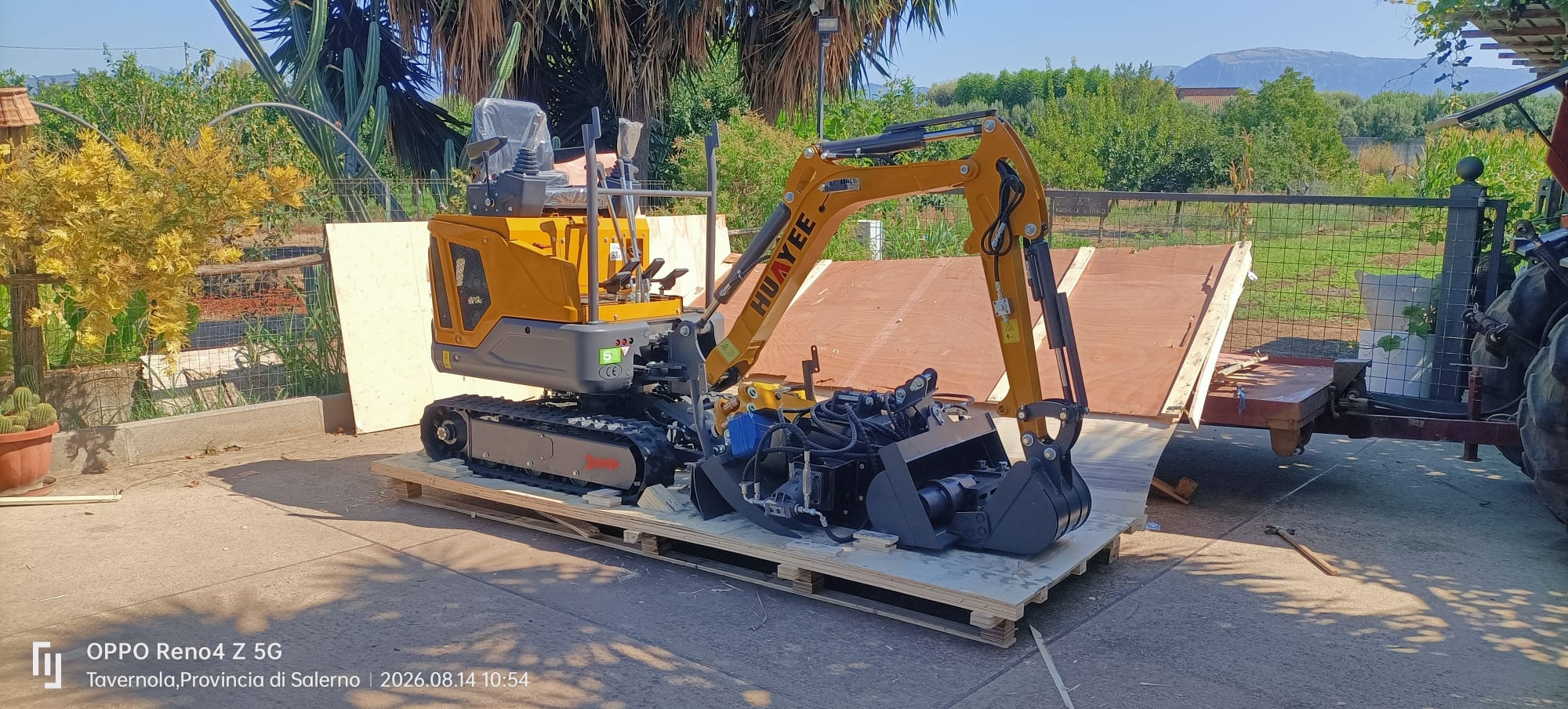
The Range in Numbers: What Each Tonnage Class Actually Delivers
The table below collects the published figures most often used to screen a model against an agricultural job. It is deliberately limited to specifications that appear in the HUAYEE model data; configurations vary by model and by order.
| Model | Operating weight | Max. digging depth | Track plate width | Ground pressure | Engine / rated output |
|---|---|---|---|---|---|
| HY10 | 1,000 kg | 1,725 mm | 180 mm | 0.4 kgf/cm² | KOOP192FA / 7.6 kW |
| HY12 | 1,200 kg | 1,670 mm | 180 mm | 0.3 kgf/cm² | Kubota D722-E4B / Briggs & Stratton XR2100 / R420 — 10.2 / 13.5 / 8.6 kW |
| HY16 | 1,600 kg | 1,780 mm | 180 mm | 0.3 kgf/cm² | Kubota D722 / 10.2 kW |
| HY18 | 1,800 kg | 2,030 mm | 180–300 mm (by model) | Working pressure 16 MPa | Kubota D722-E4B / KM385B — 10.2 / 18.1 kW |
| HY20 | 2,000 kg | 2,255 mm | 230 mm | 30 kPa | Kubota D902 / 11.8 kW |
| HY30 | 3,000 kg | 2,300 mm | 250 mm | 32 kPa | Kubota D1105 / 15.6 kW |
| HY35 | 3,500 kg | 2,610 mm | 300 mm | 29.5 kPa | Kubota D1703 / 18.2 kW |
| HY40U | 4,000 kg | 3,135 mm | 300 mm | 33.6 kPa | YANMAR 3TNV88-BSSY / R-ESSY — 20.2 / 18.2 kW |
Two readings of this table are worth separating. The first is capability: digging depth rises steadily from the HY10 to the HY40U, and so does digging force, reaching 20 kN bucket digging force on the HY30 and 30 kN at maximum power on the HY40U. The second is fit: the smallest classes carry the narrowest transport dimensions and the lowest absolute ground pressure figures, while the larger classes carry wider track plates that spread load on soft ground despite the higher machine weight.
Technical Explanation: Why Boom Swing and Tail Radius Matter More in an Orchard Than Digging Force
In open-field drainage, digging depth and bucket force decide output. In orchards, row spacing and boundary lines decide it. Two mechanisms carry most of that difference.
The first is the side-swing boom. On the 4 t class HY40U, the working device deflects 60° to the left and 45° to the right, which lets the machine excavate parallel to a wall, a fence line or a tree row without repositioning the whole machine. The same principle applies at smaller scale across the range and is what makes ditching along an orchard boundary practical with one operator. The side-swing connector on HUAYEE machines is an integrated cast steel part with no welded joint, across four load-bearing faces — relevant because the side-swing joint carries one of the highest loads on a compact machine and a welded assembly at that point is a known durability risk.
The second is tail swing. Minimum tail swing radius is 650 mm on the 2 t class HY20, 755 mm on the HY16, 830 mm on the HY12, 850 mm on the HY40U and 900 mm on the HY30. A shorter tail swing keeps the rear of the machine close to the track envelope while slewing, which is what allows work beside fences, irrigation structures and boundary hedges without the counterweight swinging into them. The body still rotates a full 360°; what changes is how much clear space the rotation requires.
A third, more mundane technical point matters in daily farm use: hydraulic hose routing. On HUAYEE models the boom hoses are routed inside the boom and protected by a wound spring sleeve, and the hoses themselves are rated from −40 °C to +100 °C with multi-layer steel wire braiding. In field conditions where hoses are exposed to sun, dust, branches and cold, that protection is a maintenance-cost variable, not a cosmetic detail.
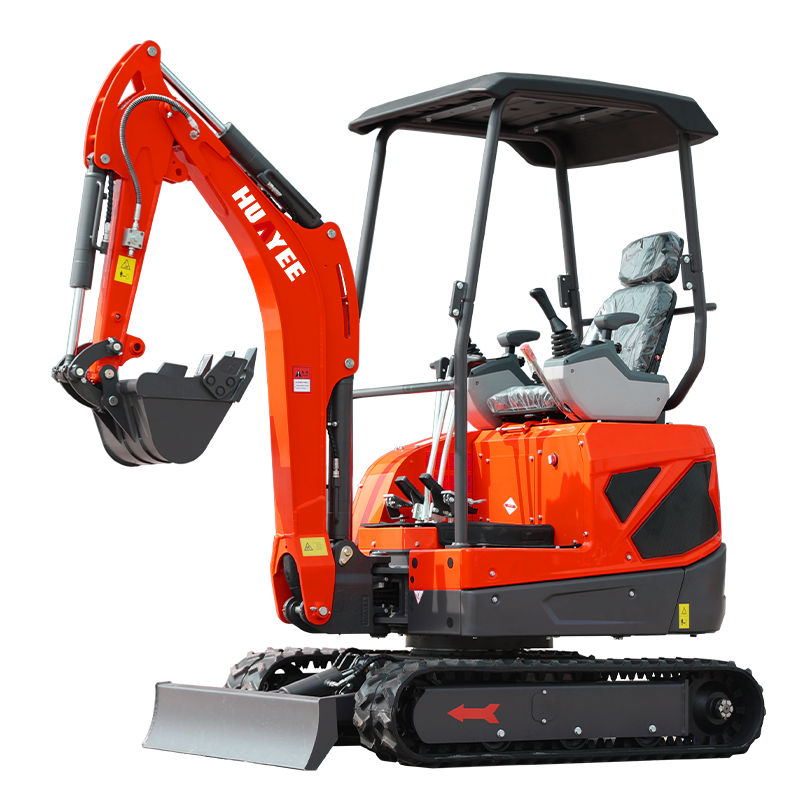
The Brand Position: What HUAYEE Excavator Brings to an Agricultural Order
HUAYEE Excavator is the mini excavator line of Shandong HUAYEE Heavy Industry Machinery Group Co., Ltd., a manufacturer and exporter of small construction machinery based in Jining City, Shandong Province, China. The company operates a 300,000 m² group site with more than 1,000 employees and more than 20 fully intelligent production lines, including in-house cutting, robotic welding, integrated stamping and painting lines. Annual production and sales capacity is about 30,000 units, and the in-house R&D team numbers more than 60 engineers, with annual R&D investment above RMB 70 million and new models, configurations and styling released every quarter.
For agricultural buyers, three capabilities are directly relevant. First, configuration flexibility: OEM and ODM customisation covers colour, logo, nameplate, engine brand, hydraulic system, open canopy or enclosed cab, rubber or steel track, cab air conditioning, high and low speed travel motor, attachments and auxiliary devices, and models localised for the destination market. The minimum order quantity is one unit with a standard lead time of 30–45 days, and 75–90 days for customised builds. Second, export experience in regulated markets: products are exported to 158 countries, exports account for about 70% of sales, and the EU is named as a main market. Third, proof rather than claims: distributors can verify the factory on site or through a 24-hour online VR factory tour and a live video walkthrough of the production lines, supported by bilingual inspection reports, and quality control covers incoming inspection of materials and key components, in-process inspection, and pre-shipment inspection with a factory inspection report or third-party inspection.
Application Scenarios: Where the Machine Actually Earns Its Keep
Four agricultural jobs recur across the HUAYEE application records and each places a different demand on the machine.
- Ditching and drainage. The requirement is digging depth plus reach along a line. The side-swing boom allows the trench to be cut parallel to a boundary, and a narrow bucket keeps the trench width controlled.
- Planting holes. An auger attachment turns the machine into a hole-drilling platform for orchards and vineyards, which is why the auxiliary hydraulic circuit, not the bucket, is the deciding specification here.
- Land levelling and ground preparation. Here the dozer blade and the machine's grading control matter; the HY20 dozer blade offers a maximum lifting height and cutting depth suited to light levelling work, while the HY30 and HY35 provide more mass for sustained grading.
- Material handling between rows. A hydraulic thumb and a trailer hitch extend the machine beyond excavation. The HY20 carries a built-in trailer hitch at the rear, which allows one hook to tow a material trailer or undertake light lifting without hiring a separate transport vehicle.
The common thread is that the value in agriculture comes from converting one machine into several tools across a short season. That is a configuration decision made at order, not an upgrade made later.
Market Context: Why the Constraint Set Is Tightening, Not Loosening
Three structural pressures shape this segment, and all three push buyers toward earlier verification rather than later correction.
The first is emission regulation. Non-road machinery sold into the European Union must satisfy Stage V engine requirements, and the United States requires EPA conformity. The documentation held by HUAYEE — Stage V type-approvals for the Kubota D1703, Kubota D1105 and KOOP KD15 engine families, plus EPA Certificates of Conformity — illustrates the paperwork depth now involved. A buyer who sources a machine without matching documentation does not have a cheaper machine; they have a machine that cannot be placed in the target market.
The second is labour structure. Agricultural work in the markets listed in the HUAYEE application data is characterised by single-operator, seasonal use. Machines that require a second person for attachment changes, transport or servicing fit that structure poorly, which is why quick-change systems and pickup-transportable sizes have become selection criteria rather than conveniences. The 1 t class HY10, at 930 mm overall width with a 1,490 mm minimum turning radius, can be transported by pickup truck and operated by one person.
The third is the shift from machine purchase to system purchase. The agricultural segment is specified with auger, narrow bucket, hydraulic thumb, ripper and trailer; a buyer comparing only base units is comparing an incomplete offer.
Comparison with Conventional Solutions: What a Compact Excavator Cannot Do
A serious comparison has to state the boundary, not only the advantage. Four limits apply to mini excavators in agricultural work.
- Depth and force ceiling. The HY18 reaches 2,030 mm maximum digging depth, which covers planting holes and shallow drainage but not deep open-field trenching. Work beyond roughly 2.5–3 m moves to the 3 t to 4 t classes, and the HY40U tops the range at 3,135 mm. Beyond that, a compact excavator is the wrong category.
- Travel speed. Self-propelled travel is limited: 1.2 km/h on the HY10, 1.7 km/h on the HY18, 2 km/h on the HY16, 3.1 km/h on the HY30 and 4.5 / 2.7 km/h on the HY40U. Moving between distant plots requires a trailer or low-bed transport, which is a real operating cost that a walk-behind or tractor-mounted alternative may not carry.
- Very soft ground still has a limit. Lower ground pressure reduces sinkage, and wider track plates spread load, but a compact excavator is not a purpose-built machine for deep mud or wetland. Site assessment before purchase remains necessary.
- Attachment performance depends on the host machine. The same auger or breaker performs differently on a 1 t and a 4 t carrier. Buying an attachment set without checking flow and pressure against the specific model produces disappointing results that are then attributed to the attachment.
Against a tractor with a rear-mounted backhoe, the compact excavator offers 360° slew, a side-swing boom and a shorter tail radius, which is decisive in orchards and around buildings. Against manual labour, it offers depth and repeatability that cannot be matched by hand tools at any realistic scale. Against a larger conventional excavator, it offers access. The correct comparison is therefore job-specific, and the constraint list above is the mechanism for making it.
Future Outlook
Three directions look most likely to shape agricultural mini excavator specification over the next buying cycles. Emission documentation will continue to be a market-entry filter rather than a differentiator, since the requirement applies to every supplier equally. Configuration diversity will keep expanding, because the same base machine is being asked to serve as a ditcher, a drilling platform and a materials handler within one season, and factory-level OEM and ODM flexibility is how that is delivered. And verifiability will become part of the purchase decision itself — factory tours, live production walkthroughs and bilingual inspection reports are increasingly requested by importers before the first order, not after the tenth.
For buyers, the practical implication is straightforward: build the constraint checklist first, then compare machines against it. Tonnage and price are outcomes of that process, not inputs to it.
Frequently Asked Questions
In the HUAYEE agriculture, orchard and livestock application record, the listed work is ditching and drainage, planting holes, land levelling, and lifting or moving materials and green waste between rows. The matched equipment for the segment is an auger, narrow bucket, hydraulic thumb, ripper and trailer, and the working mode is seasonal operation by a single operator. The ground condition is described as farmland, orchard and ranch land with soft, muddy or sloped surfaces, which is why undercarriage specification is treated as a primary selection criterion rather than a secondary one.
The sequence used in the HUAYEE model selection guidance is: operating weight class, maximum digging depth and reach, tail swing radius and turning radius for confined sites, engine brand and rated power, hydraulic configuration (gear pump, or piston pump with load-sensing valve), track type, attachment compatibility, and the spare parts, training and technical support available for the destination market. The same guidance maps weight classes to work types: 0.8–1.2 t machines for home gardens, farms and ranches; 1.6–2 t machines for residential, landscaping and municipal maintenance work; and 3–6 t machines for earthworks, house foundations and larger projects.
For the European Union, a whole-machine CE certificate and an engine emission type-approval at Stage V are the baseline. HUAYEE holds a CE Certificate of Compliance for crawler excavators HY06 to HY225, certificate no. H220809.SHHTW07 issued by Ente Certificazione Macchine Srl and valid to 8 August 2027, together with a CE noise emission verification, certificate no. 0P230814.SHHQT84, valid to the same date. EU Stage V engine type-approvals are held for the Kubota D1703, the Kubota D1105 engine family and the KOOP KD15 engine family. For the United States, EPA Certificates of Conformity are held. Company-level ISO 9001:2015 and ISO 14001:2015 certificates, nos. 62724Q0812R0S and 62724E0543R0S, are valid to 20 August 2027.
A side-swing boom lets the working device deflect sideways so the bucket reaches parallel to a wall, fence or tree row without turning the machine; on the 4 t class HY40U the deflection is 60° to the left and 45° to the right. A shorter tail swing radius keeps the rear of the machine close to the track envelope while slewing — 650 mm minimum on the 2 t class HY20, 755 mm on the HY16, 830 mm on the HY12, 850 mm on the HY40U and 900 mm on the HY30. Together they determine whether the machine can enter and work in a confined row at all. On large open sites with unrestricted space behind the machine, these two parameters matter less, and digging depth, digging force and cycle time should drive the choice instead.
The procedure is: park the machine on firm, level ground and lower the attachment to the ground; stop the engine and move the left pilot safety lever to the locked position; release the quick-change coupler and detach the attachment; move the machine to the attachment to be fitted and align the coupler with it; engage and lock the coupler, then raise the attachment slightly and confirm full engagement before starting work. The quick-change system is designed to be operated by one person without complicated tools. Hands or feet must never be placed between the coupler and the attachment, the engine must be off and the pilot safety lever locked before any work on the attachment, and only attachments matched to the machine tonnage and hydraulic flow should be used.
Stop the machine first, lower the attachment to the ground and lock the pilot safety lever. Then locate the leaking hose and check whether the damage is a burst, a cut or a loose connection, and replace it with a hose rated for the local temperature — standard hoses are rated from −40 °C to +100 °C. After replacement, run the machine and re-check the joint and the surrounding hoses at working pressure before returning it to service. If oil still leaks after replacement, if the cylinder shell or rod is scored, or if the machine loses pressure or travel power, the after-sales team should be contacted; the pump, main valve and cylinders should not be opened by the operator.
For full model specifications, configurations and certification documentation, the HUAYEE corporate brochure is available for public download: HUAYEE company profile (PDF).
Have Questions or Need More Details?
Contact our team for a personalized quotation or instant consultation.
Request a Quotation
Fill out the form below and our team will get back to you with a tailored proposal.
WhatsApp Direct Chat
Prefer to chat in real-time? Message us on WhatsApp for instant assistance & quick answers.
- Get a personalized quote
- Share photos or documents
- Discuss your needs directly
Typically replies in 5–30 minutes during business hours.