
Miniature Bearing Procurement Q&A for Precision Buyers
Miniature Bearing Procurement Q&A for Precision Buyers
A miniature bearing rarely dominates a bill of materials, but inside a dental handpiece it sets the practical ceiling for rotational speed, noise and service life. That is why miniature bearing procurement for precision devices behaves less like catalog shopping and more like a specification audit: precision grade, limiting speed, operating temperature, ring and ball material, and certification evidence all have to line up before a purchase order makes sense.
INB is the miniature bearing brand of Ningbo City Jingyin Electromechanical Technology Co., Ltd., a Ningbo-based bearing manufacturer whose stated standard range covers high-precision bearings with bore diameters from 2 mm to 8 mm and precision grades from P6 to P4. The questions below are the ones precision buyers tend to ask when evaluating INB miniature bearings against a dental handpiece specification — including the questions the published data does not answer.
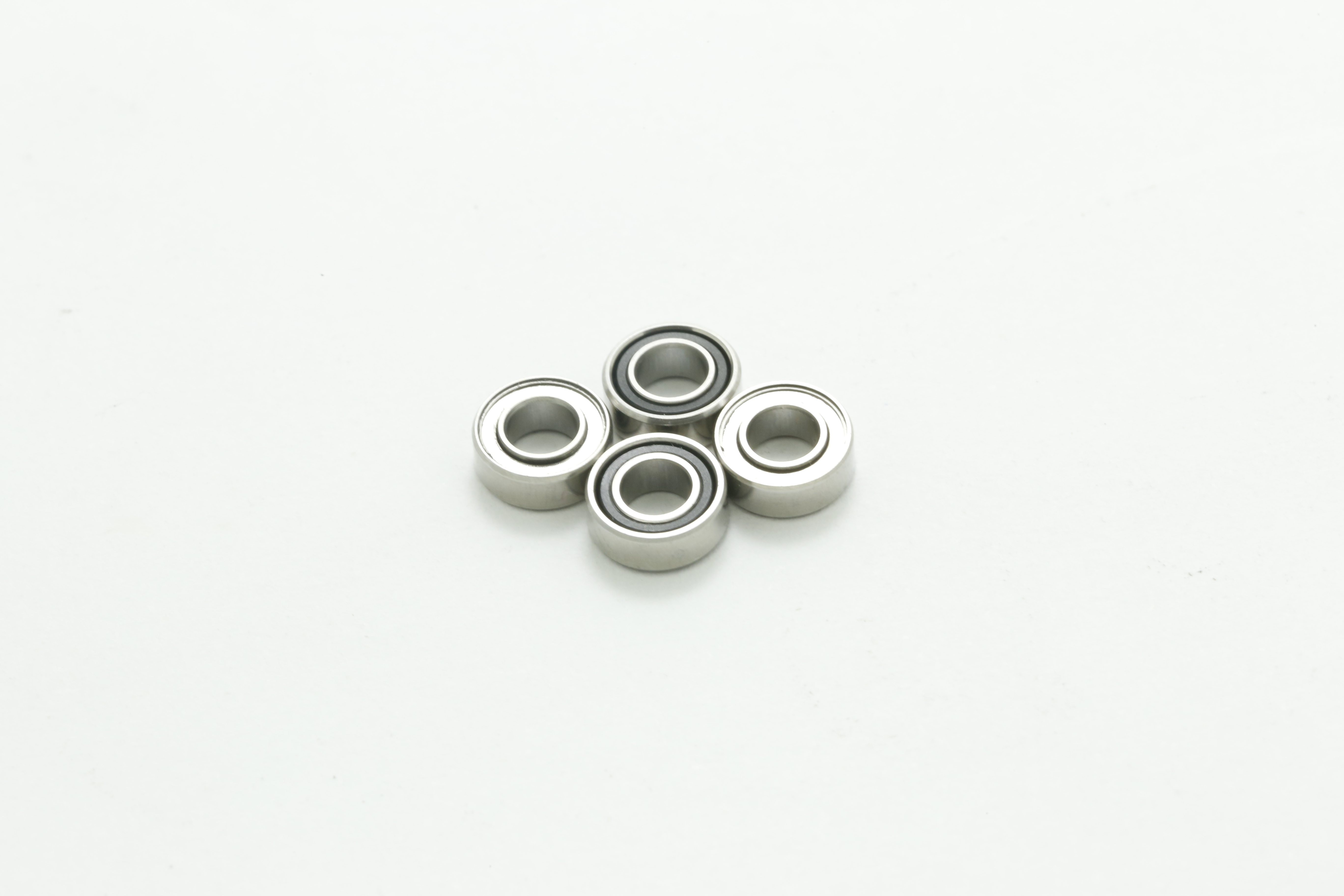
Bearing SMR144ZTLP4 W2.38 — 3.175 × 6.35 × 2.38 mm, P4 precision, SUS440.
Why miniature bearing procurement is a constraint problem
The category is expanding on the back of medical devices and robotics. The global miniature ball bearings market is estimated at approximately USD 2.25 billion in 2025 (Future Market Insights), with Asia Pacific accounting for roughly 60% of 2025 revenue and China the largest regional producer and consumer (Precedence Research). China's bearing exports grew 7.2% year on year in the first seven months of 2025, reaching nearly 497,852 tons (BearingNews / Huajing Research Institute).
Those figures are directionally useful and numerically soft. Published estimates for the same year diverge materially: Precedence Research places the 2025 market at USD 2.89 billion, IMARC Group at USD 2.0 billion, and Future Market Insights at USD 2.25 billion. The practical conclusion for a buyer is that headline market numbers should not drive a component decision; verifiable specification data should.
Buyers also frequently arrive with descriptive search language rather than a part number — extra miniature bearing, stainless steel miniature bearing, high-speed miniature bearing, low-noise miniature bearing, motor miniature bearing. Each phrase maps to a different constraint, and a supplier can only be judged once the phrase has been translated into numbers. That translation produces a constraint stack:
- Precision grade and tolerance class — the grade on the drawing, and the standard system it maps to.
- Limiting speed — a stated ceiling, not a cruise setpoint.
- Operating temperature — driven by sterilization cycles and by heat generated during grinding.
- Material and corrosion behaviour — stainless steel miniature bearings are specified for moisture and chemical exposure, not for appearance.
- Geometry — metric or imperial envelopes, thin-wall miniature bearing sections, extra miniature sizes, and flange requirements.
- Noise and running smoothness — a functional requirement in handheld dental instruments.
- Certification and traceability — ideally at model level, not only at company level.
- Supply terms — MOQ, lead time, repeatable capacity and after-sales behaviour.
Any single item can eliminate a candidate. The remainder of this article works through them in the order a precision buyer usually asks.
Technical Q&A: specifying INB miniature bearings for dental handpieces
Q1. Which precision grade should a dental handpiece miniature bearing carry?
In INB's dental handpiece range, the answer is P4. Every referenced model — SR133TL, SMR74TL, SR144ZTLP4 W2.78 and SMR144ZTLP4 W2.38 — is specified at P4 precision with SUS440 material and is designated for dental handpiece use.
Precision grades are not brand-specific. Miniature bearing precision is governed by international systems including ABMA ABEC (1–9), ISO 492 (P0–P2 notation) and DIN 620, in which higher ABEC numbers correspond to tighter tolerances (AST Bearings). Buyers comparing quotations should map a supplier's stated grade onto the standard used on their own drawing before treating two grades as equivalent.
INB states that its standard production covers precision grades from P6 to P4 and bore diameters from 2 mm to 8 mm. Requirements tighter than P4, or outside that bore range, fall beyond the stated capability rather than within it.
Q2. How should a buyer choose between SR133TL, SMR74TL and SMR144ZTLP4 W2.38?
Work from the envelope inward, then apply the dynamic ratings.
- SR133TL — 2.38 × 4.762 × 2.38 mm, P4 precision, SUS440, limiting speed 200,000 rpm, operating temperature −40 °C to 150 °C, dental handpiece application.
- SMR74TL — 4 × 7 × 2 mm, P4 precision, SUS440, limiting speed 200,000 rpm, operating temperature −40 °C to 150 °C, dental handpiece application.
- SMR144ZTLP4 W2.38 — 3.175 × 6.35 × 2.38 mm, P4 precision, SUS440, limiting speed 350,000–400,000 rpm, operating temperature −50 °C to 160 °C, dental handpiece application.
The two 3.175 × 6.35 mm models — SMR144ZTLP4 W2.38 and SR144ZTLP4 W2.78 — share bore and outside diameter and are distinguished by their listed width, 2.38 mm and 2.78 mm respectively. A buyer whose axial space is fixed by the turbine housing can therefore hold bore and outside diameter constant while selecting the width that matches the design. Where the envelope itself is smaller, SR133TL or SMR74TL are the applicable models, at their lower stated speed rating.
Q3. What do the limiting-speed and temperature ratings actually constrain?
Limiting speed is a ceiling, not a target. INB lists 350,000–400,000 rpm for the 144-series models and 200,000 rpm for SR133TL and SMR74TL. A handpiece platform specified to run near 400,000 rpm therefore falls in the 144-series envelope, not in the 200,000 rpm models — and a buyer using a 200,000 rpm part in a 400,000 rpm design would be operating outside the stated rating rather than at its edge.
Temperature range behaves similarly. The 144-series models are rated −50 °C to 160 °C; SR133TL and SMR74TL are rated −40 °C to 150 °C. Dental instruments are exposed to repeated cleaning and sterilization as well as to heat generated during grinding, so a wider stated upper and lower bound reduces the number of operating conditions that sit outside the specification. Buyers should treat both ratings as hard boundaries to verify against their own duty cycle, not as performance promises.
Q4. Why SUS440 for a medical miniature bearing?
All four referenced INB models use SUS440. Stainless steel 440C is widely cited as the primary material for miniature bearings used in medical and food-processing applications because of its resistance to moisture and chemicals (SKDIN Engineering Guide). For a dental handpiece, that resistance is functional: instruments are exposed to moisture, cleaning agents and repeated sterilization, and a corroding raceway degrades performance long before a bearing reaches its nominal life.
Material is only one variable, and buyers should not treat it as a complete qualification. INB's published model data covers material, precision, limiting speed and operating temperature. Lubrication, cage type and shield or seal configuration are not part of that stated specification and should be confirmed directly against the handpiece manufacturer's cleaning and sterilization protocol before a design is frozen.
Q5. Which certification evidence can a precision buyer verify?
INB operates in accordance with an ISO 9001 quality management system. The certificate carries number 117 24 QU 0108-07 R1S, was issued by Shanghai Ingeer Certification Assessment Co., Ltd., and is based on GB/T19001-2016 / ISO 9001:2015 Quality Management Systems — Requirements. Its scope is the manufacture of bearing and bearing parts, it applies to the global market, and it is valid until July 7, 2027.
The certificate explicitly covers the bearing models SMR74TL, SR133TL, SR144ZTLP4 W2.78 and SMR144ZTLP4 W2.38. Model-level coverage matters in procurement: it ties a specific part number — not just a company name — to a current certificate whose number, issuing body and expiry date can be checked independently.
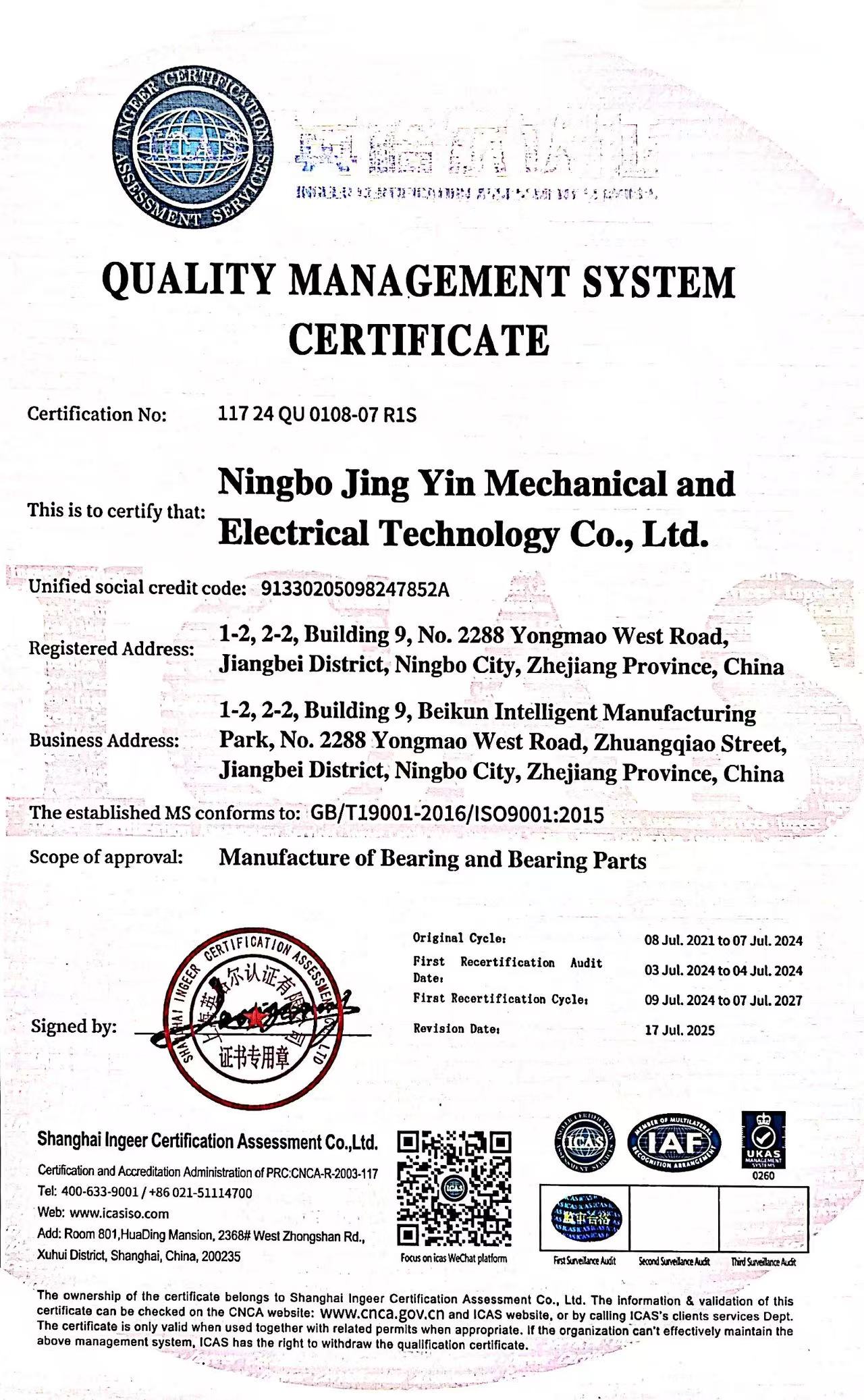
ISO 9001 certificate, number 117 24 QU 0108-07 R1S, issued by Shanghai Ingeer Certification Assessment Co., Ltd., valid until July 7, 2027.
Q6. What does an 80,000-unit dental handpiece case add to the evaluation?
In a project of 80,000 units in China, a miniature bearing with P4 precision and a limiting speed of 350,000–400,000 rpm was used in dental handpieces. Stable high-speed operation was recorded over 500 hours, with extended equipment lifespan reported as the outcome.
The application context is high-speed precision grinding in a clean medical environment with intermittent high-load operation. Read as evidence rather than as a guarantee, the case demonstrates that this specification family has been deployed at volume in the target application. Individual buyers should still validate the selected model inside their own handpiece platform, because turbine geometry, rotor balancing and lubrication practice differ between designs and can change the load a bearing actually sees.
Q7. How do MOQ, lead time and capacity shape the sourcing decision?
INB states an OEM production mode with customization according to customer requirements, a monthly capacity of 500,000 units, a minimum order quantity of 100 units, 100% testing, and a stated lead time of in-stock goods within 7 days. Company data lists an annual output of 6,000,000 units, a 30-person team and a 10-person R&D group; after-sales support is described as return and exchange.
For a buyer at the evaluation stage, those numbers answer three practical questions: whether a sample order can start small (100 units), whether a validated design can scale into volume (up to 500,000 units per month), and whether repeat orders can be served from stock. Buyers outside the company's stated main market of China — INB lists an export ratio of 5% and Russia among its export markets — should treat the 7-day figure as a production-side lead time and build freight, customs and documentation time into the schedule separately.
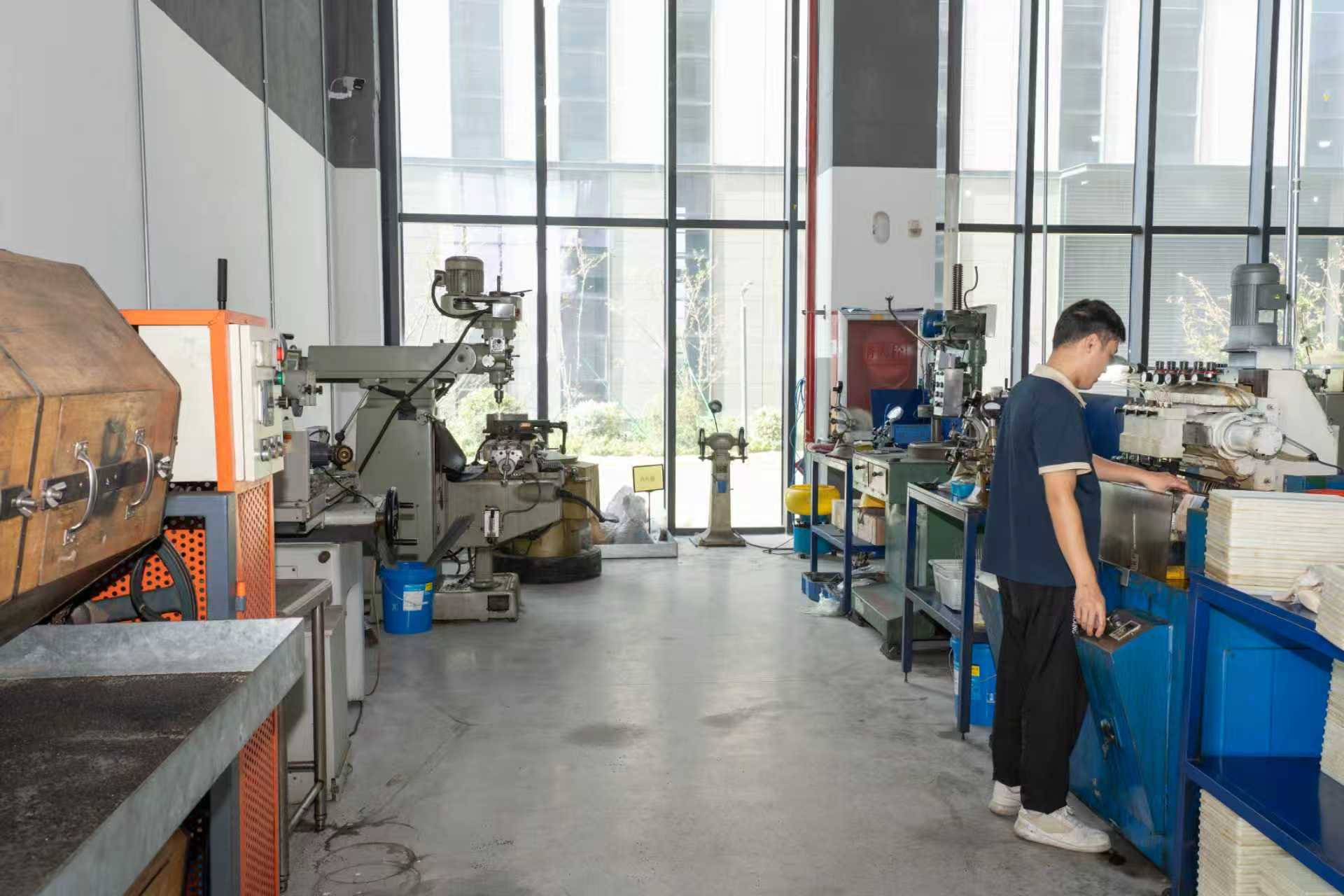
Machining operations in the INB miniature bearing workshop, where production is carried out strictly in accordance with the ISO 9001 quality management system.
INB miniature bearing reference for dental handpiece design
| Model | Bore × OD × Width (mm) | Precision | Material | Limiting speed | Operating temperature |
|---|---|---|---|---|---|
| SR133TL | 2.38 × 4.762 × 2.38 | P4 | SUS440 | 200,000 rpm | −40 °C to 150 °C |
| SMR74TL | 4 × 7 × 2 | P4 | SUS440 | 200,000 rpm | −40 °C to 150 °C |
| SMR144ZTLP4 W2.38 | 3.175 × 6.35 × 2.38 | P4 | SUS440 | 350,000–400,000 rpm | −50 °C to 160 °C |
| SR144ZTLP4 W2.78 | 3.175 × 6.35 × 2.78 | P4 | SUS440 | 350,000–400,000 rpm | −50 °C to 160 °C |
All four models are listed for dental handpiece applications. The table is the fastest way to eliminate a candidate: the envelope decides the row, and the speed and temperature ratings decide whether that row is acceptable for the intended platform.
Where constraint-driven sourcing differs from traditional procurement — and where it stops
Traditional miniature bearing procurement often starts from a catalog page and a unit price. Constraint-driven procurement inverts the order: precision grade, limiting speed, temperature range and material are fixed first, and price is then compared only among candidates that survived the constraints. The difference shows up twice. First, in the questions asked during evaluation — a price-first process rarely asks which tolerance system a quoted grade maps to. Second, in the cost of a wrong choice: a bearing that meets a price target but misses a speed or temperature constraint appears later as a field failure rather than as a line-item saving.
It is equally important to state where a focused miniature bearing supplier is not the right answer.
- Precision ceiling. INB's stated production range runs from P6 to P4. Designs requiring tighter tolerance classes sit outside that stated range and must be sourced elsewhere. The broader global miniature bearing field includes manufacturers such as MinebeaMitsumi, NSK, SKF and Schaeffler (Barden) (Intel Market Research), and buyers comparing suppliers should compare like-for-like tolerance classes rather than brand names.
- Size and geometry range. The stated bore range is 2 mm to 8 mm. Non-standard geometries — a flanged stainless steel miniature bearing, unusual thin-wall miniature bearing sections, or specific imperial miniature bearing envelopes — should be confirmed item by item against that range instead of assumed from the dental handpiece models listed here.
- Geographic weighting. The stated main market is China, with an export ratio of 5%. Buyers outside China should treat international supply as a logistics and documentation project validated during sampling, not as an automatic extension of domestic terms.
- Application focus. The stated product focus is dental bearings and micro-motors. A buyer sourcing, for example, a motor miniature bearing for a different duty cycle should verify fit with test data rather than infer it from dental handpiece performance.
Market trend: smaller envelopes, higher speeds, more documentation
Two demand-side signals shape this category. Medical devices and robotics are among the drivers behind the estimated USD 2.25 billion 2025 market for miniature ball bearings (Future Market Insights). At the same time, the largest single application segment in 2025 was automotive at approximately 39% share, driven by EV motor and sensor applications (Precedence Research) — a reminder that miniature bearing demand is increasingly shaped by motor and sensor design cycles as much as by precision instruments.
Supply concentrates geographically. Asia Pacific represented about 60% of 2025 revenue (Precedence Research), and China's bearing exports rose 7.2% year on year in the first seven months of 2025 to nearly 497,852 tons (BearingNews / Huajing Research Institute).
For precision buyers, the practical consequence is documentation rather than volume. As miniature bearings move deeper into regulated medical devices and into motor applications with longer duty cycles, the basis of a supplier relationship shifts from unit price toward model-level certification, clearly stated speed and temperature limits, and testing discipline — the items that let an engineer defend a design decision years after it was made.
Future outlook
Three developments are likely to shape miniature bearing procurement over the next few years.
- Speed ratings as a visible tier. Handpiece and motor platforms continue to push rotational ceilings. The split between a 200,000 rpm tier and a 350,000–400,000 rpm tier inside INB's own range shows how specification families are already separating rather than converging.
- Wider temperature envelopes. The −50 °C to 160 °C range published for the 144-series models reflects requirements created by repeated sterilization and intermittent high-load operation, not by nominal room-temperature running.
- Certificate-level traceability. Model-specific ISO 9001 coverage, valid to July 7, 2027 in this case, is becoming a procurement input that sits alongside the drawing rather than a marketing attachment.
Buyers evaluating suppliers in this category are well served by keeping two questions open throughout: what does the supplier state as a hard limit, and what evidence supports that statement? Those questions age better than catalog descriptions. INB's published product and certification data are available through the manufacturer's site at www.lnb-brg.com.
FAQ
The models SR133TL, SMR74TL, SR144ZTLP4 W2.78 and SMR144ZTLP4 W2.38 are specified at P4 precision. INB states standard production across precision grades from P6 to P4 and bore diameters from 2 mm to 8 mm.
SMR144ZTLP4 W2.38 and SR144ZTLP4 W2.78 are specified with a limiting speed of 350,000–400,000 rpm. SR133TL and SMR74TL are specified at 200,000 rpm.
The 144-series models are rated −50 °C to 160 °C. SR133TL and SMR74TL are rated −40 °C to 150 °C.
All four listed models use SUS440. Stainless steel 440C is widely cited as the primary material for miniature bearings in medical and food-processing applications because of its resistance to moisture and chemicals (SKDIN Engineering Guide).
The certificate, number 117 24 QU 0108-07 R1S, was issued by Shanghai Ingeer Certification Assessment Co., Ltd. under GB/T19001-2016 / ISO 9001:2015, applies to the global market, and is valid until July 7, 2027. Its scope is the manufacture of bearing and bearing parts, and it covers SMR74TL, SR133TL, SR144ZTLP4 W2.78 and SMR144ZTLP4 W2.38.
INB states a minimum order quantity of 100 units, a lead time of in-stock goods within 7 days, a monthly capacity of 500,000 units, an OEM production mode with customization according to customer requirements, and 100% testing. After-sales support is described as return and exchange.
Compare the stated envelope, limiting speed, operating temperature and material against the handpiece duty cycle, confirm lubrication and closure details that are not part of the published specification, and verify the certification number and covered model against the issuing body. Validation should run on the buyer's own handpiece platform, since turbine geometry and rotor balancing affect the load a bearing experiences.
Have Questions or Need More Details?
Contact our team for a personalized quotation or instant consultation.
Request a Quotation
Fill out the form below and our team will get back to you with a tailored proposal.
WhatsApp Direct Chat
Prefer to chat in real-time? Message us on WhatsApp for instant assistance & quick answers.
- Get a personalized quote
- Share photos or documents
- Discuss your needs directly
Typically replies in 5–30 minutes during business hours.