
Mixed-Age Programs: 12-, 14- and 16-Inch Balance Bike Picks
Mixed-Age Programs: 12-, 14- and 16-Inch Balance Bike Picks
A mixed-age riding program rarely fails because one balance bike is badly made. It fails because one size and one material path cannot serve every rider in the group. Kindergartens, learn-to-ride sessions and holiday rental fleets all order against the same constraint: a single purchase has to cover a roster spanning several years of rider growth, and it has to do so without multiplying service work across incompatible parts. This shortlist compares the two documented builds from Wuxi Purino International Trade Co., Ltd — the 12-inch magnesium-alloy AME-1202 and the steel 2-In-1 Kids Bike offered in 12-, 14- and 16-inch sizes — using three selection variables only: rider size, terrain and maintenance load.
The supplier behind both builds is Wuxi Purino International Trade Co., Ltd, a trading enterprise founded in 2016 in Wuxi, Jiangsu Province, China, that supplies electric bicycles, kids scooters and children's balance bikes, with a stated 100% export ratio and main markets in the EU and the USA. Its balance bike range is wider than this shortlist — aluminum-frame models with CST inflated tyres are also part of the range — but only the AME-1202 and the 2-In-1 Kids Bike carry the size and material detail needed for a like-for-like program comparison.
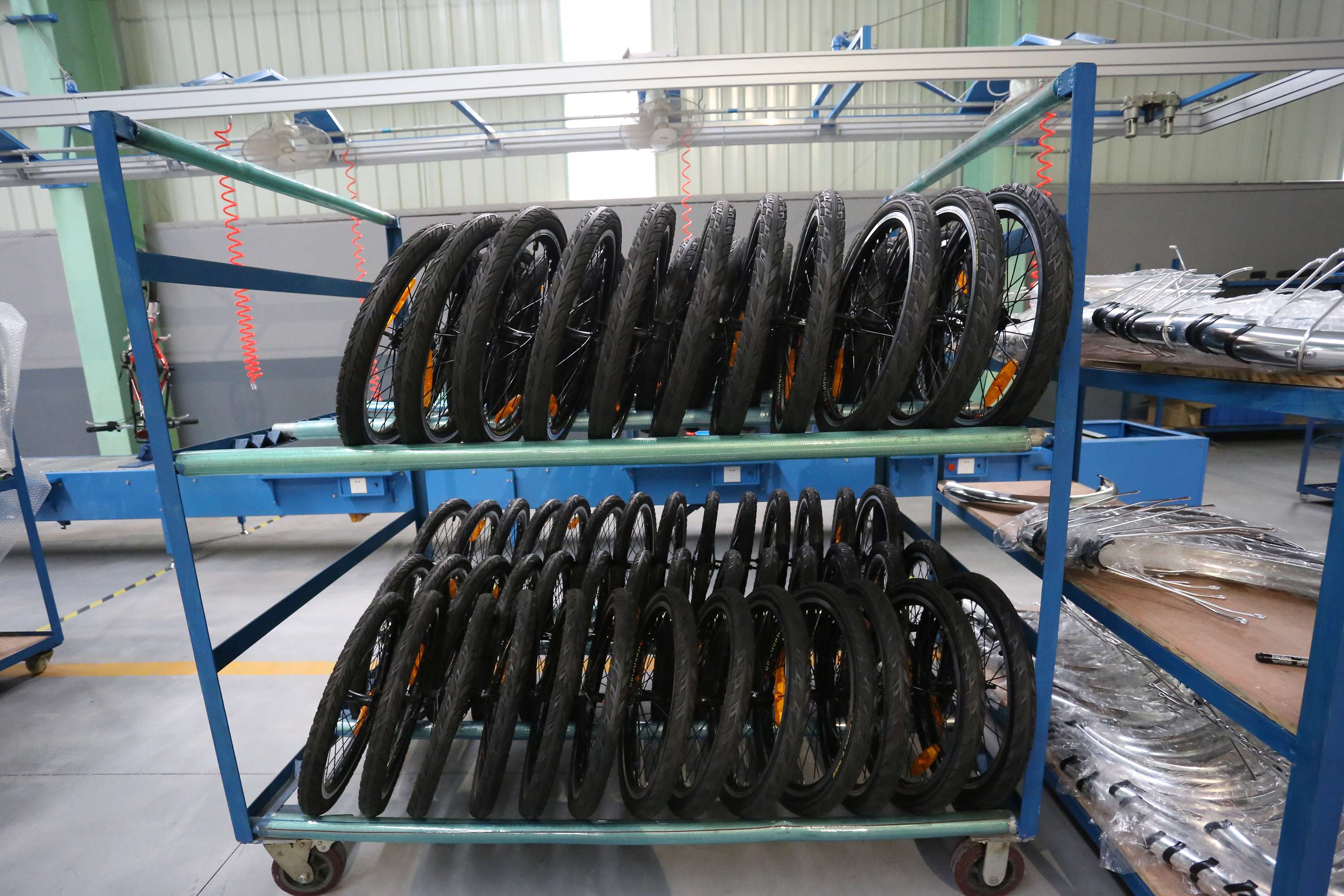
The shortlist in one view
Two builds cover the three sizes, and they separate by equipment rather than by positioning: one is a 12-inch magnesium-alloy bike with an air tyre and suspension, the other is a steel convertible that spans 12, 14 and 16 inches and adds a rear band brake plus pedal-to-balance conversion. Neither build is presented as a general upgrade over the other; the table shows where each one is documented to fit.
| Build | Sizes | Frame and equipment | Tyre and rim | Brake and conversion | Strongest documented fit |
|---|---|---|---|---|---|
| AME-1202 | 12 inch | Magnesium-alloy frame, suspension, TPR grips | Air tyre on aluminum rim | Brake detail not included in the supplied specification | Entry-size riders on uneven surfaces where comfort and grip are the priority |
| 2-In-1 Kids Bike | 12, 14, 16 inch | Steel frame | Rubber tyre on PP rim | Rear band brake; pedal-to-balance conversion | Programs wanting one build across three sizes plus pedal progression |
Why a mixed-age program needs a size ladder
A program that buys one size does not buy a fleet; it buys a usable window. Riders outside that window are either fitted to a bike that limits them or excluded from the session, and the problem compounds in settings where intake arrives in mixed cohorts rather than in matched groups. Institutional buyers already purchase balance bikes for balance training, kindergarten equipment, and backyard or park play; the supplier's case record lists kindergartens and educational institutions alongside wholesalers, retailers and cross-border e-commerce sellers.
The same record states a use duration of two to three years and describes the bikes as suited to prolonged use through growth stages. That is the commercial argument for a ladder: two frames covering three wheel sizes keep more of the roster on a correctly sized bike, and a convertible frame keeps each individual unit in service after the rider stops using balance mode.
The trade-off is neither hidden nor small. Every added size and every added component path puts another part number into stores, another inspection step into the daily routine and another item into staff training. A ladder is the right answer for a mixed-age roster; it is the wrong answer for a single-cohort program that only needs one size and one routine.
The 12-inch decision: AME-1202 magnesium alloy against the steel convertible
At 12 inches the shortlist offers a genuine either-or, because both builds exist in that size and they differ in equipment rather than in wheel diameter. The choice turns on what the program does with the bike and who maintains it.
AME-1202: what the listed specification changes in practice
The AME-1202 is the only 12-inch build in this shortlist combining a magnesium-alloy frame, an air tyre on an aluminum rim, suspension and TPR grips. For a buyer, the meaning of that specification is narrow and practical. A pneumatic tyre is a tuning variable: pressure can be adjusted to the surface, and it has to be checked and maintained in return. The aluminum rim is the matching component path for that wheel. The front suspension is a separate wear item that needs inspection rather than a fit-and-forget feature. TPR grips are a stated material choice, which matters mainly when a program standardises replacement stock.
These facts describe equipment, not outcomes. No comparative test data is supplied for the AME-1202 against the steel alternative, so the specification should not be read as evidence that the bike is faster, safer or longer-lasting. What it does support is a fit statement: where a program's 12-inch riders ride on gravel, kerbed paths or uneven playground surfaces, a suspended air-tyre build addresses surface variation in a way a rigid build does not.
Published industry figures put a 12-inch magnesium-alloy integrated casting frame at roughly 680 g with the complete bike near 3.1 kg (Montasen, September 2026). That reference explains why magnesium is treated as a lightweight path, but it is an industry figure rather than an AME-1202 measurement, and frame mass alone does not determine complete-bike mass once tyres, rims, suspension and fittings are counted.
2-In-1 Kids Bike at 12 inches: the conversion is the product
In 12-inch size the steel 2-In-1 competes on service life rather than on equipment. The pedal-to-balance conversion means the frame keeps working when the rider is ready for pedals, and the rear band brake is part of the listed specification for that later stage. A program therefore buys one unit that covers two stages of a rider's progression instead of retiring a balance bike at the transition point.
Two boundaries belong beside that advantage. First, a convertible carries more components than a pure balance bike — pedals, drivetrain and brake each need inspection — so the maintenance routine is broader, not narrower. Second, the frame weight of the steel build is not published in the supplied material, so buyers should not assume either a weight penalty or a weight advantage until the supplier confirms it for the specific size. Buyers should also confirm whether the rear band brake is active in balance mode as well as pedal mode.
14-inch and 16-inch: where the steel convertible carries the ladder
Within this shortlist, the 14- and 16-inch sizes exist only in the steel 2-In-1 Kids Bike. That single fact drives most of the fleet logic for older riders: the ladder beyond 12 inches is a steel ladder, with rubber tyres on PP rims across all three sizes and the same rear band brake and conversion design.
Consistency has a measurable operational value. One tyre and rim specification across 12, 14 and 16 inches means one spares kit, one wheel-change procedure and one inspection checklist for the whole range, which reduces training time and the risk of fitting the wrong part. For a kindergarten or school that stores equipment centrally and rotates it between rooms, that simplification often matters more than any single component upgrade.
The limitation is equally clear. In this shortlist, a 14- or 16-inch rider on gravel or kerbed park paths has no suspended or air-tyre option. That is a limitation of this shortlist, not evidence that such options are unavailable in the wider market, and it should be recorded as a programme constraint rather than a product judgement. Programs whose older riders ride exclusively on rough ground should raise it with the supplier before fixing the size split.
Selection rules for rider size, terrain and maintenance
Rule 1 — fit by measured size, not by age label
The supplied material confirms wheel sizes and equipment but does not publish saddle-height or standover ranges. Fit therefore has to rest on figures the supplier confirms in writing for each size: the saddle height range, the standover height and the maximum rider weight per size, matched against the actual roster. For a mixed-age program this is the step that determines the quantity split between 12, 14 and 16 inches, and it should be completed before any order quantity is fixed.
Rule 2 — match tyre and suspension to the surface
Surface is the fastest way to split the shortlist. Sealed halls, indoor play areas and smooth playgrounds are served by rubber or EVA tyres with a simple maintenance regime. Uneven park paths, gravel and kerbed routes favour the suspended air-tyre build at 12 inches. Where a program runs high-turnover, low-maintenance fleets, the supplier's stated EVA option is relevant for its durability and cost advantage, but EVA appears as a range and customization option rather than as a specification for the 2-In-1 in this shortlist, so availability per model and size must be confirmed.
Rule 3 — count the maintenance hours before the unit price
Maintenance capacity is the variable most often left out of a tender. An air tyre brings pressure checks and puncture work; a suspension fork adds an inspection point; a convertible adds brake adjustment and drivetrain checks. A program with one staff member and no workshop should weight the low-maintenance path heavily, while a program with a service bench and spare wheels can absorb the comfort-oriented build. Fewer component families across the fleet reduce both spare-part stock and the chance of a bike sitting idle for want of a correct wheel.
- Confirm saddle height and standover per size in writing.
- Decide the surface profile for each age group, not for the program as a whole.
- Set a maintenance routine per build before ordering, not after delivery.
- Order spare wheels, grips and brake parts with the first shipment.
- Test one unit of each build with staff before committing to fleet quantities.
How this shortlist differs from a single-size, single-material purchase
The conventional approach buys one model in one size because it simplifies ordering, storage and staff familiarity. That simplicity is real, and for single-cohort programs it usually wins. The cost appears at both ends of the roster: smaller riders are fitted to a bike they cannot yet handle, and older riders move straight from a balance bike to a pedal bike without a sized intermediate step.
A two-build ladder trades that simplicity for coverage. The 12-inch magnesium build supplies a comfort-and-grip option at the entry size, and the steel 2-In-1 supplies three sizes plus a pedal stage with one consistent tyre and rim specification. The complexity cost is a second component family in stores and a second inspection routine.
One caution applies to the comparison itself. The supplier's stated attributes for its steel-frame range include durability and cost advantage with EVA tyres, but the 2-In-1 in this shortlist is specified with rubber tyres on PP rims, so that stated attribute should not be transferred to it without confirmation. No field-failure, fatigue or safety-outcome data is supplied for either build, so this is a comparison of documented characteristics and stated attributes, not a verdict on which bike performs better over time.
Documentation to request before confirming a fleet
Purino's published CE record is an EN15194 certificate issued through TUV for the EU market, and the AME-1202 appears among the related products listed on that record. EN15194 is the standard for electrically power assisted cycles, so that document should not be read as a balance-bike test report. EU buyers should request the toy-safety file for the balance bike itself separately: the EN71-1:2026 standard introduces mandatory performance testing for all ride-on toys including balance bikes, with an effective date of 1 January 2026 (Alibaba.com / EU Standards Library, 15 January 2026).
Customs planning has its own reference point. Balance bikes without pedals are classified under HS code 95030010, which is the code used for tariff and import documentation on this product type. Programs buying through a distributor should confirm that the classification is applied consistently across the sizes in the order, since a convertible shipped in pedal configuration raises a documentation question the buyer should settle in advance.
The supplier states quality control and pre-shipment inspection but does not publish detailed QC procedures or standards. Buyers should therefore ask for the inspection checklist, the sampling plan and a recent pre-shipment report rather than treating the statement as a specification. After-sales support covers product consultation and logistics coordination; specific warranty, return and exchange terms require confirmation in the contract, and a program should obtain them in writing before the first shipment.
Customization is stated for frame colour and logo, packaging and accessories, tyre type selection among EVA, CST and air, and saddle and grip material. Two conditions apply: confirm which options are available on the specific model and size, and treat a tyre-type change as a specification change that alters the maintenance routine the program has planned around.
Supply capacity and order planning
The supplier states a minimum order quantity of 100 units, a lead time of 45–60 days and a monthly capacity of 10,000 units, and its case record reports supply at 10,000 units per month across markets including Austria, Australia, Belgium, Brazil, Canada, Germany, France, the United Kingdom, Japan, Singapore and the United States, among others. For a program, the practical reading is that a staged rollout is feasible: order the entry sizes first, then add 14- and 16-inch units as cohorts move up.
Documentation lead time deserves to sit inside the same plan. Test files, inspection checklists and contract terms are not produced in the 45–60 day production window, so requests should be raised at the specification stage. Programs that order spares with the first shipment avoid the common failure mode in which a single damaged wheel removes a bike from service for a full term.
Market context: reading the published figures correctly
Third-party research places the global balance bike market at approximately USD 1.43 billion by 2026 (The Business Research Company, September 2026) and projects growth at a CAGR of 7.2% from 2026 to 2033 (Coherent Market Insights, April 2026). Both are commercial forecasts rather than measured outcomes, and headline values for the same period differ between publishers because category definitions differ — some estimates appear to cover a broader wheeled-toy or bicycle scope. Buyers should treat these figures as context for category relevance, not as a demand forecast for a specific program or region.
The supplier's own case record is a narrower signal: it documents balance training, kindergarten equipment, backyard and park play, and gift applications across a listed set of export markets. That supports the existence of institutional demand in those markets; it is one supplier's case history and is not evidence of market-wide volume or growth.
Outlook
Two product logics look likely to persist in this category, and both are visible in this shortlist. The first is the durability-and-cost path, where a steel frame with a simple tyre specification serves high-turnover institutional fleets. The second is the comfort path, where an air tyre and suspension are used to address surface variation for younger riders. Convertible designs cut across both by extending the service life of a single unit.
One change is already in force rather than forecast: with EN71-1:2026 applying to ride-on toys in the EU from January 2026, documentation completeness becomes a selection criterion alongside frame material and tyre type. Programs that compare only the bike and not the test file are comparing an incomplete specification.
FAQ
Is a 12-inch magnesium-alloy balance bike or the steel convertible the better first purchase for a mixed-age program?
It depends on surface and maintenance capacity rather than on material. The AME-1202 covers one size — 12 inch — with a magnesium-alloy frame, an air tyre on an aluminum rim, suspension and TPR grips, which suits entry-size riders on uneven ground. The steel 2-In-1 Kids Bike covers 12, 14 and 16 inches with rubber tyres on PP rims, a rear band brake and pedal-to-balance conversion, which suits programs that want one build across a wider age span and a pedal progression. The two builds differ in documented equipment; no comparative performance test is supplied for either.
Does the 2-In-1 Kids Bike's 12/14/16-inch range make a separate 12-inch balance bike unnecessary?
Not automatically. The convertible gives size coverage and a second riding stage, but the 12-inch AME-1202 differs in equipment — air tyre, aluminum rim, suspension and TPR grips — and that difference is relevant where 12-inch riders use gravel, kerbs or uneven playground surfaces. A program with mixed surfaces may run both builds at the entry size; a program with smooth surfaces and a strong pedal-progression need may run the convertible alone.
What maintenance differences should a program plan for between air, rubber and EVA tyres?
Air tyres require pressure checks and puncture attention, and they allow pressure to be tuned to the surface. EVA is stated by the supplier as a durability and cost-advantage option and removes inflation maintenance from the routine. The 2-In-1 in this shortlist is specified with rubber tyres on PP rims, which is a third maintenance profile. Whatever the choice, the routine should be written per build, with spare wheels held for the tyre and rim specification actually ordered.
Which documents should a kindergarten or school request before confirming an order?
Request the toy-safety test file for the balance bike model itself, noting that the supplier's published CE record is an EN15194 certificate through TUV and that EN15194 covers electrically power assisted cycles rather than balance bikes. EU buyers also need to plan against EN71-1:2026, which introduces mandatory performance testing for ride-on toys from 1 January 2026. Add the pre-shipment inspection checklist and sampling plan, the HS classification under 95030010, and written commercial terms covering the stated 100-unit minimum order quantity, the 45–60 day lead time and warranty conditions, which require confirmation.
How should an order be split across 12-, 14- and 16-inch bikes?
There is no universal ratio, and none is published. The split should follow the measured roster: confirm saddle height and standover per size with the supplier, then allocate 12-inch units to the youngest cohort and 14- and 16-inch units to riders who have outgrown them. The AME-1202 is available in 12 inch only, so any 14- or 16-inch requirement falls to the steel 2-In-1 Kids Bike. A staged order is practical given the stated monthly capacity of 10,000 units and the 45–60 day lead time.
Both paths in this shortlist are documented, and the decision between them turns on roster spread, surface and staff maintenance capacity rather than on material prestige. Testing one 12-inch AME-1202 and one 2-In-1 in the sizes intended for stock against a program's own riders, conversion steps and spare-part needs is the most direct way to confirm the split before a fleet order.
Have Questions or Need More Details?
Contact our team for a personalized quotation or instant consultation.
Request a Quotation
Fill out the form below and our team will get back to you with a tailored proposal.
WhatsApp Direct Chat
Prefer to chat in real-time? Message us on WhatsApp for instant assistance & quick answers.
- Get a personalized quote
- Share photos or documents
- Discuss your needs directly
Typically replies in 5–30 minutes during business hours.