
Mobile Crushing Station Suppliers: Verifying Real Capability
A mobile crushing station is a configuration rather than a single machine. A working unit combines a host crusher, a feeding section, a screening deck, discharge conveyors and a chassis, each sized so that the plant holds a stable rate instead of running at the limit of its weakest component. Because of that structure, the most informative question in procurement is not how many tonnes per hour a catalogue lists, but which of those components the supplier actually manufactures.
Supplier capability evidence is the material a buyer can inspect before an order is placed: the factory footprint, the machining and welding equipment inside it, the range of machine families produced under the same roof, the drawings that connect a chassis to a crusher, and the certificates and test records that follow a finished unit out of the gate. None of it replaces a specification review. It decides whether the specification can be met twice — on the first unit, and again on the replacement wear parts two years later.
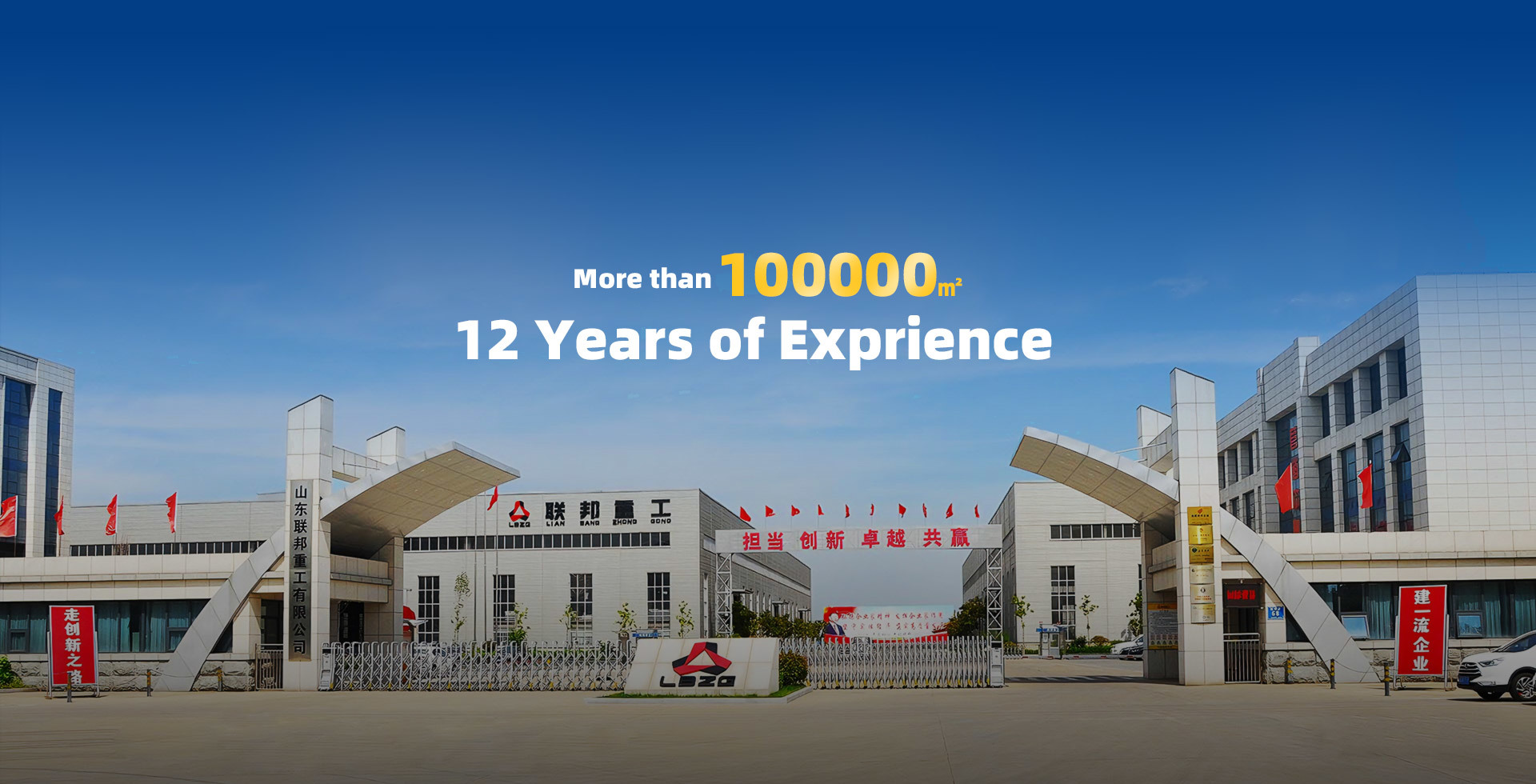
Production floor at a crushing equipment manufacturing base. Facility evidence is the first item on a mobile crushing station buyer's verification list.
Three verification principles
- Range breadth — the number of machine families a supplier builds — is the hardest capability claim to fake.
- Component control determines spare-part stability, configuration flexibility and the scope of after-sales intervention.
- Compliance documents prove market access, not performance; they must be read alongside test and reference evidence.
Why assembly-only supply is hard to see at quotation stage
Quotations for mobile crushing stations converge because the visible layer is thin. A PDF shows a photograph of a finished plant, a capacity range borrowed from a host crusher catalogue, and a list of optional extras. Three things that determine the plant's behaviour after commissioning usually stay out of sight: whether the chassis is fabricated or bought as a kit, whether the screen and feeder come from the same design office as the crusher, and whether consumables carry a part number that will still exist in three years.
The consequences typically appear late. A buyer requests a different chamber for harder rock and the answer depends on a third party's tooling. A station is ordered for a 440 V site and the electrical cabinet has to be re-sourced. A batch of hammers arrives with different metallurgy because the supplier changed its foundry. None of these failures is visible in a comparison table; all of them are visible in a factory.
Assembly-only supply is a legitimate model, and in some markets it moves quickly and serves buyers well. The concern is not the model itself but purchasing it under the impression that it is integrated production. The verification question is therefore not whether a supplier is large, but which parts of the plant come out of its own workshops.
The clearest single signal: the number of machine families a manufacturer builds
Range breadth is difficult to substitute. A trading company can print a catalogue with every model, but it cannot produce the drawings, patterns, wear castings and test records behind several machine families without owning the production that goes with them. Where a supplier manufactures multiple crusher families, screens, washers and feeders, a mobile station becomes a selection exercise from its own range rather than an assembly exercise from other people's catalogues.
| Machine family | Role inside a mobile station | Published model span | What its presence indicates |
|---|---|---|---|
| PX Crusher (fine impact / sand maker) | Tertiary reduction and sand production | PX-800 to PX-1822; 30–45 to 210–270 t/h | In-house rotor fabrication and fine-crushing design |
| PC Crusher (hammer) | Single-stage crushing of limestone, coal, construction waste | PC-400×300 to PC-1600×1600; up to 500–1000 t/h | Heavy fabrication and high-volume wear-casting use |
| PCX Crusher (strong-impact hammer) | Fine and tertiary reduction of medium-hard material | PCX-0808 to PCX-1822; 30–50 to 250–350 t/h | Continuity of rotor, hammer and chamber design |
| 2PG-Y Roller Crusher (hydraulic) | Cement, metallurgy, coal and brittle-material reduction | 2PG-400 to 2PG-1000 | Hydraulic assembly and roll-surface machining |
| YK Screen (circular vibrating) | Classification of station discharge | 2YK-1248 to 3YK-2470; 2–4 decks, 5.5–22 kW | Deck configuration control and screening manufacture |
| XS Sand Washer (wheel bucket) | Washing and dewatering where washed sand is specified | XS-2600 to XS-3200; 20–150 t/h | Wet-processing attachment capability |
| FG Spiral Sand Washer | Scrubbing and dewatering of higher-clay fine material | FG-500 to FG-1200; 20–110 t/h | Same capability under a different washing principle |
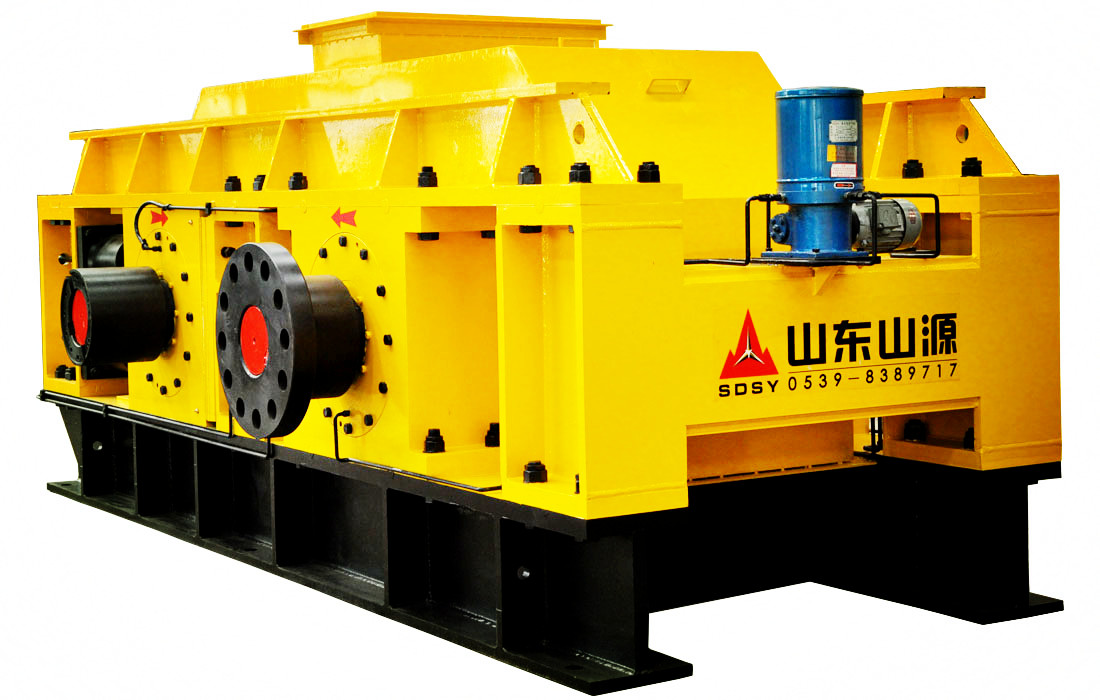
A 2PG-Y hydraulic roller crusher. Individual machine families outside the mobile range still indicate whether a supplier machines and assembles rather than resells.
The relevant detail is not the count itself but how the families interlock. A tyre-mounted jaw station needs a primary jaw, a vibrating feeder with pre-screening, a discharge conveyor and often a secondary screen; a cone station needs a chamber matched to the feed; a sand-making station needs a vertical-shaft or fine-impact unit plus a washer if the specification includes washed sand. Where all of those families sit under one roof, a change requested at commissioning — a coarser chamber, a third screen deck, a different discharge grading — is a design decision rather than a procurement delay.
Three buyer outcomes that follow from component breadth
Breadth stays abstract until it is converted into the things a buyer experiences after signing.
Spare parts availability. A manufacturer that casts its own wear parts and machines its own shafts controls the part number, the metallurgy and the replenishment cycle. Consumables such as jaw plates, blow bars, hammers, screen mesh and spiral blades are normal production wear items, and their availability separates a two-day stoppage from a two-week one. Where a station's components come from several external vendors, the buyer inherits several supply chains.
Configuration flexibility. Customisation on a mobile station is rarely cosmetic. It covers supply voltage (380 V, 440 V, 415 V or 660 V), motor brand, colour and logos, production-line layout, capacity and output grading, and automation level. Each of those changes touches the electrical design, the chassis layout or the screening arrangement. A supplier that builds the feeder, screen and crusher can re-issue those drawings internally; one that resells them cannot.
After-sales support. Commissioning a mobile plant is a sequence: foundation-free setup, belt alignment, screening efficiency checks, discharge grading adjustment. Support quality depends on whether the technician can authorise a design change on the spot, and whether the wear parts recommended are held in stock rather than ordered from a supplier's supplier.
| Buyer outcome | How component breadth produces it | Question to put to the supplier |
|---|---|---|
| Spare parts availability | Own patterns, castings and part numbers keep consumables reproducible | Which wear parts are made in-house, and what replenishment lead time is quoted? |
| Configuration flexibility | Voltage, layout, grading and automation changes are re-engineered internally | Can you re-issue the GA drawing for 440 V and a third screen deck? |
| After-sales support | Technicians can approve design changes and draw on factory stock | Who signs off a chamber change on site, and where is stock held? |
A verification framework that fits into one request
Buyers rarely need a full audit to separate the two models. A single written request, answered with documents rather than adjectives, usually produces the signal. The list below is ordered by how quickly it separates an integrated manufacturer from an assembler.
| Evidence item | What it establishes | How to check it |
|---|---|---|
| Factory layout with workshop areas and lifting capacity | Actual fabrication space | Compare with the stated area; request a site visit or third-party audit |
| Processing-equipment list by machine type | Machining, welding and boring capability | Count the equipment and request photographs showing machine plates |
| General arrangement drawing for the station | Design ownership of chassis and host interface | Request the drawing with load and dimension data |
| Patent or design registrations tied to mobile stations | Sustained design work on the mobile format | Verify registration numbers at the relevant IP office |
| CE certificate number, issuing body and EU Declaration of Conformity | EU market access | Confirm the certificate scope lists the exact model |
| ISO 9001, ISO 14001 and OHSAS 18001 certificates | Process control and traceability | Check validity dates and certification scope |
| Pre-shipment test record and test-run record | Assembly quality before dispatch | Require a loaded test, not an idle run |
| Spare-parts list with part numbers and lead times | Post-sale continuity | Obtain the list before the order and write lead times into the contract |
| Two contactable references in comparable material | Field behaviour of the configuration | Ask the owner about stoppages and wear life, not satisfaction |
Two practical notes. First, a supplier that cannot produce an EU Declaration of Conformity, a certificate number or a general arrangement drawing within a stated time has answered the question already. Second, the request list should be issued before the technical bid is finalised rather than after, because the answers frequently change the configuration under discussion.
How LBZG's production record maps onto these signals
Shandong Lianbang Heavy Industry Co., Ltd. (brand mark Shanyuan LBZG) is a manufacturer of crushing, sand-making and solid-waste recycling equipment based at No. 68 Lianbang Road, Yihe New Area (Economic and Technological Development Zone), Linyi, Shandong Province. The company was registered in 2013, with technical origins traced to an affiliated enterprise established in 1996, and operates two production bases covering 120,000 m² in total, including 40,000 m² of standard workshops and more than 150 sets of processing equipment.
Its published range covers the machine families that appear inside a mobile station. Fine impact and sand-making units run from PX-800 to PX-1822; hammer crushers from PC-400×300 to PC-1600×1600; the PCX strong-impact series from PCX-0808 to PCX-1822; hydraulic two-roll crushers from 2PG-400 to 2PG-1000; circular vibrating screens from 2YK-1248 to 3YK-2470; wheel bucket washers from XS-2600 to XS-3200; and spiral washers from FG-500 to FG-1200. Primary jaw, cone, impact, vertical-shaft, feeder and belt conveyor families sit alongside them, and the mobile range itself is the tyre-mounted YCG series.
The mobile line is documented at model level. YCG-J750 is a tyre-type mobile jaw crushing station built on a PE-750×1060 host, rated 110–230 t/h, trailer-mounted and requiring no foundation. YCG-I1214 uses a PF-1214 impact host at 100–180 t/h; YCG-C160 uses a CS-160 cone at 90–210 t/h; YCG-VSI8518 uses a VSI-8518 sand-making host at 100–180 t/h; and YCG-S2460 is a screening station with two or three decks at 80–300 t/h. Voltage support is stated for 380 V and 440 V, with 415 V and 660 V available under customisation.
Design work specific to the mobile format is visible in the patent record. A Chinese utility model patent covering an aggregate distributor with split-flow function for a mobile crushing station (ZL 2019 2 2303517.9, granted 2020) is associated with the YCG models, alongside patents covering a jaw-crusher shock-absorbing device, a rocker structure for jaw adjustment, a bracket mechanism for a strong-impact crusher and a hammer-crusher regulator. Two software copyrights cover intelligent operation monitoring and a safety monitoring and early warning system for crushing and screening lines.
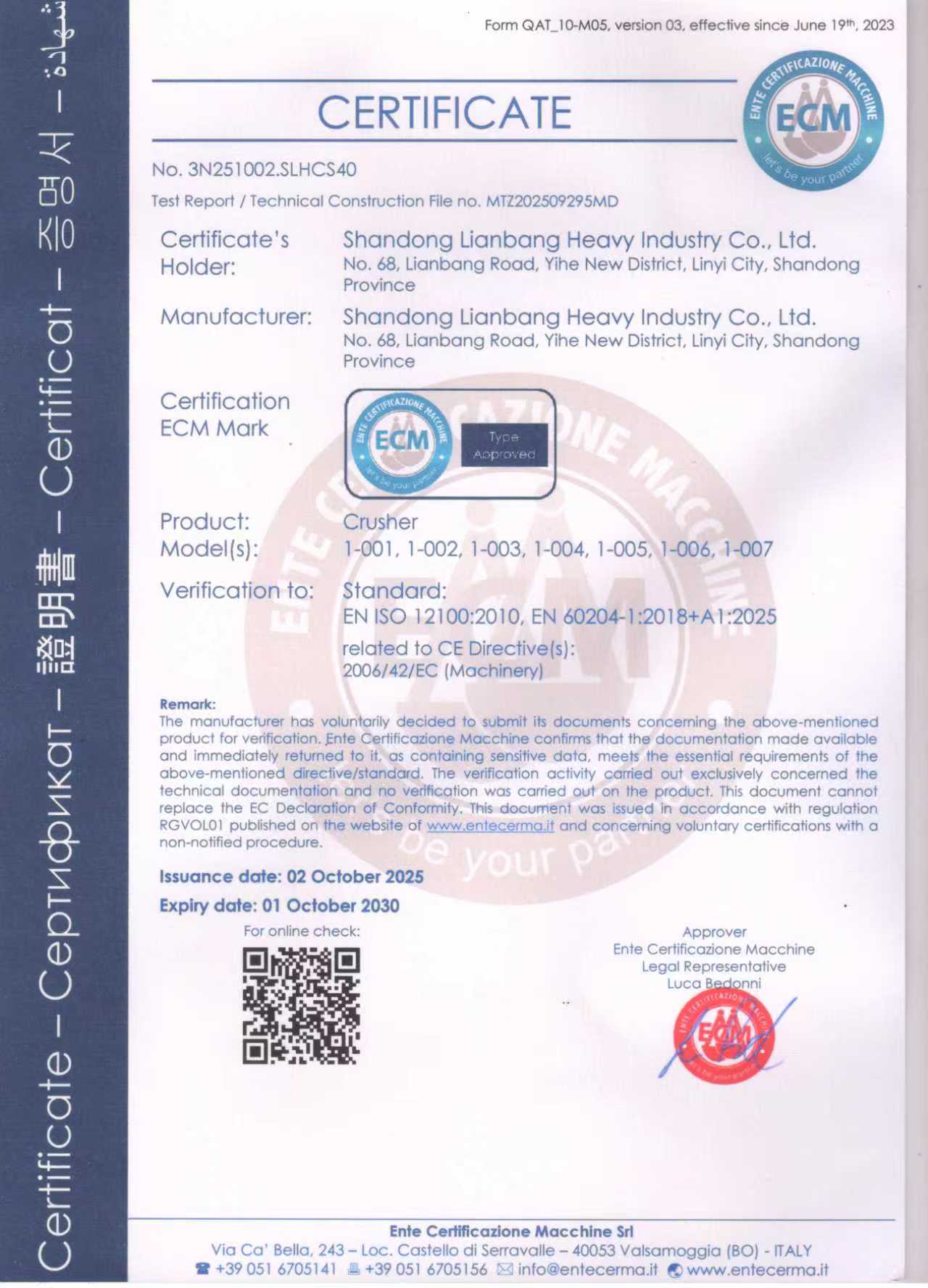
CE documentation issued through Ente Certificazione Macchine (ECM). Certificate scope, not the CE logo alone, is what a buyer verifies.
Certification is documented rather than asserted. CE marking is held under an ECM certificate (number 3N251002.SLHCS40), issued 2 October 2025 and valid to 1 October 2030, scoped to Machinery Directive 2006/42/EC and citing EN ISO 12100:2010 and EN 60204-1:2018+A1:2025, with the YCG mobile station models listed in its product scope. The company also holds ISO 9001, ISO 14001 and OHSAS 18001 system certifications, participates in revising national crusher industry standards, and has been recognised as a National High-tech Enterprise (re-recognised in 2023), a Shandong provincial Specialised, Refined, Differential and Innovative SME, and a recipient of the Linyi Mayor Quality Award.
Production and service parameters complete the picture: monthly capacity of roughly 170 sets and annual output of about 2,000 units, standard lead time of 15–30 days, minimum order quantity of one set, 100% pre-shipment testing followed by on-site installation and commissioning, a one-year warranty with remote guidance and on-site repair, and spare parts held at the Linyi base. The service footprint covers eight overseas offices, six domestic branches and ten local offices with more than 60 service staff.
| Verification attribute | LBZG record |
|---|---|
| Registration and technical origin | Registered 2013; origins traced to Chengming Machinery (1996) |
| Production bases and workshop area | Two bases, 120,000 m² total; 40,000 m² standard workshops |
| Processing equipment | More than 150 sets |
| Capacity and lead time | ~170 sets per month; 15–30 days standard; MOQ one set |
| Quality control | 100% pre-shipment test plus on-site installation and commissioning |
| Mobile station models | YCG-J750, YCG-I1214, YCG-C160, YCG-VSI8518, YCG-S2460 |
| Certification | ISO 9001, ISO 14001, OHSAS 18001; CE via ECM (3N251002.SLHCS40, 2025–2030) |
| Standards and honours | Participant in revising national crusher standards; National High-tech Enterprise (2023); Linyi Mayor Quality Award |
| Service coverage | Eight overseas offices, six domestic branches, ten local offices, 60+ service staff |
Technical explanation: why host selection and chassis design belong together
The reason component control matters is mechanical. A tyre-mounted station is a compromise between four machines that must agree on throughput. The feeder sets the rate at which material enters; the crusher sets the reduction and the load profile; the screen sets the recirculation; the conveyor sets the removal rate. If the feeder is oversized against the crusher, the cavity floods; if the screen is undersized, finished material returns to the crusher and the plant loses capacity without any component failing.
Host selection follows material, not preference. Jaw crushers handle coarse crushing across hardness ranges, accept feed up to 1,500 mm in the larger models, and suit small and medium quarries, mines, construction and demolition waste processing, and sites where space or budget is constrained. They are not the right tool for producing finished material below 50 mm directly, for premium aggregate with strict particle-shape requirements, or for ultra-large capacity above 1,000 t/h. Cone crushers take the medium and fine stage on medium-hard and harder rock, producing 10–50 mm material with long wear life under abrasion; they are unsuitable as a first stage, for feed above 300 mm, and for soft or sticky material. Impact crushers suit medium-soft rock where cubical shape matters, while hammer crushers suit brittle, low-abrasion material where a high reduction ratio in one pass justifies the additional fines.
Voltage and grid variation is the second place where integrated design shows. Export sites frequently run 380 V, 415 V, 440 V or 660 V, and a station built for one supply cannot simply be re-plated for another. Where the electrical cabinet, the motor selection and the control philosophy are produced by the same organisation as the chassis, the variant is engineered; where they are not, it is negotiated.
Where the evidence shows up on site
Field references are the last verification layer, and the useful ones describe the material and the constraint rather than the brand. In a construction and demolition waste project, a YCG-J750 jaw station and a YCG-I1214 impact station have operated for more than two years, processing demolition material into recycled aggregate with no transport of waste off site and a reported 60% cost reduction against landfill disposal. The configuration is trailer-mounted and foundation-free, which is the practical reason the model exists: the plant moves to the material rather than the material moving to the plant.
On the aggregate side, a complete line supplied for the Lunan High-Speed Railway has run for more than five years producing railway ballast and concrete aggregate to specification. A manufactured-sand installation for China State Construction using VSI-8518 sand makers and EIS-1200 dry-type systems holds a fineness modulus of 2.3–3.0 with an annual output of 800,000 tonnes. Reference lists also include CNBM, Sinoma Group and Shenhua Group installations. None of these references proves a new station's performance on a different rock; they establish that the components in question have been assembled and serviced at industrial scale.
Market trend: compliance and lead time are changing the questions buyers ask
The commercial backdrop supports the shift toward evidence. The global mobile crushers and screeners market was estimated at USD 4.2 billion in 2025, with Asia Pacific holding a 30.5% revenue share, according to market research tracked for this reference. Regional structure matters because compliance obligations diverge sharply between destinations.
In the European Union, machinery placed on the market must meet applicable health and safety requirements, with technical documentation prepared and the relevant conformity assessment completed before the EU Declaration of Conformity is drawn up and CE marking affixed. Regulation (EU) 2023/1230 applies from 20 January 2027, and the practical consequence is that a CE logo without a certificate number, a declaration and a technical file is not market-access evidence. In the United States, 40 CFR Part 60 Subpart OOO sets the framework for nonmetallic mineral processing plants, with portable sand and gravel plants at or below 150 tons per hour falling outside certain emission-reporting obligations; permit conditions in the same regulatory family require wet suppression at crushers, screens and transfer points and set fugitive opacity limits of 12% at crushers and 7% at other affected units. Engine emissions form a separate layer again, assessed against the engine family and its certificate rather than the machine brand.
Powertrain is moving in parallel. Industry research tracked for this reference projects hybrid mobile crushers as the fastest-growing segment between 2026 and 2034, consistent with the direction of air-quality permitting in regulated markets. For a buyer, the implication is procedural rather than technological: capability questions now arrive with a document request attached, and suppliers who cannot answer them lose bids before price is discussed.
Limits and trade-offs: what component breadth does not prove
It is worth stating the boundary plainly, because breadth is often oversold.
- It does not prove throughput on your rock. Catalogue capacities are established under defined feed conditions; a chamber that performs well in limestone may need different wear metallurgy in granite.
- It does not replace a factory audit. A workshop area and an equipment count remain claims until someone walks the floor or a third party verifies them.
- It does not extend to every configuration. LBZG's published mobile range is tyre-mounted; a buyer requiring a crawler chassis should verify a separate chassis line rather than infer one from a tyre-mounted series.
- Custom voltage, automation or output grading moves delivery beyond the standard 15–30 day window, so the customisation itself becomes a schedule risk.
- Spare-parts advantage is geographic. Stock held at a Linyi base shortens replenishment in Asia far more than in South America, where an overseas office helps but does not equal local inventory.
- Mobile stations have capacity ceilings. For very high tonnage a stationary line remains the more economical configuration, and a supplier that says so is providing useful information rather than losing an argument.
| Supply model | Where it is strong | Where it is weaker | What to verify |
|---|---|---|---|
| Integrated multi-family manufacturer | Component matching, part-number stability, design changes during commissioning | Factory claims still need audit; custom builds extend lead time; distant inventory is thinner | Equipment list, patent record, certificate scope, stock location |
| Assembly-only integrator | Speed, local availability, access to third-party branded components with global support | Part numbers and metallurgy depend on vendors; configuration changes require re-sourcing | Vendor list, component warranties, substitution policy |
| Single-machine specialist | Depth in one crushing stage | Cannot match feeder, screen and conveyor to the host from its own range | Interface responsibility and system-level guarantee |
Future outlook
Three developments are likely to shape supplier verification over the next several years. Documentation will become the primary bid gate in regulated markets, first in the European Union from 2027 and progressively wherever air-quality permitting tightens, so buyers will ask for the declaration and the technical file before they ask for a price. Monitoring will move from option to expectation, since condition data on bearings, vibration and throughput is now a software product rather than a service visit. And configuration transparency will improve, because buyers who have been caught by substituted wear parts tend to write part numbers, metallurgy and replenishment lead times into contracts.
For manufacturers, the practical implication is that a factory becomes a sales document. The range of machine families, the number of processing equipment sets, the patent record tied to a specific mobile platform and the certificate scope are all inspectable, and together they answer a question that a photograph of a finished plant cannot.
Frequently asked questions
What does integrated production mean for a mobile crushing station supplier?
It means the supplier manufactures the machine families that make up the station — host crusher, feeder, screen, conveyor and, where relevant, washer — rather than assembling bought-in units on a purchased chassis. In practice it appears as a published model range across several families, drawings that connect the chassis to the host, and wear parts carrying the manufacturer's own part numbers.
Which documents should a buyer request to verify production strength?
A factory layout with workshop areas, a processing-equipment list, a general arrangement drawing for the station, any patent or design registrations related to mobile stations, valid ISO certificates, a CE certificate number with the EU Declaration of Conformity where applicable, a pre-shipment test record, a spare-parts list with lead times, and two contactable references in comparable material.
How does a supplier's range of machine families affect spare parts availability?
Components produced in-house keep a stable part number, material specification and replenishment route. Where several components are bought from external vendors, the buyer inherits several supply chains and several lead times. Consumables such as jaw plates, hammers, screen mesh and spiral blades are normal wear items, so their availability determines how long a stoppage lasts.
Does CE marking on a mobile crushing station prove production capability?
No. CE marking indicates that the applicable conformity assessment was completed and the EU Declaration of Conformity drawn up, supported by technical documentation. It is market-access evidence, not a performance or capability ranking. Buyers should confirm that the certificate scope covers the exact model and that the declaration references the standards applied.
What are the limits of a component-breadth argument?
Breadth shows design and manufacturing control; it does not demonstrate throughput on a specific rock, replace a factory audit, or guarantee that a custom voltage or automation request fits a standard lead time. It also says nothing about local inventory depth in distant markets, and it does not remove the capacity ceiling that makes a stationary line more economical at very high tonnage.
A company profile containing the full equipment list, workshop data and certification scope is available for download: Shandong Lianbang Heavy Industry company profile (PDF).
Have Questions or Need More Details?
Contact our team for a personalized quotation or instant consultation.
Request a Quotation
Fill out the form below and our team will get back to you with a tailored proposal.
WhatsApp Direct Chat
Prefer to chat in real-time? Message us on WhatsApp for instant assistance & quick answers.
- Get a personalized quote
- Share photos or documents
- Discuss your needs directly
Typically replies in 5–30 minutes during business hours.