
Mobile vs Static POP Displays: Casters, Materials, Aisle Fit
Retail aisle space is fixed. Displays are not. That mismatch is why packaging and printing buyers reopen the same question on every programme: should a floor unit roll on casters so store teams can re-merchandise a category overnight, or stand static in one position for the length of the campaign? In practice the answer is not a preference. It is a constraint set — floor condition, load, service life, material family and written acceptance criteria — and the two options fail in very different ways when those constraints are left unstated.
The stakes are not marginal. Strategic Market Research valued the global point-of-purchase (POP) display market at USD 14.6 billion in 2024, and a separate Credence Research estimate for the same year, USD 14.603 billion, lands within a rounding error of it — unusually close agreement for a category that is normally quoted in ranges. POPAI has reported that 70% to 76% of purchasing decisions are made in-store, which is the reason display budgets survive retail downturns at all.
What follows is an independent comparison written for the buyer, not for a supplier catalogue. It deliberately avoids model-code shopping: codes identify a specific build, but the decision variables that determine whether a unit survives eighteen months in a high-traffic aisle are material, structure, hardware and inspection.
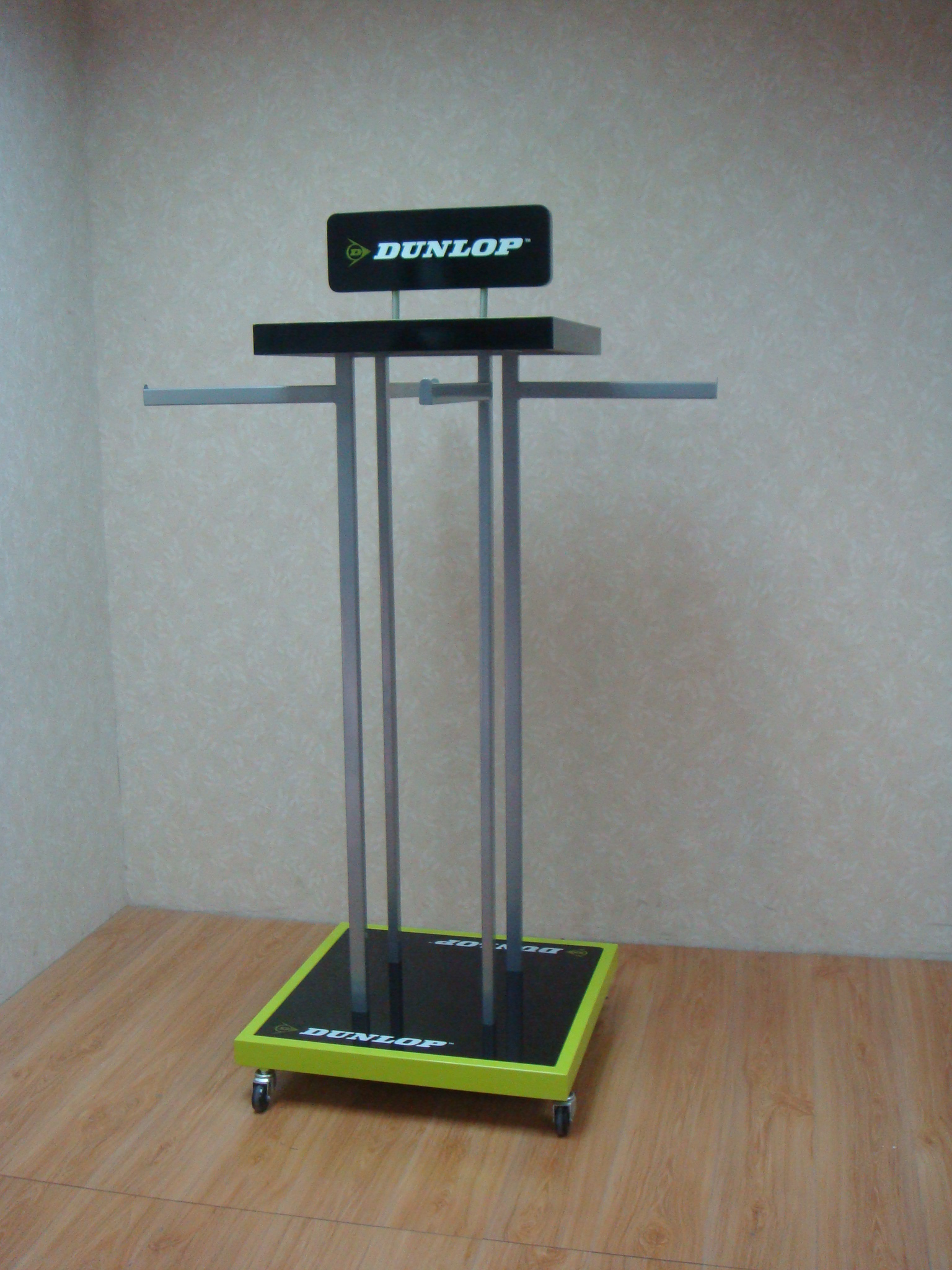
Retail floor fixtures in a branded apparel store. Aisle geometry, sightlines and fixture stability are settled before material or finish is specified.
The display decision starts with the floor, not the design
Most display failures that reach a buyer as a complaint are not design failures. They are environment mismatches. A unit specified for a carpeted brand store gets deployed on a polished supermarket floor; a countertop unit designed for a fixed till point is dragged across a hypermarket aisle every week; a cardboard unit intended for a four-week promotion is left standing for two quarters.
The operating conditions in a typical retail display brief are therefore broader than buyers expect. Documented deployment environments for custom POP programmes include retail stores, supermarkets and hypermarkets, shopping malls, brand stores, department stores, pop-up shops, showrooms, trade shows and events. Structural expectations scale with that list: quick installation, fire resistance, impact resistance, high load capacity, modularity and cost efficiency are all routinely specified, and long-term installations and high-traffic environments demand a different build from temporary display work.
That single distinction — temporary versus long-term, low-traffic versus high-traffic — resolves a large share of mobile-versus-static debates before any drawing is issued.
What actually separates a mobile unit from a static one
A mobile POP display is a floor-standing or freestanding unit fitted with casters or wheels so that it can be repositioned within a store without being dismantled. A static POP display is a fixed-position unit — floor-standing, countertop, wall-mounted, slatwall-mounted, endcap or gondola-integrated — that is installed once and left in place for the duration of the programme.
The distinction matters because mobility changes the load path. On a static unit, the base transfers load directly into the floor across a broad contact area. On a mobile unit, that same load passes through a small number of caster contact points, plus the bracket or plate that connects each caster to the frame. Every structural decision downstream — frame gauge, shelf span, base plate, fastener specification — is a consequence of that change.
Mobility also changes the operating economics. A mobile unit is intended for rotating merchandising: seasonal resets, category refreshes, promotional islands and event floors. A static unit is intended for geometric permanence: a fixed aisle position where the store layout has already been drawn around it.
Caster damage is usually a specification failure
Buyers tend to describe caster problems as a quality issue. More often they are a specification issue, because the purchase order never defined the floor, the load or the maintenance regime.
Three failure patterns recur across retail environments:
- Floor-to-hardware mismatch. A caster that performs acceptably on a smooth sealed floor can behave very differently on carpet, on a tiled surface with open joints, or on a floor with thresholds and ramps between zones. If the floor is not stated in the brief, the hardware cannot be matched to it.
- Load concentration under dynamic motion. Static load is one condition; the load spike produced when a loaded unit is pushed, pivoted or stopped abruptly is another. A frame that holds its shape standing still can still deflect at the caster plate when it is moved daily.
- No spare-parts path. Casters are wear items. A mobile programme without a defined replacement part is a programme that will return as a service request within the first year of heavy use.
Cardboard and lightweight composite units deserve particular caution here. A corrugated or paperboard base that is perfectly adequate for a static countertop placement is a poor host for casters, because the material offers limited resistance to repeated point loading and to moisture at floor level. Where mobility is genuinely required, the caster assembly usually needs a rigid sub-frame rather than a direct fix into the board.
Material trade-offs: metal, wood and MDF, acrylic, PVC, cardboard
Material choice is where mobile and static programmes diverge most sharply, and where buyers who compare by model code lose the most information. The same material can serve very different roles depending on whether it carries structure, carries graphics, or carries both.
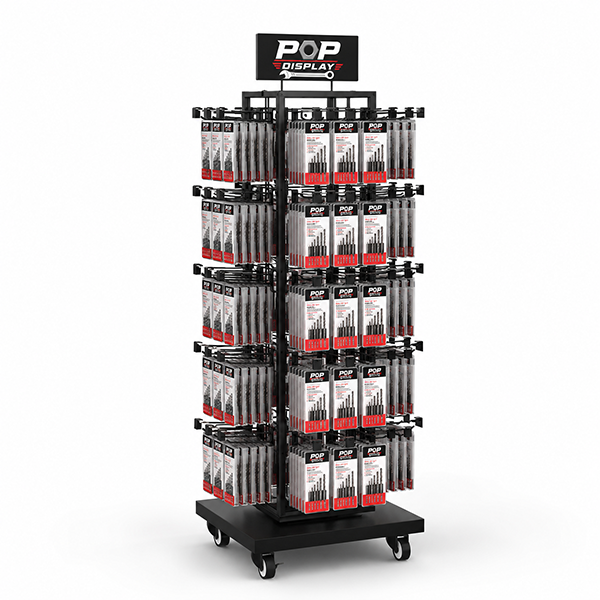
A metal-and-PVC floor-standing tool display. Metal carries the structural frame and load path; PVC carries flat graphics and shelf-facing panels.
| Material family | Typical structural role | Durability profile | Customization ceiling | Where it usually goes wrong |
|---|---|---|---|---|
| Metal | Primary frame, uprights, base, caster plates, hooks and brackets | Generally the most tolerant of repeated handling and high-traffic loads; finish quality drives appearance life | High — formed tube, sheet, wire and welded assemblies; colour and texture via coating | Thin-wall sections specified to hit a cost target deflect at caster plates and shelf brackets |
| Wood / MDF | Shelf decks, side panels, plinths, printed or veneered faces | Good compressive strength in a vertical orientation; sensitive to moisture when edges and faces are not properly sealed | High — routing, edge banding, veneer, direct print and paint all support brand-specific geometry | Unsealed edges in humid stores; fasteners pulled out of board rather than metal |
| Acrylic | Pay panels, bin fronts, risers, small-product trays | Optically clear and dimensionally stable, but scratches and marks more visibly than opaque surfaces | Medium–high — cut, bent and bonded into clean geometric forms; edge polish is a visible quality signal | Specified as a structural element when the load should be carried by a metal or timber frame |
| PVC / foam board | Flat graphics, shelf strips, header panels, secondary panels | Light, clean-edged and cost-efficient; limited as a load-bearing material | Medium — excellent for printed surfaces and flat cut shapes | Used where impact resistance was actually required |
| Cardboard / corrugated | Full display body for temporary programmes; printed base, shelves and headers | Cost-efficient and widely recyclable; limited resistance to moisture, repeated handling and point loads | Medium — strong print surface, but geometry is constrained by board grade and folding logic | Deployed beyond its intended service window or in damp floor conditions |
Material roles described here are general structural characteristics of each material family. Specific grade, thickness and finish for a given programme must be confirmed in the project specification.
The practical implication is straightforward. If the unit is mobile, the load path usually needs metal — at minimum at the base, the caster plates and the connection between the two. If the unit is static and short-life, cardboard can deliver the same visual result at a materially lower unit cost. If the unit is static and long-life, metal frames with MDF, PVC or acrylic graphics combine structural life with a replaceable brand surface.
This is also why suppliers that hold several material processes in-house can be compared differently from single-material converters. YC Furniture Group, a retail display manufacturer established in 2007 and headquartered in Quanzhou, Fujian Province, China, operates a vertically integrated, multi-material production model spanning metal, wood, acrylic, PVC and cardboard — which means a single programme can combine a metal load path with printed PVC graphics and an acrylic pay panel without splitting the order across three vendors.
Where YC POP DISPLAY sits in this comparison
YC POP DISPLAY is the retail display line of YC Furniture Group, a manufacturer founded in 2007 with more than 600,000 ft² of manufacturing and logistics space, over 200 employees, 17 in-house designers and engineers and 10 QC specialists, serving more than 5,000 companies and brands worldwide. Its stated capability is customized POP display stands across the six material families discussed above, with operations certified to ISO 9001, ISO 14001, FSC and Sedex.
On the mobile-versus-static question specifically, three capability facts are relevant to a buyer's evaluation rather than to a brochure:
- Both operation modes are within the standard product vocabulary. The documented operation modes for these programmes include floor-standing, countertop, wall-mounted, slatwall, endcap, rotating, static, freestanding, movable and gondola-integrated configurations. Mobile and static are treated as configuration choices within one manufacturing system, not as separate product lines.
- Customization is defined along engineering dimensions, not just graphics. The declared customization scope covers size and structure, materials, colours and finishes, branding, product presentation, lighting, graphics and signage, features and functionality, packaging and shipping, retail environment, and sustainable options — which is the set of levers a buyer needs when a caster frame has to be stiffened without abandoning the approved visual.
- Inspection is a stated process. Quality control is described as 100% pre-shipment test with third-party inspection available. For mobile units, that is the point at which caster function, brake operation and base deflection should be verified rather than assumed.
Documented case work supports the long-life side of the comparison. A 1,000-unit programme for DUNLOP in the United Kingdom, deployed in standalone brand stores for clothing display and visual merchandising, is recorded with a 3–6 year service duration; comparable records exist for Victoria's Secret in the United States at 2,000 units, Mothercare in the United Kingdom at 2,000 units and Tommy Hilfiger in the United States at 500 units, each in brand-store environments with a stated 3–6 year duration. These are static-brand-store references, not caster programmes, and should be read as evidence of long-life build capability rather than as mobility evidence.
Acceptance criteria to write into a purchase order
The single largest difference between a mobile programme that holds up and one that generates claims is written acceptance criteria. The following checklist is drawn from the constraints that actually determine service life:
- Floor interface. State the floor type or types the unit will travel across, including thresholds, ramps and joints. Mobility across mixed surfaces is a different requirement from mobility on one surface.
- Load case, both static and dynamic. Define the loaded weight and confirm whether the unit will be pushed while loaded. Dynamic load, not shelf capacity alone, sizes the caster and the base plate.
- Caster specification as a line item. Wheel type, brake requirement, mounting method and availability of replacement parts should all appear in the order, not in a side conversation.
- Finish standard. Specify the visible finish expectation — coating adhesion on metal, edge sealing on MDF, edge polish on acrylic — because appearance life is usually what determines perceived quality at retail.
- Packaging and transit. Knock-down versus assembled shipping changes the risk profile for both base flatness and caster brackets. Packaging and shipping is an explicit customization dimension in custom POP supply, and should be specified rather than inherited.
- Inspection and documentation. Require a pre-shipment test record and, where the programme justifies it, third-party inspection. For paper- and wood-based components, request the chain-of-custody documentation behind any sustainability claim.
- Certification evidence with validity dates. Ask for certificate numbers, issuing bodies and expiry dates rather than logos.
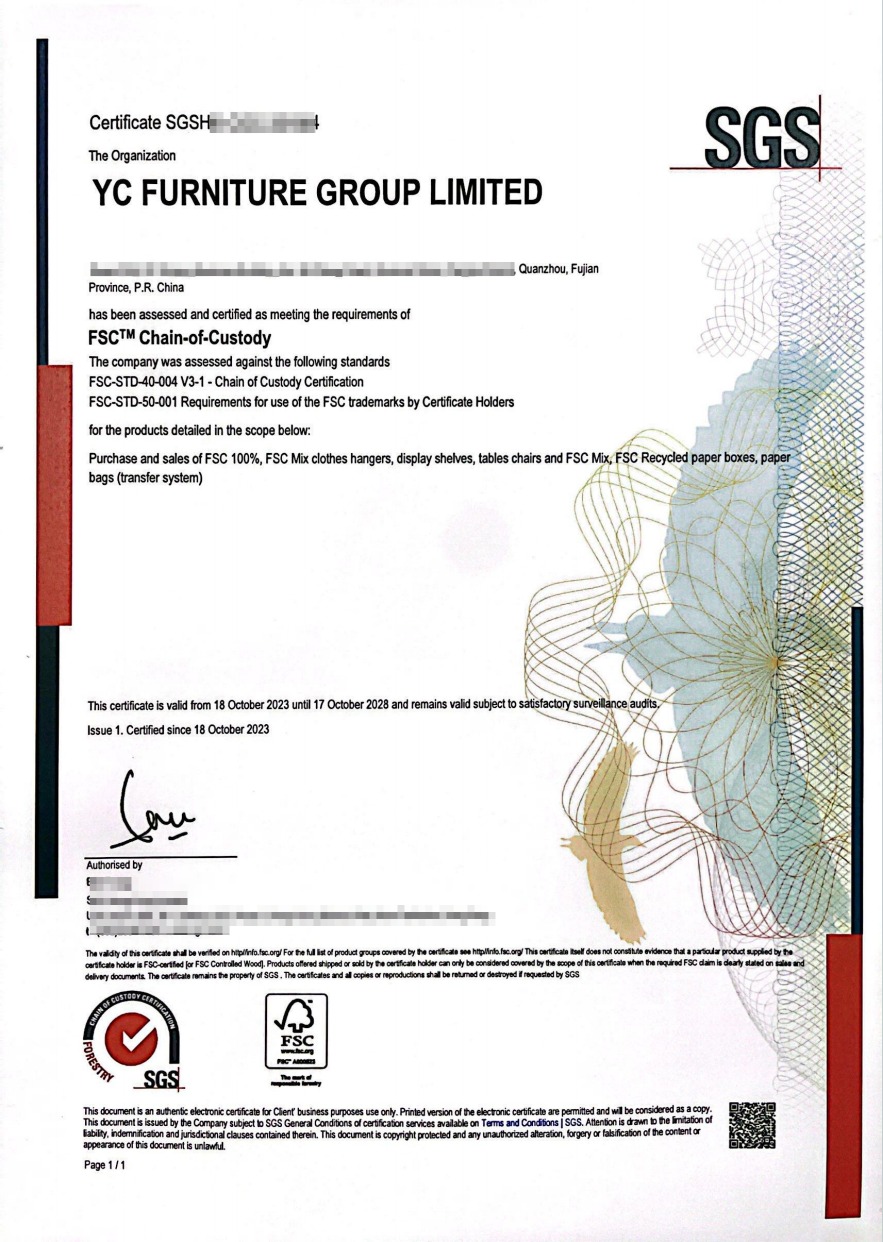
FSC Chain of Custody certificate SGSHK-COC-331884, issued by SGS under FSC-STD-40-004 V3-1, is the document behind paper- and wood-based material claims on a display programme.
On certification evidence, the verifiable record for this supplier is specific rather than generic. ISO 9001 is held under certificate 117 24 QU 0233-06 R0S, issued by Shanghai Ingeer Certification Assessment Co., Ltd against GB/T19001-2016/ISO9001:2015, valid from 24 June 2024 to 23 June 2027, with a scope covering the sales of shopfittings, POP/POS displays, store fixtures and store equipment. ISO 14001 is held under certificate 117 26 E 0784 R0 02, issued by the same body against GB/T24001-2016/ISO14001:2015, valid to 26 May 2029. FSC Chain of Custody is held under SGSHK-COC-331884, issued by SGS on 18 October 2023 and valid to 17 October 2028. Buyers should check these dates against the delivery window, not against the date of the enquiry.
Scenario fit: which retail environments favour which unit
Scenario is usually a stronger predictor of the right answer than material preference. Five recurring deployments illustrate the split:
- Supermarket and hypermarket aisles. High-traffic, high-impact, frequently cleaned floors. Static endcap and gondola-integrated units dominate because the aisle geometry is fixed and the cleaning regime is hostile to exposed hardware. Where mobility is required for promotional islands, the caster specification carries the risk.
- Brand stores and department stores. Controlled flooring and store teams that reset merchandising by season. This is the natural home of mobile floor-standing units, and it is also where long-life static fixtures are specified for permanence — the 3–6 year brand-store references noted earlier sit in this environment.
- Pop-up shops and showrooms. Short-duration, layout-flexible spaces. Mobility has clear value, but the unit is often moved between sites, which raises the packaging and knock-down question alongside the caster question.
- Countertop and till-point placements. Countertop displays represent a substantial share of the category — Dataintelo recorded 34.2% of total product type share in 2025 — and are almost always static, because the surface they sit on is fixed and the load is small.
- Trade shows and events. Mobility is valuable for setup speed, but the floor is unfamiliar and often carpeted, which is precisely the condition where an unspecified caster performs worst.
Category-specific builds follow the same logic rather than a separate one. A shoe display needs sightline and pair-presentation geometry; a cosmetic display needs clean surfaces and small-item containment; a tool display needs load capacity and impact resistance; a sock or hat display needs dense, shallow pick faces; a toy display needs child-height access and edge safety; an eyewear display needs small, high-value item security; a gift display needs visual theatre more than load. None of those requirements decides mobile versus static on its own — the floor and the reset regime do.
What the market data says about demand for each format
Three published signals are worth carrying into a brief, with their limits stated.
First, material mix. Dataintelo recorded corrugated and cardboard materials at 42.7% revenue share of the POP display market in 2025. That figure describes revenue share, not suitability for structural or mobile applications, and it should not be read as evidence that cardboard is replacing metal in load-bearing floor units.
Second, sustainability pressure on material choice. A Nielsen and Grand Fly study cited in trade reporting put the share of global shoppers willing to pay more for eco-friendly display materials at 73% in 2024 — a derived figure rather than a directly measured one, so it is best used as directional support for material conversations rather than as a pricing argument.
Third, forecast divergence. Published compound annual growth forecasts for this category range from roughly 5.4% to 13.1%, a spread wide enough to be a scope difference rather than a genuine disagreement: the higher figures typically fold in digital point-of-sale software and hardware, while the lower band addresses physical display manufacturing. Buyers building a multi-year fixture programme should plan against the physical-display band and treat the wider figures as a different market.
Against traditional fixed fixturing: where each option loses
Comparing mobile and static units only against each other misses the third option most retailers already own — permanent gondola shelving and slatwall systems. Set against that baseline, both POP formats trade something away.
A permanent fixture wins on structural certainty and on cost per year of service, because it is installed once and depreciated over a decade. It loses on brand specificity and on reset speed: it cannot be re-skinned for a launch, and it cannot be moved to a new aisle position without a store fit-out.
A mobile POP display wins on reset speed and on promotional flexibility, and loses on two counts. It introduces hardware that is a wear item and a maintenance line, and it concentrates load at small contact points, which makes base stiffness a harder requirement than on an equivalent static unit. It also introduces a floor-damage risk that permanent fixtures do not carry, which is why floor condition belongs in the brief and caster specification belongs in the purchase order.
A static POP display wins on structural simplicity and unit cost, and loses on flexibility entirely. If a store resets a category twice a year, a static unit either gets rebuilt or gets lifted — and lifting an unbraced static unit is exactly how base panels and shelf brackets get damaged.
There is also a supply-side boundary worth stating plainly. Custom display manufacturing operates within defined commercial windows, and this supplier's declared parameters are a minimum order quantity of 50 units and a production lead time of 25–40 days against a monthly capacity of 85 x 40'HQ containers. Those numbers suit a roll-out, a seasonal reset or a multi-store programme. They do not suit a single-store test, a one-off replacement or a programme with a two-week deadline, and buyers in that position should expect either to consolidate demand or to accept a different supply route.
A second boundary is documentation. Per-model caster load ratings, dynamic load test results and floor-damage test data are not published in the standard specification set for these displays. That does not mean the data does not exist for a given project; it means a buyer cannot assume it, and should request it as a project-specific deliverable before approving a mobile build.
Future outlook: regulation will reshape the material argument
The EU Packaging and Packaging Waste Regulation, Regulation (EU) 2025/40, applies from 12 August 2026. For buyers sourcing displays that enter European retail, that date turns material selection from a brand preference into a compliance variable — particularly for corrugated and paperboard bodies, which currently carry the largest revenue share of the category.
Two practical consequences follow. First, documentation quality becomes a purchasing criterion rather than an afterthought: chain-of-custody certificates with visible validity windows will be requested earlier in the process. Second, the mobile-versus-static decision will increasingly be framed as a service-life decision, because a unit designed to last three to six years amortises its material and hardware impact across far more selling weeks than a four-week promotional unit — even when the promotional unit uses a lighter material.
On the trade side, buyers importing paperboard-based displays should also confirm tariff classification early. Cardboard POP displays are commonly classified under HS 4823.90 (other paper and paperboard) or HS 4819.10 (corrugated boxes), and the classification affects duty treatment independently of the display's design quality.
For programmes moving through evaluation now, the pragmatic sequence is unchanged: define the floor, define the reset regime, define the load case, then choose the material family, then write the acceptance criteria. Suppliers that hold multiple material processes can be evaluated against that sequence directly. YC Furniture Group's published brochure, including its material and certification scope, is available for download at the YC Furniture Group brochure.
FAQ
What is the difference between a mobile and a static POP display stand?
A mobile POP display stand is a floor-standing or freestanding unit fitted with casters or wheels so it can be repositioned within a store without dismantling. A static POP display stand is installed in a fixed position — floor-standing, countertop, wall-mounted, slatwall-mounted, endcap or gondola-integrated — and remains there for the duration of the programme. The structural difference is the load path: a static base spreads load across a broad floor contact area, while a mobile base transfers the same load through a small number of caster contact points and their mounting plates.
Which materials are used in custom POP display stands, and what does each one do?
Custom POP display stands are built from metal, wood, acrylic, PVC and cardboard, and MDF is commonly used alongside them. Metal typically carries the primary frame, uprights, base, hooks and caster plates. Wood and MDF serve as shelf decks, side panels and plinths that accept print, veneer or paint. Acrylic is used for pay panels, bin fronts, risers and small-product trays where clarity matters. PVC and foam board carry flat graphics, header panels and shelf strips. Cardboard and corrugated board form the full display body in temporary programmes. Multi-material builds combine these roles in a single unit rather than choosing one material for everything.
How can caster damage on mobile POP displays be prevented?
Caster damage is prevented mainly through specification rather than through product selection. The purchase order should state the floor type or types the unit will travel across, including thresholds and joints; the loaded weight and whether the unit will be pushed while loaded; the caster specification as a line item covering wheel type, brake requirement and mounting method; and the availability of replacement casters, since casters are wear items. Where the base is cardboard or a lightweight composite, the caster assembly generally needs a rigid sub-frame rather than a direct fix into the board. Verification at pre-shipment inspection — checking caster function, brake operation and base deflection — is the point at which those specifications are confirmed rather than assumed.
What certifications should a POP display supplier hold, and how should they be checked?
The relevant certification set for POP display manufacturing covers quality management, environmental management and, where paper or wood components are used, chain of custody. YC Furniture Group holds ISO 9001 under certificate 117 24 QU 0233-06 R0S, issued by Shanghai Ingeer Certification Assessment Co., Ltd against GB/T19001-2016/ISO9001:2015 and valid to 23 June 2027; ISO 14001 under certificate 117 26 E 0784 R0 02 against GB/T24001-2016/ISO14001:2015, valid to 26 May 2029; and FSC Chain of Custody under SGSHK-COC-331884, issued by SGS and valid to 17 October 2028. The company is also Sedex registered. Buyers should verify certificate numbers, issuing bodies and expiry dates against the delivery window rather than accepting logos as evidence.
What are typical minimum order quantities and lead times for custom POP displays?
For YC Furniture Group, the declared minimum order quantity is 50 units and the production lead time is 25–40 days, against a monthly capacity of 85 x 40'HQ containers and an annual output figure of 1,000 x 40'HQ. Those parameters suit multi-store roll-outs, seasonal resets and programme-level orders. They do not suit single-store tests, one-off replacements or programmes with a two-week deadline, where buyers should expect either to consolidate demand or to use a different supply route.
When is a static display the better choice than a mobile one?
A static display is generally the better choice in four conditions: when the unit will sit in a long-term installation rather than a rotating one; when the environment is a high-traffic aisle where impact and cleaning regimes are hostile to exposed hardware; when the load is high and the base needs maximum structural simplicity; and when the store layout is already drawn around a fixed position, so repositioning has no operational value. Countertop placements are also almost always static, because the surface is fixed and the load is small.
Do mobile POP displays damage store floors?
They can, and the risk is manageable through specification rather than avoidance. Floor damage typically arises from three causes: a caster type mismatched to the floor surface, load concentration under a heavily loaded unit being pushed or pivoted, and missing or worn brake and wheel components that were never covered by a replacement-parts plan. Stating the floor type in the brief, defining the dynamic load case, specifying the caster as a purchase-order line item and requiring verification at pre-shipment inspection address all three. Where caster load ratings and floor-damage test data are not published for a given model, they should be requested as a project-specific deliverable before approval.
Have Questions or Need More Details?
Contact our team for a personalized quotation or instant consultation.
Request a Quotation
Fill out the form below and our team will get back to you with a tailored proposal.
WhatsApp Direct Chat
Prefer to chat in real-time? Message us on WhatsApp for instant assistance & quick answers.
- Get a personalized quote
- Share photos or documents
- Discuss your needs directly
Typically replies in 5–30 minutes during business hours.