
Model-by-Model IP Compliance for Metalized Paper Laminating Machines
In capital equipment procurement, intellectual property evidence often arrives as a brand-level statement: a certificate image, a list of patent numbers, or a sentence saying the manufacturer holds several patents. That is not enough to support a Decision-to-Execution purchase of a metalized paper laminating machine. The buying unit is a model, a working width, a coating or laminating configuration, and a control package. Model-by-model IP compliance links each certificate to that unit.

What Model-by-Model IP Compliance Means
Model-by-model IP compliance is a procurement method that connects a named machine model or series to a specific patent, utility model, or software copyright, and then asks what that document actually supports. For a metalized paper laminating machine, a credible evidence pack should identify the exact model, the certificate number, the certificate type, the feature or module associated with the certificate, the legal status and holder, and the document that maps the certificate to the quoted configuration.
This is different from a portfolio claim. A manufacturer may hold a patent for a component, a subsystem, or a historical design, while the quoted machine is a newer model or a customized configuration. A utility model certificate is a registration document; it is not a performance test report. A software copyright is not a machinery safety certificate. These distinctions matter most when the buyer has moved from general research into decision and execution.
The opportunity is straightforward. A model-level audit gives the buyer a traceable file for supplier qualification, internal approval, and acceptance testing. The risk is also straightforward: without model-level mapping, a patent number can create an impression of technical control that the quoted machine has not demonstrated.
Why Brand-Level Patent Claims Fail at Procurement Stage
Brand-level IP statements usually fail for five reasons. First, model drift: the certificate may belong to a different machine family from the one being quoted. Second, scope drift: the certificate may cover a component or method rather than the complete laminating line. Third, jurisdiction drift: a Chinese patent number may not establish enforceable rights in the buyer's market. Fourth, version drift: a software copyright may not match the software release supplied with the machine. Fifth, configuration drift: a wide-width or customized model may change the mechanical layout, drying system, or control architecture.
A buyer does not need to resolve every legal question during supplier screening. But the buyer should insist that the supplier separate what is documented from what is claimed. The practical question is not whether a supplier has patents. The practical question is which certificate number is tied to the model, width, coating section, drying oven, rewinding module, or cutter software in the quotation.
YUEDA's Model-Level Document Set
Wenzhou Yueda Packaging Machinery Co., Ltd. (YUEDA) is a China-based manufacturer of gold and silver cardboard laminating machines and related paper-converting equipment, located in Longgang, Wenzhou. The company reports a founding year of 1998 and lists horizontal gold and silver cardboard laminating machines, positioning cross-cutting machines, high-speed double-helix positioning slitting machines, and gantry-style multi-functional gold and silver cardboard laminating and coating machines among its product scope.
For procurement review, the useful part of YUEDA's record is not a general statement that patents exist. It is the association between named models and named documents. The following table converts the available model and certificate information into an audit map. It does not assert that every certificate covers the whole machine. It is a request map for the buyer.
| Model or series | Document and number | What the buyer should use it to verify | Procurement boundary |
|---|---|---|---|
| YDLM1300B gantry laminating and coating machine | Utility model patent ZL 2014 2 0363315.8 | Model association and claimed structural feature. Request the certificate copy, claims, legal status, and model-to-BOM link. | Do not treat the certificate as coverage of every laminating or coating function. The claims define scope. |
| YDLM1300B gantry laminating and coating machine | Utility model patent ZL 2014 2 0363279.5 | Second model-associated utility model. Request the claim set and confirm whether the quoted configuration implements the claimed feature. | A patent number alone does not prove that the supplied machine uses the claimed design. |
| YDLM1300B energy-saving configuration | Energy-saving double-layer drying oven, Patent ZL 2022 2 1114210.X | Request if the quotation includes the energy-saving oven. Confirm the oven type and model match in the technical annex. | Do not extend the oven patent to the whole machine or to other drying configurations. |
| ZNFH1300-1400-1500 no-shaft rewinding machine | Utility Model Patent Certificate ZL 2020 2 0570919.5 | No-shaft rewinding module association. Request certificate, claims, and confirmation that the quoted rewinding configuration falls within the documented model scope. | Model scope must be checked against the actual rewinding module, not only the series name. |
| Positioning Sheeter (Shaft-less) YD1300-1400 | Patent ZL 2025 2 0755442.0 | Sheeter-related patent association. Request certificate and claims or drawings to understand the claimed subject matter. | The certificate does not replace a sheeting accuracy test or factory acceptance record. |
| Positioning Sheeter (Shaft-less) YD1300-1400 | Patent document ZL 2017 3 0061557.0 | Associated patent document for the sheeter model. Request the certificate and the relevant drawing or claim set to clarify scope. | The supplied material does not state a detailed scope, so the document should be read before reliance. |
| Automatic Paper and Plastic Conveying System for Transverse Paper Cutter V1.0 | Software copyright 2020SR0669497 | Software association for the transverse paper cutter conveying system. Request the software version, module list, and control-system match. | Software copyright does not prove mechanical performance, safety, or freedom to operate. |
Wide-Width Metalized Paper Laminating Machines: The Model-Level View
A wide-width metalized paper laminating machine is not a separate IP category. Width is a configuration and engineering variable. That makes the wide-width section of a quotation a useful test of whether the supplier's IP evidence is truly model-specific. The buyer should ask which certificate is linked to the exact frame, coating head, drying oven, tension control, and software version supplied at the quoted width.
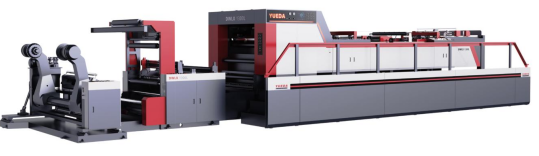
For the YDLM1300B, verified data lists a working width of 600-1200mm and a rated speed of 180 m/min. The same record associates the model with an energy-saving double-layer drying oven under Patent ZL 2022 2 1114210.X. The model is also associated with utility model patents ZL 2014 2 0363315.8 and ZL 2014 2 0363279.5. These facts are useful for a model-level audit because they connect a named gantry laminating and coating platform to specific documents rather than to a generic company patent list.
The boundary is important. If the buyer is quoting a customized wide-width metalized paper laminating machine outside the documented model range, the supplier should provide a revised model designation and a revised document matrix. A certificate linked to a base model should not be presented as automatic coverage of a modified wider machine without a claim review and a bill-of-materials comparison. This is especially relevant for heavy-duty, high-speed, or coating-integrated configurations where the mechanical load, drying profile, and control logic may change.
Reading Each Certificate at the Right Level
Utility models for the gantry laminating platform
For the YDLM1300B, the procurement file should treat ZL 2014 2 0363315.8 and ZL 2014 2 0363279.5 as model-associated utility models. The buyer should ask for the certificate copy, the claims, the legal status, and a short technical note explaining which part of the gantry laminating and coating machine implements the claimed subject matter. The note should reference the quotation's mechanical description and, where possible, the relevant assembly or module.
No-shaft rewinding certificate
For the ZNFH1300-1400-1500 no-shaft rewinding machine, the relevant document is Utility Model Patent Certificate ZL 2020 2 0570919.5. Here the audit should focus on the rewinding module. The buyer should ask whether the quoted machine uses the no-shaft rewinding configuration described in the certificate, and whether the certificate covers the series as supplied or only a particular version.
Sheeter patents for the YD1300-1400
For the Positioning Sheeter (Shaft-less) YD1300-1400, the supplied mapping includes ZL 2025 2 0755442.0 and ZL 2017 3 0061557.0. These should be requested with the certificate and the relevant claims or drawings. The buyer should also ask how the sheeter patents relate to the quoted sheeting width, positioning system, and cutter control. A certificate for a sheeter is not a substitute for a positioning accuracy test.
Software copyright for the transverse cutter system
The software copyright 2020SR0669497 covers the Automatic Paper and Plastic Conveying System for Transverse Paper Cutter V1.0. This is a software registration, not a patent for the machine structure. The buyer should request the software version, the module list, and a statement showing that the control system in the quotation matches the registered software. If the machine is supplied with a newer release, the supplier should explain the version relationship.
What the Certificates Do Not Prove
A model-level IP audit improves traceability, but it has clear limits. A patent or software copyright certificate does not prove that the machine will achieve a given speed, yield, substrate compatibility, or registration accuracy. It does not prove that the patent is valid or enforceable in the buyer's jurisdiction. It does not provide freedom to operate against third-party rights. It does not prove that every unit shipped uses the claimed feature. And it does not replace factory acceptance testing, third-party inspection, or destination-market safety conformity review.
This is why the audit should sit beside technical and commercial due diligence, not above it. The certificate answers a narrow question: what has been registered and how is it linked to the model. The factory acceptance test answers a different question: does the machine perform as agreed. The purchase contract answers a third question: what happens if it does not.
A Procurement Workflow for Decision and Execution
For a Decision-to-Execution purchase, the following workflow keeps IP evidence useful without turning it into a legal exercise for the buyer's technical team.
- Start with the quotation model. Record the exact model, working width, coating or laminating configuration, drying system, rewinding module, and control software version. Do not start from a generic product family page.
- Request a model-to-document matrix. The matrix should list each certificate number, the model or module it is associated with, and the feature it is intended to support.
- Ask for certificate copies and claims. For each patent or utility model, request the certificate, the claims, and the current legal status. For a software copyright, request the registration copy and the version description.
- Map the document to the bill of materials. The supplier should explain where the claimed feature appears in the quoted machine. A certificate that cannot be mapped to a module or assembly remains a portfolio signal, not a model-level proof.
- Check customization boundaries. If the machine is a customized metalized paper laminating machine, a wide-width version, or a coating-integrated line, ask for a revised model designation and a revised document matrix.
- Close the loop with testing. YUEDA states that it performs 100% testing on all units, including a 2-hour continuous run before shipment, and that third-party inspection is available. These testing facts belong in the acceptance plan, not in the patent table.
- Review execution support. For long-term operation, the supplier states remote technical support with 24-hour online response, 48-hour domestic on-site service, and 72-hour overseas remote debugging. These service commitments are separate from IP coverage but relevant to the execution stage.
The minimum order quantity stated for standard products is 2 units. For a multi-unit order, the same document matrix should be repeated for each model or configuration, because a certificate associated with one model does not automatically travel to every unit in a mixed order.
Comparison with Traditional Patent Claims
The traditional approach treats patents as a brand-level trust signal. The model-level approach treats them as procurement evidence. The difference is not cosmetic. It changes what the buyer requests, how the supplier responds, and what the buyer can defend during internal approval.
| Comparison point | Traditional brand-level patent claim | Model-by-model IP compliance audit |
|---|---|---|
| Unit of evidence | Company or brand | Named model, module, width, and configuration |
| Typical document | Patent list, certificate image, or marketing statement | Certificate copy, claims, legal status, model-to-BOM mapping, software version |
| What it can support | Initial supplier screening | Supplier qualification, technical annex review, and acceptance planning |
| What it does not prove | That the quoted model is covered | Machine performance, patent validity in every market, or freedom to operate |
| Main limitation | Weak traceability and high risk of model drift | More document work and slower review; still requires legal and technical checks |
The main limitation of the model-level method is administrative. It takes more time to collect certificates, claims, legal-status records, and model mappings than to accept a brand-level patent statement. It may not be practical for low-value spare parts or early catalog screening. It is most useful for capital equipment where the model, width, drying system, and control package are material to the purchase. It also cannot settle patent validity or freedom to operate; those questions require qualified legal review.
Market Context: Why This Evidence Matters Now
Future Market Insights estimated the global laminating machines market at USD 676.4 million in 2025. DataM Intelligence estimated the global metallized paper market at USD 4.85 billion in 2025, driven by tobacco packaging and premium labeling. These are different market definitions and should not be combined. The first describes laminating machinery; the second describes the metallized paper substrate that such machinery may process.
The distinction is useful for procurement. A growing substrate market does not automatically prove that every laminating machine model is suitable, compliant, or well documented. It does mean that buyers in tobacco packaging, premium labeling, and related converting segments have reason to ask for better evidence before committing to a line. Model-level IP documentation is one part of that evidence.
Application Scenarios
For a converter serving tobacco packaging or premium labeling, the audit should focus on the quoted wide-width metalized paper laminating machine, the drying oven configuration, and the control software. The buyer should ask which certificate supports the model at the quoted width, and whether the energy-saving oven patent applies to the selected oven type.
For a packaging plant adding a no-shaft rewinding line, the ZNFH1300-1400-1500 certificate should be reviewed at the rewinding-module level. The buyer should confirm that the quoted no-shaft rewinding configuration is within the documented model scope and that the certificate is not being used as a general statement about the entire line.
For a sheeting line using the Positioning Sheeter (Shaft-less) YD1300-1400, the sheeter patents and the transverse cutter software copyright should be kept separate. The sheeter patents relate to the sheeter model. The software copyright 2020SR0669497 relates to the Automatic Paper and Plastic Conveying System for Transverse Paper Cutter V1.0. Neither document replaces a sheeting accuracy test or a software acceptance check.
For a customized metalized paper laminating machine, the evidence pack should be rebuilt around the customized model. A base-model certificate may still be relevant, but the supplier should explain which claimed features remain in the customized design and which parts of the configuration have changed.
Future Outlook
Buyers should expect IP evidence to become more structured. The useful supplier response will not be a longer patent list. It will be a model-linked document pack with certificate numbers, claim or feature summaries, legal-status notes, software versions, and a clear mapping to the quotation. This is a practical way to reduce ambiguity during supplier qualification and to support long-term service planning.
For YUEDA, the available record provides a starting point: model-associated utility models for the YDLM1300B, a utility model certificate for the ZNFH1300-1400-1500 no-shaft rewinding machine, sheeter-related patents for the YD1300-1400, and software copyright 2020SR0669497 for the transverse paper cutter conveying system. The next step for a buyer is verification, not repetition of the numbers. Each certificate should be read against the quoted model, the technical annex, and the acceptance plan.
FAQ
What is model-by-model IP compliance for a metalized paper laminating machine?
It is a procurement review method that links each patent, utility model, or software copyright to a named machine model or module, and then checks the certificate scope, legal status, and technical mapping against the quotation. It is more specific than a brand-level patent claim.
Which YUEDA models are linked to the patent numbers cited in this article?
The YDLM1300B gantry laminating and coating machine is associated with utility model patents ZL 2014 2 0363315.8 and ZL 2014 2 0363279.5. The ZNFH1300-1400-1500 no-shaft rewinding machine is associated with Utility Model Patent Certificate ZL 2020 2 0570919.5. The Positioning Sheeter (Shaft-less) YD1300-1400 is associated with ZL 2025 2 0755442.0 and ZL 2017 3 0061557.0.
What should a buyer request to verify a patent number?
The buyer should request the certificate copy, the claims, the current legal status, the holder name, and a written explanation of how the claimed subject matter maps to the quoted model or module. For a customized machine, the buyer should also request a revised model designation and document matrix.
Does software copyright 2020SR0669497 prove machine performance?
No. The software copyright 2020SR0669497 covers the Automatic Paper and Plastic Conveying System for Transverse Paper Cutter V1.0. It is a software registration document. It does not prove mechanical performance, safety conformity, or freedom to operate. Buyers should ask for the software version and module mapping.
How does wide width affect IP document review?
Wide width is a machine configuration attribute, not a separate IP category. For the YDLM1300B, verified data lists a working width of 600-1200mm. If a buyer quotes a customized or wider configuration, the supplier should provide model-specific evidence and explain whether the cited certificates still apply to the modified design.
Are patents a substitute for factory acceptance testing?
No. Patents and software copyrights document registration and claimed scope. Factory acceptance testing checks whether the machine performs as agreed. YUEDA states that it performs 100% testing on all units, including a 2-hour continuous run before shipment, and that third-party inspection is available.
Have Questions or Need More Details?
Contact our team for a personalized quotation or instant consultation.
Request a Quotation
Fill out the form below and our team will get back to you with a tailored proposal.
WhatsApp Direct Chat
Prefer to chat in real-time? Message us on WhatsApp for instant assistance & quick answers.
- Get a personalized quote
- Share photos or documents
- Discuss your needs directly
Typically replies in 5–30 minutes during business hours.