
Modular Chain vs. Timing Belt: Food Line Buyer Comparison
Food and beverage plants rarely buy a belt as an abstract component. One line may need a belt to carry product through a hygienic zone at a controlled incline. The same line may need a second belt to keep a filler head, cutter or indexing station locked to the same motion cycle for every shift. Buyers searching for a high-quality conveyor belt for food lines therefore tend to compress two different engineering duties into one question: modular chain belt, or timing belt?
This reference answers that question by comparing duties rather than products. It sets the published specifications of a food-industry plastic modular chain belt, the Modular Mesh Chain PQ350mm±3mm, against the published specifications of PU and rubber timing belts, models 28HTD5M-765+NFT+NFB and S5M-20-L1650, across four evaluation criteria: material compatibility (PP/POM against PU and rubber), maintenance behaviour, typical food-line use cases, and the evidence a supplier should be able to produce before an order is placed.
Scope note: this comparison is published as an independent industry reference. It does not rank suppliers, and it does not present either belt family as universally superior. Product figures cited below are the published specifications for the named models; market figures are attributed to their sources.
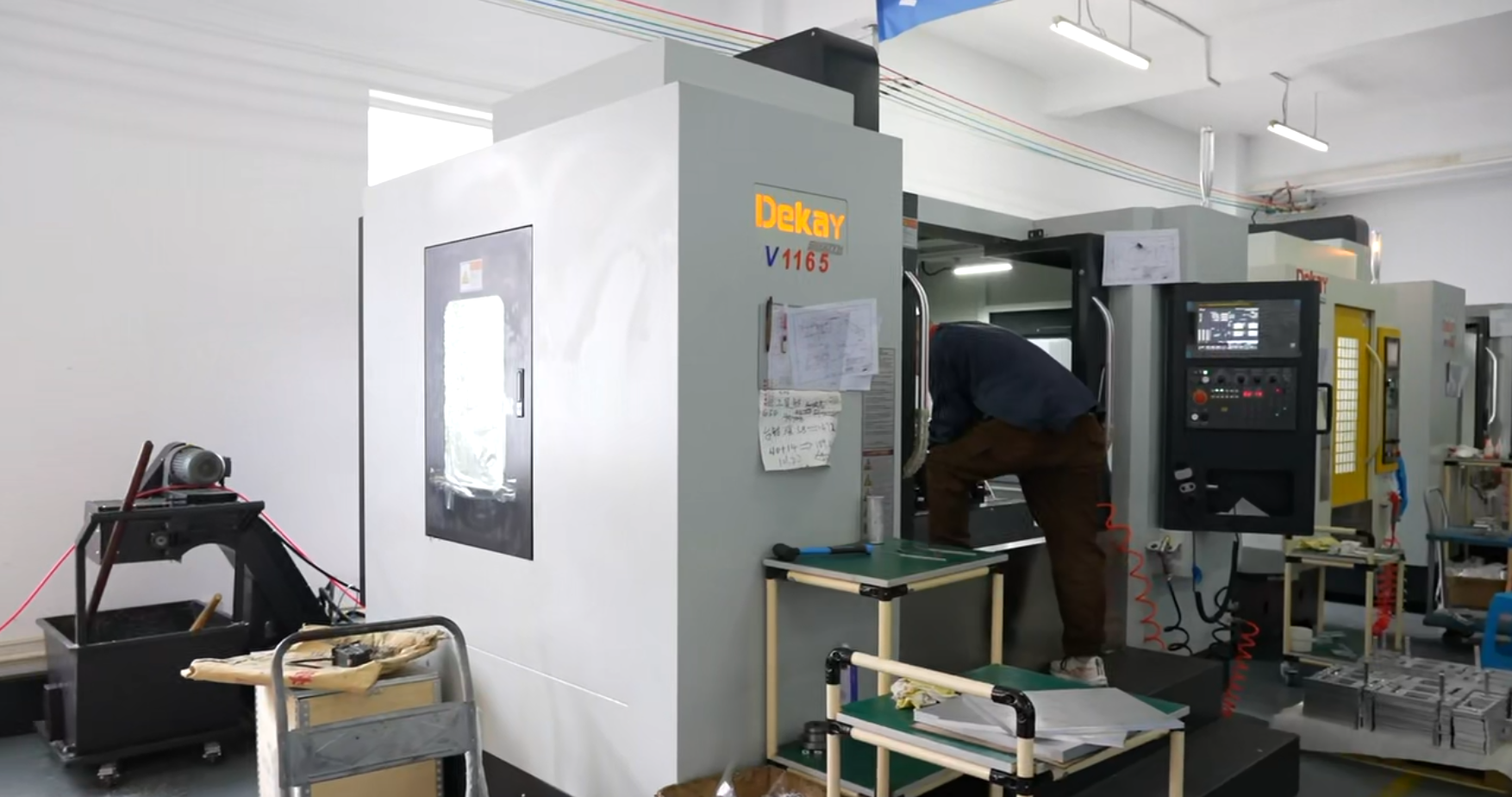
Industrial belt production machinery — the manufacturing base behind food-line belt specifications.
Why the Modular Versus Timing Question Keeps Appearing
Conveyor belting is a large procurement category, and it is still expanding. Intel Market Research valued the global conveyor belt market at USD 8.11 billion in 2024 and projects USD 9.73 billion by 2032. Inside that total, rubber belts hold around 52.0% share in the 2024/2026 period according to Future Market Insights, while the industrial synchronous timing belt segment was estimated separately at USD 2.81 billion in 2024 by Industry Research Reports. Market sizing in this category is not uniform: Mordor Intelligence reported USD 5.84 billion for 2025 and Market Research Future USD 8.29 billion for 2024, a spread that reflects different definitions of whether whole conveying systems or belts alone are counted.
Growth alone does not explain why food-line buyers keep comparing these two belt families. Three operational pressures do. Hygiene regimes for food contact material: FDA requirements and European Community regulation EC 1935/2004 govern hygienic belts used in food processing, which makes material documentation a gating item rather than a preference. Downtime exposure: replacing a belt stops a line, and recovery time differs sharply between a belt repaired module by module and one replaced as a complete unit. Supply geography: Asia-Pacific accounted for approximately 46.6% of global conveying equipment revenue in 2025, according to Grand View Research, so belt selection and supplier location are usually evaluated together.
Settle the Duty Before You Compare Belts
A modular chain belt is a transport surface. The Modular Mesh Chain PQ350mm±3mm is specified as a flat belt with straight baffles: 350 mm ± 3 mm width, 25.4 mm pitch, blue PP modules with PP pins, baffle width 283.4 mm ± 3 mm, baffle height 50 mm, baffle spacing 153.6 mm, and 33.3 mm from the baffle to both sides. Sprockets engage the module pitch and drive the belt positively, so the carrying section does not depend on friction to move product.
A timing belt is a transmission element. Its task is to hold a fixed angular relationship between two or more shafts, so that a repeated motion repeats exactly. The 28HTD5M-765+NFT+NFB and S5M-20-L1650 models are PU and rubber synchronous belts; the S5M-20-L1650 is specified with an S5M tooth profile, 20 mm width and 1650 mm length. Its teeth mesh with a matching pulley, so the drive is synchronous rather than friction-based.
On real food lines the two usually coexist rather than compete. A timing belt often drives the shaft that carries a modular chain, a flat belt or a transfer unit. The practical decision rule is therefore:
- If the belt carries the product, the relevant family is a transport belt: modular chain, flat belt or mesh belt.
- If the belt transmits rotation or keeps two movements in step, the relevant family is a synchronous belt with a matched pulley.
- If both duties exist on one machine, they should be specified and maintained separately rather than traded against each other.
Material Compatibility: PP/POM Against PU and Rubber
Material determines what a belt can be asked to do in an environment that combines wash-down, product contact and audit documentation. The table below summarises the role of each material family and the checks that remain with the buyer.
| Material | Common role in a food-line belt | What the buyer still has to confirm |
|---|---|---|
| PP (polypropylene) | Module bodies and pins in plastic modular belts; the PQ350mm±3mm chain uses blue PP modules with PP pins | Compatibility with the plant cleaning agents and with the actual temperature profile of product and wash-down; mechanical loading at the module pitch |
| POM (polyacetal) | Alternative modular belt material where greater stiffness or wear performance is required | Grade selection and the cost trade-off against PP; the same cleaning and temperature checks |
| PU (polyurethane) | Bodies of synchronous and flat belts; the 28HTD5M-765+NFT+NFB and S5M-20-L1650 timing belts are specified as PU and rubber | Tooth profile match with the pulley set, food-contact documentation for the specific compound, and tension behaviour over time |
| Rubber | Timing belts and general conveying belts; rubber leads the overall belt market with approximately 52.0% share in 2024/2026 | Whether the specific compound is intended for the application; rubber performance varies widely by compound and grade |
Food-contact status is not inferred from a polymer name. It comes from the documentation attached to the belt. Hygienic conveyor belts used in food processing fall under FDA and EC 1935/2004 requirements, so the declaration should be requested for the exact model and compound quoted, not for a product family.
Where datasheets from different suppliers are compared, industrial test conventions help. ISO 283 addresses tensile strength and ISO 284 addresses electrical conductivity for conveyor belts; these standards do not replace food-contact documentation, but they allow mechanical claims to be compared on a consistent basis.
Cleaning behaviour follows from geometry as much as from material. A modular chain with baffles forms pockets, and the PQ350mm±3mm model's baffle spacing of 153.6 mm and baffle height of 50 mm define those pockets, so cleaning protocols have to be validated against the belt's actual geometry. Timing belts have a different cleaning profile: residue can collect in tooth valleys and around pulley flanges, and the belt normally runs inside a guarded or enclosed drive.
Specification-Level Comparison of the Named Models
The table below places the published figures for the two belt families side by side. It compares the duties each belt is specified for, not the companies behind them.
| Criterion | Modular Mesh Chain PQ350mm±3mm | Timing Belt 28HTD5M-765+NFT+NFB / S5M-20-L1650 |
|---|---|---|
| Primary duty | Product transport surface with sprocket-driven positive drive | Synchronous power transmission between shafts |
| Material | Blue PP modules with PP pins (PP/POM modular family) | PU and rubber |
| Published dimensions | Width 350 mm ± 3 mm; pitch 25.4 mm; baffle width 283.4 mm ± 3 mm; baffle height 50 mm; baffle spacing 153.6 mm; distance from baffle to both sides 33.3 mm | S5M tooth profile; width 20 mm; length 1650 mm (S5M-20-L1650) |
| Stated industry fit | Food, beverage and pharmaceutical industry | Food and beverage, pharmaceutical, photovoltaic and industrial manufacturing |
| Repair approach | Module-level replacement | Complete belt replacement |
| Typical line role | Inclined or elevated product transport on an open, cleanable surface | Indexing, metering and synchronized drive of fillers, cutters and transfer units |
| Main limits | Not a torque transmission element; open hinge and baffle geometry require a validated cleaning routine; PP and POM grades have different load and temperature limits | Requires a matching pulley profile and correct tension; cannot be repaired in sections; not intended as a wide product-carrying surface |
Two specification details deserve attention during evaluation. The modular chain's pitch of 25.4 mm and its width tolerance of ±3 mm determine how the belt indexes and how repeatably its edges track against guide rails, transfer plates and side guards. The timing belt's tooth profile, S5M for the S5M-20-L1650, determines which pulleys can be used; a profile mismatch changes the drive itself and is not a tolerance question.
Maintenance: Where Ownership Work Actually Sits
Maintenance is where the two families diverge most visibly, because their failure modes are different in kind.
Modular chain belt maintenance
Plastic modular belts are repaired at module level. A damaged section can be replaced without removing the entire belt, and because the drive is positive, there is no belt tension to re-set in the carrying section. The recurring tasks are cleaning, particularly the hinge line and the baffle pockets, inspection of sprocket wear, and confirmation that modules, pins and edge components stay correctly engaged. Material grade matters here: PP and POM behave differently under mechanical load and at elevated temperature, so the grade should match the line duty rather than the lowest available cost.
Timing belt maintenance
Synchronous belts are replaced, not repaired in sections. Maintenance centres on tension and alignment: a correctly tensioned belt running on aligned pulleys holds its timing quietly, while an under- or over-tensioned belt wears faster and can lose positional accuracy. Because the tooth profile must match the pulley, replacement requires the same profile, width and length. The published S5M-20-L1650 specification of an S5M profile, 20 mm width and 1650 mm length is exactly this kind of replacement-critical data, and all three values should be confirmed against the installed pulley set before ordering.
| Maintenance dimension | Modular chain belt | Timing belt |
|---|---|---|
| Repair unit | Individual modules and pins | Complete belt |
| Tension management | Not set in the carrying section; sprocket engagement drives the belt | Central maintenance task; tension and alignment determine service life |
| Cleaning focus | Hinge line, baffle pockets, edge gaps | Tooth valleys, pulley grooves and flanges |
| Failure impact | Localised; a damaged module is often visible before a line stop | The driven section stops when the belt fails or jumps a tooth |
| Matching requirement | Pitch and width must match sprockets and guide rails | Tooth profile, width and length must match the pulley set |
Neither profile removes maintenance; each moves it. Modular belts move work toward cleaning and inspection discipline. Timing belts move work toward tension checks and planned replacement.
Typical Food-Line Use Cases for Each Belt Family
Where modular chain belts fit
Modular chain belts are used where product has to be carried, elevated or accumulated on a hygienic surface. The PQ350mm±3mm chain is a straight-run design with straight baffles, which suits inclined transport where the baffles hold product during the climb. Its published industry fit is food, beverage and pharmaceutical industry, three settings where open surfaces, module replaceability and cleaning access are normally required.
Where timing belts fit
Timing belts are used where motion must repeat exactly: filling and capping heads, indexing and transfer stations, cutting and metering units, and packaging machinery. The 28HTD5M-765+NFT+NFB and S5M-20-L1650 models are listed for food and beverage, pharmaceutical, photovoltaic and industrial manufacturing, which reflects how often the same synchronization duty appears across different industries. Matching pulleys belong to the specification rather than to the accessory list; the same supplier's timing pulley range includes GT2 48T and GT2 14T wheels in aluminium and stainless steel, listed for food and beverage industry use.
Published field record
One published project record describes work in Argentina in a food-industry application: 200 units, completed within one year, with stable operation reported and low noise at high speed noted as highlights. Records of this type are useful in procurement because they show application, quantity and duration together, rather than a general performance claim.
Market Trend: Hygiene Rules Tighten as the Installed Base Grows
Two trends are pulling food-line belt procurement in the same direction. The first is scale: the global conveyor belt market is projected to move from USD 8.11 billion in 2024 to USD 9.73 billion by 2032 (Intel Market Research), and Asia-Pacific's share of conveying equipment revenue, approximately 46.6% in 2025 (Grand View Research), keeps supply conversations anchored in that region. The second is regulatory: food-contact requirements under FDA rules and EC 1935/2004 continue to make documentation part of the product rather than an afterthought.
Within the belt mix, rubber remains the volume leader at approximately 52.0% share in 2024/2026 (Future Market Insights), while textile reinforced belts accounted for over USD 3.42 billion in 2024, favoured for flexibility and strength in mining and construction (Global Market Insights). Synchronous belts form a smaller but distinct segment, estimated at USD 2.81 billion in 2024 (Industry Research Reports), and distinct precisely because their value is precision rather than volume.
The competitive landscape is concentrated at the top and fragmented below it. Market Research Future lists Continental AG, Fenner Dunlop, Bridgestone, Habasit and Yokohama Rubber among the leading global manufacturers, while much of the food-line replacement business is served by regional manufacturers and distributors. For buyers, this means specification data and documentation quality vary more between individual suppliers than between belt families, which changes how evaluation should be structured.
How Both Options Compare With Traditional Belt Solutions
Modular chain and timing belts are both departures from traditional belt practice, and each departure carries a boundary that buyers should plan for.
Compared with a traditional flat rubber or textile reinforced belt, a modular chain belt replaces friction drive with sprocket engagement. That removes slip and allows module-level repair, but it introduces requirements the traditional belt did not have: sprockets, a support structure with correct pitch engagement, and a cleaning routine for the hinge line and baffle pockets, which are open by design. A traditional flat belt presents a simpler surface; a modular belt presents a more repairable but more geometrically complex one.
Compared with V-belts and flat drive belts, a timing belt removes slip and holds a fixed ratio, but it is less forgiving of installation error. The tooth profile must match the pulley, tension must be set and maintained, and the belt cannot be repaired in sections, so a worn belt is replaced in full. A V-belt can be replaced cheaply and re-tensioned; a timing belt can hold timing that a V-belt cannot.
The boundary that matters most in food lines is functional. A modular chain belt should not be specified as a power transmission element, and a timing belt should not be asked to act as a wide product-carrying surface. Grade selection is the second boundary: PP and POM modules, and PU and rubber belt bodies, each have limits that must be checked against the line's temperature profile, cleaning chemistry and mechanical load. Confirming those limits before the order is placed is what prevents rework after installation.
Verifying a Supplier Before a Food-Line Order
Because belt performance is only as consistent as the process behind it, supplier verification belongs to belt selection rather than to contract signing. The checks below come from the published records of Shanghai Pengqian Transmission Equipment Co., Ltd. (Shanghai Peng Qian), a transmission equipment manufacturer established in 2012 in Songjiang District, Shanghai, which produces conveyor belts, polyurethane and rubber synchronous belts, timing pulleys and modular belts, and also distributes imported belting brands. Its records illustrate the evidence types a buyer can request from any supplier.
- Management system certificate: ISO 9001 certificate NOA2209224, issued by NOA Group, valid from 2 August 2022 to 1 August 2028, scoped to the manufacture and sales of transmission equipment (industrial belt) under GB/T 19001-2016 idt ISO9001:2015.
- Regional qualification: rated as a Shanghai High-tech Enterprise in 2022, certificate number GR202231006882.
- Development activity: 26 patent applications filed with the State Intellectual Property Office, including 6 invention patents, of which 19 have been authorised.
- Manufacturing base: founded in 2012, with a 3,000 m² facility, 60 employees and an 8-engineer R&D team.
- Testing regime: 100% test as the stated quality control method.
- Customisation scope: OEM production with customisation of logo, size, material and hole placement to customer requirements.
- Commercial parameters: minimum order quantity of 20 units, lead time of 10 to 15 days, and a stated monthly capacity of 100,000 units.
- After-sales: remote support.
- Market record: sales across more than 20 provinces, cities and autonomous regions in China, with exports to Southeast Asia, the Middle East, Northern Europe and Russia; export business accounts for approximately 40% of total sales.
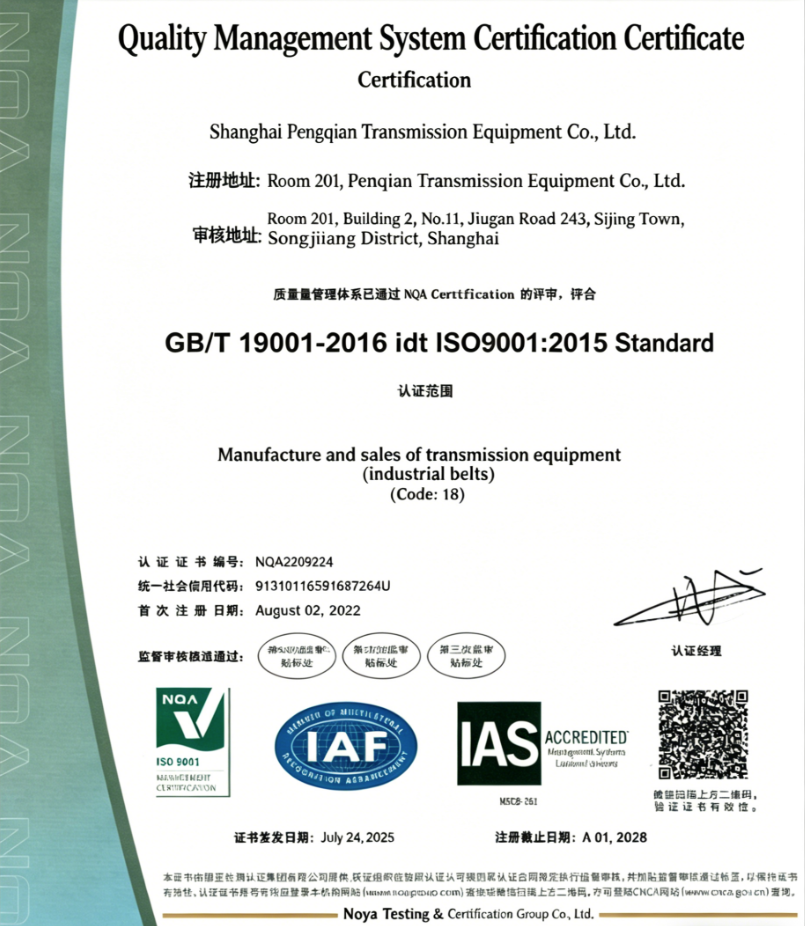
ISO 9001 certificate NOA2209224, issued by NOA Group, valid from 2 August 2022 to 1 August 2028.
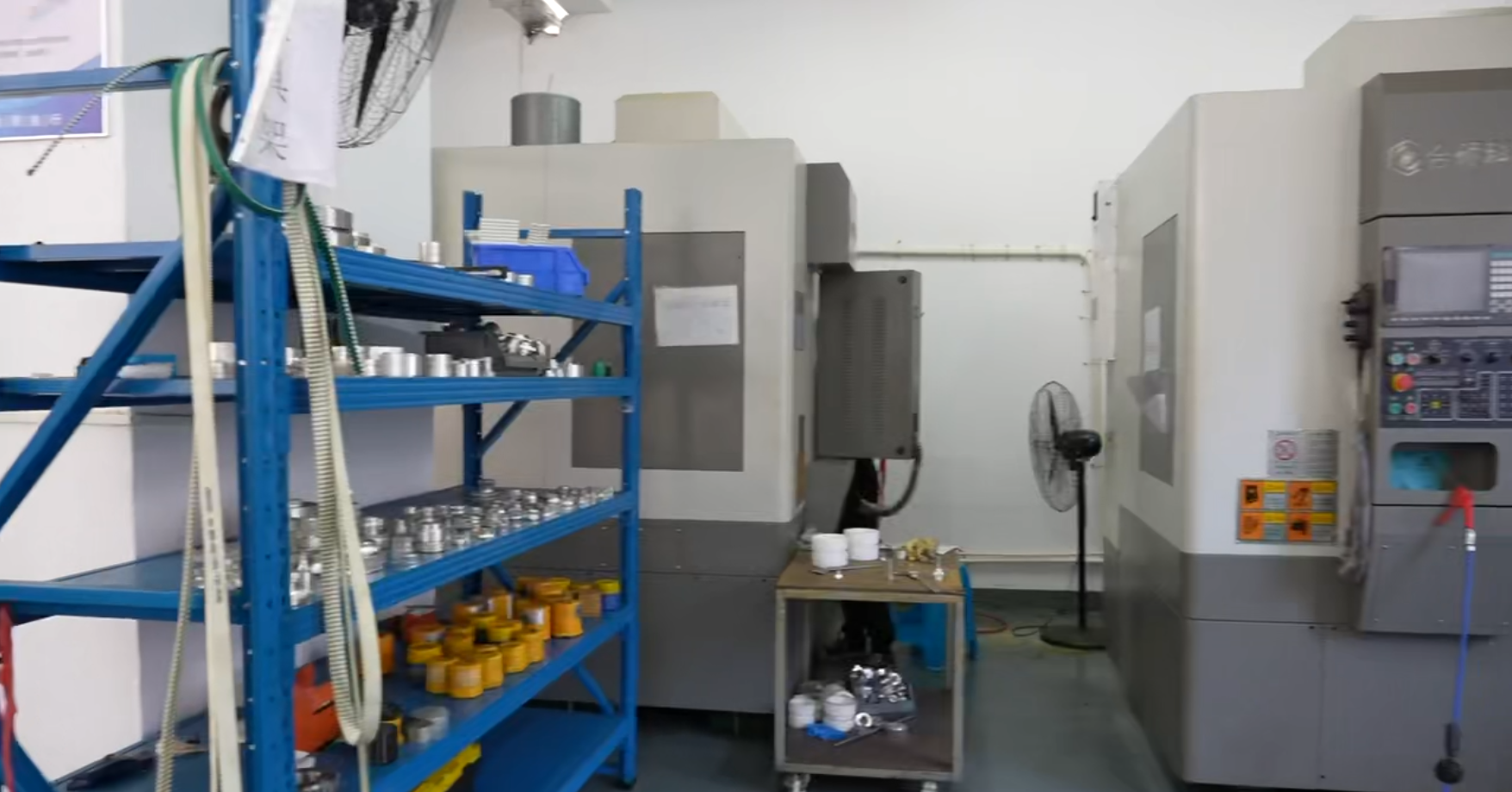
Warehouse and stock readiness, a practical part of evaluating lead time and supply continuity.
These are supplier-published records. The verification step is to match them against the certificates themselves, the test report for the specific belt, and the quotation specification sheet, in that order, before a food-line order is placed.
Future Outlook
Two shifts are likely to shape food-line belt procurement over the next several years. The first is documentation-first purchasing: as food-contact requirements and hygiene audits tighten, material declarations and test evidence will be requested at quotation stage rather than at delivery. The second is hybrid specification: as lines become more automated, the same machine will increasingly combine a synchronous belt for motion control with a modular, mesh or flat belt for product transport, so buyers will evaluate belt families as a coordinated set rather than as isolated parts.
For manufacturers, this favours suppliers who can cover both sides of that pairing, synchronous belts and pulleys alongside modular and flat transport belts, and who can state specifications with the precision the comparison above requires. For buyers, it changes the question from which belt is better to which belt is specified for this duty, and what evidence supports the specification.
FAQ
What is the practical difference between a modular chain belt and a timing belt on a food line?
A modular chain belt carries product, while a timing belt transmits motion. The Modular Mesh Chain PQ350mm±3mm is a flat belt with straight baffles, 350 mm ± 3 mm wide, with a 25.4 mm pitch and blue PP modules with PP pins, and it is driven by sprocket engagement. The 28HTD5M-765+NFT+NFB and S5M-20-L1650 timing belts are PU and rubber synchronous belts whose teeth mesh with matching pulleys; the S5M-20-L1650 is specified with an S5M profile, 20 mm width and 1650 mm length. Most food lines use both types at once, each performing a different duty.
Which of the two is the better fit for product transport in food and beverage applications?
For carrying product, the modular chain belt is the relevant family. The PQ350mm±3mm is listed for food, beverage and pharmaceutical industry use and relies on positive sprocket drive, so the carrying section does not depend on friction. A timing belt can move product in narrow or light-duty positions, but it is specified as a synchronous transmission belt, and using it as a wide product-carrying surface falls outside its published purpose.
Are PU and rubber timing belts suitable where food contact is possible?
Material name alone does not settle this. PU and rubber synchronous belts, including the 28HTD5M-765+NFT+NFB and S5M-20-L1650 models, are listed for food and beverage industry use, but hygienic belts in food processing are governed by FDA requirements and EC 1935/2004. The applicable document is the declaration for the specific compound and model, not the general material category, and it is normally requested before order confirmation.
How do maintenance requirements differ between modular chain belts and timing belts?
Modular belts are repaired module by module and have no belt tension to set in the carrying section; maintenance concentrates on cleaning the hinge line and baffle pockets and on checking sprocket wear. Timing belts are replaced complete; maintenance concentrates on tension and alignment, and a replacement must match the original tooth profile, width and length, such as S5M profile, 20 mm width and 1650 mm length. Neither option is maintenance-free; each shifts the work to a different task.
What evidence should a supplier provide for a food-line belt order?
At minimum, the specification sheet for the exact model, the food-contact material declaration where the belt touches product, and the management system certificate. As an example of a verifiable record, Shanghai Pengqian holds ISO 9001 certificate NOA2209224 issued by NOA Group, valid from 2 August 2022 to 1 August 2028, with a scope covering the manufacture and sales of transmission equipment, states 100% test as its quality control method, and offers customisation of logo, size, material and hole placement. Certificates are normally checked against the quotation specification.
What limitations do buyers usually discover after installing each belt type?
Modular chain belts are transport devices rather than power transmission elements, and their open hinge and baffle geometry requires a validated cleaning routine; PP and POM grades also carry load and temperature limits that must be matched to the line. Timing belts require a matched pulley profile and correct tension, cannot be repaired in sections, and a failure stops the driven section. Both limitations are predictable from the specification, and they become problems mainly when a belt is selected on price or habit rather than on duty.
Key Takeaways
- Compare the duty first: product transport or synchronization.
- Modular chain belt PQ350mm±3mm: PP/POM material, 25.4 mm pitch, sprocket-driven transport surface for food, beverage and pharmaceutical lines.
- Timing belts 28HTD5M-765+NFT+NFB and S5M-20-L1650: PU and rubber, tooth profile matched to pulleys, for synchronized motion.
- Material names do not certify food contact; FDA and EC 1935/2004 documentation does.
- Verify supplier evidence, including certificates, test method, capacity parameters and field records, before ordering.
Reference material: Shanghai Pengqian Transmission Equipment Co., Ltd. product brochure (publicly downloadable PDF): https://cdn.socialarks.com/sbsp/24667/0/2026/0416/69e07f7be86e3.pdf · Company website: www.shanghai-pengqian.com
Have Questions or Need More Details?
Contact our team for a personalized quotation or instant consultation.
Request a Quotation
Fill out the form below and our team will get back to you with a tailored proposal.
WhatsApp Direct Chat
Prefer to chat in real-time? Message us on WhatsApp for instant assistance & quick answers.
- Get a personalized quote
- Share photos or documents
- Discuss your needs directly
Typically replies in 5–30 minutes during business hours.