
Modular Luxury Hotel Tent Systems: The Procurement Case
Resort developers planning permanent accommodation in coastal, desert, mountain, or ecologically sensitive sites face a recurring procurement question: which building system delivers hotel-grade comfort, regulatory compliance, and reasonable capital efficiency in the same package? Modular luxury hotel tent systems have emerged as a serious answer, and supplier evaluation now depends on verifiable parameters, certification evidence, and lifecycle reasoning rather than visual appeal alone.
A building system, not a product category
A modular luxury hotel tent system is a pre-engineered accommodation platform that combines a structural frame, an architectural membrane, an insulated wall system, glazing, and interior modules into a configurable building solution. The buyer is not purchasing a single tent in the conventional sense. The buyer is procuring a repeatable platform that can be sized, insulated, glazed, fitted with bathrooms and climate control, and installed as long-term resort accommodation.
This distinction matters for procurement. It changes the questions a buyer should ask: What membrane grades are used? What wind and snow loads can the frame withstand? What certification documents cover the product in the target market? How are bathroom, HVAC, electrical, and flooring modules integrated? What is the expected service life, and what happens after installation?
One manufacturer that has built its product strategy around this system approach is Stars Glamping (STARS GLAMPING TENT CO.,LTD), a luxury tent manufacturer based in Nansha District, Guangzhou, China. Founded in 2018, the company operates a 20,000 m² manufacturing base, exports to more than 40 countries, and produces a luxury hotel tent range under five model designations: Luxury Tent Tethys, Luxury Tent Villa, Luxury Tent Octagon, Luxury Tent Shell, and Luxury Tent Pisces. The company website is www.starstent.com.
Why the market moved from single tents to systems
Conventional hotel construction remains the default in many resort projects, but it carries conditions that are hard to justify on difficult sites. Long construction schedules, heavy capital commitment, transportation of building materials to remote locations, and environmental approval processes can delay a project for years. Standard event or camping tents, by contrast, are fast to deploy but cannot meet the operational requirements of a hotel: waterproofing, thermal insulation, fire retardancy, sound separation, en-suite bathrooms, air conditioning, and 24/7 permanent use.
Between these two options, the modular luxury hotel tent system fills a specific gap. It provides the engineering discipline of a building—structural calculations, rated fabrics, compliance documentation, integrated services—while keeping the logistics and site impact of a membrane structure.
Market data explains the growing interest. The global glamping market was valued at approximately USD 3.8 billion in 2025, with tents representing a major accommodation segment, according to Grand View Research. Fortune Business Insights projects the market to reach USD 9.15 billion by 2034 at a CAGR of 10.67%. Estimates vary because the definition of glamping is not identical across research houses, but the direction is consistent: high-end outdoor accommodation is becoming a permanent category in hospitality investment, not a seasonal niche.
Inside the Stars Glamping modular luxury hotel tent system
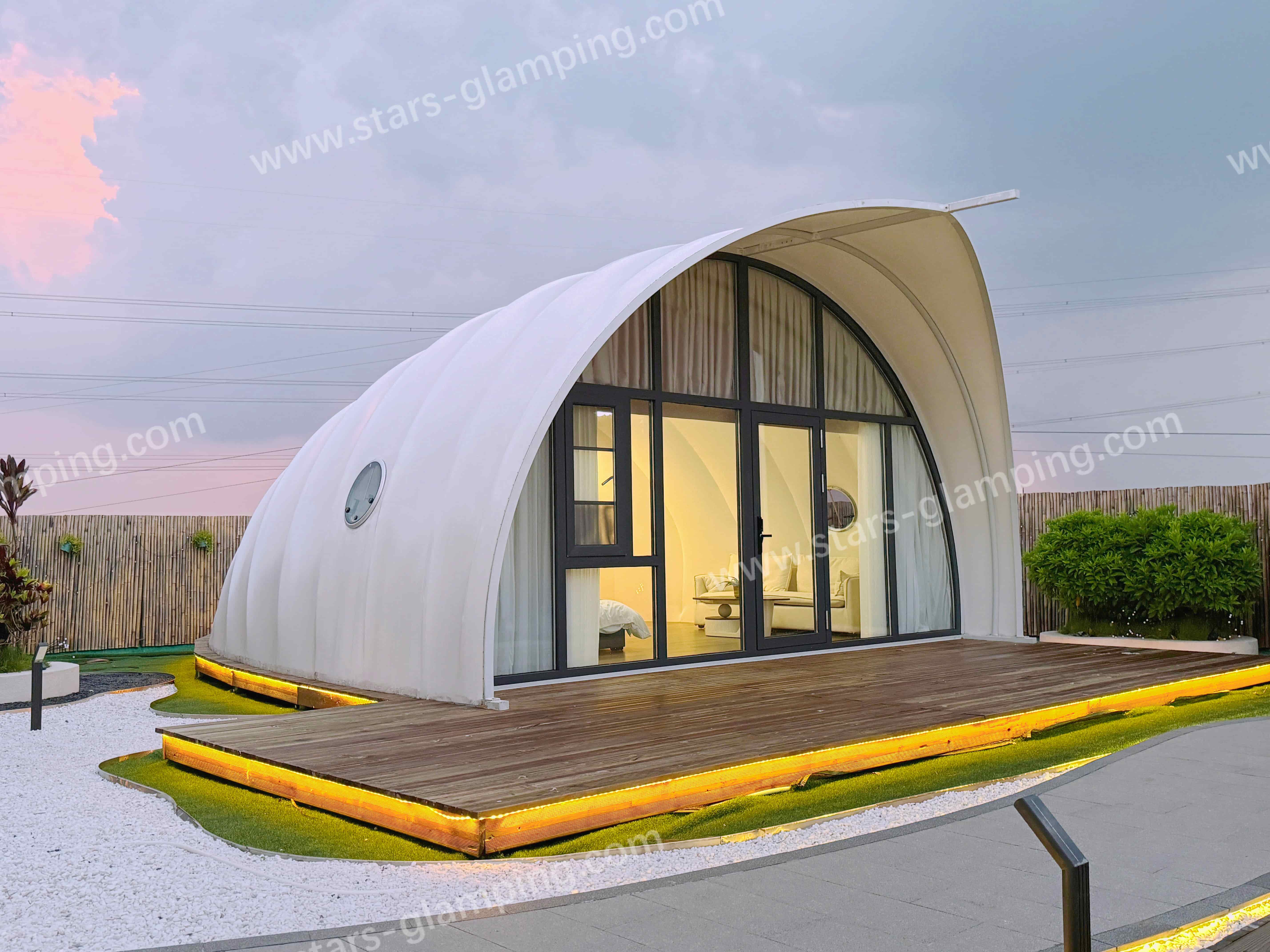
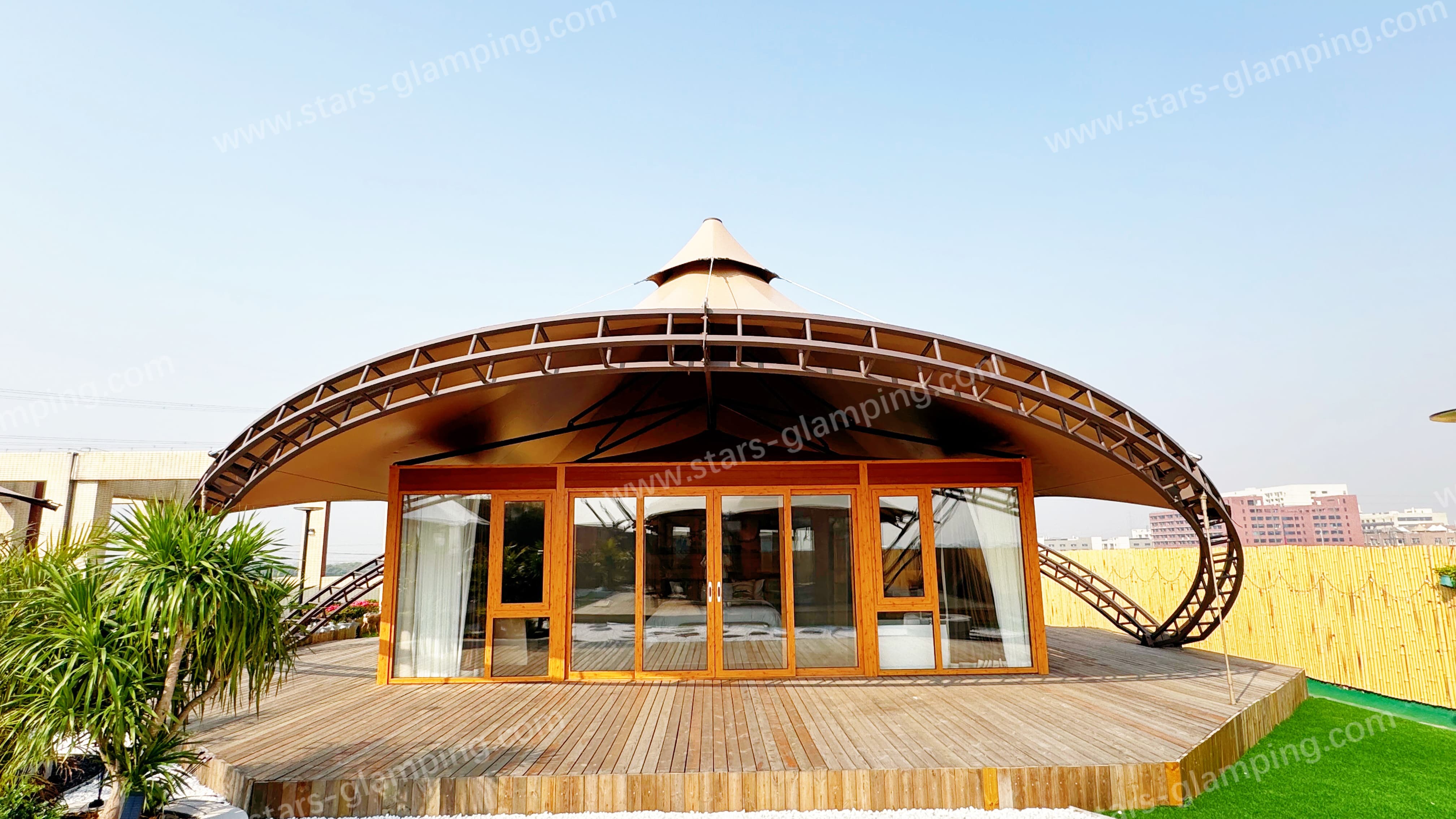
The Stars Glamping system is organized around five model designations. Four of them—Tethys, Villa, Octagon, and Shell—share a steel pipe frame, a 1,050 g/m² PVDF architectural membrane, and an insulated glass wall system. The fifth, Pisces, uses a solid wood and steel hybrid frame, an 850 g/m² PVC polyester fabric, and an insulated canvas wall system.
| Model | Wall system | Cover fabric | Frame | Service life |
|---|---|---|---|---|
| Tethys | Insulated glass wall | 1,050 g/m² PVDF membrane | Steel pipe | 25–30 years |
| Villa | Insulated glass wall | 1,050 g/m² PVDF membrane | Steel pipe | 25–30 years |
| Octagon | Insulated glass wall | 1,050 g/m² PVDF membrane | Steel pipe | 25–30 years |
| Shell | Insulated glass wall | 1,050 g/m² PVDF membrane | Steel pipe | 25–30 years |
| Pisces | Insulated canvas wall | 850 g/m² PVC polyester | Solid wood + steel pipe | 10–15 years |
Across the range, the published performance envelope is consistent. The system is rated for wind resistance up to 120 km/h (level 10 wind), snow load of 80 kg/m², waterproof rating of at least 5,000 mm H₂O, and a temperature range of -30°C to +70°C. Fire rating is B1/M2, and the fabrics are UV-stabilized and anti-aging.
| Parameter | Rating |
|---|---|
| Wind resistance | Up to 120 km/h (Level 10 wind) |
| Snow load | 80 kg/m² |
| Waterproof rating | ≥ 5,000 mm H₂O |
| Temperature resistance | -30°C to +70°C |
| Fire rating | B1 / M2 (fire-retardant) |
| UV protection | UV stabilized, anti-aging |
| Service life | 10–15 years (Pisces) / 25–30 years (PVDF models) |
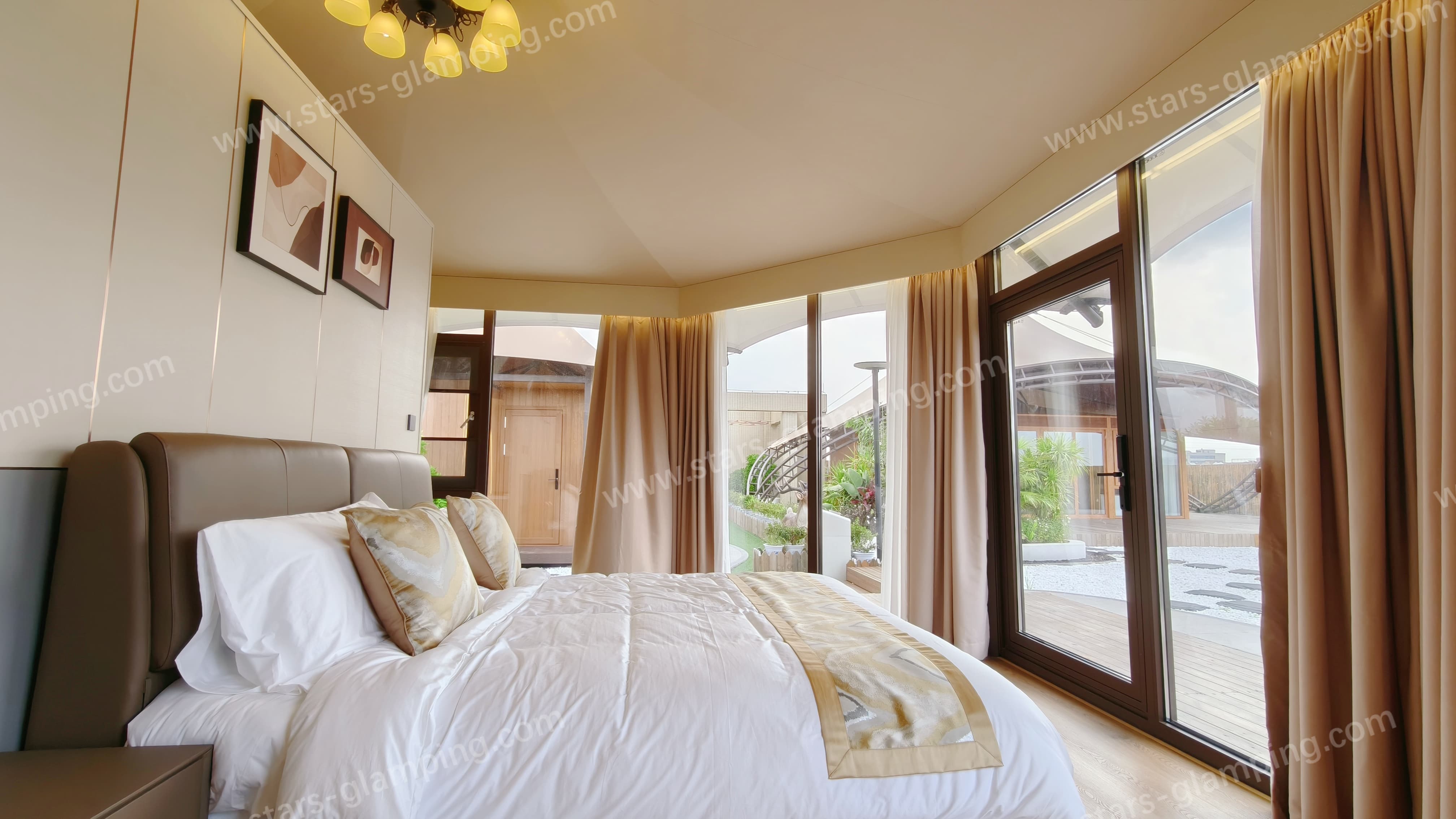
The system extends beyond the shell. The standard equipment set for resort application includes air conditioning, insulation lining, glass doors and panoramic windows, wooden flooring, a bathroom module with shower and toilet, electrical and lighting systems, and curtain and shading systems. This is what turns a membrane structure into a hotel unit.
Manufacturing and quality context
For buyers, the credibility of a modular system depends on what happens inside the factory. Stars Glamping operates a 20,000 m² manufacturing base with a 4,000 m² simulation exhibition hall, and reports a total monthly production capacity of 500 tents. For custom luxury tent projects, the company lists a monthly capacity of 50–80 units depending on project size. The production process is described as fully independent, with a 12-step quality inspection system, raw material inspection, in-process quality control, pre-shipment inspection, and third-party inspection available. The minimum order quantity is one unit, with samples available.
Technical explanation: what the parameters actually mean
The technical core of a modular luxury hotel tent system lies in four disciplines: structural engineering, membrane science, environmental sealing, and compliance.
Structural engineering
The frame is the load-bearing element. The four PVDF models use a steel pipe frame; the Pisces model combines solid wood with steel pipe. The published rating of up to 120 km/h wind speed corresponds to level 10 wind, and the 80 kg/m² snow load indicates the structure is engineered for cold-climate and high-altitude sites, not just fair-weather operation. The company also states that its patented wind-resistance technology, which covers core functions such as wind resistance, waterproofing, heat insulation, and quick assembly, enables products to resist level-12 typhoons. Buyers responsible for typhoon-prone coastal projects should treat the 120 km/h continuous rating as the specification baseline and request site-specific structural calculations for extreme events.
Membrane science: PVC vs. PVDF
Fabric selection is the main lifecycle decision. The Pisces model uses 850 g/m² PVC polyester, a proven material in upscale glamping that offers a service life of 10–15 years. The Tethys, Villa, Octagon, and Shell models use 1,050 g/m² PVDF architectural membrane, a higher-performance material associated with a service life of 25–30 years. Industry reference data on high-performance PVDF architectural membranes cites service life of 15–30 years and wind capacity of 120–140 km/h, which aligns with the product specification.
Waterproofing deserves separate attention. The published product rating is a minimum hydrostatic head of 5,000 mm H₂O. Engineering-grade PVC/PVDF membranes used in this class of accommodation are non-porous, and industry reference data places heavy-duty membrane systems above 10,000 mm hydrostatic head. For island and beach resorts, the practical implication is that the membrane itself is not the weak point in the weather envelope; the connections, seams, and wall-to-membrane junctions are where quality control becomes visible. This is one reason buyers should evaluate the factory in-process inspection rather than relying only on the fabric data sheet.
Thermal behavior and climate range
The system is rated for -30°C to +70°C. In hot climates, insulation lining and shading systems reduce heat gain; in cold or high-altitude locations, the insulated wall system and climate-control integration maintain interior conditions. The Nepal mountain project, for example, specified thermal insulation as a key requirement. The Cape Verde safari project, by contrast, used natural ventilation design for a warmer, off-grid setting. This illustrates why a modular system needs configurable insulation rather than a single fixed specification.
Fire safety and hotel compliance
Fire retardancy is a baseline for commercial hospitality use. The Stars Glamping range is rated B1/M2. For reference, common standards for tents in hospitality include NFPA 701 in the U.S. and EN 13501-1 in Europe. Buyers should confirm which standard their insurance provider and local authority expect.
Certification evidence
For the EU market, the manufacturer Safari Tent and Safari Lodge Tent lines hold a CE Attestation of Conformity issued by UDEM under the General Product Safety Directive, certificate number M.2024.206.C96444, tested to EN ISO 5912:2020. The certificate is valid until 30 January 2029. While this specific certificate is issued for the Safari Tent product lines, it verifies the manufacturer compliance framework and production quality under a recognized EU standard for tent structures. The luxury hotel tent models are produced under the same quality system.
Acoustic considerations
Sound separation is a legitimate question for hotel operators. The insulated glass wall system in the PVDF models and the insulated canvas wall system in the Pisces model provide a meaningful barrier to exterior noise compared to unlined tent fabric. However, membrane and glass wall systems do not have the same acoustic mass as masonry construction. For sites next to roads, nightlife areas, or surf breaks, buyers should evaluate acoustic performance in relation to the specific location rather than assume hotel-equivalent soundproofing.
Application evidence: four environments, one system
Case documentation from the manufacturer covers four distinct resort environments. Each project used the same system logic but different configurations.
| Country | Client type | Units | Application | Duration | Project highlight |
|---|---|---|---|---|---|
| Nepal | Resort developer | 19 | Mountain resort accommodation | Long-term permanent use | Custom mountaintop design, high wind resistance, thermal insulation, panoramic view |
| India | Government tourism developer | 100 | Beachfront resort accommodation | Long-term permanent use | Environmentally friendly, high wind resistance, thermal insulation, panoramic view |
| Cape Verde | Resort developer | 12 | Wildlife safari accommodation | Long-term outdoor use (8+ years) | Eco-friendly materials, off-grid solution, natural ventilation design |
| Saudi Arabia | Resort developer | 30 | Desert resort accommodation | Long-term permanent use | Custom desert design, high wind resistance, thermal insulation, panoramic view |
The India project, involving 100 luxury tents for a beachfront resort, shows that the system can scale to full-resort volume. The Saudi Arabia project demonstrates desert-specific customization. The Nepal project is the cold-climate and altitude case. The Cape Verde project, designed for wildlife safari accommodation with off-grid and natural ventilation requirements, is the eco-tourism reference. In each documented case, the stated outcome was an enhanced guest experience and increased resort occupancy rate.
Market trends shaping procurement decisions
Three trends are influencing how buyers evaluate luxury hotel tent systems.
First, permanence is becoming the default. Resort operators are no longer treating luxury tents as seasonal or temporary capacity. They are asking for 10-to-30-year service life, permanent installation, all-season operation, and maintenance plans. This shifts the technical conversation from fabric aesthetics to structural engineering and membrane lifecycles.
Second, certification and documentation are moving up the priority list. As the market grows and insurance requirements tighten, buyers are requesting fire ratings, EU CE documentation, hydrostatic head values, and material certifications before shortlisting suppliers. The growing use of reference standards such as NFPA 701 and EN 13501-1 reflects this professionalization.
Third, buyers are purchasing systems rather than units. The combination of bathroom integration, HVAC, insulation, flooring, glazing, and branding customization means the supplier role is closer to a building-system provider than a tent vendor. The manufacturer stated service package—installation guidance, engineering drawings, 24-hour global after-sales response, spare parts supply, and remote or on-site project assistance—reflects this expectation.
Geographically, Europe led the global glamping market with a 35% revenue share in 2025, according to Grand View Research. That helps explain why EU certification evidence is increasingly prominent in procurement discussions. At the same time, projects in the Middle East, Southeast Asia, Africa, and the Americas are visible in the manufacturer export markets, pointing to a global rather than regional demand pattern.
How the system compares with traditional building alternatives
A useful way to frame the decision is to compare a modular luxury hotel tent system with two alternatives: conventional hotel construction and standard event tents.
| Criteria | Modular luxury tent system | Conventional hotel building | Standard event tent |
|---|---|---|---|
| Capital intensity | Moderate | High | Low |
| Construction time | Weeks to a few months | Months to years | Days |
| Design service life | 10–30 years | 50+ years | Under 5 years |
| Guest comfort level | Hotel-grade when fitted with bathroom, AC, insulation | Full hotel standard | Basic, unsuitable for permanent hotel operation |
| Regulatory pathway | Requires case-specific engineering review in some jurisdictions | Mature building approval process | Not designed for permanent occupancy |
| Site impact | Lighter foundation, fewer permanent modifications | Large footprint and site alteration | Minimal, but temporary |
| Expansion logic | Modular, can be scaled by adding units | Difficult after completion | Easy but non-durable |
Honest limitations buyers should weigh. The modular luxury tent system is not a universal replacement for permanent construction. Three boundaries are worth stating clearly. First, service life is limited to 10–30 years depending on membrane grade, which is shorter than the 50-year-plus horizon of concrete and steel buildings. For core assets that must be depreciated over decades, this matters. Second, regulatory classification can be complex: in some jurisdictions, membrane structures are governed by temporary structures or special event codes—IFC Chapter 31 is a common reference—which may require additional engineering review and permitting for permanent resort use. Third, acoustic performance and thermal mass differ from hard-wall construction, so sites with extreme noise or temperature conditions need project-specific evaluation.
Future outlook: toward a standards-based accommodation category
The direction of the luxury hotel tent segment points toward greater engineering rigor. PVDF architectural membranes with 20-to-30-year service lives will continue to push the category away from premium camping and toward lightweight permanent construction. Insulation technology, glass wall integration, and modular bathroom systems will determine competitive differentiation.
For resort developers, the practical implication is that supplier selection should be built around verification: membrane weight and type, hydrostatic head, fire rating, wind and snow load calculations, certification numbers, and documented project references. The Stars Glamping system, with its five model designations and shared technical platform, is one example of how manufacturers are structuring their offer for this procurement reality. The broader lesson is that the purchase is no longer a tent. It is an engineered accommodation system with a defined lifecycle, and it should be procured with the same discipline applied to any other building system.
Frequently asked questions
What is a modular luxury hotel tent system?
A modular luxury hotel tent system is an accommodation platform built from pre-engineered structural frames, architectural membranes, insulated wall systems, glazing, and interior modules such as bathrooms, flooring, electrical systems, and climate control. In the Stars Glamping product range, the system is delivered through five model designations: Luxury Tent Tethys, Villa, Octagon, Shell, and Pisces. Buyers can configure size, layout, fabric, frame material, bathroom integration, interior furniture, and branding around this platform.
What certifications should a luxury hotel tent have for resort projects?
For the EU market, the Safari Tent and Safari Lodge Tent lines from Stars Glamping hold a CE Attestation of Conformity issued by UDEM with certificate number M.2024.206.C96444, tested to EN ISO 5912:2020. The luxury hotel tent range carries a B1/M2 fire rating. Common hospitality references in North America and Europe are NFPA 701 and EN 13501-1. Buyers should also verify how membrane structures are classified under local building codes, because some jurisdictions apply temporary or special event structure rules to tents.
What are the most important technical parameters to compare?
The key specification fields are wind resistance, snow load, waterproof rating, temperature range, fire rating, membrane type, and service life. The Stars Glamping luxury tent range lists wind resistance up to 120 km/h (level 10 wind), snow load of 80 kg/m², waterproof rating of at least 5,000 mm H₂O, temperature resistance of -30°C to +70°C, and B1/M2 fire rating. The PVDF models are rated for 25–30 years; the PVC polyester model is rated for 10–15 years.
Can a luxury hotel tent include a bathroom and air conditioning?
Yes. The application equipment set for the system includes a bathroom module with shower and toilet, an air conditioning system, insulation lining, glass doors and panoramic windows, wooden flooring, electrical and lighting systems, and curtain and shading systems. Bathroom integration is also listed as a customization option in the manufacturer production capabilities.
Which model is suitable for beach, desert, mountain, or eco-tourism projects?
All five models are positioned for resort accommodation across beachfront, desert, mountain, tropical, and all-weather conditions. The PVDF models—Tethys, Villa, Octagon, and Shell—use insulated glass walls and offer a 25-to-30-year service life, which suits permanent beachfront and mountain installations. The Pisces model uses a solid wood and steel hybrid frame with insulated canvas walls and a 10-to-15-year service life, a configuration applied in safari and eco-tourism projects. Selection depends on wind, humidity, temperature range, design life, and the visual language of the resort.
What customization options and order terms are available?
The manufacturer offers size and layout customization, tent structure design, fabric selection (PVC, PVDF, or insulation grades), frame material options (steel or aluminum), interior layout and furniture, bathroom integration, logo branding, and color customization. The minimum order quantity is one unit, with samples available. Lead time is 15–20 days for standard models and 20–30 days for customized projects; overseas delivery is typically 15–30 days.
What determines the price of a luxury hotel tent system?
Pricing is configuration-dependent rather than list-based. The principal cost drivers are membrane type (PVC polyester versus PVDF architectural membrane), wall system (insulated canvas versus insulated glass), unit size and layout, integration of bathroom and climate-control modules, interior fit-out level, and structural customization. Because PVDF membranes and glass wall systems involve higher material cost and longer service life, buyers should expect a meaningful price difference between the PVDF series and the PVC/canvas series when comparing quotations.
For a full product and specification overview, the manufacturer brochure is available here: Stars Glamping Corporate Brochure (PDF)