
Moisture Retention Trays: Specification Guide for Buyers
Moisture retention food containers are rigid plastic food packaging trays with a structured base that captures purge — the liquid released by fresh meat, poultry, fish and seafood during chilled storage — underneath the product instead of around it. The format is an engineering answer to a narrow but persistent constraint in chilled protein retail: purge is a normal physiological outcome, while visible pooled liquid on a retail pack is not.
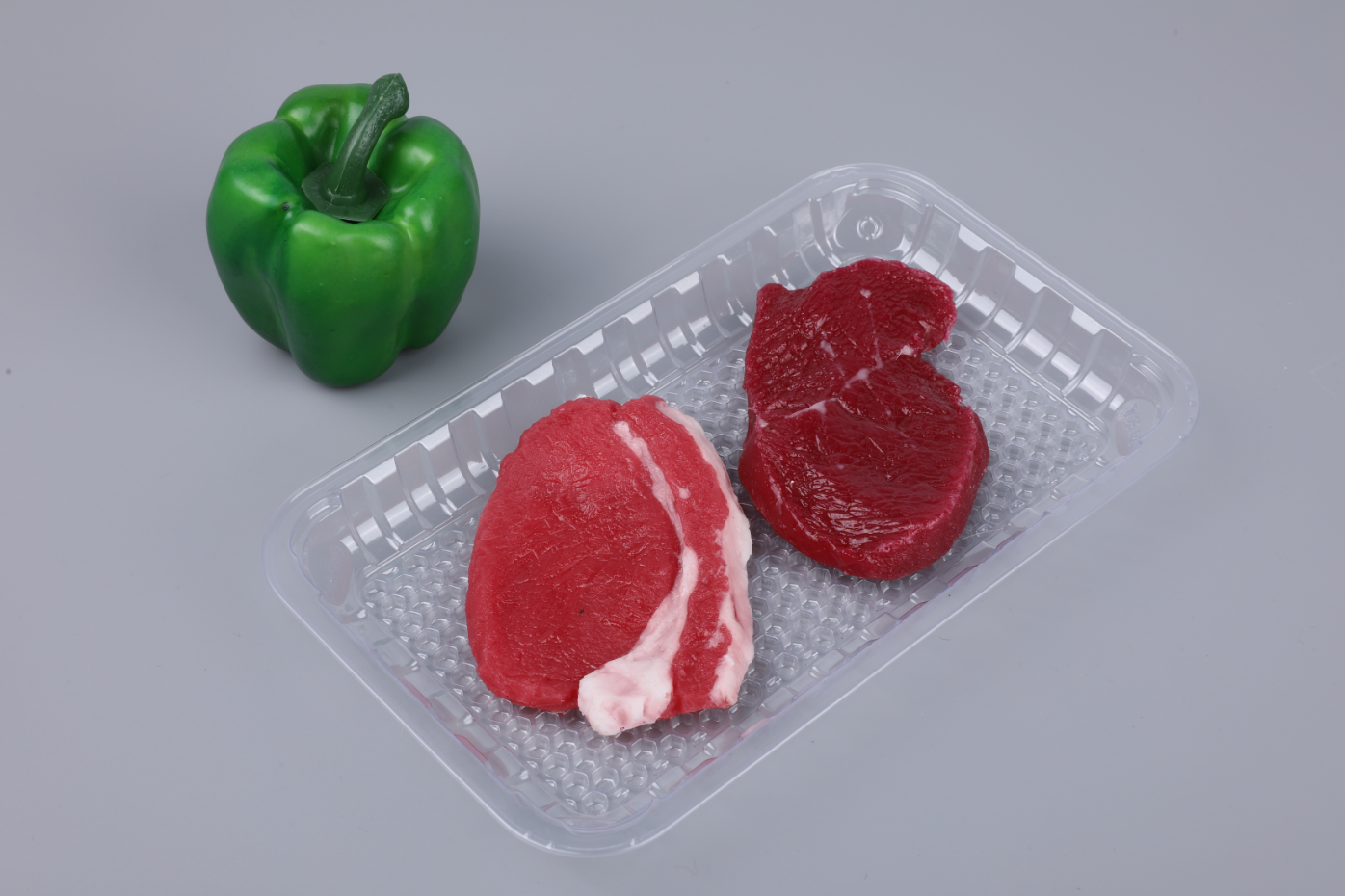
Figure 1 — A moisture retention tray in a chilled fresh-meat application. Purge moves into recessed cells in the tray base rather than pooling against the product.
This guide is written for buyers at the research and evaluation stage — readers who already understand the problem and now have to fix the specification. That means deciding tray geometry, confirming that the material and packaging format match the line and the chiller, checking retention capacity against realistic purge load, assembling the certification and test documents that will be requested at supplier approval, and understanding the order economics that sit behind any price band quoted.
One clarification before the detail. In this article, moisture retention refers to purge management inside protein packaging. It is not the same requirement as condensation or humidity control in fresh produce packaging, where ventilation and airflow are the governing design variables. The two are frequently merged in sourcing conversations, and specifying the wrong one produces trays that fail in the chiller aisle rather than in the pallet.
Purge is a specification variable, not a cosmetic defect
Fresh meat, poultry and seafood release exudate after slaughter and during chilled storage. The amount depends on species, cut, post-mortem handling, storage temperature and time in the cold chain. In a sealed or overwrapped pack, that liquid accumulates in the base and migrates towards the product surface as the pack is handled, stacked and displayed.
The commercial consequences are consistent across markets. Pooled liquid reads to shoppers as a freshness signal rather than a physics outcome, which affects selection at the shelf and shortens the window before markdown. Retail buyers treat a wet pack as a presentation failure even where the product itself is within specification. For the packer, the problem is compounded because purge volume is not constant: it varies by season, by supplier, by cut specification and by how long the pack sits in a display case.
The long-standing response is an absorbent pad placed under the product. It works, and it remains a legitimate choice. It also introduces a second component into every pack: an additional material to clear for food contact, an additional line step to position the pad correctly, and an additional failure mode when the pad shifts, folds or becomes saturated and stops separating liquid from the product. Component reduction is one route buyers take to remove that variability, and it is the practical argument behind structured-base trays.
How a moisture retention tray works
LINHUA Moisture Retention Trays (MRT) are built on the company's turned-edge PET tray platform. A network of small recessed cells is formed into the tray base. As purge is released, it moves into these lower cells rather than remaining freely around the food, so the visible product area stays cleaner during packing, transport and display. Because the function is formed into the tray itself, the separate absorbent pad can potentially be reduced or removed, depending on the food type and the pack.
The turned-edge flange matters for a second and largely mechanical reason. Turning folds the PET flange into a smooth, consistent profile rather than leaving a conventional cut edge. In overwrap packaging, stretch film contacts that flange under tension; a smoother surface with a larger contact radius reduces the risk of the film catching, scratching or tearing during wrapping. Actual performance still depends on the film specification and the machine settings, so the flange is a risk reduction rather than a guarantee.
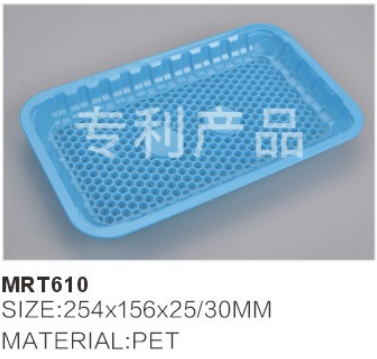
Figure 2 — Moisture Retention Tray MRT610 (254 × 156 × 25/30 mm), showing the cell network formed into the PET base.
Material and format boundary
MRT trays are made of PET and are specified for stretch film or overwrap packaging. That combination delivers clear product visibility and structural support without requiring a sealing machine, which is why the format suits supermarket overwrap lines and processor packing halls that already run film-wrapped trays.
It also defines the boundary. An MRT tray is not a barrier package. Where the requirement is a controlled gas atmosphere, the correct format is a MAP barrier tray — PP with an EVOH multilayer barrier structure — used with a gas-flush sealer and compatible lidding film. Where the requirement is vacuum skin presentation with the product immobilised, the correct format is a VSP tray with a skinning machine and skin film. In both cases the moisture question has to be solved within those systems rather than by the tray base alone. Choosing between MAP, VSP and overwrap is therefore a prior decision; the moisture retention tray is a specification inside the overwrap route.
The six standard models and what their dimensions constrain
The MRT range currently covers six footprints. All are PET, all are specified for stretch film or overwrap, and all use the same retention-cell principle in the base.
| Model | Dimensions (L × W × H) | Material | Packaging method |
|---|---|---|---|
| MRT58 | 205 × 135 × 25/30 mm | PET | Stretch film / overwrap |
| MRT610 | 254 × 156 × 25/30 mm | PET | Stretch film / overwrap |
| MRT810 | 255 × 208 × 25/30 mm | PET | Stretch film / overwrap |
| MRT87 | 218 × 188 × 30 mm | PET | Stretch film / overwrap |
| MRT511 | 288 × 145 × 30 mm | PET | Stretch film / overwrap |
| MRT911 | 274 × 218 × 30 mm | PET | Stretch film / overwrap |
Footprint and depth, not nominal capacity alone, decide whether a tray is right for a product. A tray that is a few millimetres too deep for a fixed film path produces a loose wrap; one that is too shallow leaves a fillet or chop overhanging the flange, which then interferes with the seal at the film edge. The 25/30 mm depth option on three of the footprints allows the same plan size to run at two product heights, which is useful where a retailer wants a consistent shelf footprint across a range while packers need to accommodate different cut thicknesses.
Where no standard footprint matches, dimensions, depth, colour, material structure and cell layout can be developed as a custom plastic food packaging project, including new mould development. The trade-off is straightforward: a standard model removes tooling cost and development time from the programme, while a custom footprint buys a better fit at the cost of a mould project, a higher minimum order quantity and a longer first-delivery schedule.
Certification, test reports and what each document actually covers
At evaluation stage, the useful question is not whether a supplier holds certificates. It is which certificate covers this product, in this market, for this application, and whether it is current. Those are four separate checks, and a supplier pack that answers only the first is incomplete.
| Document | Reference / issuer | Scope as stated | What the buyer should confirm |
|---|---|---|---|
| BRCGS Global Standard Packaging Materials, Issue 7 (Grade B) | Certificate CN057524-1, Bureau Veritas Certification; issued 14 Oct 2025, expires 05 Nov 2026 | Extruding, laminating with PE or EVOH film or not, vacuum and thermal forming of PP, PET and PS plastic tray, plates, cups and lid for direct contact with food; manufacturing category 04 — Rigid plastics | Renewal status for shipments scheduled after the stated expiry; that the category and forming scope match the exact tray |
| ISO 9001:2015 quality management system | Certificate 18426Q00712R001, Beijing Zhongjiaoyuanhang Certification Co., Ltd.; valid 08 Jun 2026 – 07 Jun 2029 | Production and related management activities of disposable plastic tableware within the qualification licence scope | That the certificate is understood as a quality-system document, not a food-contact clearance |
| HACCP management system | Certificate 610H151, ICG; Codex Alimentarius HACCP | Procurement, manufacture (including extrusion, forming, conversion and packing), storage, supply and distribution of food packaging products for export to Australian and other international markets | The copy on file runs to 15 October 2026 — request the renewed certificate before approving orders placed after that date |
| SMETA 2-Pillar audit report (Version 7) | Report ZAA600206602, Bureau Veritas CPS – Asia | Labour standards, health and safety | That this is an ethical-trade audit report, not a product certification |
| Global Recycled Standard 4.0 scope certificate | Certificate TRC-GRS-222470-00, TÜV Rheinland (China) Ltd. | Hard goods (PC0022); Other [Cups, Plastic Containers] (PD0100) | SKU-level coverage and the exact claim wording, if a recycled-content claim is required |
| Third-party food-contact test report | Report NBHL260902990901CW, SGS-CSTC Standards Technical Services (Ningbo) Co., Ltd.; issued 17 Sep 2026 | PET container DP1LBSS-01, US FDA 21 CFR 177.1630 chloroform-soluble extractives; USA market | That test reports are SKU-specific — a report naming a hinged container does not automatically extend to an MRT model |
The scope statement is the part that matters. A certificate that names forming of PET trays for direct food contact is directly relevant to an MRT tray. A quality-management certificate is relevant to consistency and process control but says nothing about migration. An audit report addresses labour and safety conditions. Each document answers a different procurement question, and treating them as interchangeable is one of the more common errors in supplier approval files.
Practically, this means the approval file for a moisture retention tray should contain: the current BRCGS certificate with its scope wording, the ISO 9001 certificate if quality-system assurance is part of the sourcing policy, the current HACCP certificate, a product-specific declaration of compliance or test report for the destination market, and — where a sustainability claim is being made — the GRS scope confirmation with the claim language agreed. Anything less shifts risk to the buyer after the container has shipped.
Where the format fits, and where it does not
The comparison that matters is not between brands. It is between packaging approaches, because each one solves a different part of the chilled-protein problem.
| Approach | What it controls | Typical fit | Constraint to verify |
|---|---|---|---|
| PET moisture retention tray with stretch film | Purge separation through cells in the tray base; possible reduction of the absorbent pad | Chilled fresh meat, poultry, fish and seafood on overwrap lines and supermarket display | Retention capacity against actual purge volume; film and machine settings |
| Conventional PET tray with absorbent pad | Purge absorbed by a separate pad | Established processes; packs with higher or more variable purge | Extra component to source and document; pad positioning step; pad displacement |
| MAP barrier tray (PP / EVOH structure) | Controlled gas atmosphere plus barrier performance | Chilled foods where shelf-life management is the primary objective | Requires gas-flush sealer, compatible lidding film and barrier structure; does not manage purge by itself |
| VSP tray | Vacuum skin presentation with product held in position | Premium steaks, cuts, fillets and seafood where shelf presentation dominates | Requires skinning machine and skin film; purge control is secondary |
| CPET ready-meal tray | Heat resistance for chilled or frozen ready meals | Prepared foods and meals requiring reheating within confirmed limits | Not a purge-control format; temperature limits must be confirmed per model |
Two limitations deserve to be stated plainly, because they determine whether a trial succeeds.
First, cell volume is finite. Retention capacity is a function of cell geometry and pack weight, and where purge volume is high — large cuts held for extended periods, or storage towards the upper end of the chilled range — liquid can exceed what the base will hold. In those cases a pad-based approach, or a combined approach, may remain the more reliable specification. LINHUA's own guidance is consistent with this: performance depends on food type, pack weight, purge volume, storage temperature and storage time, and the choice should be confirmed through actual packing trials rather than assumed from a neighbouring product line.
Second, the format is deliberately narrow. An MRT tray does not deliver a modified atmosphere and cannot substitute for a barrier tray where shelf life is the governing requirement. It is not a reheating container; CPET covers ready-meal and oven or microwave applications within confirmed temperature limits. And it is not a lidded takeaway format — food packaging containers with lids, hinged and clamshell containers, and base-and-lid combos serve the deli, bakery and grab-and-go side of the same chilled category. Selection should follow the packaging method, not the food category name.
Cost structure: what moves the price band before a quotation exists
No responsible tray quotation can be produced without the application details, so the useful exercise at evaluation stage is understanding which variables will move the number.
- Resin. PET and PP are synthetic polymers manufactured from natural resources, and their prices fluctuate with input costs. Because a thermoformed tray is largely converted resin, gram weight and gauge translate fairly directly into unit cost. A tray specified heavier than the application needs is an avoidable cost.
- Tooling. Standard models carry no mould cost. A new footprint, depth or cell layout requires mould development, which adds both cost and development time before the first production run.
- Order quantity and mix. The standard minimum order quantity is one full container per item, with mixed loading possible for a first or trial order covering several items. Products with customisation requirements carry a correspondingly higher minimum.
- Lead time. Production is normally 30–45 days after order confirmation, depending on specification, quantity and current schedule. Custom mould projects require additional development and sampling time.
- Capacity and seasonality. LINHUA operates a site of approximately 30,000 m² with monthly capacity around 1,800 MT. Seasonal peaks — seafood seasons in particular — are better booked against a confirmed forecast than against a spot requirement.
- Freight efficiency. Nesting ratio and container fill determine landed cost per tray. A deeper tray that nests less efficiently can cost more per unit than its ex-works price suggests.
Read together, these variables explain why price bands for moisture retention trays vary so widely between quotations that appear to describe the same product: standard versus custom tooling, gram weight, order quantity per SKU, and timing against seasonal capacity are usually doing most of the work.
Field evidence from chilled protein supply chains
Two supplier-reported project summaries illustrate how the format is actually deployed. They are provided as reference cases for structuring a trial, not as independently audited outcomes.
A meat processing company in New Zealand runs MAP barrier trays and moisture retention trays for fresh beef and pork destined for chilled retail distribution, at approximately 4–6 containers per month over a one-year relationship. The reported priorities were stable supply, consistent tray quality and reliable sealing performance, with the packaging supporting efficient production, cleaner retail presentation and stable cold-chain distribution. Notably, the two formats are used side by side rather than as substitutes — which reflects the boundary described earlier.
A seafood processing company in New Zealand packs fresh fish, salmon portions, fillets and chilled seafood, at roughly 6–8 containers per season. The reported result was improved product presentation and moisture management across different fish and seafood sizes, supported by multiple tray depths and custom-size development. Again, the moisture retention tray sits within a broader format set that includes VSP, MAP and turned-edge trays.
The pattern is consistent: buyers rarely replace an entire packaging programme with one format. They assign the moisture retention tray to the overwrap portion of the range, where purge control and component reduction are the active constraints, and keep barrier formats where atmosphere and shelf life govern.
Regulatory and market direction
Three data points frame the medium-term picture. The global food containers market was valued at USD 331.7 billion in 2024, according to Grand View Research — a reminder that rigid container decisions sit inside a very large, slow-moving demand base rather than a niche.
Regulation is moving faster than the market. The EU Packaging and Packaging Waste Regulation (EU) 2025/40 applies from 12 August 2026, including restrictions on PFAS in food-contact packaging, as confirmed by the European Commission. Alongside Regulation (EU) No 10/2011 on migration limits, this raises the documentary bar for any plastic food packaging container placed on the EU market, and it favours designs whose material composition is simple to describe and to verify.
Material investment points in a related direction. The global EVOH packaging market is projected to reach USD 3.055 billion by 2035 at a CAGR of 5.16%, according to Market Research Future — a forecast that should be read as a directional signal rather than a firm planning figure, given its commercial-research origin. Barrier performance continues to attract capital because shelf life is a hard commercial requirement in chilled distribution.
Moisture retention trays sit outside that barrier investment, but they respond to the same underlying pressure. A mono-material PET tray without a separate absorbent pad presents a simpler material stream than a tray plus a mixed-material pad, subject to local collection and sorting rules. Component reduction and material simplicity are becoming easier arguments to make internally than they were a few years ago, which is part of why structured-base formats have moved from specialty item to catalogue range.
What buyers should watch over the next planning cycle
- Certificate renewal dates. BRCGS certificate CN057524-1 runs to 05 November 2026 and the HACCP certificate on file to 15 October 2026. Approval files built earlier in the year should be refreshed rather than reused.
- Declarations of compliance by market. A US FDA test report and an EU declaration of compliance are different documents answering different questions. Specify which one the destination market requires.
- SKU-specific evidence. Test reports name products. Confirm that the report in the approval file names the exact tray being purchased.
- Trial protocol. Define the purge assessment before the trial starts — pack weight, storage temperature, display duration and the pass criteria for visible liquid.
- Tooling lead time. Where a new footprint is likely, start the mould conversation in parallel with the commercial negotiation; the development phase, not production, is usually the schedule risk.
- Seasonal booking. For seafood and seasonal meat programmes, forecast against capacity before the season rather than after the first order.
Frequently asked questions
How does a moisture retention tray work?
A moisture retention tray has a fine honeycomb-style structure built into the base. As fresh meat, poultry, fish or seafood releases purge, the liquid moves into the recessed cells underneath the product instead of remaining visibly pooled around the food. This helps keep the pack looking cleaner and may reduce or eliminate the need for a separate absorbent pad, depending on the food type, pack weight and amount of purge.
How do I choose between a moisture retention tray and a conventional tray with an absorbent pad?
For fresh meat, poultry, fish and seafood applications where visible purge affects retail presentation, a moisture retention tray can be the better option because the moisture-management function is integrated into the tray structure and may reduce or eliminate a separate absorbent pad. A conventional tray with an absorbent pad may still be suitable where the existing packaging process is already established, or where purge volume is higher and the packer prefers to keep the current structure. The final choice should be confirmed through actual packing trials.
How do I choose the right material for a food packaging tray?
Material follows the application rather than the other way round. PET suits applications where clear product presentation matters, including fresh meat, seafood, fruit and overwrap packaging. PP is widely used for food trays and can form part of MAP or VSP barrier structures. CPET suits ready meals and prepared foods requiring higher temperature resistance. Multilayer structures using EVOH and PE may be considered where additional barrier or sealing performance is needed. The inputs required to narrow the choice are food type, storage temperature, packaging method, heating requirement and barrier requirement, with target-market food-contact requirements confirmed before production.
Can moisture retention trays be customised, and does that require a new mould?
Customisation is possible and, where no standard footprint fits, a new mould can be developed. Depending on the product, customisation may cover tray dimensions, depth, shape, colour, material structure, compartments, ventilation holes and other functional features. An existing tray sample, drawing or dimensional specification can be used as a reference for evaluation. New projects normally begin with application and specification confirmation before mould development and sampling, and sample approval is an important step before final production approval.
What information should be included in an enquiry for moisture retention trays?
A faster, more accurate quotation follows from a complete enquiry: the product or tray type, or a photo or sample if available; required dimensions as length × width × depth; the food application; required quantity or estimated annual demand; and any colour or special requirements. For MAP or VSP projects, the packaging machine model, sealing mould details, lidding or skin film specification, storage temperature and required shelf life should also be provided. If not all technical information is available, partial information plus a sample or drawing is still workable for initial product matching.
Moisture retention trays are a narrow format with a clear job: keep purge out of the presentation area, reduce dependence on a separate absorbent component, and do so on an existing overwrap line without new equipment. Specified properly — with the right footprint and depth, confirmed purge expectations, SKU-specific compliance documentation and realistic order economics — they remove a recurring source of retail markdown and line variability. Specified loosely, they become another tray that works in the trial and disappoints in the chiller.
A downloadable product catalogue covering the moisture retention tray range and related food packaging formats is available here: Linhua E-catalogue 2025 (PDF).
Have Questions or Need More Details?
Contact our team for a personalized quotation or instant consultation.
Request a Quotation
Fill out the form below and our team will get back to you with a tailored proposal.
WhatsApp Direct Chat
Prefer to chat in real-time? Message us on WhatsApp for instant assistance & quick answers.
- Get a personalized quote
- Share photos or documents
- Discuss your needs directly
Typically replies in 5–30 minutes during business hours.