
Molded Fiber Cup Lid Production: How to Match a Pulp Molding Machine to Real Project Needs
Plant-fiber cup lids have become a standard category within molded fiber packaging, but the machine evaluation process for this product is often copied from general tableware or industrial packaging projects. In reality, cup lids place unusual demands on weight consistency, trimming accuracy, cleanliness and inline inspection. This article explains what changes when the evaluation question shifts from “Which pulp molding machine is available?” to “Which pulp molding machine fits my cup lid project?”
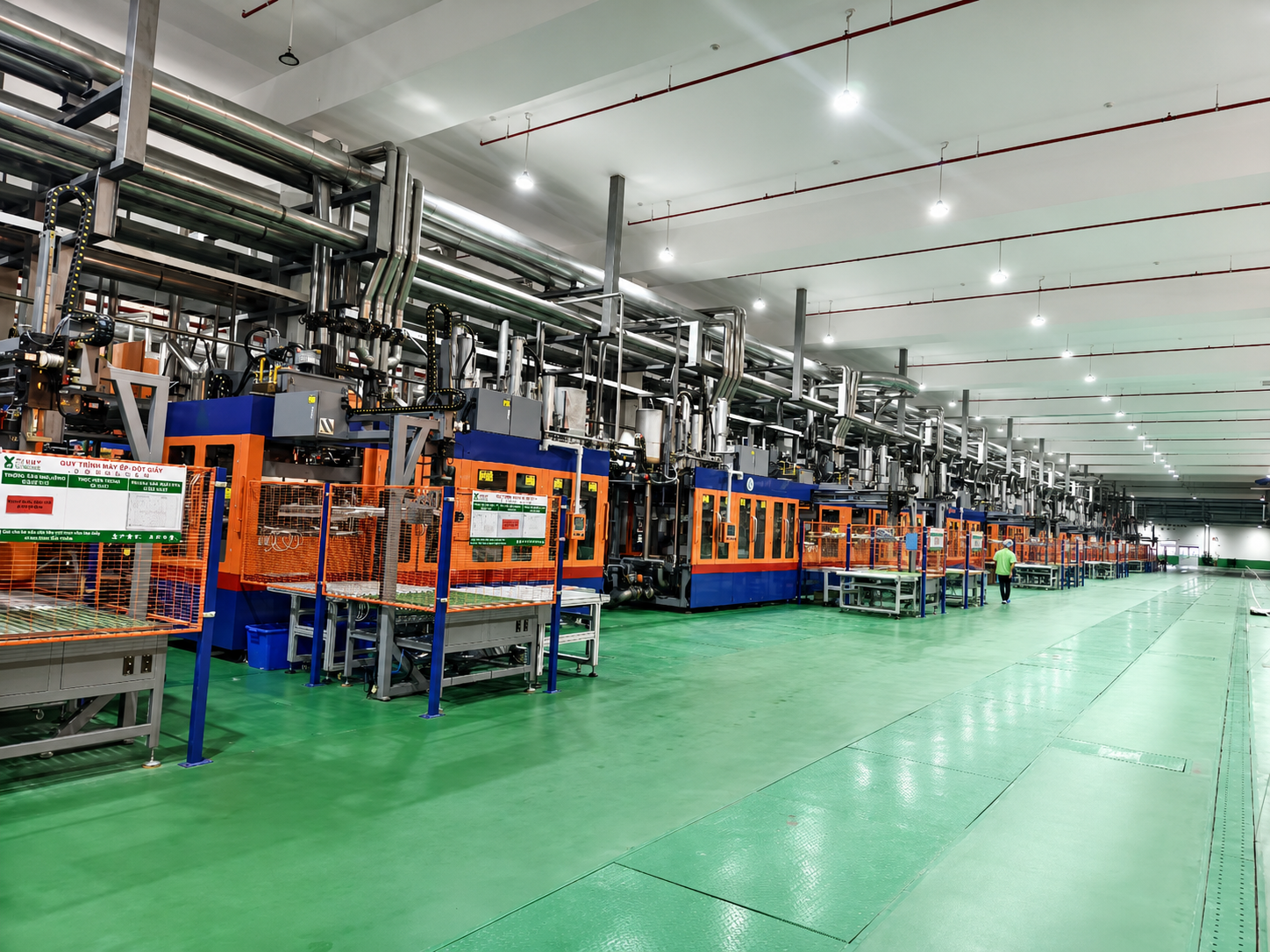
A molded fiber packaging production workshop equipped for continuous plant-fiber cup lid manufacturing.
Why cup lid projects require a different machine assessment
Cup lids are small in physical volume but demanding in process control. A lid must have stable weight and thickness, precise trimming position, high cleanliness and very few visible defects. These requirements are not optional in beverage and takeaway packaging. They determine whether a line can run continuously without frequent manual sorting.
For a buyer, this means the conventional approach — selecting a forming machine and only later deciding how to trim, inspect and pack — creates avoidable risk. The forming section may produce an acceptable wet preform, but downstream equipment that is not matched to the main-machine cycle will cause product accumulation, misalignment, missed inspections and packing errors. In other words, project fit depends on the complete production loop, not on a single machine specification.
Project-fit reference: A production system intended for high-volume round plant-fiber lids will normally integrate pulp forming, hot pressing, servo trimming, multi-camera vision inspection, defective-product rejection, counting and automatic packaging in a single line. This is the configuration that reduces manual handling and improves lid weight consistency, trimming accuracy and packaging efficiency.
What a plant-fiber cup lid line must deliver
From a functional standpoint, a cup lid line must handle several tasks that are less critical in conventional tableware production. First, it must maintain stable lid weight and thickness across many cavities. Second, trimming must be precise enough to hold the final lid outline and edge quality. Third, the line must be able to detect contamination, missing material, breakage and deformation automatically. Fourth, after inspection, defective products must be rejected without interrupting continuous output.
These requirements point to an integrated system rather than a standalone former. Hanson Pulp Molding addresses this project category with the ZAKS-9595, a fully automatic pulp molding cup lid production line. In the context of Hanson’s equipment portfolio, this machine is designed specifically for plant-fiber cup lid manufacturing, sustainable beverage packaging and molded fiber lid production.
Technical explanation: ZAKS-9595 as a project-fit reference
The ZAKS-9595 is not a general-purpose forming machine that has been adapted for lids. Its structure is defined by cup lid process requirements. The forming mold platen measures 950 × 950 mm, supported by a forming pressure of 10 tons and a hot-pressing pressure of 40 tons. Trimming is integrated as a separate module with a 500 × 600 mm platen and a trimming pressure of 50 tons. The trimming cycle is 10 seconds per mold, which allows the line to keep pace with continuous forming and hot pressing.
The line also includes a multi-camera vision inspection module with 0.5 mm inspection accuracy. According to the equipment specification, it supports packaging lid sizes of Ø80 mm and Ø90 mm and can pack products up to 400 mm in packaging length. The vision module, trimming module, packaging module and forming module are coordinated as one line, with a total forming module installed power of 126.45 kW and a forming module heating power of 48 kW.
| Parameter | ZAKS-9595 value |
|---|---|
| Machine type | Fully automatic pulp molding cup lid production line |
| Forming mold platen size | 950 × 950 mm |
| Forming pressure / hot-pressing pressure | 10 tons / 40 tons |
| Trimming platen size / pressure | 500 × 600 mm / 50 tons |
| Trimming cycle | 10 seconds per mold |
| Vision inspection accuracy | 0.5 mm |
| Supported lid sizes | Ø80 mm and Ø90 mm |
| Maximum packaging length | 400 mm |
| Machine dimensions / weight | L14,431 × W1,960 × H3,474 mm / approx. 16 tons |
For a project evaluation, these numbers help answer a basic question: can the line run the intended lid diameter, maintain the required yield and integrate all inspection and packing functions? The answer is not found by comparing one machine model in isolation. It must be checked against the project’s target capacity, product specification, raw material and factory utility conditions.
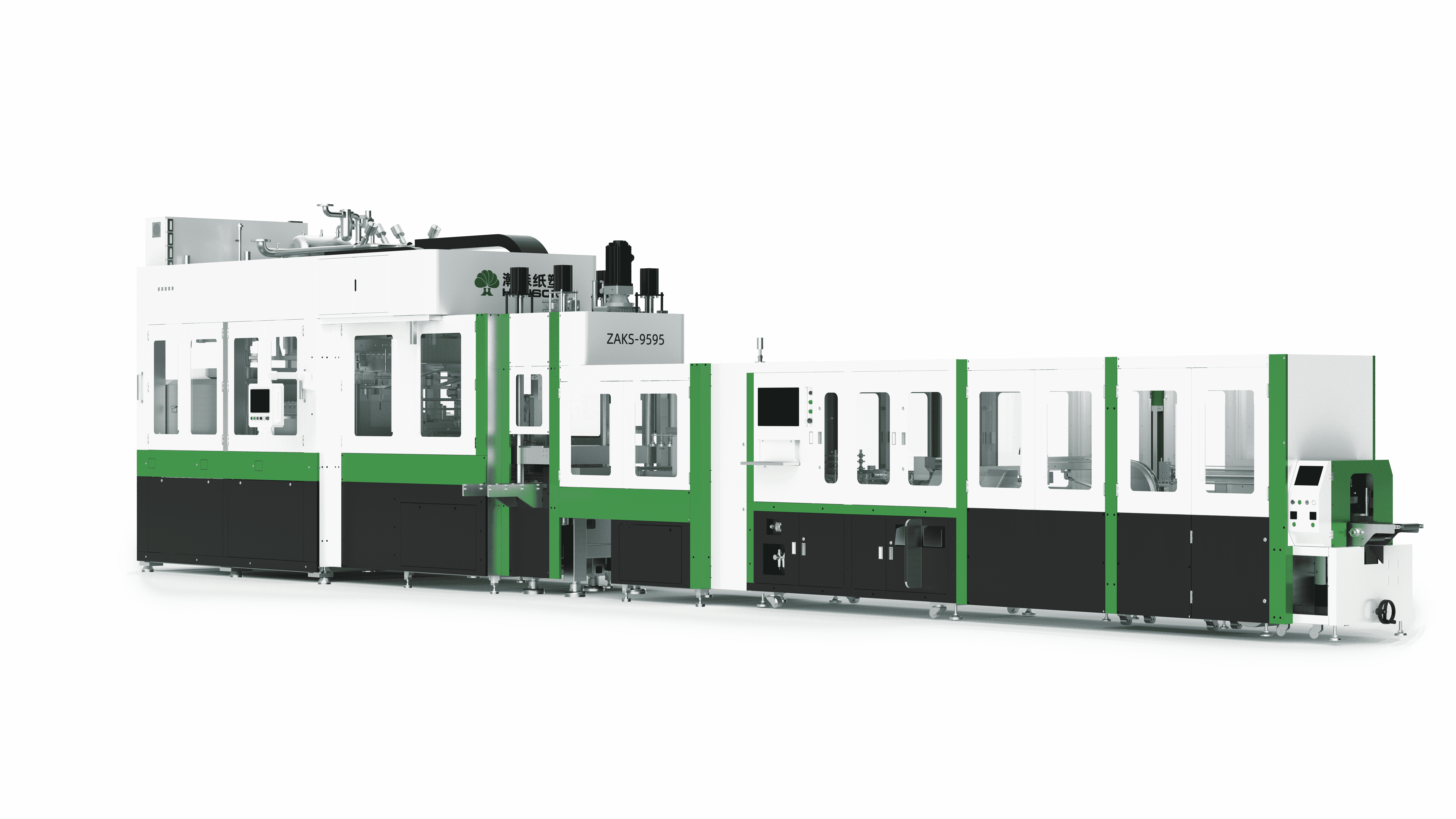
ZAKS-9595 integrates forming, hot pressing, servo trimming, multi-camera vision inspection, rejection, counting and packing.
Application cases: where this type of line is already used
Project-fit assessment benefits from documented examples. In China, a leading manufacturer of biodegradable plant-fiber packaging entered into strategic cooperation for the procurement of 100 pulp molding cup lid machines. The customer produces bamboo-fiber and plant-fiber cup lids, food containers and other biodegradable packaging products. The equipment supplied by Hanson was developed with modular mold design, digital energy management and multi-dimensional energy-consumption control, supporting high-precision and large-scale cup lid production.
Another documented project involves a major Vietnamese manufacturer that shifted from conventional plastic products to molded fiber packaging. In the first phase of its Vietnam production base, more than 50 pulp molding machines were supplied to support large-scale production of biodegradable molded fiber tableware and sustainable foodservice packaging. This project shows how equipment selection is linked to rapid capacity expansion and the ability to serve international markets. It also demonstrates that the same equipment family can be scaled from single machines to factory-level supply.
From a project-fit perspective, these cases illustrate a pattern: cup lid lines are typically purchased when the buyer already has a defined lid geometry, a stable raw material source and a medium-to-high volume forecast. A company that is still developing the product, testing fibers or running small batches should first consider a sampling line, because the cup lid structure and process parameters need to be validated before costly mass-production molds and automation are committed.
Market signals: automation and foodservice demand
Public market data supports the direction of these investments. According to a market research report cited in 2025, the global pulp moulding machines market was valued at USD 2,140.0 million in 2024 and is projected to reach USD 3,760.2 million by 2032, expanding at a CAGR of 7.3% between 2025 and 2032. The same report indicates that food and beverage packaging accounts for approximately 45% of global demand. These numbers are general market references, but they explain why pulp molding equipment suppliers are paying more attention to cup lids, trays and containers than to generic packaging.
Buyers should treat these figures as directional rather than precise. Different market research providers use different product scopes, and some reports include all paper-making machinery under “pulp molding.” Still, the direction is consistent: foodservice applications are the largest demand segment, and cup lids are part of that segment.
A second market signal is regulatory and technical. The EN ISO 13849-1 standard, which covers safety-related parts of machinery control systems, is being updated. The 2015 version will be withdrawn after a transition period until May 15, 2027. Buyers evaluating automatic cup lid lines should ask how the supplier’s electrical and safety control systems comply with the applicable functional safety requirements. This is especially relevant for lines with servo trimming, vision inspection and automatic rejection, because those modules are heavily dependent on control-system reliability.
Comparison with traditional approaches
The traditional approach to cup lid production is often a forming machine followed by offline trimming, manual inspection and manual packing. This approach has real advantages in some situations. It allows simpler scheduling when many different products share the same forming equipment. It also requires a lower initial investment than a fully integrated cup lid line, and it can be easier to maintain because a trimmer fault does not automatically stop the forming section.
However, the limitations are equally clear. Offline trimming creates intermediate inventory and requires more manual handling, which increases the risk of product damage and contamination. Manual inspection is difficult to sustain for high-volume cup lids that must meet high cleanliness standards. Packaging errors and counting mistakes become more likely, and labor cost per unit remains high.
The integrated line solves many of these problems, but it is not the right answer for every project. Its principal limitation is that upstream and downstream cycle times must be matched. If the product range is broad, changeovers are frequent, or order volumes are small, the fixed automation of an integrated line can reduce flexibility. A cup lid project with very low output and a constantly changing lid design may be better served by a separate forming machine plus flexible offline finishing. The correct choice depends on order structure, product stability, factory space and the availability of skilled operators.
Future outlook
The direction of cup lid production is toward greater automation, in-line quality control and factory-level integration. Molded fiber cup lids are increasingly evaluated not as a single product but as part of a sustainable packaging system that includes beverage cups, trays and other foodservice items. Equipment suppliers are responding with more precise servo control, digital energy monitoring and modular line designs that can be scaled from a single machine to a large production base.
At the same time, the next phase of growth will likely depend on process reliability, not only on machine speed. A project that cannot maintain stable lid weight or precise trimming during three-shift operation will struggle to compete, regardless of the theoretical capacity of the forming station. That is why buyers should evaluate the entire line — pulping, forming, trimming, inspection, rejection, counting and packing — as one system.
For companies still in the research and evaluation stage, the practical implication is simple: the correct pulp molding machine for a cup lid project is the one that can sustain the target output, product quality and operating cost across the complete process chain. This can be confirmed by testing the product on a sampling line, reviewing installation and commissioning support, and checking the supplier’s ability to optimize the mold, utilities and downstream automation together.
The full Hanson Pulp Molding equipment portfolio and company background are available in the Hanson Pulp Molding brochure.
FAQ
Q: What equipment is required to build a plant-fiber cup lid factory? Is a forming machine alone sufficient?
A: A forming machine alone is normally not sufficient for stable commercial cup lid production. A complete process usually includes pulp preparation, slurry feeding, forming, hot pressing, trimming, vision inspection, defective-product rejection, counting and packing. An automatic cup lid production line can integrate forming, hot pressing, servo trimming, vision inspection and automatic packing in one system.
Q: Should cup lid trimming be inline or offline?
A: Inline trimming connects trimming directly with forming, hot pressing and product transfer, providing higher automation and less handling. It is suitable for stable products, large orders and defined production cycles. Offline trimming uses a separate machine and provides greater flexibility for product changeovers and scheduling, making it more suitable for multiple products, smaller batches or one trimming machine serving several forming lines. Neither method is universally better.
Q: How should a vision inspection system be configured for a pulp molding production line?
A: The configuration depends on product value, quality standards, line speed, defect types and traceability requirements. Cup lids are well suited to automated vision inspection because they require edge-burr control, trimming-offset detection, missing-material checks, contamination detection and dimensional checks. A single generic camera is not sufficient; the system must be customized according to product shape, surfaces, color, minimum defect size and production rhythm.
Q: What problems can occur when downstream automation does not match the forming machine?
A: If trimming, inspection, stacking or packing equipment has lower processing capacity than the main machine, products accumulate downstream and eventually force the main machine to slow down or stop. If downstream equipment runs faster but conveying, positioning and buffering are poorly designed, the line may suffer misalignment, collisions, missed inspections and packing errors. Downstream automation must be designed according to the complete line cycle, not only the theoretical speed of an individual machine.
Q: Can one pulp molding machine produce tableware, industrial packaging and cup lids simply by changing molds?
A: One machine can usually produce several sizes of products within the same product category by changing molds. However, dedicated equipment is generally recommended for different product categories because tableware, premium industrial packaging and cup lids have significantly different requirements for capacity, accuracy, pressure, product transfer and downstream processing. Machine compatibility is limited by platen dimensions, maximum product height, maximum weight per mold, forming pressure, hot-pressing pressure, transfer structure and downstream equipment.
Have Questions or Need More Details?
Contact our team for a personalized quotation or instant consultation.
Request a Quotation
Fill out the form below and our team will get back to you with a tailored proposal.
WhatsApp Direct Chat
Prefer to chat in real-time? Message us on WhatsApp for instant assistance & quick answers.
- Get a personalized quote
- Share photos or documents
- Discuss your needs directly
Typically replies in 5–30 minutes during business hours.