
Molded Pulp Export Compliance: Certificates That Matter
Molded Pulp Export Compliance: Certificates That Matter
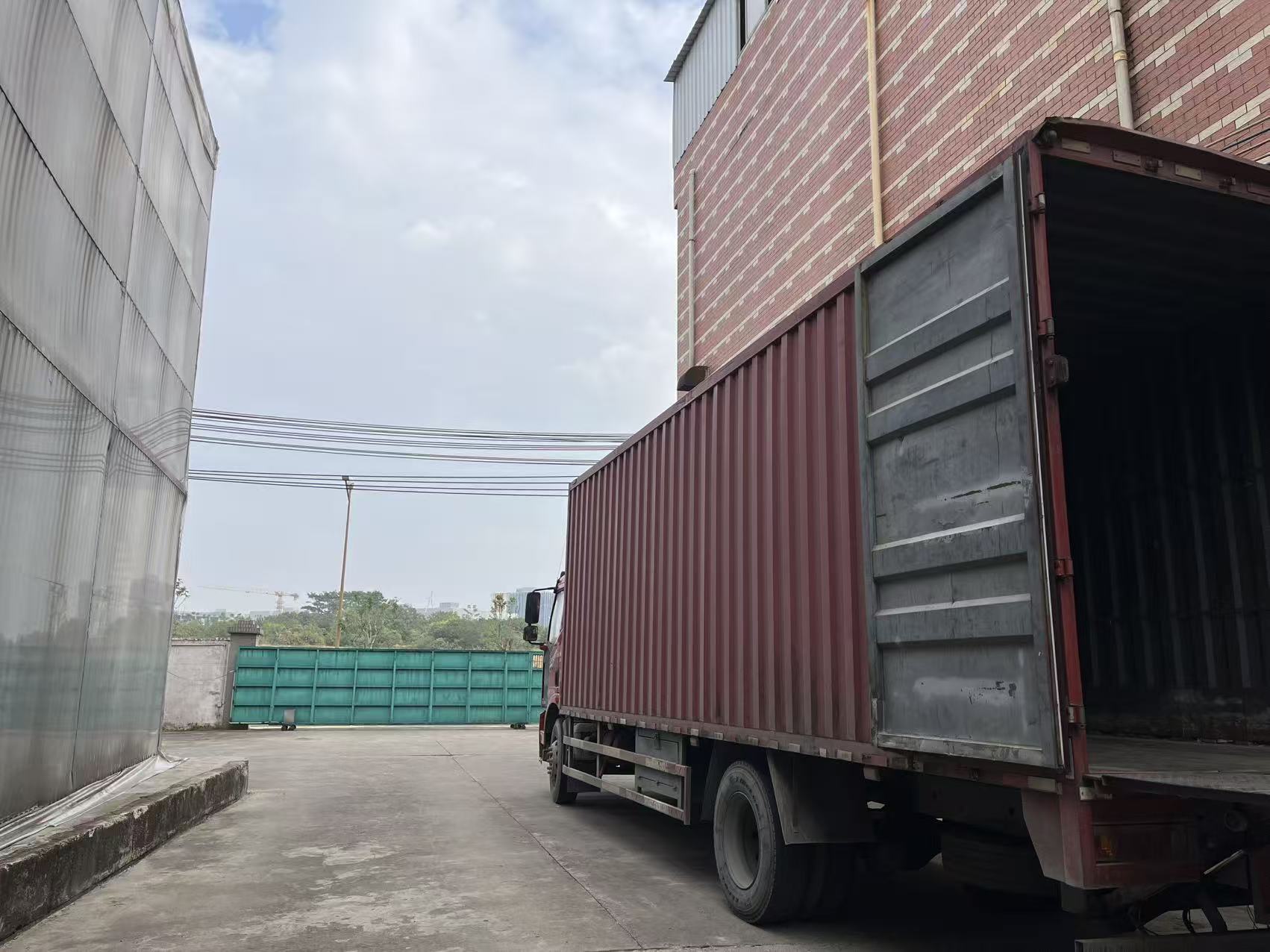
Export dispatch area. A molded pulp tray qualifies for a market through documents, not through material alone.
No single certificate makes a molded pulp tray sellable in every market. Whether a document is mandatory depends on three variables: what the tray comes into contact with, where it is placed on the market, and what claim the brand prints on the pack. Everything else is optional evidence that helps buyers rank suppliers.
That distinction matters most between evaluation and execution. At the discovery stage, buyers ask whether molded fiber can replace expanded polystyrene or thermoformed plastic. At the order stage, they ask a narrower question: which documents must exist before a purchase order is released, and which of the remaining ones are simply competitive advantages.
The Compliance Question Changes Once a Purchase Order Is on the Table
Molded pulp is a fiber product, and buyers often assume fiber products carry a simpler compliance profile than plastics and foams. That assumption is partly right and partly misleading. The material itself is not the regulated object — the packaging as placed on a market, and the claims attached to it, are.
Three variables decide whether a document is mandatory for a specific order:
- Contact category. A food grade molded pulp tray, a medical device pulp tray, a cosmetic packaging pulp tray and a molded pulp electronics tray do not raise the same qualification requirements, even when they come off the same forming line.
- Destination market. The European Union, North America, the Middle East and Southeast Asia apply different packaging and waste rules, and those rules attach to the packer or importer rather than to the molding factory.
- The claim being made. A tray sold as recyclable, biodegradable, plastic-free or fiber-sourced is making a statement that has to be supportable in the destination market.
A supplier certificate folder is therefore evidence about a supplier. It is not, by itself, a market entry permit.
Legal, Contractual and Commercial: Three Different Kinds of Mandatory
Most certification confusion in molded pulp sourcing comes from mixing three requirement types into one wish list. Separating them makes the export decision much faster.
| Requirement type | What makes it mandatory | Consequence if missing |
|---|---|---|
| Legal / regulatory | Destination market packaging law applies to the packaging placed on that market | Shipment cannot be placed on the market legally |
| Contractual | The importer, retailer program or brand owner writes it into the specification | Order fails inspection or supplier does not qualify |
| Commercial | Nothing — it is used to compare suppliers | No legal consequence, but weaker position in supplier shortlisting |
The practical takeaway: before asking a molding supplier to email certificates, buyers should first determine which of their requirements are legal for the destination market and which are contractual for their own retail channel. Everything left over should be treated as comparison data, not as an entry barrier.
Category 1 — Management System and Process Consistency
Management system certification, most commonly expressed as ISO 9001, is the category that answers a question about the factory rather than the tray. It evidences that documented process control exists at a certified site, within a defined scope. It does not certify product performance, material safety or recyclability.
The scope line is the part buyers should read. A certificate issued against GB/T 19001-2016 / ISO 9001:2015 under number 04524Q32380R0S (issued 26 November 2024, valid to 25 November 2027) covers the scope described as paper holders. For a buyer, the meaningful question is whether the trays being ordered fall inside that described scope, and whether the manufacturing site on the certificate is the site that will run the order.
Where this category becomes effectively mandatory is procurement policy rather than law. Many brand owners and industrial buyers will not open a supplier file without a valid quality management certificate, and a supplier that supports the certificate with in-line controls — incoming, in-process and final inspection — is easier to audit. In pulp molding, those checks matter because thickness, moisture content and dimensional fit vary with fiber batch and pressing conditions rather than with a single fixed input.
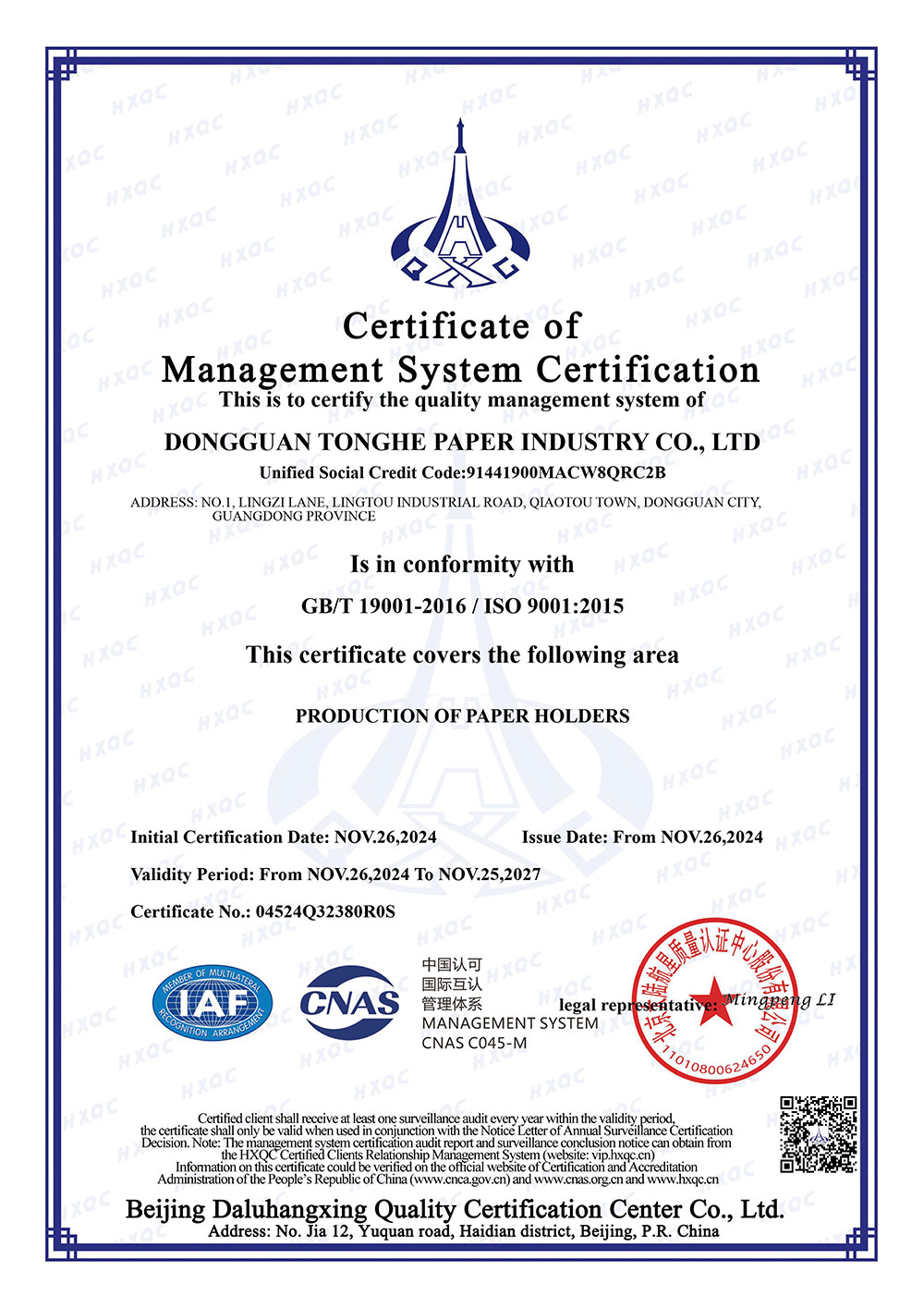
A management system certificate is scoped: the description on the document defines what it actually covers.
Category 2 — Fiber Sourcing and Chain of Custody
Forest and fiber chain-of-custody schemes answer a different question again: where did the raw material come from, and can that origin be traced through purchasing, production and sale. For molded pulp, which is made from wood pulp, bamboo pulp, sugarcane pulp or recovered paper, chain of custody matters when the brand owner makes a fiber-origin claim on the shelf or in a sustainability report.
Chain-of-custody evidence is usually contractual rather than legally mandatory. It appears in the specification when a retailer, a public tender or a corporate sustainability policy requires it. A certificate such as RINA-COC-003845, issued against FSC-STD-40-004 V3.1 and FSC-STD-50-001 with validity from 7 June 2024 to 6 June 2029, describes a scope that includes purchasing FSC 100%, FSC Mix and FSC Recycled material, pulp from recovered paper, and the manufacture (transfer system) and sale of pulp and paper products including pulp trays, for global and EU markets.
Two boundaries are worth stating plainly. First, chain of custody is not a recyclability certificate for the finished tray — it evidences sourcing, not end-of-life behavior. Second, if a converter handles both certified and non-certified fiber, the certified volume is tracked by a transfer or credit system, so buyers should confirm the claim they intend to print is the claim the certificate supports.
Category 3 — Restricted Substances and Material Safety Documentation
This is the category most often misread by buyers, because two very different documents are frequently filed together.
Restricted substance test reports screen a sample for regulated substances. RoHS-style reporting is relevant when molded pulp trays carry or travel with electrical and electronic goods, and it is also commonly requested by EU buyers as a general due-diligence document. Reported test activity in this category references the IEC 62321 series of methods and the use of ICP-OES, UV-Vis and GC-MS analysis, on a declared scope of paper tray. Two reports held for molded pulp trays carry the numbers DSP25050447-1 (dated 14 May 2025) and SZXPC26000164601 (dated 16 January 2026).
A material safety data sheet is a different instrument. It documents handling, storage and transport classification, not environmental performance. Certificate DSP25050758-1, dated 24 May 2025, was prepared with reference to ISO 11014:2009 and GB/T 16483-2008, together with the IATA Dangerous Goods Regulation (66th edition) and the IMO International Maritime Dangerous Goods Code. Buyers who file a safety data sheet as evidence of eco-compliance are filing the wrong document.
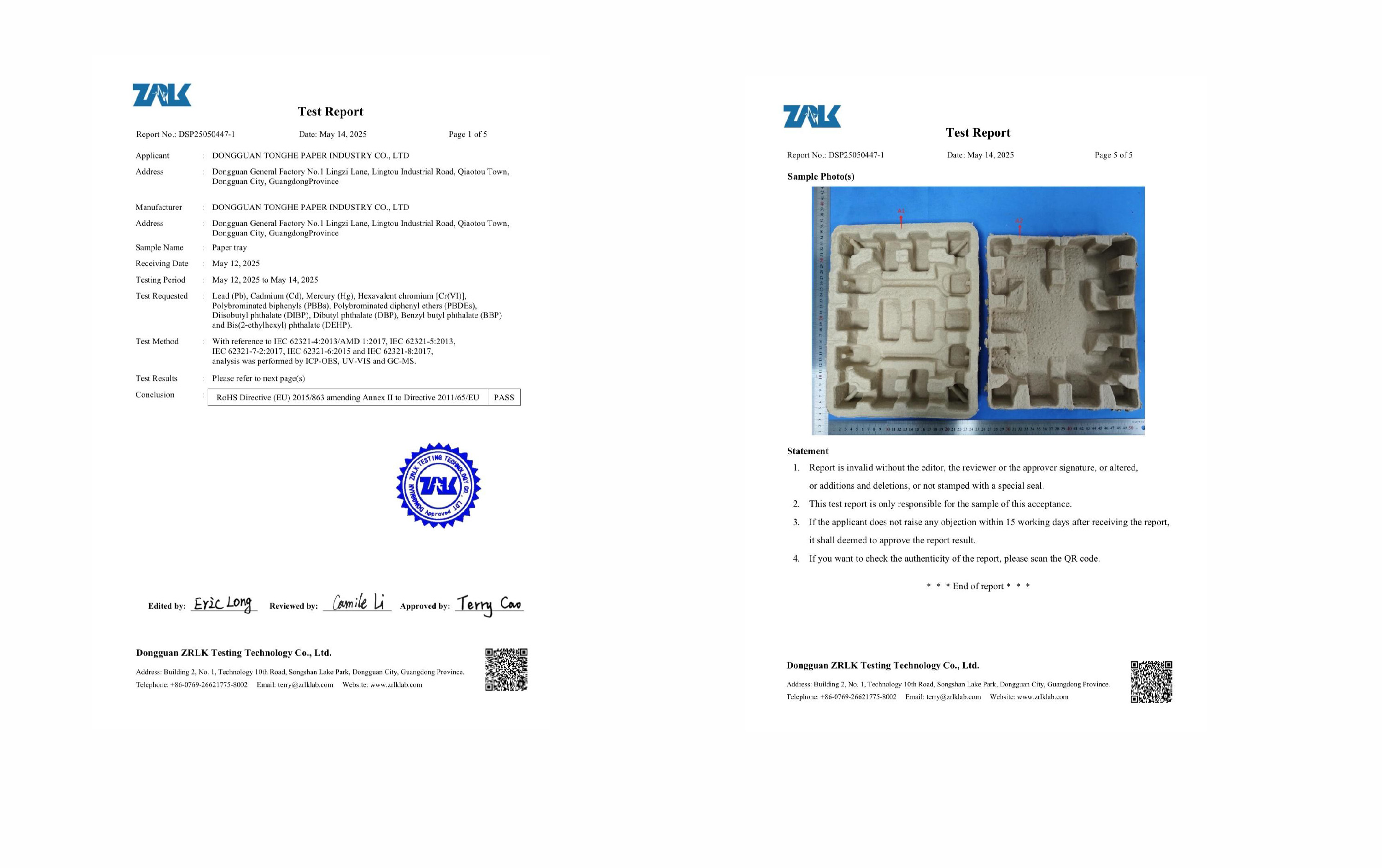
Restricted substance testing is sample- and scope-specific; it does not certify food contact suitability.
Category 4 — Market Regulation: Recyclability by Design
The clearest legally mandatory element in molded pulp export today is market-level packaging regulation, and it applies to the packer or importer, not to the converter. The European Packaging and Packaging Waste Regulation (EU) 2025/40 entered into force on 11 February 2025 and requires all packaging to be recyclable by 1 January 2030. Comparable extended producer responsibility and recyclability frameworks are tightening in other regions as well.
For a molded pulp tray, that direction is broadly favorable because a fiber tray is a mono-material construction in a well-established paper recycling stream. The qualification gap sits in the details. Coatings, laminated inserts, printed films, adhesives and barrier treatments added for branding or moisture resistance can move a tray out of the simplest recycling pathway. Custom coating, embossing and printing are standard options in this category of packaging, which means the recyclability question has to be asked at the specification stage, not after tooling is cut.
Category 5 — Claim-Specific Evidence and Food Contact Suitability
Claims are where compliance becomes commercial. If a tray is marketed as biodegradable, the buyer needs support under defined conditions rather than a generic statement. The manufacturer in this category states that its plant-fiber material achieves complete biodegradation in 28 days in a natural composting environment, and that the raw materials are selected as virgin wood pulp, bamboo pulp and sugarcane pulp without harmful chemical additives. That is a company statement tied to material and conditions, and it should be read as such until it is mapped onto the specific composting scheme a destination market recognizes.
Food contact is a separate technical track. Molded pulp trays in this category are produced in sugarcane pulp, bamboo pulp and wood pulp with wet-press density of 0.15 to 0.25 g/cm³ and dry density of 0.28 to 0.45 g/cm³, thickness of 0.8 to 5.0 mm, moisture content of 8 to 12 percent or below, edge crush strength of 3 to 8 kN/m and compressive strength of 2 to 8 MPa. The stated applicable temperature range is minus 20 to plus 80 degrees Celsius for standard trays, extended to minus 20 to plus 120 degrees Celsius for food grade trays. Those figures matter because a food contact assessment is only meaningful within the actual use temperature and load of the application.
Where Certification Evidence Usually Breaks Down
Across export orders, the same failure points recur. None of them require a new certificate; all of them require reading the existing ones properly.
- Scope mismatch. A document describing paper trays or paper holders does not automatically cover a newly developed custom molded pulp tray geometry, coating or print.
- Market mismatch. A certificate issued for one market may not satisfy the legal requirement of another; market lists on the document should be checked line by line.
- Document type confusion. Restricted substance test reports, safety data sheets and chain-of-custody certificates each answer a different question, and substituting one for another is a common audit finding.
- Validity windows. Certificates carry issue and expiry dates. A supplier folder containing an expired document is not evidence.
- Sample versus production. Substance screening applies to what was tested. Material source, coating and ink changes after testing invalidate the assumption even when the paper is unchanged.
- Claim overreach. Statements such as eco-friendly or sustainable are not certificates; they are marketing language and carry no verifiable content.
Matching Document Scope to the Application
The fastest way to convert a certificate folder into a decision is to map each document to the application it must serve.
| Application | Qualification focus | Specification anchor |
|---|---|---|
| Food service and fresh produce | Contact suitability, use temperature, recyclability of the finished pack | Food grade trays stated at minus 20 to plus 120 degrees Celsius; disposable food and fresh produce tray formats |
| Medical devices | Sterilization-related standards, hospital plastic restrictions, dimensional fit | Medical device pulp trays; healthcare segment projected at 8.6 percent CAGR |
| Electronics | Restricted substances, anti-static and moisture-proof options, drop protection | Molded pulp electronics trays; anti-static and moisture-proof customization |
| Cosmetics and gift sets | Surface finish, printing ink compliance, cavity geometry | Cosmetic packaging pulp trays; embossing, printing and coating options |
| Industrial and heavy goods | Structural performance, stacking stability, moisture exposure | Edge crush strength 3 to 8 kN/m; compressive strength 2 to 8 MPa; shockproof tray construction |
Compliance as a Sourcing Variable: What the Market Data Shows
The commercial backdrop explains why compliance questions now arrive early in supplier conversations. Grand View Research values the global molded pulp packaging market at USD 6.2 billion in 2025 and projects USD 10.2 billion by 2033. The same source reports that Asia Pacific held a 41.0 percent revenue share in 2025 with China the largest single market, and that the tray segment alone accounted for more than 41.0 percent of revenue in 2025.
Buyers should treat headline market values with care. A second estimate for 2025 places the market at USD 4.5 billion, and the gap is explained by product definition — whether machinery, specialty coatings and fiber lids are counted inside the category. The definitional difference is a useful reminder that the same discipline applies to certificates: the number or the document only means something once its scope is stated.
Regulation is the stronger signal for export planning. The EU recyclability deadline of 1 January 2030 applies to packaging, not to suppliers, so importers will progressively push documentation requirements upstream. In parallel, molded pulp for healthcare and medical devices is projected to grow at 8.6 percent CAGR, driven by sterilization standards and hospital plastic bans — a segment where qualification documentation, not price, usually decides the supplier.
Molded Pulp Against Traditional Packaging: Where the Compliance Burden Sits
Molded pulp is often presented as the low-friction compliance option against expanded polystyrene and thermoformed plastic. That framing is only partly accurate.
| Consideration | Molded pulp trays | Foam and rigid plastic packaging |
|---|---|---|
| Recyclability direction | Mono-material fiber construction generally aligns with paper recycling streams | Dependent on polymer type and local collection infrastructure |
| Regulatory exposure | Exposed to recyclability and claim rules through the packaging placed on market | Same regulation applies; material substitution does not remove the obligation |
| Documentation profile | Sourcing, substance and safety documents plus claim support | Substance and safety documentation; recyclability evidence often harder to obtain |
| Known limits | Moisture sensitivity, tighter geometry tolerances, tooling required for custom shapes | Lower moisture sensitivity, established low-cost tooling base |
The honest limitation is this: choosing molded pulp does not remove compliance work, it relocates it. Fiber packaging carries its own documentation requirements around sourcing, contact suitability and claim support, and it introduces material constraints that plastic does not have — sensitivity to prolonged moisture, a practical thickness range of 0.8 to 5.0 mm, and a temperature envelope that has to be matched to the application rather than assumed. Buyers who expect fiber to be documentation-free will be disappointed; buyers who expect it to be simpler to defend in a recyclability-driven market usually find it is.
A Pre-Order Compliance Checklist for Export Buyers
- State the destination market first, then decide which requirements are legal and which are contractual.
- Request certificate copies with scope description, certificate number, issue date and expiry date — not logos.
- Confirm the manufacturing site named on the certificate is the site producing the order.
- Match document type to purpose: chain of custody for fiber claims, substance testing for restricted materials, safety data sheets for transport.
- Validate the finished specification, including coating, printing and inserts, against the recyclability requirement of the destination market.
- Test physical performance on samples before releasing volume, since protection claims are application-specific.
- Plan commercial parameters early: minimum order quantity of 1,000 pieces, production lead time of 15 to 30 days, and delivery terms under FOB, CIF, CFR or EXW.
- Agree an inspection method such as pre-shipment inspection, and confirm payment terms in advance.
For reference, Dongguan Tonghe Paper Industry Co., Ltd. (Tonghe Paper Co., LTD) operates a 23,000 square meter molding facility in Dongguan, Guangdong, China, with 160 employees, an engineering team of 12, annual output of 12,000 tons and monthly capacity up to 1,000 tons, exporting mainly to the EU, the United States, Australia, Saudi Arabia, Malaysia and Brazil, with an export ratio of about 50 percent. Order volumes and delivery windows in this category follow the pattern above rather than being negotiated per shipment.
What Is Likely to Change Next
Three shifts are worth tracking for buyers who place molded pulp orders across multiple markets. First, recyclability rules are moving from voluntary labeling to design requirements, which will push coating and print decisions earlier into product development. Second, documentation will increasingly be requested per shipment rather than per relationship, favoring suppliers that maintain current certificate files and traceable fiber records. Third, healthcare and medical device packaging will keep pulling qualification standards into a segment that historically competed mainly on tooling cost.
None of these changes creates a universal certificate. They raise the value of suppliers who can state clearly what their documents cover, what they do not cover, and where the boundaries of the material sit.
FAQ: Molded Pulp Certifications for Export Buyers
Which certificates are legally required to export molded pulp trays into the European Union?
None by name. EU rules regulate the packaging placed on the market rather than a specific document. Under Regulation (EU) 2025/40, which entered into force on 11 February 2025, all packaging must be recyclable by 1 January 2030. Chain-of-custody certification, restricted substance test reports and quality management certificates are requested under contractual or commercial terms by importers and brand owners, not imposed as a universal legal license.
Does a restricted substance test report prove that a molded pulp tray is safe for food contact?
No. Restricted substance testing screens a declared sample for regulated substances, using methods such as the IEC 62321 series with ICP-OES, UV-Vis and GC-MS analysis. Food contact suitability depends on material grade, migration behavior, and the actual use temperature and load. In this product category, food grade trays are specified for minus 20 to plus 120 degrees Celsius, while standard trays are specified for minus 20 to plus 80 degrees Celsius.
What does a quality management certificate such as ISO 9001 actually cover?
It covers the management system of the certified site within a stated scope. Certificate 04524Q32380R0S, issued against GB/T 19001-2016 / ISO 9001:2015 with validity from 26 November 2024 to 25 November 2027, describes a scope of paper holders. It evidences process control and consistency; it does not certify product performance, material safety or recyclability of any specific tray.
Is a material safety data sheet the same as an environmental certificate?
No. A safety data sheet documents handling, storage and transport classification. Certificate DSP25050758-1, dated 24 May 2025, was prepared with reference to ISO 11014:2009 and GB/T 16483-2008, along with the IATA Dangerous Goods Regulation (66th edition) and the IMO International Maritime Dangerous Goods Code. It supports shipping documentation, not environmental or compostability claims.
How should buyers verify that a certificate covers the trays they are ordering?
Check four items on the document itself: the scope description, the certificate number, the validity dates, and any market or product model listing. Then confirm the covered scope matches the ordered tray geometry, material and finish, including any coating or printing. Where the document describes paper trays or paper holders generically, ask the supplier to confirm in writing that the specific item falls inside the covered scope.
Are molded pulp trays automatically recognized as compostable in every market?
No. Compostability claims are governed by market-specific schemes and by the conditions under which degradation is assessed. The manufacturer in this category states that its plant-fiber material achieves complete biodegradation within 28 days in a natural composting environment, and that raw materials are wood pulp, bamboo pulp and sugarcane pulp without harmful chemical additives. Buyers intending to print a compostability claim should confirm which scheme and which conditions the destination market recognizes.
What commercial constraints should be planned alongside certification?
In this product category the standard parameters are a minimum order quantity of 1,000 pieces, production lead time of 15 to 30 days, monthly capacity up to 1,000 tons, delivery under FOB, CIF, CFR or EXW terms, payment by letter of credit, and acceptance through pre-shipment inspection. Custom shapes require mold development, so tooling time should be added to the lead time for a first order.
Reference Material
A downloadable company profile covering molded pulp tray capability, materials and documentation can be accessed here: Tonghe Paper company profile (PDF).