
Molded Pulp Packaging: Materials, Uses and Buying Criteria
Molded pulp packaging is a formed structure of plant fibers and recycled paper that cushions products in boxes and cases. This reference explains how molded pulp trays are made, which industries use them, what to look for in a supplier, and where the material is heading.
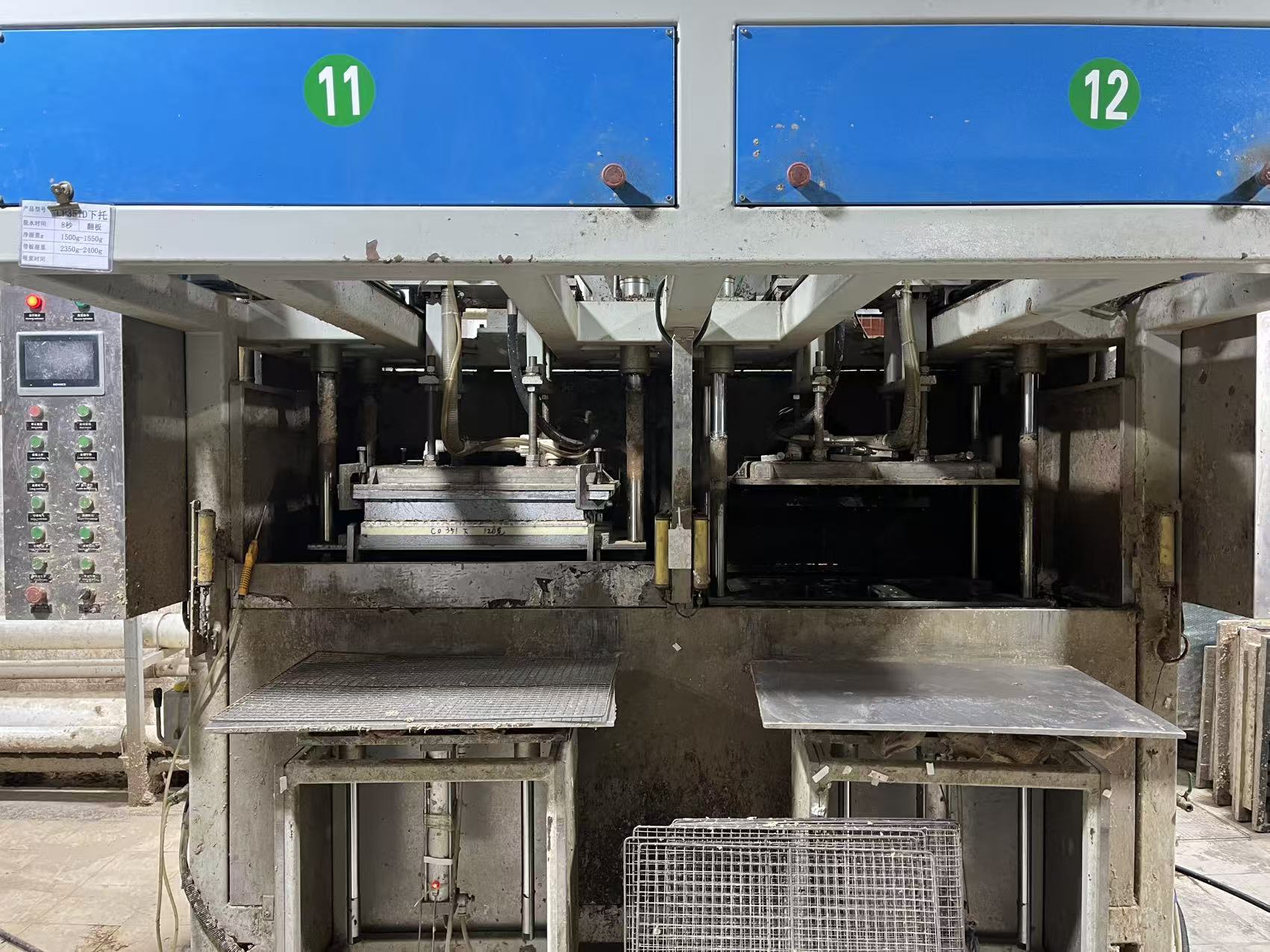
Wet-press molding is the primary forming approach for dense, stable molded pulp trays.
What Molded Pulp Packaging Is
Molded pulp, also called molded fiber, is a packaging material formed from a slurry of water and natural fibers. The slurry is pressed into molds to create trays, inserts, edge protectors, egg flats, produce punnets, food containers and industrial liners. The finished parts are rigid, lightweight and absorb shock, which makes them a direct substitute for expanded polystyrene (EPS) foam and vacuum-formed plastic inserts in many packaging systems.
The product family covered under the molded pulp category includes molded pulp trays, custom molded pulp trays, molded fiber inserts, biodegradable pulp trays, food-grade pulp trays, cosmetic packaging trays, medical device trays and heavy-duty protective pulp packaging. These are used for consumer goods, electronics, food, medical equipment, cosmetics, auto parts and other packaged products.
A 2025 estimate by Grand View Research values the global molded pulp packaging market at USD 6.2 billion, with a projected value of USD 10.2 billion by 2033. Trays are the largest product segment, contributing more than 41.0% of global revenue in 2025. The same data places Asia Pacific at 41.0% of global revenue, led by China.
Why Buyers Are Moving From Foam and Plastic to Molded Pulp
The reasons are regulatory, commercial and operational in mix.
Regulatory pressure. The European Packaging and Packaging Waste Regulation (EU) 2025/40 entered into force on February 11, 2025. It requires all packaging sold in the European Union to be recyclable by January 1, 2030. In parallel, single-use plastic rules, plastic taxes and hospital plastic bans are pushing manufacturers toward fiber-based formats. Molded pulp is recyclable through paper streams, and biodegradable pulp trays are designed to leave no plastic residue.
Cost and weight in logistics. Fiber packaging can reduce freight weight compared with rigid paper boxes. Tonghe Paper states that its lightweight molded pulp construction reduces weight by approximately 50% compared with traditional hard gift boxes, while maintaining stacking strength. Lighter inbound and outbound packaging reduces shipping cost per unit and improves warehouse density.
Protection performance. Molded fiber parts absorb impact because natural fibers interlock into a dense protective structure. Thicker molded walls can improve compressive and edge-crush values. Suppliers generally provide samples for side-by-side drop and compression testing before a buyer commits.
Customization. Molded pulp is not limited to egg cartons and cup carriers. Tooling can be opened for multi-cavity, irregular shapes that fit a specific product's contours. In a production context, brands use this for cosmetic inserts, medical device holders, electronics cushioning and high-end gift boxes.
Procurement simplification. Buyers can source food-grade trays, cosmetic pulp trays, medical trays and protective pulp packaging from one manufacturer instead of managing foam, plastic and paper suppliers separately.
Supplier Profile: Tonghe Paper Co., Ltd.
One supplier illustrating the current generation of Chinese pulp molding manufacturing is Tonghe Paper Co., Ltd. (corporate name: Dongguan Tonghe Paper Industry Co., Ltd.), based in Qiaotou Town, Dongguan, Guangdong Province. The company operates a 23,000m² production base with about 160 employees and a 12-person engineering and R&D team. Its rated annual output is 12,000 tons of molded pulp products, which corresponds to roughly 1,000 tons per month.
Tonghe Paper produces from sugarcane pulp, bamboo pulp and wood pulp, and it also works with recycled paper input for certain general-purpose grades. The company describes its fiber sources as renewable and its production process as free of harmful chemical additives. In natural composting conditions, the material is stated to reach 100% degradation in 28 days. All products are positioned to comply with international environmental requirements such as SGS RoHS and PFAS-free standards. Public company information associated with the Tonghe Paper brand also cites ISO 9001, ISO 14001 and FSC certification.
Approximately 50% of the company's output is exported. Its stated main markets include the EU, the United States, Australia, Saudi Arabia, Malaysia and Brazil. Production capabilities include pulping, wet-press forming, hot pressing, trimming, drying and in-house mold development.
How Molded Pulp Trays Are Manufactured
The process can be divided into four stages: slurry preparation, forming, drying and finishing.
Slurry preparation. Natural fibers are mixed with water to form a pulp suspension. Common raw materials are wood pulp, bamboo pulp and sugarcane bagasse pulp. Custom grades can be specified for color, fiber blend and performance.
Forming. The slurry is drawn into a perforated mold, where fibers accumulate on the mold surface while water is removed. Wet-pressure molding compresses the wet part to a density of roughly 0.15–0.25 g/cm³. This step determines the part shape, wall thickness and fiber distribution.
Drying. Preformed parts are dried in ovens, hanging baskets or ventilated sheds to reduce moisture. Tonghe Paper maintains a moisture content specification of ≤8–12% for its molded pulp products.
Hot pressing and finishing. A hot press step increases surface smoothness and structural strength, bringing dry-pressure density to 0.28–0.45 g/cm³. Parts are trimmed on edge-cutting machines. Additional options include calendering, water- and oil-repellent coating, embossing, printing, dyeing and spraying.
Key Technical Specifications
The table below lists the general specification range for Tonghe Paper's molded pulp trays. Values shift with fiber blend, wall design and whether a part is wet-pressed or hot-pressed.
| Parameter | Typical Range |
|---|---|
| Raw materials | Sugarcane pulp, bamboo pulp, wood pulp; customization available |
| Wet-pressure density | 0.15–0.25 g/cm³ |
| Dry-pressure density | 0.28–0.45 g/cm³ |
| Thickness | 0.8–5.0 mm, customized as required |
| Moisture content | ≤8–12% |
| Edge crush strength | 3–8 kN/m |
| Compressive strength | 2–8 MPa |
| Standard temperature range | -20°C to +80°C |
| Food-grade temperature range | -20°C to +120°C |
| Degradability | Biodegradable in composting conditions |
| Colors | Natural, white, yellow, customized |
Types of Molded Pulp Trays and Their Applications
Molded pulp trays are specified across several distinct application segments. The following overview matches product type to typical industry use.
| Product Type | Typical Industries | Key Characteristics |
|---|---|---|
| Molded Pulp Trays | Electronics, appliances, gifts, general packaging | Natural or bleached pulp; calendering and water/oil-resistant treatment options |
| Custom Molded Pulp Trays | Export goods, industrial products | Product-specific cavities; replaces foam vacuum-forming; recyclable pulp inner lining |
| Pulp Packaging Trays | Branded inner packaging, storage | Logo printing and embossing; stackable designs; recyclable after use |
| Eco-Friendly Molded Fiber Trays | Electronics, cosmetics, appliances, hardware, medical | Anti-static options; pressure- and impact-resistant; breathable; customizable |
| Biodegradable Pulp Trays | Food service, fresh produce, general packaging | Zero plastic film; no PE/PET coating; compostable; no microplastic pollution |
| Medical Device Pulp Trays | Medical devices, surgical instruments | Supports EO sterilization; virgin pulp without fluorescent agents; low dust; precise cavities |
| Cosmetic Packaging Pulp Trays | Cosmetics and personal care | Anti-scratch custom-fit inserts; stable dimensions; customizable color and thickness |
| Food Grade Molded Pulp Trays | Food service, catering, food processing | Food-contact-safe fibers; wide temperature adaptability; oil/water treatment available |
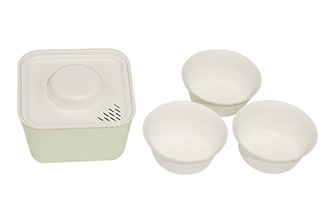
Food-grade molded pulp trays are used for cutlery, lunchboxes, hamburger boxes and other food-contact applications.
Food and Catering
Food-grade molded pulp trays are made from sugarcane, bamboo or wood pulp and are designed for direct food contact. The operating range for food-grade trays is -20°C to +120°C, which covers refrigeration, hot holding and most packaging-line environments. Products in this category include cutlery trays, lunchbox inserts, hamburger box trays and table-knife trays.
Medical Devices
Medical device pulp trays are one-piece molded structures with custom cavities for probes, handles, catheters and surgical instrument components. Because these trays are often specified for export of medical devices to Europe and North American hospitals, the fiber source matters: virgin wood pulp with no fluorescent agents and no shedding is the stated specification for Tonghe's medical-grade trays, with EO sterilization support and clean-workshop production. Degradable and recyclable construction also helps avoid plastic taxes in regulated markets.
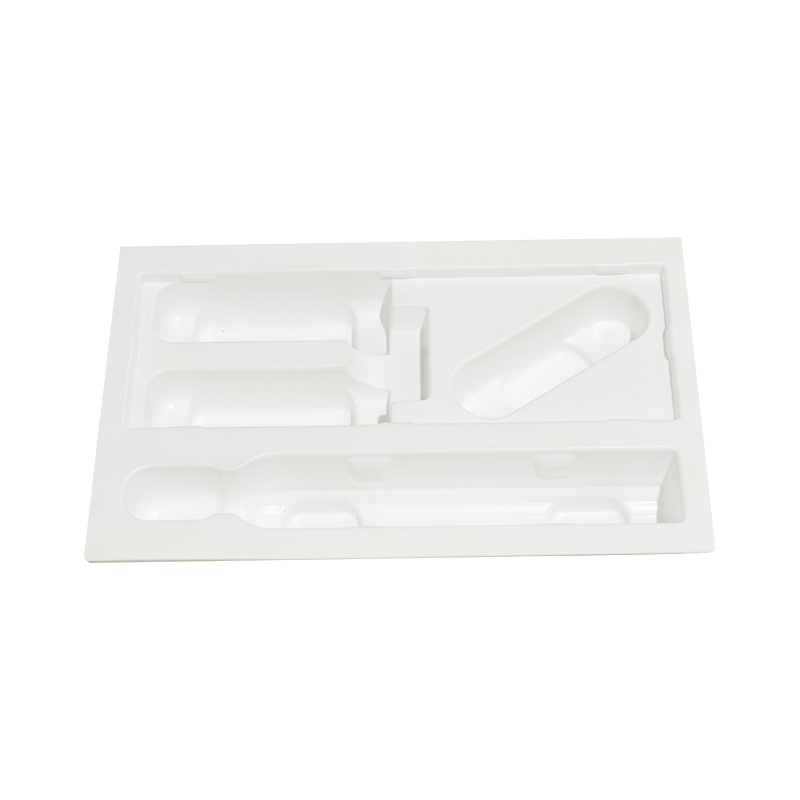
Custom-molded cavities in medical pulp trays can be designed to fix probes, handles and instrument components in place.
Cosmetics and Personal Care
Cosmetic packaging pulp trays are custom-fit inserts that hold bottles, jars, tubes and compacts without scratching the surface. The tray structure stabilizes the product inside the outer carton and can be colored or coated to match premium packaging lines.
Electronics and Industrial Goods
Eco-friendly molded fiber trays are used for 3C electronics, electrical appliances, hardware and automotive components. The pulp structure absorbs shock, holds parts in position, and can be produced in an anti-static modified pulp version for electronic components and connectors. Water- and oil-repellent treatment supports use in humid environments.
Market Trends in Molded Pulp Packaging
Four market signals matter for procurement teams evaluating molded pulp.
Size and growth. Grand View Research estimates the global molded pulp packaging market at USD 6.2 billion in 2025, with a projected USD 10.2 billion by 2033. The trajectory is consistent with the substitution of plastic and foam in consumer packaging, food service and industrial packaging.
Regional concentration. Asia Pacific generated 41.0% of global revenue in 2025, with China as the largest country-level market. For international buyers, this means supply chains for molded pulp trays continue to run heavily through Chinese manufacturing clusters.
Trays as the dominant form. The tray segment holds the largest revenue share at 41.0% in 2025. This is highly relevant for buyers because tray production requires precise tooling, dimensional control and finishing capability — not just the ability to form generic shapes.
Healthcare acceleration. Mordor Intelligence projects an 8.6% CAGR for molded pulp used in healthcare and medical device packaging, driven by ISO sterilization standards and plastic bans in hospitals. Medical trays are a specialized segment with stricter material requirements than general-purpose packaging.
The European requirement for recyclable packaging by January 2030 is the broadest regulatory driver. Buyers selling into the EU should be able to demonstrate recyclability or compostability of their packaging structure, which molded pulp products can support if the material is not laminated with non-fiber plastic films.
Molded Pulp vs. Foam and Vacuum-Formed Plastic Inserts
Compared with EPS foam and PET/PVC vacuum-formed trays, molded pulp offers a different set of trade-offs.
| Criterion | Molded Pulp Trays | EPS Foam Inserts | Vacuum-Formed Plastic Trays |
|---|---|---|---|
| Base material | Plant fibers, recycled paper | Petroleum-based plastic | Plastic sheet |
| End of life | Recyclable or compostable options | Difficult recycling | Recycling dependent on local plastic collection |
| Shock absorption | Fibrous cushioning structure | High compressive energy absorption | Moderate; mainly positional fixation |
| Shape freedom | High; custom tooling | High; custom molding | Moderate; draft angles required |
| Surface finish | Calendering, coating, printing | Smooth closed surface | Smooth, glossy possible |
| Moisture behavior | Breathable; treated options for wet conditions | Water resistant | Water resistant |
| Weight | Roughly 50% lighter than hard paper gift boxes, per Tonghe Paper | Very light | Light |
Molded pulp is not a universal replacement for foam or plastic. The most important boundary is moisture. Untreated pulp fiber is breathable and will absorb water if the packaging is exposed to wet or high-humidity conditions; suppliers usually add water- and oil-repellent coatings for food, cosmetic and industrial applications where moisture or grease can occur. Buyers should also plan for mold investment: every custom tray shape requires a mold, so new product introductions involve tooling cost and development lead time before series production begins. This is manageable for mid-volume and high-volume runs, but it is different from buying stock plastic inserts off the shelf.
What to Verify When Sourcing Molded Pulp Trays
The following checking points are based on the typical failure modes that molded pulp buyers encounter.
- Raw materials. Confirm the fiber blend and whether recycled content is used. If you need medical, food or cosmetic-grade trays, ask for the material declaration and check for fluorescent agents, plastic films or PFAS.
- Physical test data. Review density, moisture content, edge crush strength and compressive strength. These values should match your load, stacking and transit conditions.
- Moisture control. Confirm the moisture content specification and whether coating is required for your environment. Tonghe's molded pulp specification is ≤8–12% moisture by default.
- Customization capability. Verify the supplier's mold development capacity, not just its production line. Tonghe operates an in-house mold department, which shortens the design-to-sample loop.
- Environmental compliance. Ask for documentation showing RoHS compliance, PFAS-free status, and where applicable ISO 9001, ISO 14001 and FSC certification.
- Trial process. Request samples for drop testing, compression testing and production-line trials. The comparison between a thin, moisture-prone pulp tray and a properly pressed tray is visible in physical testing.
- Shipping terms. Confirm the supplier's shipping methods, incoterms and payment terms before placing a repeat order.
Future Outlook
Molded pulp packaging will continue to face upward regulatory pressure. The EU's January 2030 recyclability requirement is already influencing material selection for packaging that enters the European market. Healthcare is the fastest-expanding use case, with an 8.6% projected CAGR in medical packaging, which rewards suppliers that can maintain clean-workshop production and a documented fiber chain. The broader market is expected to grow from USD 6.2 billion in 2025 to USD 10.2 billion in 2033, with Asia Pacific remaining the production center.
For manufacturers such as Tonghe Paper, the practical direction is the same as for the industry: density control, surface finishing, custom tooling and materials that survive real logistics. Buyers can simplify their supplier structure by selecting a pulp molding partner that covers multiple segments — food, medical, cosmetics, electronics — because the underlying process is similar and the differences are mostly in mold design, coatings and compliance documentation.
FAQ
What payment terms and shipping methods do you accept?
We accept T/T, Alibaba Trade Assurance. We can ship by sea, air, express (DHL/FedEx/UPS). Please tell us your destination port or address to calculate freight cost.
Company documentation. For a full company profile with production capability and product specifications, Tonghe Paper's corporate brochure is available as a public download: