
Molded Pulp Tray Selection by Project Scenario: Food, Medical and Industrial Use
HTNXT Industry Reference / Packaging & Printing
Molded pulp trays are molded fiber structures that protect, position or support a product during storage, transport and presentation. At project level, they are not one generic material: the same word can mean a food-contact tray, a cosmetic insert, a medical device liner or an industrial cushioning tray. This article explains how project buyers preparing a moulded pulp packaging specification can map molded pulp tray options to the actual operating environment, protection target and compliance requirement.
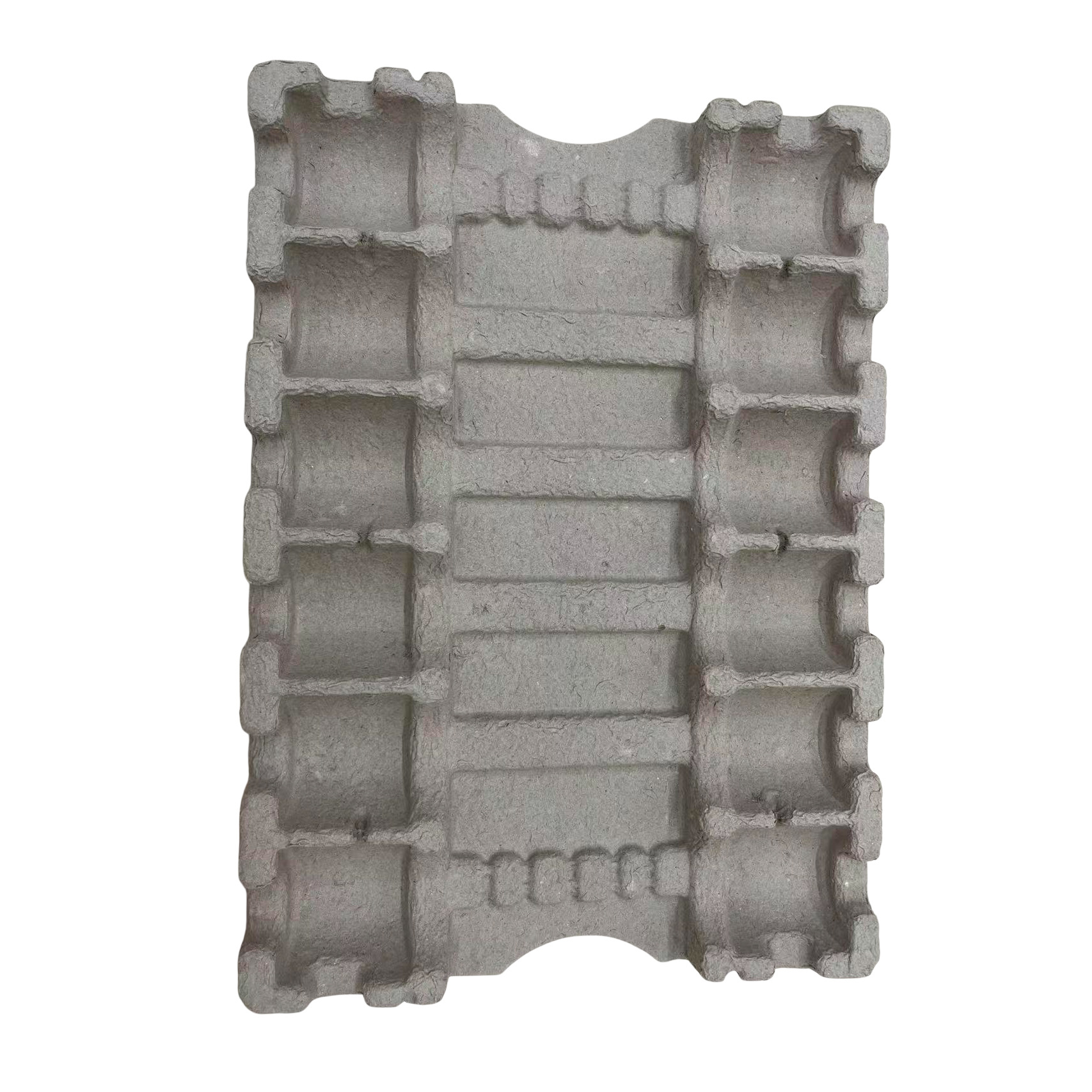
Molded fiber trays are commonly selected as project-specific inner packaging rather than as a single stock product.
Why project fit changes the molded pulp tray decision
A molded pulp tray purchase begins with more than the raw material question. There is a clear difference between using molded pulp as an environmental message and using it as a reliable inner packaging component. In procurement terms, the distinction is functional: a food service tray that holds a hamburger or cutlery set is not necessarily the same construction as a tray that keeps a medical probe or an electronic connector stationary during long-distance shipment.
The application notes available for this article cover projects in markets across Europe, North America, Australia, New Zealand, the Middle East and Southeast Asia, with operating expectations such as recyclability, biodegradability, food-contact safety and shock-absorbing cushioning. These notes describe pulp packaging projects where the tray is an inner protective packaging element. Other common project labels include molded pulp trays, pulp packaging trays, eco-friendly molded fiber trays, custom molded pulp trays and protective molded pulp packaging. The tray itself should be selected only after defining which of those labels matches the product, the distribution route and the industry rules.
Mapping molded pulp tray options to project scenarios
A practical first step is to separate project types by the dominant risk. For perishable goods the main concern may be food contact or moisture; for cosmetics it is often surface finish and fit; for medical devices it is cleanliness, fibre shedding and sterilisation compatibility; for electronics it is cushioning, positional stability and electrostatic requirements.
| Project scenario | Typical buyer priority | Molded pulp tray option used for the decision |
|---|---|---|
| Food service, catering, fresh produce and disposable tableware | Food safety, biodegradability, temperature tolerance, clean disposal | Food Grade Molded Pulp Trays; Biodegradable Pulp Trays |
| Cosmetics, gift packaging and wine boxes | Clean fit, scratch protection, surface finish, brand printing | Cosmetic Packaging Pulp Trays |
| Medical devices, probes, catheters and surgical instruments | Low dust, precise positioned cavities, EO sterilisation support, export compliance | Medical Device Pulp Trays |
| 3C electronics, appliances, lighting, industrial parts and hardware | Cushioning, compression resistance, anti-static option, replacement of foam and vacuum-formed plastic | Eco-Friendly Molded Fiber Trays; Custom Molded Pulp Trays |
| General OEM export packaging, brand display and multi-industry products | Recyclability, printed logo or embossing, stackable storage, part customisation | Molded Pulp Trays; Pulp Packaging Trays |
None of these categories is perfectly isolated. In practice, a manufacturer may need a food-safe fibre with a customisable shape, or an industrial cushioning tray with a logo printed on the outer-facing surface. The product line offered by Dongguan Tonghe Paper Industry Co., Ltd. (Tonghe Paper), a molded pulp manufacturer based in Dongguan, Guangdong Province, China, reflects that overlap. Tonghe Paper produces molded fiber products mainly from sugarcane pulp, bamboo pulp and wood pulp, and its current export markets include the European Union, the United States, Australia, Saudi Arabia, Malaysia and Brazil. Its range includes custom molded pulp trays, molded pulp trays, pulp packaging trays, eco-friendly molded fiber trays, biodegradable pulp trays, medical device pulp trays, cosmetic packaging pulp trays and food grade molded pulp trays.
Food grade molded pulp trays and fresh produce projects
Food packaging projects should start with raw material and food-contact evidence. In the Tonghe Paper product data, food grade molded pulp trays are based on sugarcane pulp, bamboo pulp or wood pulp, and the supplier highlights food-safe degradable fibre, customisable size and colour, cushioning and compressive resistance, and wide temperature adaptability.
The listed temperature range for standard molded pulp trays is generally from minus 20 degrees Celsius to plus 80 degrees Celsius; the food grade version is listed from minus 20 degrees Celsius to plus 120 degrees Celsius. That difference matters for food service lines that may pass through heating, transport or short-term holding conditions. The same group of products can be formed into items such as spoon trays, fork trays, table knife trays, lunch box trays and hamburger box trays. For disposable food service projects, biodegradable pulp trays are also described as zero-plastic constructions with no PE or PET plastic film coating, which makes them easier to treat after use.
One application record linked to food service and retail projects involved restaurants and supermarkets in export markets such as Australia, Canada, Germany, France, the United Kingdom, the Netherlands, Denmark, Sweden, Malaysia, Saudi Arabia, Qatar and the United States. The record notes a purchase quantity of about 2,000 units, with packaging used for transport and turnover. The stated outcome was shockproof and shatterproof behaviour, with environmental protection listed as the project highlight.
Buyers of fresh produce trays should still check the required storage environment. The application guidance recorded for this product family recommends keeping the area well ventilated and dry, and avoiding prolonged exposure to direct sunlight. If a food project needs oil or water resistance, the buyer should verify whether a coating or treatment is part of the specification.
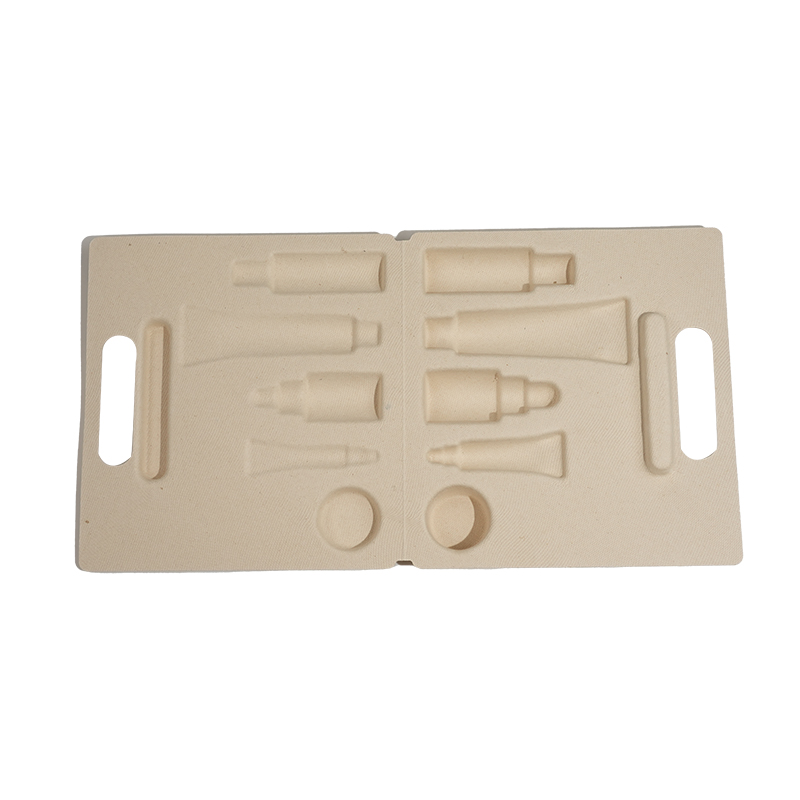
Cosmetic packaging pulp trays are usually selected for custom fit and protection rather than for cushioning alone.
Cosmetic packaging pulp trays: fit and finish come first
Cosmetic packaging projects ask for a different balance. The pulp tray is often visible when the customer opens the outer carton, so surface quality, cleanliness and dimensional accuracy become purchasing criteria. According to the Tonghe Paper product description, cosmetic packaging pulp trays can be built as custom-fit insert structures for cosmetics, with anti-scratch cushioning protection, customisable colour and thickness, and stable physical properties for inner packaging.
For brand owners, the tray can also be more than a protective element. The general custom service described by Tonghe Paper includes special coating, embossing and printing. That means the interior packaging can carry a logo or decorative finish without moving the work to a separate packaging supplier. The visible outcome is a tray that keeps the cosmetic product fixed in place while supporting the brand presentation.
Another reason cosmetic buyers move to molded fibre is consistency with sustainability claims. Unlike plastic vacuum-formed inserts, these fibre trays are designed as degradable packaging and can be matched with recycled or plant-based raw material choices. The product itself is listed as fully biodegradable in a natural composting environment, with a 100 percent degradation time of about 28 days stated by the manufacturer.
Medical device pulp trays: dust control and sterilisation logistics
Medical device projects require more than a biodegradable material claim. In high-risk packaging, the tray must not damage the device, create loose particles or interfere with sterilisation. The Medical Device Pulp Tray record in the Tonghe Paper range is designed for an inner lining paper tray specifically for medical devices. The product data lists support for EO sterilisation, one-piece moulding with precise positioning, shockproof and drop-resistant properties, low dust and no shedding.
Raw material control is also more visible in this category. The supplier states that virgin wood pulp used in the medical tray is free of fluorescent agents, that the product is manufactured in a clean workshop, and that a material inspection report is available. Customised cavities are offered to fit probes, handles, catheters and surgical instrument components. This level of customisation is relevant for buyers who need a pulp tray to hold several device components without allowing them to shift during shipment.
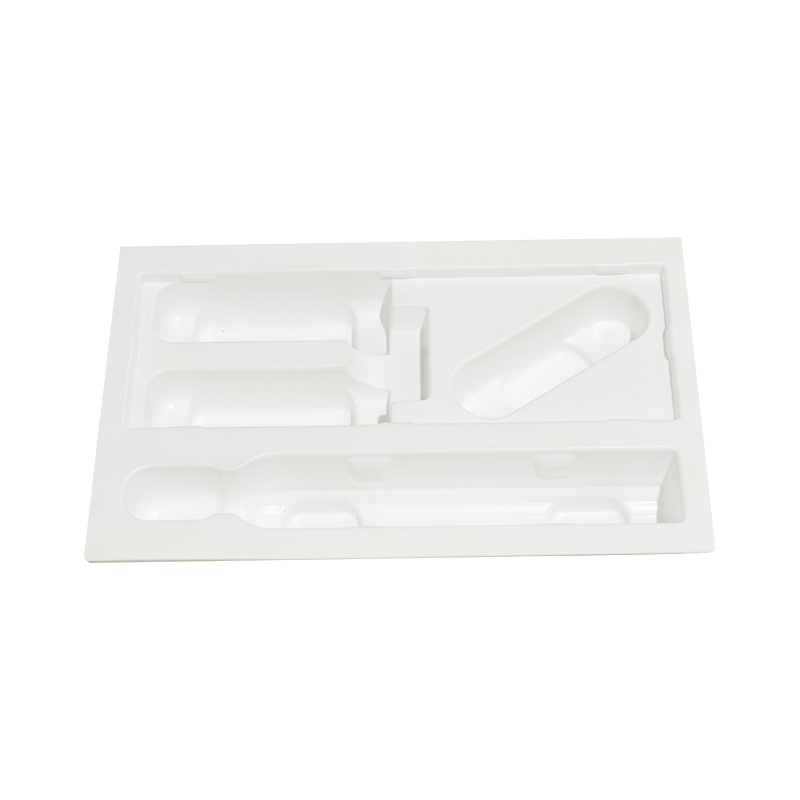
Medical device pulp trays are specified with cavity precision, low dust and sterilisation considerations in mind.
Electronics and general industrial protective trays
For electronics, home appliances, lighting, hardware and similar goods, the key project requirement is often cushioning under compression and vibration. Eco-friendly molded fiber trays are described as having strong buffering and protective performance, with integrated molded inner lining resistant to pressure, impact and shock. Corners and edges can be designed to fit the product more closely, which reduces damage caused by transport bumps and knocks.
In the product literature, this construction is positioned as a replacement for EPS foam and vacuum forming. The custom moulding route allows the tray to fix the product in place and prevent shaking. Some electronics projects may also require an anti-static property. The Tonghe Paper specification notes that modified pulp can be made into an anti-static version suitable for industrial products such as electronic components and connectors.
Industrial buyers often call this service custom protective pulp packaging or custom molded pulp tray sourcing. The value for a project is not limited to protection. Because pulp trays can be stacked and reused, a well-designed liner may reduce storage volume compared with loose foam parts. Recyclability is another procurement criterion: the material can be collected and recycled after use, and the finished tray can be printed with logos or embossed.
Technical specifications that matter to project buyers
At evaluation stage, buyers should compare molded pulp tray vendors on the same physical parameters. The product specification sheets provided by Tonghe Paper list the following common ranges across its molded pulp tray family:
| Parameter | Listed range | What it means for a project |
|---|---|---|
| Wet-press density | 0.15-0.25 g/cm3 | Indicates the density range of the wet-formed tray structure before hot pressing. |
| Dry-press density | 0.28-0.45 g/cm3 | A higher dry-pressed density is generally linked to a smoother surface and stronger structural feel. |
| Thickness | 0.8-5.0 mm, customisable | Thicker trays normally add cushioning depth; thinner designs reduce material weight. |
| Moisture content | less than or equal to 8-12% | Moisture control affects storage stability and resistance to environmental humidity. |
| Edge crush strength | 3-8 kN/m | Gives a practical indication of edge strength under stacking or transit loads. |
| Compressive strength | 2-8 MPa | Helps buyers compare resistance to vertical compression. |
| Applicable temperature | Standard: -20 degree C to +80 degree C; food grade: -20 degree C to +120 degree C | Useful when the tray will pass through warm or cold logistics environments. |
The same parameter range can be applied to custom pulp trays with different fibre compositions. Because these figures are printed in the supplier specification, a project engineer can compare them with internal drop test and stacking test results. Parameter alignment is useful at the early sourcing stage, but final tray design should still be validated with actual product samples.
Custom moulded pulp trays and project development workflow
Some OEM projects start with an existing plastic tray and ask for a moulded pulp equivalent. Others begin with a new product shape and require mould development from scratch. The production capability record for Tonghe Paper lists OEM and ODM production with customisation of material, colour, LOGO, anti-static function and moisture-proof function. Monthly capacity is stated as 1,000 tons, with a standard lead time of 15 to 30 days and an MOQ of 1,000 pieces per custom item.
The company also describes quality control stages as IQC, IPQC and FQC. For a project buyer, that information creates a simple checklist: incoming material inspection, in-process quality control and final quality control all need to be visible in the supplier procedure.
The wider factory profile includes a 23,000-square-metre production base, about 160 employees and 12 engineers in the research and development team. The company says its annual output is about 12,000 tons. These details do not guarantee a good tray, but they help a sourcing team understand whether the manufacturer has enough capacity and engineering resource for mould iterations.
Market context and regulation shaping molded pulp tray projects
Verified market research used for this article estimates that the global molded pulp packaging market was valued at USD 6.2 billion in 2025 and is projected to reach USD 10.2 billion by 2033. The tray segment accounted for more than 41 percent of the global market revenue in 2025. Asia Pacific is described as the largest regional market, with 41 percent revenue share and China as the largest country market.
Regulatory signals are also relevant to project specification. The European Packaging and Packaging Waste Regulation (EU) 2025/40 entered into force on 11 February 2025. Regulatory summaries note that packaging placed on the EU market must be recyclable by 1 January 2030. This does not mean every moulded pulp tray is automatically compliant; it means buyers should be able to explain the material composition and recyclability path of the packaging they specify.
In the medical segment, market research from Mordor Intelligence suggests molded pulp for healthcare and medical devices is projected to grow at an 8.6 percent compound annual growth rate, supported by ISO sterilisation standards and plastic reduction measures in hospitals. For suppliers, this reinforces the idea that medical project buyers need more than a generic sustainable tray; they need evidence of clean production, material control and sterilisation compatibility.
Molded pulp trays versus traditional plastic-based inner packaging
Most molded pulp tray projects replace an earlier packaging format made from EPS foam, vacuum-formed plastic blisters or plastic thermoformed inserts. A general comparison can be made on three dimensions:
- End of life: molded pulp trays are designed to be biodegradable or recyclable; conventional plastic inserts are more difficult to recover in the same waste stream.
- Brand presentation: pulp trays can be embossed or printed and can be produced with a cleaner, more natural surface appearance.
- Functional adjustment: moulded fibre can be modified for anti-static or moisture-related requirements, while the base material remains plant-based.
There are also genuine boundaries. A molded pulp tray is primarily an inner protective component, not a complete shipping container. Its performance under long-term humidity or direct outdoor exposure is limited, and the application guidance consistently recommends a ventilated, dry storage area with no prolonged direct sunlight. If the project cannot control environmental moisture, the buyer must ask for water-resistant or oil-resistant treatment and then test the treated sample in the real distribution route.
Another limitation is custom moulding cost. Because each product shape may need a different cavity, custom molded pulp tray projects are not always suitable for very low-volume trial runs. The MOQ of about 1,000 pieces per custom item is a realistic entry point for evaluating a production design. High-volume projects benefit from the repeatability of the mould; short-run projects may find the mould investment harder to justify.
Future outlook for project-based molded pulp tray sourcing
Project-based sourcing is gradually moving beyond the question of whether pulp is greener than plastic. The more useful question is which fibre tray design can meet the specific geometry, transit load, hygiene condition and end-market regulation of the product. The rise of the tray segment in the global market data suggests that suppliers with strong mould capability and consistent process control will be better positioned to handle this demand.
Buyers are also likely to ask for clearer evidence. Instead of accepting a generic biodegradable claim, they may request a material inspection report, a food-contact statement, anti-static test results or a PFAS-free declaration. In the Tonghe Paper profile, the manufacturer states that all products comply with international environmental standards including SGS RoHS and PFAS-free requirements. Sourcing teams should still request the current certificates and test reports directly from the supplier before final approval.
FAQ: molded pulp tray selection for project teams
Which molded pulp tray should be used for food-contact packaging?
For direct food contact, buyers should select a food grade molded pulp tray rather than a standard industrial tray. In the Tonghe Paper product data, food grade molded pulp trays are based on sugarcane pulp, bamboo pulp or wood pulp, and the food grade version is listed with an applicable temperature range from minus 20 degrees Celsius to plus 120 degrees Celsius. The supplier also states that its products are PFAS-free; however, each project should still confirm current food-contact documentation for the specific fibre formulation.
Can medical device pulp trays be customised for complex device shapes?
The product specification for medical device pulp trays includes customised cavities to fit probes, handles, catheters and surgical instrument components. One-piece moulding with precise positioning helps prevent movement, and the tray is described as low-dust with no shedding. EO sterilisation support is listed, but medical device packaging qualification should follow the buyer's own validation process for the final device and sterilisation method.
Are anti-static molded pulp trays suitable for electronic components?
The eco-friendly molded fiber tray description notes that modified pulp can be made into an anti-static version suitable for industrial products such as electronic components and connectors. This means anti-static capability is an option rather than a standard property of all pulp trays. OEM buyers should state electrostatic requirements before mould development and confirm the anti-static performance through sample testing.
What is the typical MOQ and lead time for a custom molded pulp tray project?
Tonghe Paper lists a monthly capacity of about 1,000 tons, a standard lead time of 15 to 30 days and a custom MOQ of about 1,000 pieces. Quality control is carried out in stages from incoming material inspection to in-process and final inspection, described as IQC, IPQC and FQC. Exact logistics time also depends on shipping method, destination port and whether mould development is needed.
How should buyers compare protective performance between suppliers?
Comparison should begin with the same physical parameters: thickness, density, moisture content, edge crush strength, compressive strength and applicable temperature range. Buyers can then request free samples and carry out drop or vibration tests using the actual product. The supplier states that samples are available for comparison and testing, which is especially useful when a project replaces EPS foam or vacuum-formed plastic inserts with molded fibre.
This industry reference is published for project buyers evaluating molded pulp tray options. For process backgrounds, specification sheets and production capability details, the manufacturer profile of Tonghe Paper is available as a public document: Download Tonghe Paper company profile (PDF).
Have Questions or Need More Details?
Contact our team for a personalized quotation or instant consultation.
Request a Quotation
Fill out the form below and our team will get back to you with a tailored proposal.
WhatsApp Direct Chat
Prefer to chat in real-time? Message us on WhatsApp for instant assistance & quick answers.
- Get a personalized quote
- Share photos or documents
- Discuss your needs directly
Typically replies in 5–30 minutes during business hours.