
Monalisa Porcelain Tiles for Commercial and Public Spaces
Public and commercial buildings are the most demanding client a tile will ever have. A hospital corridor is walked, wheeled, mopped and disinfected many times a day. An airport terminal absorbs rolling luggage, trolleys and ride-on cleaning machines. A hotel lobby is judged by the way its floor looks at 7 a.m., after a full night of use. In each of these settings, the floor finish belongs to the building's operating cost, not only to its decoration.
Monalisa Group Co., Ltd. (“Monalisa”) is a Foshan-headquartered architectural ceramics manufacturer founded in 1992. The company operates four production bases — Xiqiao (Foshan), Qingyuan (Guangdong), Tengxian (Guangxi) and Gao'an (Jiangxi) — with a total of 37 production lines, and its range covers ceramic tiles, ceramic slabs (thin plates, large plates and rock plates) and porcelain art paintings. Two of its porcelain tile formats are particularly relevant to commercial and public work: 8FMB10032PM, an 800×800×10 mm glazed-polished tile in the Classic Stone series, and 120-270FEG12207M, a 1200×2700×12 mm homogeneous body tile with a matt / natural stone face.
This article examines how those formats map onto specific project types, what the supporting documentation actually covers, and where porcelain tile is — and is not — the right answer for a commercial or public building.
Why public and commercial projects expose weak flooring specifications
The difference between a successful and an unsuccessful flooring specification rarely appears on opening day. It appears in year five, when a facility needs to replace a damaged run of tiles and discovers the series has been discontinued, or when the cleaning contractor's routine gradually dulls a lobby floor, or when a tender review asks for the certificate that covers the exact format installed and nobody can locate it.
Public and municipal work adds a second layer of difficulty. Hospitals, schools, kindergartens, libraries, museums and sports halls are occupied by people who did not choose the finish and cannot avoid it. Those surfaces are cleaned with industrial chemistry, subjected to rolling loads, and inspected against building regulations. A specification therefore has to be defensible on three separate fronts at once: technical performance, documented compliance, and long-term availability.
Porcelain tile answers all three more readily than most alternatives, which is part of why the segment keeps expanding. According to Spherical Insights, the glazed porcelain tile segment holds the largest portion of the porcelain tiles market, driven by aesthetic versatility and durability. The specification question is no longer whether porcelain tile belongs in a hospital or a transit concourse, but which format and documentation package belongs in which space.
Two formats, two different jobs
Monalisa's porcelain tile range is not a single product applied everywhere. The two formats most often specified in commercial and public work differ in size, body construction, surface finish and the applications each is listed for.
8FMB10032PM — 800×800×10 mm, glazed-polished Classic Stone
8FMB10032PM is an 800×800×10 mm porcelain tile with a glazed-polished finish, classified as Classic Stone and produced from clay and quartz sand. Its listed application scope covers residential construction, commercial spaces such as shopping malls, supermarkets, office buildings, restaurants, cafes and gyms, public buildings including hospitals, schools, kindergartens, libraries, museums and sports halls, municipal engineering such as pavements, plazas, park trails, public restrooms and metro station halls, industrial and logistics environments including clean workshops and warehouse flooring, hospitality and tourism spaces, and agricultural and livestock flooring where a slip-resistant, chemical-resistant and easy-to-wash surface is required.
The 800×800 mm module is a familiar size for institutional work. It suits corridor runs, ward floors, classroom blocks and civic concourses where a repetitive grid is easy to lay out, easy to repair in sections and easy to keep consistent with previous phases of a building programme.
120-270FEG12207M — 1200×2700×12 mm, homogeneous body, matt or natural stone face
120-270FEG12207M is a 1200×2700×12 mm homogeneous body porcelain tile, offered with a matt or natural stone surface. Its listed application scope covers commercial spaces such as shopping malls, supermarkets, office buildings, restaurants, cafes and gyms; hospitality and tourism environments including guest rooms, corridors, pool surrounds, shower areas and outdoor terraces; public buildings; municipal engineering; industrial and logistics settings; and residential construction including floors and walls in living rooms, bedrooms, kitchens, bathrooms and balconies.
A 1200×2700 mm panel changes the visual character of a space because fewer joints interrupt the surface. That matters in hotel lobbies, mall atria and reception areas where the floor is part of the brand impression, and it matters operationally in pool surrounds and shower areas where fewer joints mean fewer places for water and cleaning residue to collect.
A third option for high-end interiors: the 900×2700×12 mm Luxury Slab
For spaces where porcelain is used as a surface skin rather than simply as flooring, the 900×2700×12 mm glazed-matt Luxury Slab (90-270FDK09003M / 90-270FDK09008M) is listed for luxury flagship stores, five-star hotel lobbies, fine dining restaurants and art galleries, as well as kitchen countertops, islands, vanity tops and integrated slab sinks, custom furniture surfaces, medical and cleanroom environments, rail transit and airport terminals, and external curtain wall or ventilated rain-screen systems.
What the technical sheet tells a specifier — and what it does not
The most useful single threshold when classifying porcelain tile is water absorption. International standards such as ISO 13006 and ANSI A137.1 require a water absorption rate of 0.5% or less for a tile to be classified as porcelain. That figure is what separates porcelain from ordinary ceramic wall tile, and it is the reason porcelain holds up in wet, frequently cleaned and externally exposed locations where a more porous body would not.
Beyond the material classification, project buyers generally need documentation rather than description. Monalisa holds 15 certifications including ISO 9001 and ISO 14001, and has been recognised as one of the first batch of “Green Factories” by China's Ministry of Industry and Information Technology.
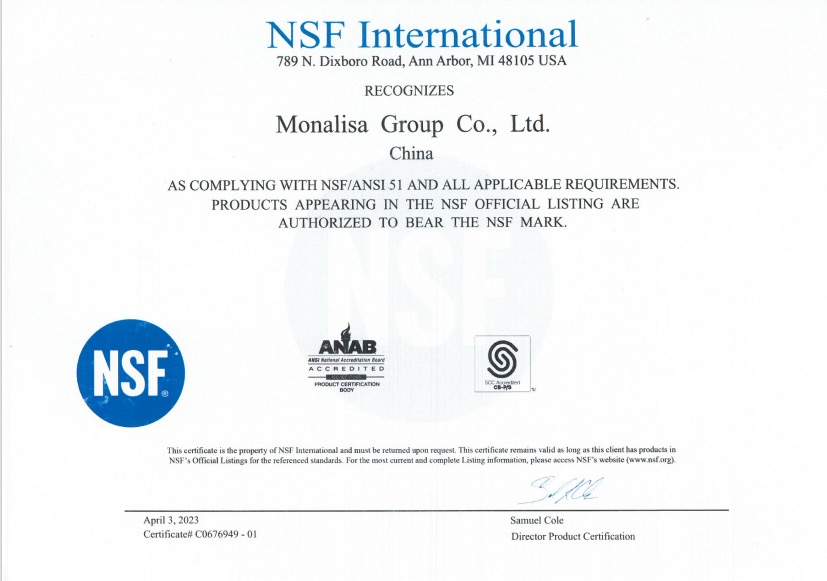
Two certificates are worth naming explicitly because they are the ones most often requested in tender documents:
- NSF certification C0676949-01, issued by NSF International on 3 April 2023, with a recorded validity through 3 April 2999 and coverage of the USA, EU and China markets. The certificate record lists 8FMB10032PM (3516), 120-270FEG12207M (3220) and the 90-270FDK09003M / 90-270FDK09008M slab among the related products.
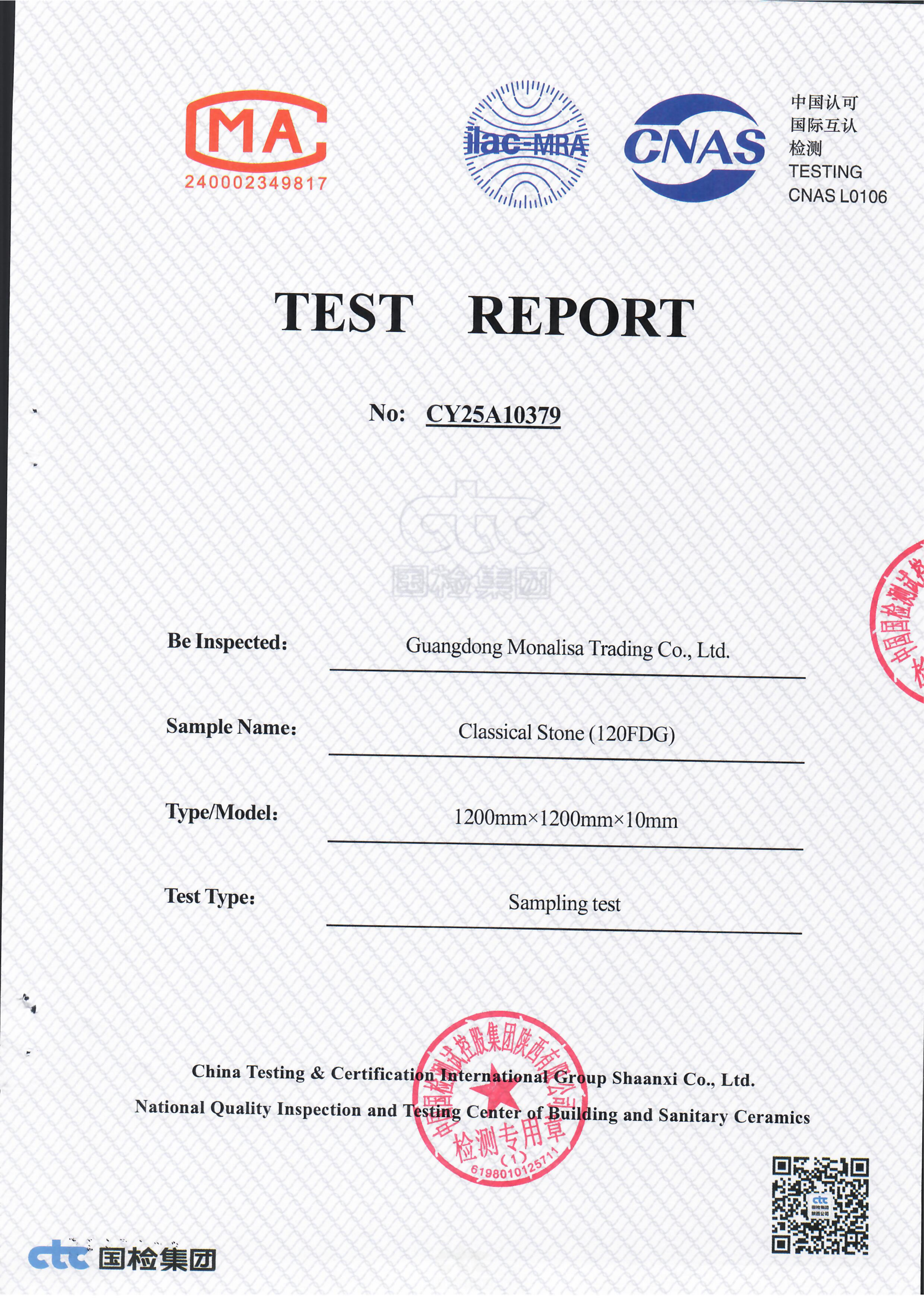
- CE certification CY25A10379-TVOC, issued 7 March 2025 by China Testing & Certification International Group Shaanxi Co., Ltd. and valid to 7 March 2035. It is issued under EN 14411:2016, the European standard covering the definition, classification, characteristics, assessment and verification of constancy of performance for ceramic tiles, and is recorded against the 1200×1200×10 mm work size, B I a, for wall and floor, glazed, even.
Two further technical points deserve attention before tender. The first is phase count. Both formats carry one in the technical sheet — eight phases for 8FMB10032PM and three for 120-270FEG12207M. A phase count describes how many distinct face patterns are produced within a series, and on long corridors, large lobbies or wide concourses it directly affects how visible pattern repetition becomes.
The second is fire performance. Requirements for flame spread and fire resistance of interior finishes in hospitals, schools and other public buildings are normally set by the applicable local building code rather than by the tile manufacturer. Buyers specifying porcelain tile into a hospital or school should therefore request the fire-related test documentation for the specific format and finish, and confirm it against the local code before the specification is frozen.
Matching formats to spaces
The table below maps project types to the Monalisa formats whose listed application scope covers them. It is not a ranking; it is a fit check against the product documentation.
| Space or project type | Monalisa format | Format and finish | Basis for the match |
|---|---|---|---|
| Hospitals, schools, kindergartens, libraries, museums, sports halls | Porcelain Tile 8FMB10032PM | 800×800×10 mm, 8 phases, glazed-polished | Public building applications are listed for this product; the format is also the one specified for a municipal airport project. |
| Hotel guest rooms, corridors, pool surrounds, shower areas, outdoor terraces | Porcelain Tile 120-270FEG12207M | 1200×2700×12 mm, matt / natural stone face | Hospitality and tourism applications are listed for this product, and it is covered by CE documentation under EN 14411:2016. |
| Shopping malls, supermarkets, office buildings, restaurants, cafes, gyms | Porcelain Tile 120-270FEG12207M or 8FMB10032PM | 1200×2700×12 mm or 800×800×10 mm | Both formats list commercial space applications including malls, offices and food service. |
| Pavements, plazas, park trails, public restrooms, metro station halls | Porcelain Tile 8FMB10032PM or 120-270FEG12207M | 800×800×10 mm or 1200×2700×12 mm | Municipal engineering applications are listed for both formats. |
| Luxury flagship stores, five-star hotel lobbies, fine dining, art galleries | Luxury Slab 90-270FDK09003M / 90-270FDK09008M | 900×2700×12 mm, 5 phases, glazed-matt | High-end commercial space applications are listed for the slab range. |
| Clean workshops, warehouse flooring, anti-static workshops | Porcelain tile formats | Format selected by load and specification | Industrial and logistics applications are listed for the porcelain tile range. |
| Agricultural and livestock flooring | Porcelain tile formats | Format selected by cleaning regime | Listed for flooring that is slip-resistant, chemical-resistant and easy to wash. |
A municipal-scale reference point: 80,000 m² at Jogjakarta Airport
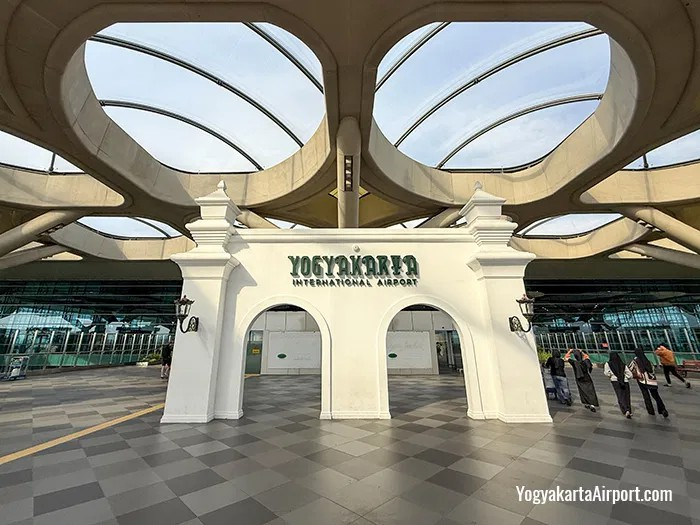
The largest publicly documented example of these formats in municipal use is Jogjakarta Airport in Indonesia, where a municipal government client specified 80,000 m² of porcelain tile over a two-year programme, using 8FMB10032PM. The project achieved a modern minimalist aesthetic.
The reported outcomes are the part most relevant to procurement. Life-cycle maintenance cost was 30% lower, and the tight-joint installation approach produced a 15% saving on grouting materials and labour. Breakage rate was below 0.3%, which reduced replacement losses. For a public building, that combination — a lower ongoing maintenance burden, a lower installation material cost, and a low breakage rate — is roughly what the business case looks like in practice, and it is the reason a specifier would choose a modular format with a low breakage history over a cheaper tile that fails during handling and installation.
What the market data shows
The porcelain tile market is expanding while its supply base consolidates. Spherical Insights values the global porcelain tiles market at approximately USD 9.73 billion in 2024, with a projected value of USD 18.33 billion by 2035. Within that market, glazed porcelain tile holds the largest segment share.
Supply-side data tells a more complicated story. China remains the world's top ceramic tile exporter, though export volumes fell 2.5% in 2024 to 600 million sqm, with 74% of exports absorbed by Asian markets, according to Ceramic World Web and the Mecs Research Centre. Total Chinese tile production fell 12.1% in 2024 to 5.91 billion sqm, representing 48% of the country's total production capacity, according to the China Building and Sanitary Ceramics Association.
The financial picture at manufacturer level reflects the same contraction. Monalisa Group Co., Ltd (002918.SZ) reported annual revenue of approximately CNY 3.92 billion for fiscal year 2025, a 15.28% decrease year over year. Read alongside the national production decline, the pattern is a market where tonnage is shrinking but specification requirements are tightening — which favours producers who can supply documentation, consistent batches and technical support rather than volume alone.
It is also a market with established global competitors. Industry reviews such as Ceramic World Review and Mordor Intelligence identify Mohawk Industries, Grupo Lamosa and SCG Ceramics among the leading producers in the ceramic and porcelain tile sector. For buyers, the practical consequence is that supplier comparison should be built on verifiable, project-specific criteria — format availability, certificate scope, batch continuity and after-sales terms — rather than on brand familiarity.
Porcelain tile compared with other finishes — including where it is the wrong choice
Porcelain tile is often presented as a universal answer. It is not. Each finish family trades something away, and the honest comparison below reflects that.
| Finish or material | Typical strength | Typical constraint |
|---|---|---|
| Porcelain tile (glazed or homogeneous body) | Very low water absorption; wide design range including stone, concrete and wood looks; suitable for floors and walls | Rigid and relatively heavy; large formats need adequate substrate preparation, mechanical handling and designed movement joints |
| Natural stone (marble, granite) | Distinctive appearance; can be re-polished in place | Requires sealing; absorption varies by stone; colour and veining continuity is harder to guarantee across a large order |
| Glazed ceramic wall tile | Lower unit cost; very broad decorative range | Generally a wall product rather than a heavy-duty floor finish |
| Resilient flooring (LVT, vinyl sheet) | Warm and quiet underfoot; fast to install and replace | More sensitive to prolonged moisture and heavy static or rolling loads; appearance changes over time |
| Poured terrazzo | Seamless, monolithic appearance | Site-cast process is slower; individual repairs are harder to blend into the surrounding surface |
Boundaries that should be planned for before tender
Four constraints matter more than most, and each is verifiable rather than hypothetical.
- Certification scope is format-specific. The CE certificate CY25A10379-TVOC is written around a defined work size and model. A specifier moving from one format to another must confirm that the certificate and test documentation apply to the exact size and finish being ordered, rather than assuming coverage transfers.
- Weight and substrate. A 1200×2700×12 mm panel is substantially heavier and more awkward to handle than a 600×600 mm tile. Installation requires mechanical handling equipment and a substrate planned for the load and for the joint layout. This is a real cost line in a retrofit, and it should be priced before the finish is selected.
- Minimum order quantity. Monalisa's OEM/ODM production runs on a minimum order quantity of 2,000 sqm, with a lead time of 7–15 days and a monthly capacity of 12.5 million m². Very small projects, or projects with a bespoke pattern request below that threshold, may need to adapt the specification instead of expecting a custom run.
- Porcelain does not flex. It is a rigid finish. Movement and expansion joints must be designed into the layout, and acoustic or underfoot-comfort requirements are better served by resilient or textile finishes in spaces where those factors dominate.
After-sales terms that affect the specification decision
Monalisa's standard terms include a product warranty of 5–15 years depending on series and project type, covering manufacturing defects such as colour difference, dimensional deviation and glaze cracks; free technical consultation on tiling layout, installation technique and substrate preparation; technical representation on site for large projects; complaint response within 24 hours with a solution within 7 working days; and same-batch tiles held in stock for two years for future replenishment or repair. That last term is the one that most often decides whether a public building can still be repaired with matching material five years after handover.
Future outlook
Three shifts appear likely to shape porcelain tile specification in commercial and public work over the next several years.
The first is documentation-led procurement. As public buyers tighten compliance requirements, the ability to produce certification, test reports and consistent batch records becomes a qualifying condition rather than an advantage. Monalisa's record includes 15 certifications, and its participation in drafting 49 national, industrial, local and group standards — alongside 892 authorised patents, of which 145 are invention patents — indicates the direction the company has invested in.
The second is the shift toward larger formats and lower joint density in high-traffic public interiors. Monalisa's development history runs this way: the 1800×900×5.5 mm large ceramic thin plate launched in 2007 won first prize at the China Building Materials Science and Technology Progress Award, and in 2021 the company launched a 9000×1800×10.5 mm ultra-large ceramic plate, setting a new record in China's ceramic industry.
The third is verified project experience as a selection filter. Monalisa's participation in major public works — eight venues of the Beijing Olympic Games, ten venues of the Guangzhou Asian Games, the Hong Kong-Zhuhai-Macao Bridge, designation as the ceramic tile supplier for the China Pavilion at Expo 2020 Dubai, and exclusive supply of official architectural ceramics for the 19th Asian Games Hangzhou 2022 — functions as evidence that the manufacturing system can hold specification and delivery at event scale.
FAQ
Which porcelain tile format is appropriate for hospitals, schools and other public buildings?
The 800×800×10 mm glazed-polished porcelain tile 8FMB10032PM lists public building applications including hospitals, schools, kindergartens, libraries, museums and sports halls, and is also listed for municipal engineering such as pavements, plazas, park trails, public restrooms and metro station halls. The 1200×2700×12 mm homogeneous body tile 120-270FEG12207M lists the same public building category alongside commercial, hospitality and municipal applications. The appropriate choice depends on the joint layout, substrate and maintenance regime of the specific building.
What certifications should a buyer confirm before specifying porcelain tile for a public project?
Two are commonly requested. NSF certification C0676949-01, issued by NSF International and covering the USA, EU and China markets, is recorded against 8FMB10032PM, 120-270FEG12207M and the 90-270FDK09003M / 90-270FDK09008M slab. CE certification CY25A10379-TVOC, issued under EN 14411:2016 and valid to 7 March 2035, is recorded against a defined 1200×1200×10 mm work size. Monalisa also holds 15 certifications including ISO 9001 and ISO 14001. Because certificate scopes are written around specific formats and work sizes, buyers should verify that the certificate applies to the exact product being ordered.
Which Monalisa product suits hotel lobbies, guest rooms and shopping malls?
The 1200×2700×12 mm homogeneous body porcelain tile 120-270FEG12207M is listed for commercial spaces including shopping malls, supermarkets, office buildings, restaurants, cafes and gyms, and for hospitality and tourism environments including guest rooms, corridors, pool surrounds, shower areas and outdoor terraces. Its matt or natural stone face and large panel size reduce the number of joints across a lobby or atrium. For luxury flagship stores, five-star hotel lobbies, fine dining and art galleries, the 900×2700×12 mm glazed-matt Luxury Slab is listed as an alternative.
How is a large public project supplied consistently over a multi-year programme?
Monalisa operates four production bases with 37 production lines, a monthly capacity of 12.5 million m² and 100% product testing, with an annual output of 100 million square metres from a 2,779,333.33 m² manufacturing footprint. Standard production lead time is 7–15 days with a minimum order quantity of 2,000 sqm for OEM/ODM runs, and customisation is available for pattern and logo. For continuity after handover, same-batch tiles are held in stock for two years for replenishment or repair replacement. The Jogjakarta Airport project, delivered over two years with 80,000 m² of tile, is a documented example of this kind of programme.
What are the practical limits of porcelain tile in commercial and public spaces?
Porcelain tile is rigid and relatively heavy, so large formats such as 1200×2700×12 mm require planned substrate preparation, mechanical handling and designed movement joints — factors that affect retrofit cost. Certification and test documentation is typically scoped to a specific format and work size, so coverage cannot be assumed to transfer between products. OEM/ODM production carries a minimum order quantity of 2,000 sqm, which may exclude very small bespoke projects. And in spaces where acoustic performance or underfoot warmth is the dominant requirement, resilient or textile finishes may serve the building better than a ceramic surface.
For full product data, format ranges and test documentation, Monalisa's public brochure is available here: Monalisa product brochure.