
Motor Capacitor Certificate FAQ: CBB60 TÜV, CD60 CQC and ISO 9001 Scope
Motor Capacitor Certificate FAQ: CBB60 TÜV, CD60 CQC and ISO 9001 Scope
A motor capacitor certificate answers the question written into its scope — and nothing beyond it. Taizhou Huifeng Electron Co., Ltd. circulates four documents that buyers frequently receive as one compliance pack: TÜV Rheinland certificate R 50500943 for CBB60 run capacitors, RoHS certificate of conformity G170323Z38EN, CQC product certification CQC09006039887 for the CD60 series, and ISO 9001 certificate 25024Q10313R1M. Each is real evidence of something specific, and each stops at a boundary printed on its face.
The recurring risk is not forgery. It is misreading: a quality-system certificate filed as product approval, a CD60 document attached to a CBB60 order, or a 2017 substance declaration treated as a batch test record. In each case the buyer believes a box has been ticked that the document never ticked. This review takes the four documents one at a time, states what each covers, and marks the point where a follow-up question should be asked before a purchase order is released.
Why certificate scope, not the certificate logo, decides the answer
Procurement teams rarely read certificates line by line; they recognise issuing bodies and file names. That shortcut works when documents are equivalent and fails when they are not. The four documents in this set come from three different certification bodies and describe three different levels of assurance: a capacitor type tested against a performance standard, a substance declaration tied to a European directive, a product certification tied to a Chinese national standard and a single series, and a management-system certificate covering production processes.
A scope statement normally fixes four variables — product identity (type designation or series), construction or technology, a ratings envelope, and the standard or directive applied. When any one of those four differs from the item on the purchase order, the certificate becomes adjacent evidence. It may still say something useful about the supplier, but it no longer closes the specific conformity question the buyer is asking.
Three misreadings account for most of the problems seen in capacitor documentation packs:
- System certificate read as product approval. ISO 9001 describes how production is organised. It does not test a capacitor and does not state a substance-restriction position.
- Series certificate applied across a product family. The CQC document in this set names the CD60 series and an aluminium electrolytic construction. It does not name CBB60 or any metallized film run capacitor.
- Declaration read as a batch record. The RoHS certificate confirms conformity for named items at the time of issue. It is not a per-lot test report and does not follow a shipment.
None of these errors requires bad faith on either side. The correction is procedural: read the scope against the purchase order, in writing, before the file is closed.
The four documents at a glance
The table condenses what each document states about itself. Where a detail matters to a purchasing decision — a capacitance value, a voltage, a validity date — the certificate text prevails over any summary, including this one.
| Document | Number and issuer | Standard or directive | What it addresses | Where its scope stops |
|---|---|---|---|---|
| TÜV Rheinland certificate | R 50500943 TÜV Rheinland LGA Products GmbH | EN 60252-1:2011+A1 | CBB60 (Huifeng) AC motor capacitor tested within a listed ratings envelope | Ratings outside the envelope, other series, substance restrictions, batch results |
| RoHS certificate of conformity | G170323Z38EN Ningbo GIG Testing Technology Service Co., Ltd. | Directive 2011/65/EU | CBB60 40 µF and CBB60 12 µF items, with CBB65, CBB61 and CD60 at model/type reference level | Capacitance values not named, REACH, per-shipment testing |
| CQC product certification | CQC09006039887 China Quality Certification Centre | GB/T 3667.2-2016 | CD60 series aluminium electrolytic capacitor, 250 VAC, 50–500 µF ±15%, 10/55/10, 50/60 Hz | CBB60 and other metallized film run capacitors |
| ISO 9001 certificate | 25024Q10313R1M Zhongqiu United International Certification (Beijing) Co., Ltd. | GB/T 19001-2016 idt ISO 9001:2015 | Production of aluminium electrolytic capacitors for AC motors, metallized film dielectric capacitors and self-healing low-voltage shunt capacitors; valid 1 March 2024 to 14 March 2027 | Product conformity, batch testing, RoHS or REACH declarations |
Scope summaries condensed from the four documents; the certificate text prevails in any dispute.
CBB60 TÜV Rheinland certificate R 50500943: product-level evidence with a defined envelope
Certificate R 50500943 was issued on 14 April 2021 by TÜV Rheinland LGA Products GmbH. It records testing of the type designation “CBB60 (Huifeng)” as an AC motor capacitor against EN 60252-1:2011+A1. Of the four documents, this is the clearest product-level evidence: a third-party assessment attached to a named capacitor type rather than to a production system or a substance list.
What makes it usable in a purchasing decision is the envelope printed on the certificate:
- Rated voltage: AC 370 V, 380 V, 390 V, 400 V, 410 V, 420 V, 430 V, 440 V and 450 V
- Rated frequency: 50/60 Hz
- Rated capacitance: 1 µF to 60 µF
- Capacitance tolerance: ±5%
- Climatic category: 40/85/21 and 25/70/21
A specification inside those limits maps to the certificate without further interpretation. A specification outside them — a higher AC working voltage, a capacitance above 60 µF, a wider tolerance band or a different climatic category — is not covered by this document, even if the part is still a CBB60 in commercial terms. In that situation the correct step is to ask which document covers the configuration, not to stretch the nearest certificate.
Three further details matter in practice. First, the type designation is supplier-specific: “CBB60 (Huifeng)” identifies this manufacturer's type, so a competitor's CBB60 requires its own certification. Second, the standard is cited with its amendment, EN 60252-1:2011+A1, which is the form a tender should be checked against. Third, the relevant IEC family is broad — the IEC 60252-1:2010 scope covers motor capacitors for asynchronous motors supplied from a single-phase system at frequencies up to and including 100 Hz, with rated voltages up to and including 660 V — so a certificate is always narrower than the standard it references.
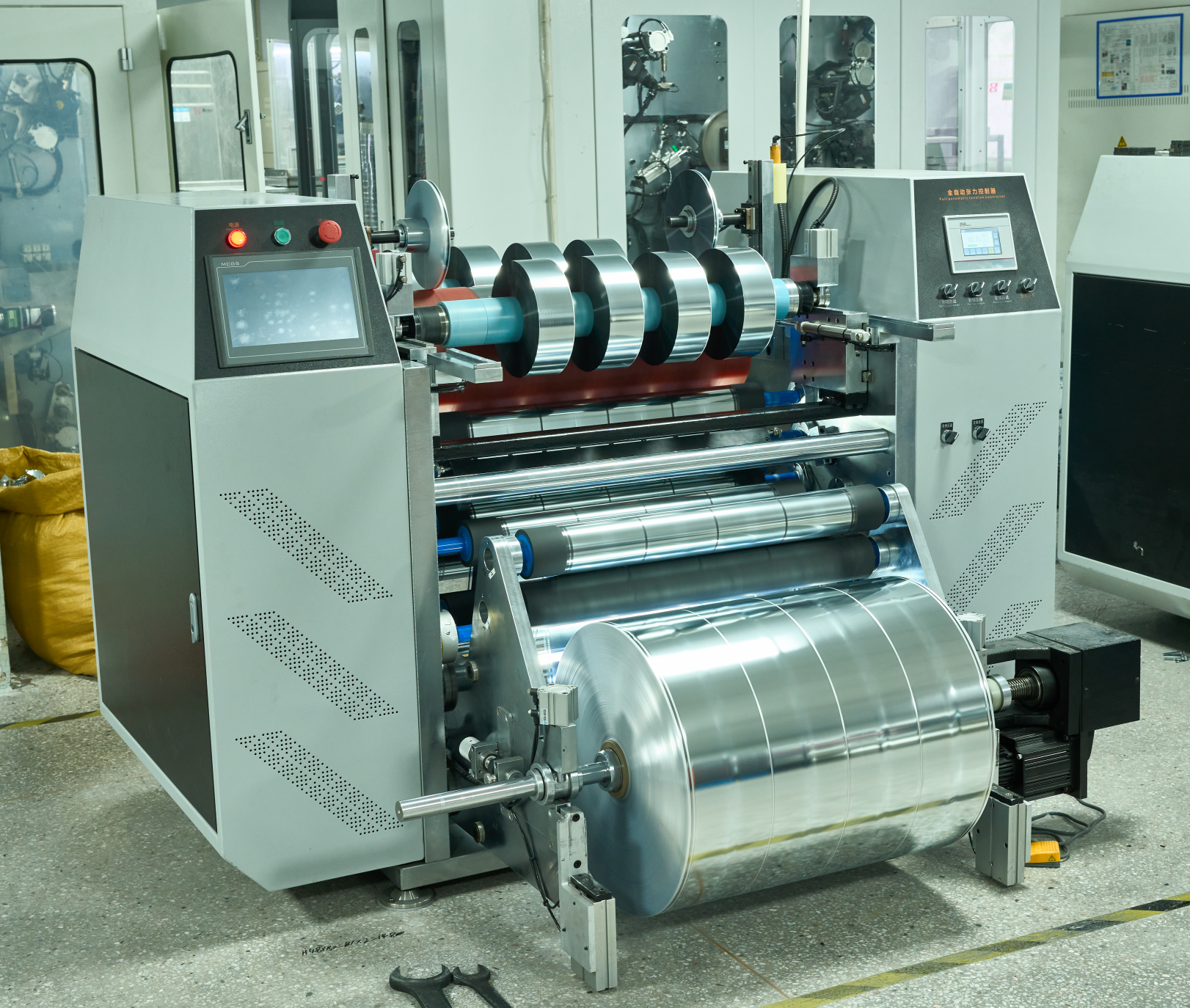
Film cutting ahead of winding: the metallized polypropylene construction behind the CBB60 run capacitor family, the product type addressed by TÜV Rheinland certificate R 50500943.
RoHS certificate G170323Z38EN: substance compliance with a model list worth reading closely
RoHS certificate of conformity G170323Z38EN was issued on 14 April 2017 by Ningbo GIG Testing Technology Service Co., Ltd. and cites Directive 2011/65/EU on the restriction of hazardous substances. Its declared scope reads: Capacitor CBB60 (40 µF ±5%) and CBB60 (12 µF ±5%), with CBB65, CBB61 and CD60 listed as model/type reference.
That sentence has two layers, and the difference matters when a buyer is specifying a value that is not on the list. The two capacitance values — 40 µF and 12 µF, both ±5% — are identified at value level. The other designations appear as model/type references. A buyer sourcing 25 µF, 30 µF or 50 µF run capacitors should therefore ask how the declaration maps to that value, rather than assuming the document simply travels with the whole series.
The document is a conformity declaration, not a test record for a shipment. It states a position against a substance directive at a point in time; it does not report results for a specific production lot, and it says nothing about electrical performance or endurance. Buyers should also note its stated standard: Directive 2011/65/EU. A REACH SVHC statement is a different document type and should be requested separately when the compliance file requires one.
The 2017 issue date is the other practical point. Where a buyer's compliance team works to a current restricted-substance list, or where an end customer asks for a declaration aligned to a later consolidated text, the useful action is to confirm the mapping with the supplier. A dated declaration is valuable evidence of a tested position; it is not self-updating.
CQC09006039887: a CD60 document that cannot serve as CBB60 approval
CQC product certification CQC09006039887 was issued on 9 May 2023 by the China Quality Certification Centre under GB/T 3667.2-2016. Its declared scope describes an A.C. motor aluminium electrolytic capacitor, CD60 series, 250 VAC, 50 µF–500 µF ±15%, climatic category 10/55/10, 50/60 Hz.
That single sentence carries three limits that should be separated before the document is filed against a purchase order: a construction (aluminium electrolytic), a series (CD60), and a ratings window (250 V AC, 50–500 µF, ±15%, 10/55/10, 50/60 Hz). Nothing in the scope names CBB60 or any metallized film run capacitor.
The boundary is technical rather than administrative. CBB60 is a metallized polypropylene film run capacitor built for continuous duty; CD60 is an aluminium electrolytic start capacitor intended for short starting service. Different construction, different duty profile, and in this document set different certification routes. The CQC scope describes exactly the construction and series it covers, which is why the limit is a scope statement rather than an omission.
Practical consequence for tenders. When a questionnaire asks “do you hold CQC certification?”, the accurate answer is series-specific. Sending CQC09006039887 in response to a CBB60 run capacitor enquiry supplies a valid document for a different product. The better follow-up is to ask which certificate the specification actually depends on: for a run capacitor, the product-level TÜV document and the RoHS declaration are the relevant pair.
The same reading works in reverse. For a CD60 start capacitor order, CQC09006039887 is the series-specific document, and the appropriate technical question is whether the required capacitance and voltage sit inside the stated 250 V AC, 50–500 µF window — not whether the supplier also holds a run-capacitor certificate.
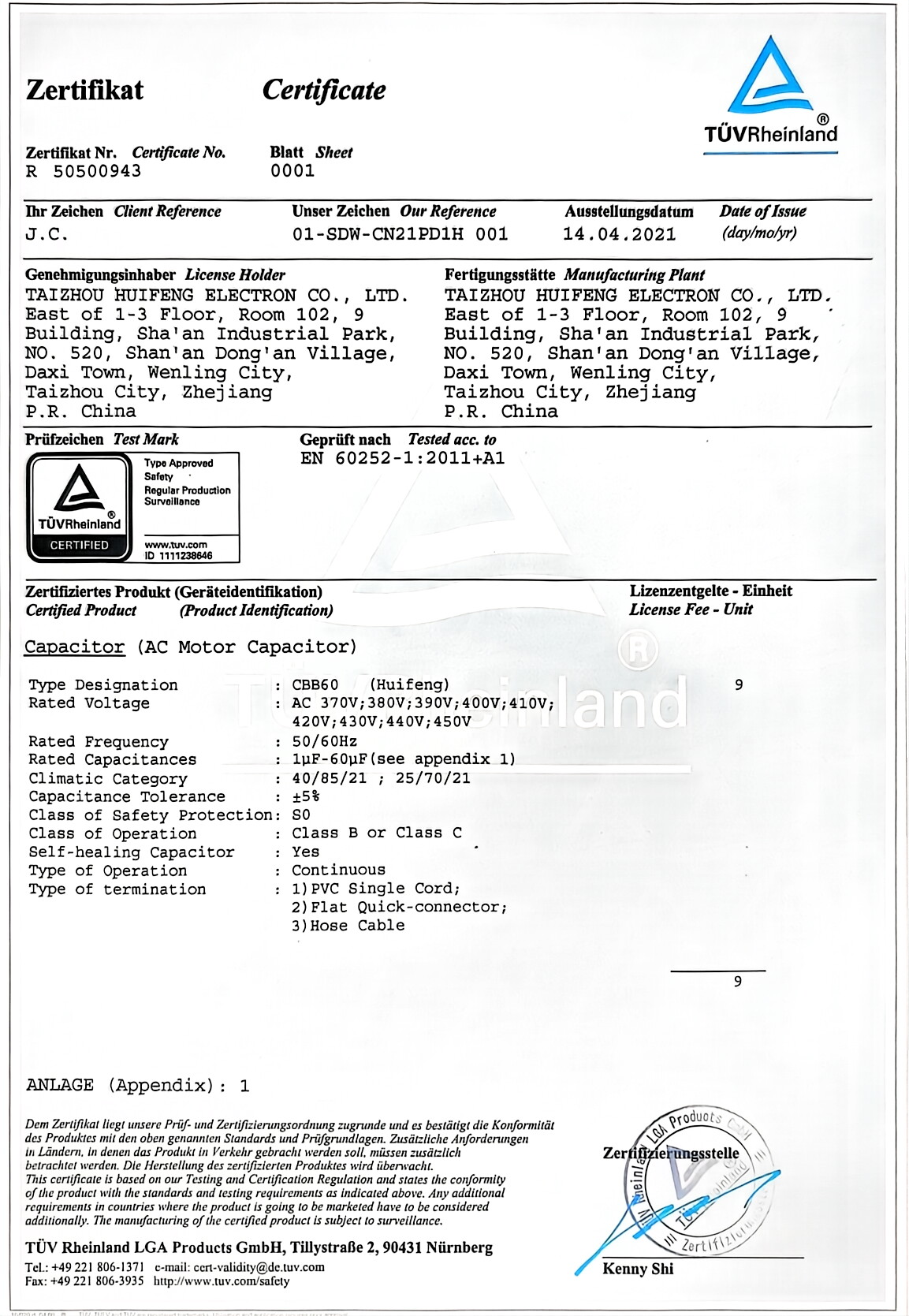
Certificate R 50500943, issued 14 April 2021: the ratings envelope and the type designation printed on the document define what it can be used to support.
ISO 9001 certificate 25024Q10313R1M: system evidence, not product approval
ISO 9001 certificate 25024Q10313R1M was issued on 1 March 2024 by Zhongqiu United International Certification (Beijing) Co., Ltd. under GB/T 19001-2016 idt ISO 9001:2015, with validity to 14 March 2027. Its scope reads: production of aluminum electrolytic capacitors for AC motors, metallized film dielectric capacitors and self-healing low-voltage shunt capacitors.
What that establishes is that both capacitor families are produced under a certified quality management system, with a certification body's audit behind the certificate. What it does not establish is that any individual capacitor meets a performance standard, that a shipment passed a test, or that products comply with a substance restriction. The scope describes processes, not products.
Two features of this document are commonly misread. The process scope is broad — it names metallized film dielectric capacitors alongside aluminium electrolytic types — but breadth of process coverage is not product approval, and the certificate does not specify RoHS or REACH declarations at all. Separately, the certificate carries an explicit validity period, 1 March 2024 to 14 March 2027, so a copy held in a supplier file should be checked for currency rather than assumed current.
Batch assurance therefore has to come from somewhere else: the supplier's production testing, agreed sampling at incoming inspection, and lot-level records defined in the purchase contract. Taizhou Huifeng Electron describes quality control based on 100% testing of semi-finished products and finished products, with a final check on appearance and details during packaging. That is a process description from the manufacturer, and it is the correct complement to — not a substitute for — the four certificates discussed here.
From evaluation to execution: a repeatable scope check
A buyer moving from shortlisting to order release needs a check that can be repeated for every document and every specification. Seven steps cover the work:
- Classify the document: product certificate, conformity declaration, series-specific product certification, or management-system certificate.
- Match the product identity: type designation or series against the part number on the purchase order.
- Match the construction: metallized film run capacitor or aluminium electrolytic start capacitor.
- Check the ratings envelope: capacitance, rated voltage, frequency, tolerance and climatic category.
- Check the standard and its edition against the tender or customer specification.
- Check the issue date and validity, and request the current revision.
- Record which document answers which clause of the compliance file, and name the gap explicitly where none does.
Applied to typical orders, the mapping becomes straightforward. For CBB60 run capacitors in pumps, fans and washing machines, the relevant pair is the TÜV product certificate — provided the ratings sit inside the stated envelope — plus the RoHS declaration for the named values. For CD60 start capacitors on single-phase motors, the series-specific CQC document applies. Where a specification calls for CBB65 film run capacitors, as used in air-conditioning and refrigeration equipment, the documents in this set mention CBB65 only at model/type reference level on the RoHS declaration, so the conformity question needs a separate answer.
Custom configurations concentrate the scope question. Huifeng's customization options cover capacitance, voltage, casing, lead-out method, brand or logo, printing method, packaging method and label stickers — several of which change exactly the variables a certificate fixes. The company states a minimum order of 300 units for regular items and 1,000 units for customized items, a 25–35 day lead time and monthly capacity of 650,000 units. Before a custom release, the buyer should establish which document covers the new ratings rather than assuming a standard-range certificate follows the part. A company-reported ODM project for a wholesaler in the United Arab Emirates, covering 100,000 CBB60 units for water-pump motors over two years, illustrates the order scale at which that documentation discipline pays for itself.
What the four documents do not establish
Stating the limits plainly is more useful than implying completeness. None of the four documents provides batch-level results for a specific shipment, a REACH SVHC position, or proof that a capacitor suits a particular motor without the motor manufacturer's specification. The TÜV and RoHS documents in this set record the European market, the CQC document is a Chinese certification scheme, and the ISO 9001 certificate is issued in China; requirements for other destinations should be reviewed separately rather than inferred.
There is also a functional limit that no certificate can remove. Run capacitors and start capacitors perform different jobs, and a document covering one product family says nothing about the suitability of the other in a given circuit. Certificate review answers the documentation question; the electrical question still belongs to the motor specification and the sample approval.
Frequently asked questions
Does TÜV certificate R 50500943 cover every CBB60 capacitance and voltage?
No. The certificate covers the type designation CBB60 (Huifeng) within a defined envelope: rated capacitance 1 µF to 60 µF, rated voltages AC 370 V through 450 V in the listed steps, 50/60 Hz, ±5% tolerance, and climatic categories 40/85/21 and 25/70/21. A requirement outside that envelope — a higher voltage, a larger capacitance or a different tolerance — is not covered by this document and needs its own supporting evidence.
Can CQC09006039887 be used as evidence for CBB60 run capacitors?
No. Its scope names an A.C. motor aluminium electrolytic capacitor of the CD60 series, 250 VAC, 50 µF–500 µF ±15%, climatic category 10/55/10, 50/60 Hz, certified to GB/T 3667.2-2016. CBB60 is a metallized polypropylene film run capacitor, a different construction and series. A CBB60 compliance file should rely on the product-level TÜV document and the RoHS declaration instead.
Does ISO 9001 certificate 25024Q10313R1M prove RoHS or REACH compliance?
No. The certificate covers the quality management system for the production of aluminium electrolytic capacitors for AC motors, metallized film dielectric capacitors and self-healing low-voltage shunt capacitors, and it does not specify RoHS or REACH declarations. It is also not a batch test report. Substance compliance is answered by the RoHS certificate of conformity G170323Z38EN, and a REACH SVHC statement must be requested as a separate document.
Which document covers a CBB60 capacitance that the RoHS declaration does not name?
The RoHS declaration names CBB60 40 µF ±5% and CBB60 12 µF ±5% at value level, with CBB65, CBB61 and CD60 as model/type reference. For a different capacitance, ask for a document that names that value. Note that the TÜV certificate answers a different question: it addresses performance and safety testing across 1 µF to 60 µF, not substance restriction. Both questions therefore need their own answer in the compliance file.
What changes in the document set when a CBB60 is customized?
Customization covers capacitance, voltage, casing, lead-out method, brand or logo, printing method, packaging method and label stickers, and several of these change the variables a certificate fixes. The stated minimum order is 1,000 units for customized items against 300 units for regular items, with a 25–35 day lead time. Buyers should confirm which document covers the customized ratings before release rather than assuming the standard-range certificate transfers.
How current are the four documents?
The TÜV Rheinland certificate was issued on 14 April 2021, the RoHS certificate on 14 April 2017, the CQC certification on 9 May 2023, and the ISO 9001 certificate on 1 March 2024 with validity to 14 March 2027. Because issue dates differ widely across one pack, buyers should request the current revision of each document instead of relying on the copy already in the file.
Outlook: scope discipline scales with supplier volume
One commercial research estimate places the global motor capacitor market at approximately USD 24.04 billion in 2025, with a projected compound annual growth rate of 4.77% from 2025 to 2032 (Maximize Market Research; a single commercial source, so the figure is best read as an order-of-magnitude indicator rather than a validated forecast). Whatever the true trajectory, the documentation workload moves in one direction: more suppliers, more series and more destination markets mean more documents to file, and more chances to file the wrong one against a purchase order.
The durable response is a scope-first habit. A certificate is not a badge; it is a statement with edges. Reading those edges against the specification takes a few minutes per document and prevents the more expensive discovery — after goods arrive — that the evidence never covered the part.
Read together, the four documents give a buyer a defensible picture. TÜV Rheinland R 50500943 answers the CBB60 performance question inside a defined envelope, G170323Z38EN answers the substance question for named capacitance values, CQC09006039887 answers a CD60 series question, and 25024Q10313R1M answers a production-system question. Where a requirement falls outside all four, the correct action is to ask rather than to file the nearest available certificate.
Reference material: the manufacturer's product and capability brochure is available for download — Taizhou Huifeng Electron brochure (PDF).
Have Questions or Need More Details?
Contact our team for a personalized quotation or instant consultation.
Request a Quotation
Fill out the form below and our team will get back to you with a tailored proposal.
WhatsApp Direct Chat
Prefer to chat in real-time? Message us on WhatsApp for instant assistance & quick answers.
- Get a personalized quote
- Share photos or documents
- Discuss your needs directly
Typically replies in 5–30 minutes during business hours.