
Motor Start Capacitor Specs: What CD60 Ratings Really Mean
A motor start capacitor is defined by duty rather than by size. In a single-phase motor circuit it is typically energised only while the motor accelerates and is taken out of the circuit once the rotor approaches running speed, so its datasheet describes a brief electrical event rather than years of continuous service. That single characteristic explains why start-capacitor specifications look so different from run-capacitor specifications: capacitance in the hundreds of microfarads, a wider tolerance band, a shorter test-voltage duration, and a climate category that has to be read in context.
The practical problem for a buyer moving from research into evaluation is not finding suppliers who list a start capacitor. It is deciding whether two catalogues are describing the same component, and whether the certificate attached to one part number actually applies to the part number being ordered. The CD60 aluminium electrolytic motor start capacitor produced by Taizhou Huifeng Electron Co., Ltd. — a capacitor manufacturer founded in 1993 and based in Wenling, Zhejiang Province, China — is a useful reference case, because its published specification, its certification scope and its production model do not all describe the same set of values. Those gaps are exactly what a procurement team has to close before issuing a purchase order.
Why start-capacitor specifications are harder to compare than they look
Motor capacitors are often discussed as a single product category, but they are a family of parts with different dielectric systems, different duty cycles and different enclosure conventions. The distinction that matters first is functional. CBB60 metallized polypropylene film capacitors are continuous-duty run capacitors, while CD60 aluminium electrolytic capacitors are start capacitors built for short-duration service. These two roles are not interchangeable, and substituting one for the other without motor-specific validation converts a cost saving into a qualification risk.
That functional split sits underneath a wider standard boundary. IEC 60252-1, the international standard most often cited for motor capacitors, applies to capacitors intended for connection to windings of asynchronous motors supplied from a single-phase system having a frequency up to and including 100 Hz, and also to capacitors connected to three-phase asynchronous motors so that those motors may be supplied from a single-phase system. Its scope covers impregnated or unimpregnated capacitors with a dielectric of paper, plastic film, or a combination of both, either metallized or with metal-foil electrodes, at rated voltages up to and including 660 V. The standard therefore frames the whole family, but it does not tell a buyer which family member belongs in a given motor.
For a procurement engineer, the real work begins when two supplier documents both say "CD60" and still disagree on tolerance, voltage steps, climate category or certification scope. A start capacitor is a low-unit-cost part with a disproportionate effect on whether a pump, a fan motor or a single-phase drive starts cleanly, so the cost of getting the comparison wrong is measured in returns and service calls rather than in component price.
Reading a CD60 datasheet: the numbers that decide fit
The published CD60 specification is compact. What matters is not memorising the values but knowing which decision each value governs.
| Parameter | Published CD60 value | What it constrains in practice |
|---|---|---|
| Capacitance range | 50 µF to 1500 µF | Available starting torque window; the smallest and largest frames a supplier can offer without a separate design |
| Rated voltage | 125 VAC; 200/250 VAC; 300/330 VAC | Which supply voltages the part can be specified for, and how much headroom remains at the motor terminal |
| Capacitance tolerance | ±15 %; −10 % to +20 % | Spread of starting behaviour across a production batch; a deliberately asymmetric band, not a symmetric one |
| Loss tangent | tgδ ≤ 0.15 at 100 Hz, 20 °C | Internal heating during the start interval; a limit condition rather than a typical value |
| Test voltage between terminals | 1.2 UN for 2 seconds | The dielectric withstand level applied in production testing, and therefore the basis of incoming inspection |
| Climate category | 10/55/21 | Lower category temperature, upper category temperature and damp-heat exposure, read as a coded triplet |
| Product standard | GB/T 3667.2-2016 | The national standard the part is declared against, and the reference point for any test report |
| Construction | Aluminium case; white plastic cover; aluminium foil and electrolytic paper dielectric; vacuum-impregnated core; cable or wire leads | Mounting, termination method and the thermal behaviour of the element |
Two of these rows deserve more attention than they usually get. The first is the tolerance band. A symmetric ±5 % band, typical of metallized film run capacitors, and an asymmetric −10 % to +20 % band on an electrolytic start capacitor describe different manufacturing physics: an electrolytic element is formed and impregnated rather than wound to a fixed film area, so the distribution is not centred the way a film capacitor's is. A buyer comparing a CD60 against a CBB60 on tolerance alone is comparing two different measurement intents.
The second is the climate category. Capacitor datasheets conventionally encode climate class as a triplet: the lower category temperature, the upper category temperature, and a damp-heat duration in days. Read that way, 10/55/21 describes a part qualified down to −10 °C, up to +55 °C, with a 21-day damp-heat exposure. That is a materially wider upper-temperature window than a 25/70/21 film run capacitor in one direction and a narrower one in another, and it matters because a start capacitor mounted beside a compressor or inside a pump housing does not operate at ambient room temperature.
Neither the CD60 datasheet nor the run-capacitor datasheets declare an expected service life in hours in the same way. CBB60 and CBB65 specifications state an expected usage time of 3000 hours; the published CD60 specification does not carry an equivalent hour figure, which is a normal consequence of a part whose electrical stress is concentrated into seconds per start rather than into continuous operation. Buyers who expect an hours figure for a start capacitor should ask what the supplier's validation basis actually is instead of assuming one exists.
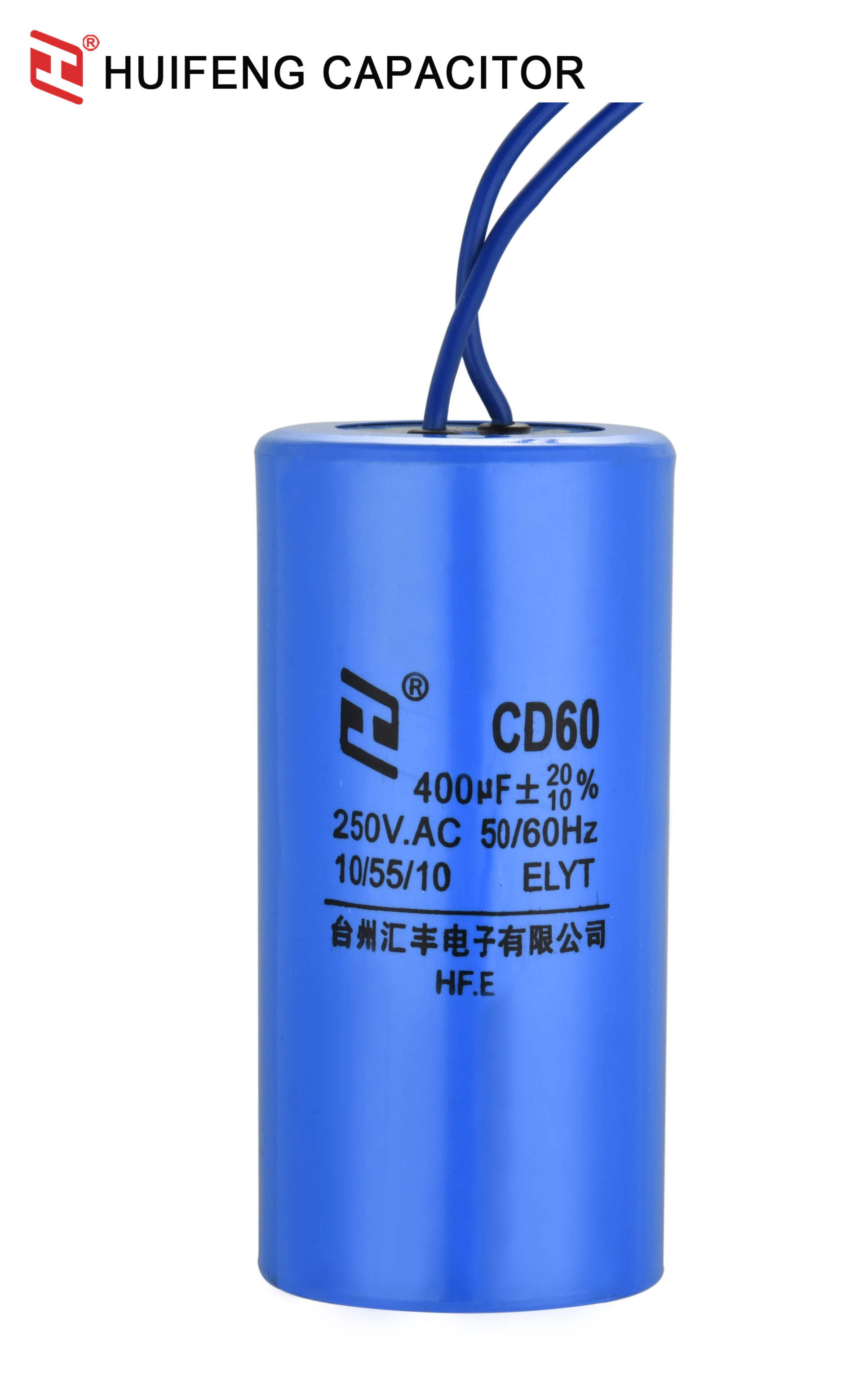
A CD60 motor start capacitor in its aluminium case with wire leads — the termination style most commonly used where the capacitor sits inside a motor terminal box.
Certification coverage: where the evidence for a CD60 actually stops
Certification is the part of a start-capacitor evaluation where buyers most often over-read a document. A certificate proves something specific about a specific scope; it does not prove that every product in a supplier's catalogue inherits the same status. For Taizhou Huifeng Electron, four documents exist, and each one stops at a defined point.
| Document | Issuer and reference | What it covers | Where it stops |
|---|---|---|---|
| CQC product certification | China Quality Certification Centre, CQC09006039887, issued 9 May 2023 | A.C. motor aluminium electrolytic capacitor, CD60 series, 250 VAC, 50 µF to 500 µF, ±15 %, climatic category 10/55/10, 50/60 Hz, against GB/T 3667.2-2016; recorded as long-term valid | The scope names a single rated voltage and a capacitance ceiling of 500 µF, while the product datasheet covers three voltage steps and up to 1500 µF |
| RoHS certificate of conformity | Ningbo GIG Testing Technology Service Co., Ltd., G170323Z38EN, issued 14 April 2017 | Directive 2011/65/EU (RoHS); tested capacitors listed as CBB60 40 µF ±5 % and CBB60 12 µF ±5 %, with model/type reference CBB65, CBB61 and CD60 | The tested items are CBB60 capacitance values; CD60 appears as a model reference, not as a tested capacitance point |
| TÜV Rheinland safety certification | TÜV Rheinland LGA Products GmbH, R 50500943, issued 14 April 2021 | Capacitor (AC motor capacitor), type designation CBB60 (Huifeng), AC 370 V to 450 V, 1 µF to 60 µF, ±5 %, 50/60 Hz, climatic category 40/85/21 or 25/70/21, against EN 60252-1:2011+A1 | The certified type designation is CBB60; the certificate is not a CD60 document |
| ISO 9001 quality management system | Zhongqiu United International Certification (Beijing) Co., Ltd., 25024Q10313R1M, valid 1 March 2024 to 14 March 2027 | Production of aluminium electrolytic capacitors for AC motors, metallized film dielectric capacitors and self-healing low-voltage shunt capacitors, against GB/T19001-2016 idt ISO9001:2015 | A management-system certificate addresses process control, not the electrical conformity of any individual part number |
This is not a criticism of the supplier; it is how product certification works across the industry. CQC scopes are written around the models and ratings submitted for testing, and TÜV certificates are written around a named type designation. The error is almost always on the buyer's side, when a certificate is filed against an order it does not cover. Reading the scope line before the certificate number is the single most effective habit in this category.
Aluminium foil, electrolyte and the core: how a CD60 is built
A CD60 is an electrolytic device, not a film device, and its construction explains much of its specification. Aluminium foil and electrolytic paper form the electrode and separator system; the wound core is vacuum-impregnated with electrolyte; the element is housed in an aluminium casing closed with a white plastic cover, with cable or wire leads. Each of those steps shifts the electrical result — impregnation quality affects loss tangent, foil condition affects withstand voltage, and the seal affects how the part behaves over a service life spent in a warm enclosure.
Taizhou Huifeng Electron manufactures its own capacitor cores rather than buying them in, and the company also produces the metallized film used in its film-capacitor lines through three sets of vacuum electroplating equipment. Core production in-house is relevant to start capacitors for a specific reason: the electrolytic core is where tolerance, loss tangent and withstand behaviour are actually determined, so vertical control over that step removes one layer of incoming inspection between the foil and the finished part.
The production model around the CD60 is built for a component that customers order repeatedly in modest volumes. Monthly capacity is stated at 650,000 units, against an annual output of 7,200,000 pieces across the product range from a 10,000 m² facility with 50 employees. Quality control is a 100 % test regime covering both semi-finished and finished product rather than an AQL sample. Customisation is offered on an ODM basis across capacitance, voltage, casing, lead-out method, brand or logo, printing method, packaging method and label stickers. Minimum order quantities are 300 units for regular items and 1000 units for customised items, with a lead time of 25 to 35 days. Standard products are held in inventory to support repeat orders, and after-sales support is provided by sales and technical staff together.
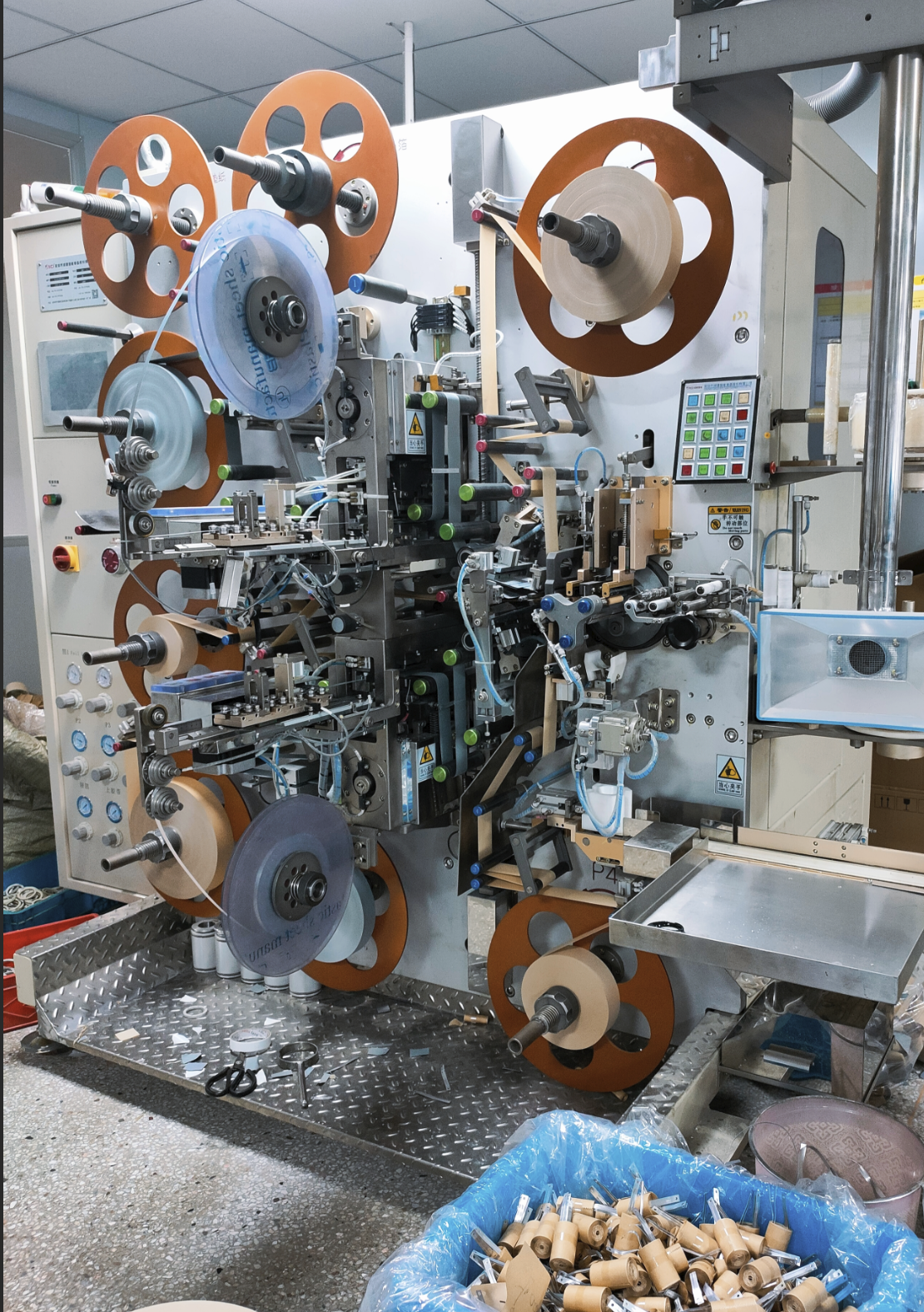
Winding a CD60 start-capacitor core. The wound element is subsequently vacuum-impregnated with electrolyte before it is housed in the aluminium case.
Where start capacitors are specified in practice
Start capacitors concentrate in applications where a single-phase motor has to overcome a standing load. The declared application field for the CD60 series is water pump motor manufacturing, together with capacitor wholesalers, distributors and the maintenance and repair trade; the part is described as widely used for starting 50 Hz and 60 Hz AC single-phase motors. That distribution channel matters as much as the technical fit, because a wholesaler stocks by number of distinct ratings rather than by depth per rating, and a repair operation buys against an immediate fault rather than against a forecast.
The working conditions that shape the requirement are demanding in a specific way. Pump motors run hot and run continuously once started, so the capacitor is expected to deliver high insulation, stable capacitance, resistance to ageing and a long service life even though its own energised interval is short. A start capacitor that drifts in capacitance does not fail dramatically; it produces a motor that becomes progressively harder to start, which is a much more expensive fault to diagnose in the field.
A two-year supply relationship with a wholesaler in the United Arab Emirates illustrates how the commercial side works in this category. The customer ordered 100,000 units on an ODM basis for water pump and motor applications, with the stated results being stable performance and no negative reviews, and the stated highlights being precise voltage withstand, voltage stability and long life. For a buyer evaluating a first order, the useful part of that record is not the volume — it is that the same specification was reconfirmed across a multi-year repeat cycle rather than validated once at sampling.
Market direction: steady growth and heavier documentation
Motor capacitors are a mature component category attached to a large installed base of pumps, fans, compressors and small single-phase drives. One commercial research publisher, Maximize Market Research, estimates the global motor capacitor market at approximately USD 24.04 billion in 2025 and projects a compound annual growth rate of 4.77 % from 2025 to 2032. That figure should be read as a single commercial estimate rather than a consensus number, and it aggregates run and start types together, so it indicates direction rather than a specific opportunity in start capacitors.
The direction it indicates is nonetheless consistent with what buyers see at the transaction level. A mid-single-digit growth rate implies a market driven mainly by replacement and by incremental appliance and pump production rather than by sudden demand spikes, which in turn favours suppliers with stable capacity and repeatable documentation over suppliers competing on price alone. In the same period, the documentation expectation is rising: buyers increasingly ask for a certificate scope that names the ordered rating, a test voltage consistent with the declared standard, and a management-system certificate that covers the actual production process. For a manufacturer operating under ISO 9001 with a CQC scope for the CD60 series, that shift is manageable; for a trading intermediary without first-party test records, it is increasingly difficult.
Start, run or HVAC: choosing the right family, and the limits of each
Three product families cover most single-phase motor applications, and each has a boundary that buyers should state explicitly in the specification rather than discover at commissioning.
| Attribute | CD60 start capacitor | CBB60 run capacitor | CBB65 run capacitor |
|---|---|---|---|
| Duty | Short-duration starting | Continuous running | Continuous running |
| Dielectric | Aluminium foil and electrolytic paper, vacuum-impregnated with electrolyte | Polypropylene film or metallized safety film coated with zinc and aluminium | Polypropylene film or metallized safety film coated with zinc and aluminium |
| Enclosure | Aluminium case, white plastic cover | Cylindrical plastic case, flame-retardant epoxy encapsulation | Aluminium case, flame-retardant epoxy encapsulation |
| Capacitance range | 50 µF to 1500 µF | 1 µF to 150 µF | 1 µF to 120 µF |
| Rated voltage | 125 VAC; 200/250 VAC; 300/330 VAC | 250/300 VAC; 320/370 VAC; 400/450 VAC | 250/300 VAC; 320/370 VAC; 400/450 VAC |
| Capacitance tolerance | ±15 %; −10 % to +20 % | ±5 % | ±5 % |
| Test voltage | 1.2 UN, 2 s | 2 UN, 2 s | 2 UN, 2 s |
| Declared standard | GB/T 3667.2-2016 | GB/T 3667.1-2016 | GB/T 3667.1-2016 |
| Climate category | 10/55/21 | 25/70/21; 40/85/21 | 25/70/21; 40/85/21 |
| Declared usage time | Not stated in the published datasheet | 3000 hours | 3000 hours |
| Typical application field | Starting single-phase pump and general-purpose motors | Pumps, washing machines, air compressors, fan motors | Air-conditioning and refrigeration equipment |
Three limits follow directly from that table. First, a CD60 is not a continuous-duty part: it is designed to be energised during acceleration, and using an electrolytic start capacitor as a run capacitor ignores the duty distinction the whole family is built around. Second, the CD60's published voltage steps begin at 125 VAC and the run capacitors begin at 250/300 VAC, so cross-family substitution is not a matter of matching capacitance — the voltage architecture differs. Third, the declared standard differs between the families, GB/T 3667.2-2016 for the start type and GB/T 3667.1-2016 for the run types, so a test report written against one is not automatically valid for the other.
A fourth limit is documentary rather than electrical. The TÜV Rheinland safety certificate in this portfolio names CBB60, and the CQC certificate in this portfolio names the CD60 series at 250 VAC and 50 µF to 500 µF. Buyers who need third-party evidence at 125 VAC or at 1000 µF are outside both scopes and should plan for supplier test data or a project-specific certification route instead of quoting a certificate number that does not reach their specification.
What belongs in the RFQ
Because so much of the risk in this category is documentary, the enquiry document carries most of the protection. A start-capacitor RFQ that resolves the following points produces comparable quotations; one that does not produces quotations that appear comparable and are not.
- The ordered rating, written as the full triplet. Capacitance, rated voltage and tolerance band together, not capacitance alone.
- The duty statement. Starting service for a single-phase motor, with the start interval and the number of starts per hour described qualitatively if the exact figures are not yet fixed.
- The climate category required. State it; do not accept a default, because the CQC scope and the datasheet may not name the same category.
- The standard and the test voltage expected. GB/T 3667.2-2016 and 1.2 UN for 2 seconds is the declared basis for the CD60 series; confirm that incoming inspection will use the same basis.
- The termination and enclosure. Cable or wire leads, lead length, aluminium case finish and the cover type all affect assembly time at the motor plant.
- The certificate expectations, by scope. Ask the supplier to state which certificate covers the ordered rating and to declare, in writing, which ratings it does not cover.
- Customisation items, separated from standard items. Marking, printing, packaging and labelling carry different minimum quantities from the electrical specification itself.
- Volume, delivery window and after-sales route. State the expected annual quantity and the required delivery date so that the 25 to 35 day lead time and the 300 / 1000 unit minimums can be tested against reality.
The installation sequence is worth capturing in the same document, because a large share of field failures in this category originate at replacement rather than at manufacture. The established procedure is to disconnect the power supply, discharge the existing capacitor, verify the replacement specification, connect the leads according to the motor wiring diagram, secure the capacitor in its mounting position, and inspect before power-on. Commissioning then follows the equipment manufacturer's procedure: restore power, observe whether the motor starts promptly and reaches normal speed without abnormal humming, repeated start attempts or unusual vibration, and check running current, operating voltage and temperature against the equipment specification.
Future outlook
Two forces are likely to shape the next several years of start-capacitor procurement. The first is documentation pressure. As buyers in Europe and Asia formalise supplier qualification, the certificate scope line becomes a screening field rather than an attachment, and suppliers who can state clearly what their CQC, RoHS, TÜV and ISO 9001 documents do and do not cover will find qualification faster than those who present certificates as a single undifferentiated package. The second is application-side tightening around motor efficiency, which increases the value of a start capacitor whose capacitance stays within its declared band over the service life rather than drifting until starting becomes marginal.
Against a market growing at a mid-single-digit rate, neither force favours rapid capacity expansion. They favour manufacturers with vertical control over core production, a 100 % test regime and the ability to document a specific rating on request — which is a process claim rather than a product claim, and correspondingly harder for a competitor to copy quickly.
Frequently asked questions
What is the difference between a motor start capacitor and a motor run capacitor?
A start capacitor is designed for short-duration service during motor acceleration, while a run capacitor is designed for continuous duty while the motor operates. In construction terms, CD60 start capacitors use aluminium foil and electrolytic paper with a vacuum-impregnated electrolyte core, whereas CBB60 and CBB65 run capacitors use metallized polypropylene film. The two roles are not interchangeable, and substitution without motor-specific validation creates a qualification risk.
What capacitance and voltage range does a CD60 start capacitor cover?
The published CD60 specification covers a capacitance range of 50 µF to 1500 µF with rated voltage options of 125 VAC, 200/250 VAC and 300/330 VAC. Capacitance deviation is declared as ±15 % and −10 % to +20 %, loss tangent as tgδ ≤ 0.15 at 100 Hz and 20 °C, and test voltage between terminals as 1.2 UN for 2 seconds, against the GB/T 3667.2-2016 product standard with a climate category of 10/55/21.
Which certificates apply to a CD60 motor start capacitor from this manufacturer?
The CD60 series is named in CQC certificate CQC09006039887, issued by the China Quality Certification Centre on 9 May 2023 and recorded as long-term valid, with a scope of 250 VAC, 50 µF to 500 µF, ±15 %, climate category 10/55/10, 50/60 Hz, against GB/T 3667.2-2016. The RoHS certificate G170323Z38EN lists CD60 among its model/type references but tests CBB60 capacitance values of 40 µF ±5 % and 12 µF ±5 %. The TÜV Rheinland certificate R 50500943 covers the CBB60 type designation, not the CD60 series. ISO 9001 certificate 25024Q10313R1M covers the production system from 1 March 2024 to 14 March 2027.
Can a CD60 start capacitor be used continuously?
No. The CD60 series is an aluminium electrolytic capacitor intended for starting 50 Hz and 60 Hz AC single-phase motors, and its specification is written around a short energised interval rather than continuous operation. Continuous-duty service is the role of the CBB60 and CBB65 metallized film run capacitors, which declare an expected usage time of 3000 hours and long-term operation limits of 1.1 UN maximum working voltage and 1.3 In maximum working current. The two families also differ in declared standard, GB/T 3667.2-2016 for the start type and GB/T 3667.1-2016 for the run types.
What should a buyer confirm before ordering custom start capacitors?
Customisation at Taizhou Huifeng Electron is available on an ODM basis across capacitance, voltage, casing, lead-out method, brand or logo, printing method, packaging method and label stickers, with a minimum order quantity of 1000 units for customised items against 300 units for regular items, and a lead time of 25 to 35 days. A buyer should confirm in writing which certificate scope covers the customised rating, since CQC scope CQC09006039887 is written around 250 VAC and 50 µF to 500 µF, and should confirm the incoming inspection basis — the declared test voltage is 1.2 UN for 2 seconds.
The CD60 start capacitor is a small, inexpensive part that decides whether a single-phase motor starts cleanly, and the differences between suppliers show up less in the capacitance figure than in the tolerance band, the climate category and the exact scope of the certificates attached to the order. Reading those three elements before comparing price is the shortest route to a specification that holds up in the field.
Taizhou Huifeng Electron Co., Ltd. publishes its product range, production capacity and certification details in its company brochure, available at the Huifeng Electron brochure (PDF).
Have Questions or Need More Details?
Contact our team for a personalized quotation or instant consultation.
Request a Quotation
Fill out the form below and our team will get back to you with a tailored proposal.
WhatsApp Direct Chat
Prefer to chat in real-time? Message us on WhatsApp for instant assistance & quick answers.
- Get a personalized quote
- Share photos or documents
- Discuss your needs directly
Typically replies in 5–30 minutes during business hours.