
Motorcycle Seat Supplier Viability for Repeat Sourcing
Repeat motorcycle seat sourcing rarely fails on the first sample. It fails on the fourth or fifth order, after the buyer has committed to a model range, a market, and a delivery promise. This industry reference sets out a viability framework for evaluating motorcycle seat manufacturers against the constraints that actually govern repeat programs — monthly capacity, lead time, minimum order quantity, certification, pre-shipment release control, and warranty coverage — rather than first-article quality alone.
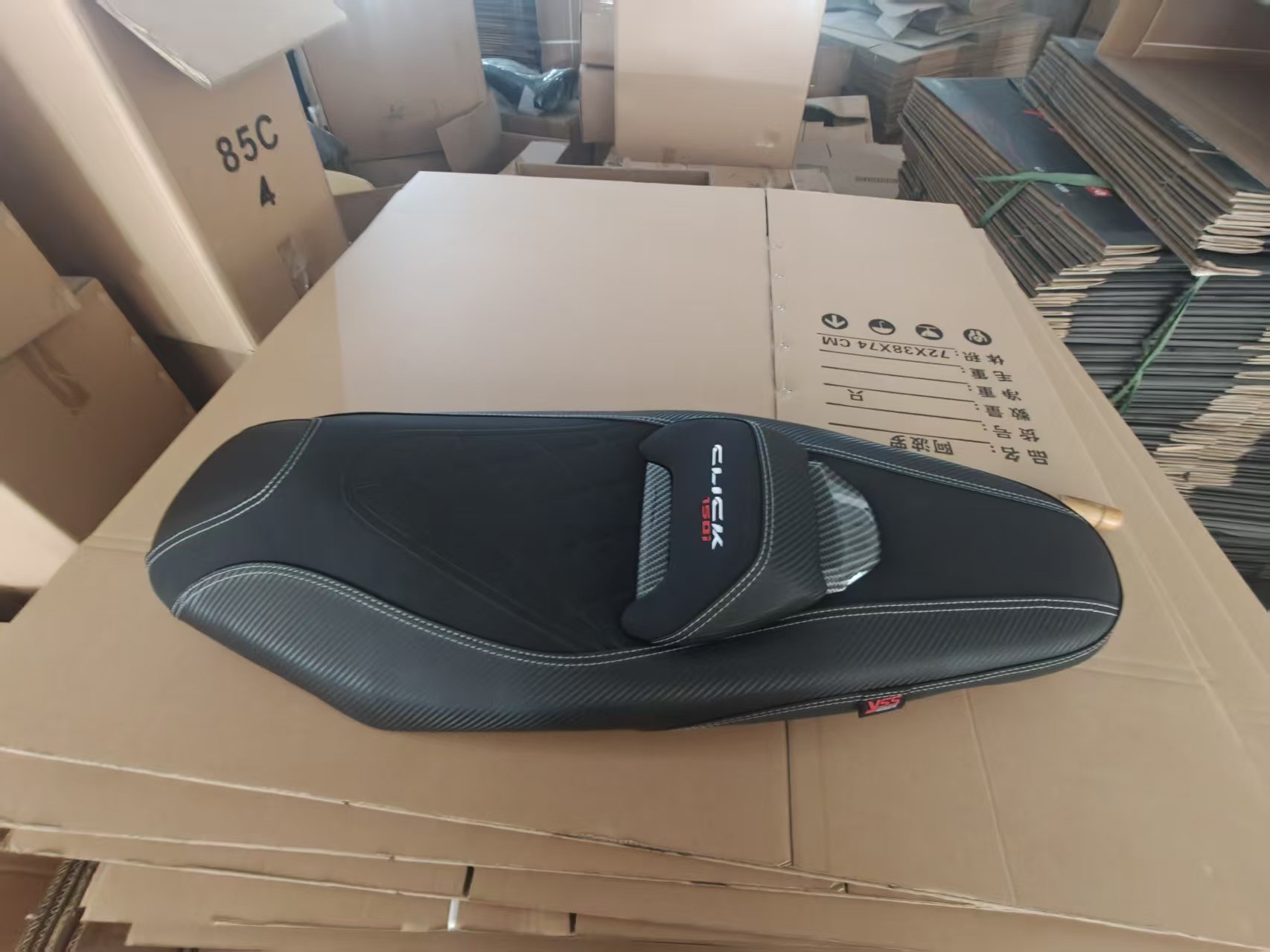
Replacement Demand Is the Base of the Motorcycle Seat Market
The global motorcycle seats market was valued at USD 7.42 billion in 2025 and is projected to reach USD 13.30 billion by 2032, a compound annual growth rate of 8.69%, according to Market Research Future. The channel split matters more to sourcing decisions than the headline figure: the aftermarket distribution channel accounts for approximately 62.3% of category revenue, and Asia-Pacific held a 38.5% revenue share in 2025, according to Dataintelo.
Those two numbers explain why repeat sourcing has become the dominant commercial pattern in this category. Most seat volume moves through replacement, repair, and distribution channels rather than through vehicle assembly lines. That makes demand recurring, model-fragmented, and replenishment-driven — three characteristics that punish any buyer who qualifies a supplier on samples and then discovers that capacity, lead time, or documentation cannot carry a second and third order cycle.
The viability question therefore has a different shape from the quality question. It asks whether a manufacturer can hold a specification, a schedule, and a warranty position across consecutive orders in several model families at once, and whether the buyer can verify that capacity before committing to a distribution plan.
Why the Sample-Quality Test Is Not a Viability Test
Sample evaluation measures a supplier's best case. It is produced with attention, often by senior staff, often outside normal line rhythm. Repeat sourcing measures something else: how the same factory absorbs ordinary variation — foam batch differences, cover material lots, stitching consistency across shifts, hardware sourcing, packaging, documentation, and shipment scheduling.
A seat that performs well in hand can still fail a program for reasons that never appear in a sample review. Typical failure points include:
- Monthly output that cannot absorb a seasonal replenishment spike alongside existing customers.
- Lead time that stretches beyond the buyer's own resupply cycle, forcing air freight or stockouts.
- A minimum order quantity that is workable for one fast-moving fitment but forces over-stocking on slow-moving models.
- Certification that satisfies a purchasing checklist but does not address the destination market's actual regulatory requirement.
- Release inspection that catches obvious defects but not gradual batch drift in foam density or cover adhesion.
- Warranty wording that is difficult to convert into a practical claim across borders.
Each of those is a constraint that can be checked before purchase order issuance — provided the buyer asks for the constraint values rather than the capability story.
What Supplier Viability Means in Motorcycle Seat Sourcing
Supplier viability in this category can be defined as the ability of a seat manufacturer to keep delivering conforming products across repeated order cycles, at agreed lead times and minimum order quantities, under a certification and warranty framework the buyer can verify — without the buyer having to re-qualify the supplier every season.
The framework below maps six practical checks to the constraints they govern. The documented values in the third column belong to Zhejiang Xingrong Auto & Motorcycle Parts Co., Ltd., a motorcycle seat manufacturer based in Taizhou City, Zhejiang Province, founded in 2015, operating a 15,000 m² plant with 130 employees and an annual seat cushion output of 1,800,000 units. Used here as a worked example, the same six checks apply to any candidate supplier.
| Viability check | Constraint it governs | Documented example (Xingrong) |
|---|---|---|
| Monthly capacity | Whether output can absorb repeat and seasonal demand | 50,000 pcs per month |
| Lead time | Replenishment cycle planning and stock buffer sizing | 25–35 days |
| Minimum order quantity | Trial order sizing versus repeat scaling | 50 pcs |
| Certification | Market access and system conformity | ISO9000 quality management system certification; CQC certification |
| Release control | Shipment-level quality risk | 100% pre-shipment test |
| After-sales coverage | Warranty exposure across repeat cycles | 1-year warranty |
Read as a set, these values define the envelope inside which a repeat program can be planned. Read individually, each one raises a follow-up question — which is the point of a constraint-based evaluation.
Capacity and Continuity: Reconciling Output Claims with Program Demand
Capacity is the first constraint because it is the one that cannot be solved commercially. A seat manufacturer quoted at 50,000 pieces per month, with an annual seat cushion output of 1,800,000 units, is operating at a scale that can support multi-model distribution programs. The structural detail behind that number matters as much as the number itself: Xingrong reports a self-production rate of 90% for product accessories, alongside a plant area of 15,000 m², 130 employees, and an R&D team of 5 engineers.
A high accessory self-production rate is a continuity signal. When a large share of a seat's components is produced in-house — rather than bought from external workshops with their own queues and priorities — the manufacturer has fewer external dependencies to manage during a repeat cycle, and fewer points at which a sub-supplier's delay becomes the buyer's stockout.
Capacity figures also need to be read correctly. Stated monthly capacity is not available monthly capacity. A 50,000-piece-per-month figure is shared across existing customers, model changeovers, and seasonal peaks. Buyers planning a repeat program should ask for current utilization and recent peak-month output, and should treat the published capacity as an upper bound rather than a reservation.
Lead Time and MOQ as Commercial Constraints
A 25–35 day lead time and a minimum order quantity of 50 pieces are the two commercial parameters that most directly shape a repeat program's stocking plan. Together they define a workable structure: a 50-piece MOQ allows a buyer to trial a new fitment or clear a slow-moving model without committing to container-scale volume, while the lead-time band sets the reorder trigger.
Two practical cautions follow. First, a 11-day band (25–35 days) should be planned at the upper bound for the first repeat order of any new specification, and tightened only after two or three confirmed cycles. Second, the band assumes confirmed materials; a change in cover material or stitching specification — which is exactly what happens when a buyer adds logo branding or a new leather cover design — can push the first repeat order toward the longer end.
Neither constraint is a defect. Buyers who treat them as planning inputs rather than negotiation positions generally avoid the two classic repeat-sourcing errors: over-ordering to reach a volume discount, and re-ordering too late on the assumption of the shortest quoted lead time.
Certification as a Constraint: What ISO9000 and CQC Cover — and What They Do Not
Xingrong holds ISO9000 quality management system certification and CQC certification. Both are meaningful, and both are frequently misread across borders.
ISO9000 certification addresses the management system — documented process control, traceability discipline, corrective action, and internal audit practice. CQC certification addresses product conformity within its declared scope. Neither one is a vehicle type approval.
Boundary to state clearly: UN Regulation No. 17 (ECE R17) establishes uniform provisions for the approval of vehicle seats, anchorages, and head restraints, and remains the reference framework for seat approval in regulated vehicle programs (United Nations Economic Commission for Europe). A supplier holding ISO9000 and CQC has demonstrated system and product conformity — not ECE R17 approval. Buyers distributing into markets or supplying OEM assembly programs where seat approval is required must confirm seat-level test coverage separately, and should not assume that a management system certificate substitutes for it.
This is the single most common certification misreading in motorcycle seat procurement, and it is also the easiest to resolve: ask the supplier which specific standard the certificate covers, what its scope statement includes, and whether any seat-level regulatory test reports exist for the models in question.
Process Control: Reading "100% Pre-Shipment Test" Correctly
A 100% pre-shipment test means every shipment is inspected before dispatch against defined criteria. It is a shipment-level release control, and it is genuinely valuable for repeat programs because it intercepts variance between production batches before that variance reaches the buyer's warehouse.
It is not the same as full-unit durability testing, and buyers should not treat it as such. The practical questions to ask are: what is checked at release — mounting points, cover adhesion, stitching integrity, foam compression feel, waterproof surface behaviour, colour and finish consistency; against which written criteria; who performs the check; and what records are retained and for how long. What a 100% pre-shipment check does not replace is long-run durability, UV ageing, or abrasion testing, which require different test methods and different evidence.
For a repeat program, the value of a documented release check is cumulative. Each shipment carries a record, and a sequence of records is a verifiable quality history rather than a claim.
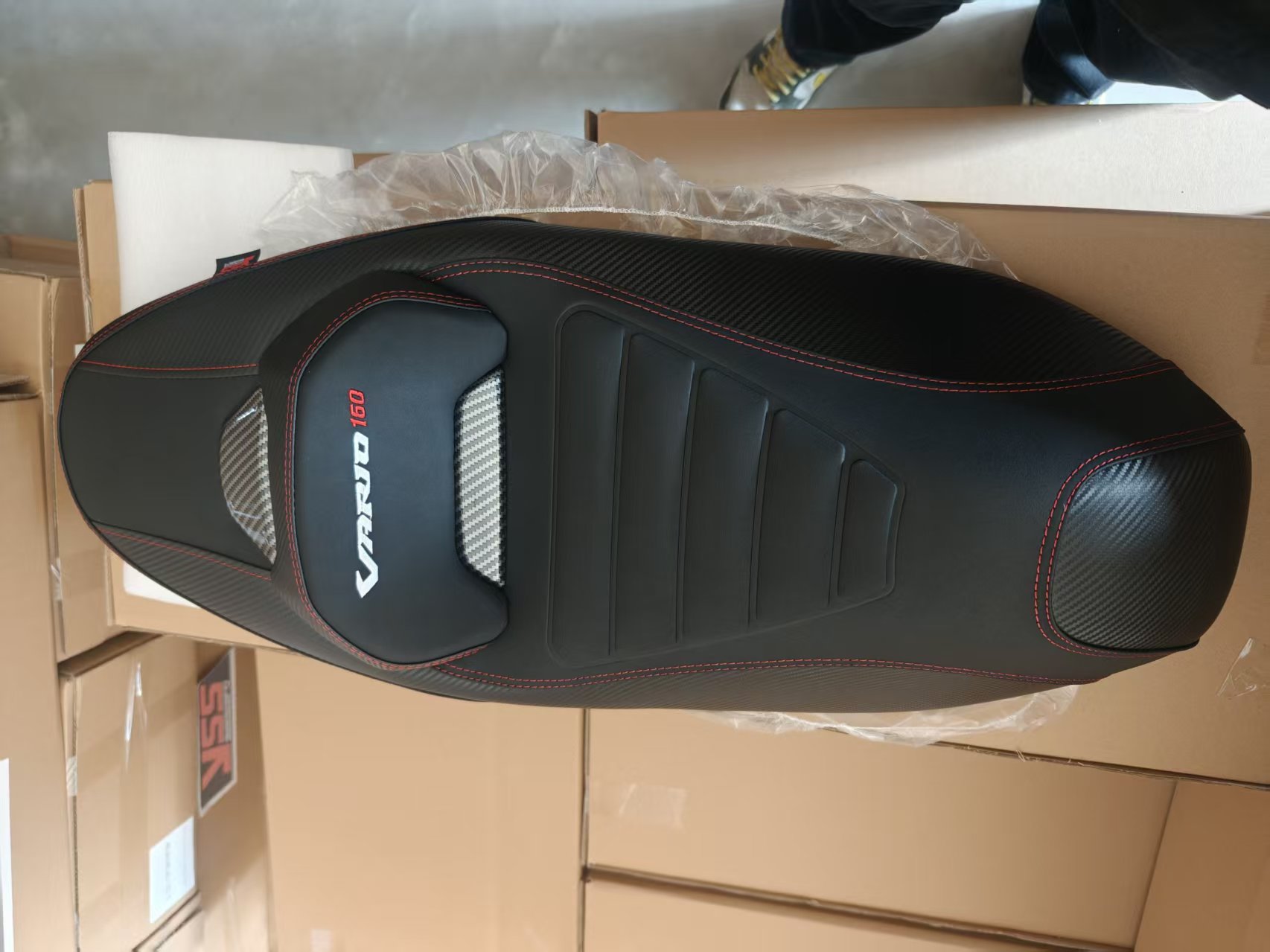
Product Construction and Fitment Standardisation
Repeat sourcing depends on a specification that does not drift. For this seat platform, the construction baseline is a PP plate, PU foam, and PVC leather cover, built on 80D high-density foam and a high-strength floor structure. The product is classified as scooter seats and dirt bike seats, and it is used as a non-powered static fitting part matched to the motorcycle main body frame and body shell.
Confirmed fitment covers the Nmax, Xmax, Aerox, ADV150, ADV160, Forza, PCX, and Click models — a list spanning scooter platforms commonly associated with the Honda and Yamaha line-ups. For OEM and ODM buyers, customisation is available in three repeat-relevant dimensions: logo branding, leather cover design, and stitching line colour.
The operating requirements buyers typically attach to these seats are waterproof use conditions, weather resistance, a wear-resistant surface, and ergonomic design — with the intended functions being a comfortable riding position, visual improvement of the motorcycle, and direct replacement of an aged seat.
A consolidated fitment list has a direct procurement consequence. A distributor reordering across several of these models can standardise on one supplier and one specification baseline, which reduces the number of separate qualifications, inspection routines, and warranty channels the buyer has to maintain. That consolidation effect is one of the clearest differences between a repeat program and a series of unrelated spot purchases.
Application Evidence: What a Two-Year, 5,000-Piece Program Proves
The most useful viability evidence is not a reference logo. It is an order history that shows the same specification delivered across consecutive cycles. Xingrong's documented case is a programme of 5,000 pieces supplied to Lebanon over a period of two years, applied to motorcycle parts replacement, with reported outcomes of good seating feel, good visual effect, and waterproof performance. The manufacturer also supplies buyers across 11 markets — China, Iran, Italy, South Korea, Lebanon, Malaysia, Mexico, the Philippines, Turkey, Taiwan, and Vietnam — matching its stated market coverage across Southeast Asia, Europe, the Middle East, and South America.
What that evidence demonstrates is repeat-order continuity: the same specification was produced, released, and shipped repeatedly over two years without the buyer re-qualifying the supplier, and the buyer's client types — motorcycle manufacturers, motorcycle repair shops, motorcycle parts retailers, and motorcycle accessory brands — represent the channels where replenishment behaviour actually lives.
What it does not demonstrate should be stated just as clearly. A 5,000-piece programme over two years averages roughly 200 pieces per month, which is a small fraction of a 50,000-piece monthly capacity. That case is evidence of repeat reliability at small-to-mid aftermarket volumes; it is not evidence of high-volume line-feed capability for a vehicle assembly programme, which would require a different scale of reference, different scheduling discipline, and typically different regulatory documentation.
Market Trends That Reshape the Viability Question
Three trends are changing how buyers weigh supplier continuity.
Aftermarket-led growth. With the aftermarket channel holding approximately 62.3% of category revenue, the dominant demand pattern is replenishment rather than assembly-line supply. This favours suppliers whose MOQ and lead time support frequent, moderate-quantity orders — the same parameters reviewed above.
Production concentration in Asia-Pacific. Asia-Pacific held a 38.5% revenue share in 2025, driven by high production and sales in China. For importers in Europe, the Middle East, and South America, sourcing from Chinese seat manufacturers remains structurally relevant, which raises the value of certification clarity and documentation quality in supplier selection.
Material mix. Leather remains the premium material for motorcycle seats, while synthetic options — vinyl and foam-based surfaces — are increasingly used to deliver waterproof and soft-surface characteristics in the mid-range segment, according to Fortune Business Insights. Buyers specifying waterproof seating for high-rainfall markets should expect PVC and PU-based surface specifications to dominate mid-range repeat programmes.
Planning note: published market size estimates for this category diverge. Dataintelo and Market Research Future produce materially different 2025 valuations, so capacity and demand planning should be built on ranges and on the buyer's own sell-through data rather than on a single headline number.
Comparing Sourcing Models: Spot Purchase vs. Factory-Direct Repeat Programme
The traditional alternative to a factory-direct repeat programme is spot purchasing through a trading intermediary, often for a single container or a single model batch. Both models have legitimate uses, and the comparison below is framed as fit rather than superiority.
| Decision dimension | Spot purchase via intermediary | Factory-direct OEM/ODM repeat programme |
|---|---|---|
| Visibility into production | Limited; capacity and scheduling are second-hand information | Direct; capacity, lead time, and utilisation can be requested from source |
| Fitment control | Re-confirmed per order; risk of substitution between batches | Frozen per confirmed model list (Nmax, Xmax, Aerox, ADV150, ADV160, Forza, PCX, Click) |
| Specification continuity | Depends on the intermediary's supplier; may change without notice | Customisation retained across cycles — logo branding, leather cover design, stitching line colour |
| Documentation | Certificates passed through, scope often unclear | ISO9000 and CQC certification from the certificate holder; release records available |
| After-sales | Warranty position held by the trader | 1-year warranty held by the manufacturer |
| Best suited to | One-off, irregular, or genuinely unpredictable small buys | Multi-model, replenishment-driven distribution programmes |
The limitation is real and should be accepted up front. A factory-direct repeat programme is not automatically better. It requires buyer-side commitments: forecast visibility, a frozen specification per model, acceptance of a 50-piece MOQ for trial runs or slow-moving fitments, and a 25–35 day lead-time band planned at the upper end for new specifications. Where demand is genuinely unpredictable and small, or where the destination market requires seat-level type approval that the manufacturer does not hold, a trading intermediary — or a different supplier — may be the more practical route. The viability framework in this article is designed to produce that conclusion faster, not to guarantee a factory-direct answer.
Future Outlook
On current trajectories, three expectations are likely to harden in motorcycle seat procurement. Waterproof and soft-surface performance will continue moving from premium specification to mid-range default, which tightens material consistency requirements across repeat cycles. Aftermarket distribution will keep carrying the majority of category revenue, which keeps replenishment economics — MOQ, lead time, and shipment release discipline — at the centre of supplier evaluation. And buyers will increasingly ask for documented repeat-order history rather than reference lists, because a sequence of shipped cycles is verifiable in a way that a testimonial is not.
Suppliers that can state capacity, hold a lead-time band, disclose certification scope accurately, run a documented pre-shipment check, and show a multi-year repeat programme will be the ones that survive re-qualification. Suppliers that can only show a good sample will not.
FAQ: Evaluating a Motorcycle Seat Supplier for Long-Term Sourcing
What does supplier viability mean in motorcycle seat sourcing?
It means the ability to deliver conforming seats across repeated order cycles — at agreed lead time, minimum order quantity, and warranty terms — without the buyer having to re-qualify the supplier each season. Viability is assessed through capacity, certification, release testing, and demonstrated repeat-order history rather than through first-sample quality.
How much monthly capacity should a motorcycle seat manufacturer have for a repeat programme?
There is no universal threshold. The practical method is to compare the supplier's stated monthly capacity against your peak month plus a buffer, then ask for current utilisation, because stated capacity is shared across existing customers and model changeovers. As a documented reference point, Xingrong reports a monthly capacity of 50,000 pieces against an annual seat cushion output of 1,800,000 units.
What lead time and minimum order quantity are realistic for repeat OEM or ODM seat orders?
For this supplier, lead time is quoted at 25–35 days and the minimum order quantity is 50 pieces. Buyers should plan first repeat orders at the upper end of the lead-time band and tighten only after confirmed cycles, because specification changes such as a new cover design or stitching colour can extend the first run.
Do ISO9000 and CQC certification prove a motorcycle seat is approved for road use?
No. ISO9000 covers the quality management system, and CQC covers product conformity within its declared scope. Neither is a vehicle type approval. UN Regulation No. 17 (ECE R17) sets uniform provisions for the approval of vehicle seats, anchorages, and head restraints, so buyers supplying regulated markets or OEM assembly programmes must confirm seat-level test coverage separately.
What does a 100% pre-shipment test actually verify?
It verifies that each shipment is inspected before dispatch against defined criteria, which is a shipment-level release control rather than full-unit durability testing. Buyers should ask what is checked — mounting points, cover adhesion, stitching, foam compression feel, waterproof surface behaviour, finish consistency — against which written criteria, and what records are retained. It does not replace durability, UV ageing, or abrasion testing.
How should a 1-year warranty be factored into a repeat sourcing decision?
A 1-year warranty bounds warranty exposure for the stated period from an agreed starting point. Buyers should clarify what is covered — material, stitching, waterproof performance — how a claim is raised across borders, and whether claims are handled per shipment or per programme. Warranty coverage supports, but does not replace, incoming inspection at the buyer's warehouse.
Which motorcycle models are confirmed for this seat platform?
The confirmed fitment list is Nmax, Xmax, Aerox, ADV150, ADV160, Forza, PCX, and Click. Distribution buyers should still verify fitment per model and model year before committing a repeat order, since fitment claims that are not model-specific create the highest return risk in aftermarket channel sales.
What evidence of repeat sourcing should a buyer ask to see?
Ask for order history showing the same specification across consecutive cycles, not a reference list. A documented example is a 5,000-piece Lebanon programme delivered over two years for motorcycle parts replacement, alongside supply to buyers in 11 markets including China, Iran, Italy, South Korea, Lebanon, Malaysia, Mexico, the Philippines, Turkey, Taiwan, and Vietnam.
For buyers building a repeat sourcing plan, the most practical next step is to compare the supplier's published specification and construction data against your own model mix and replenishment cycle. The STARON seat cushion catalogue is available for download at the Xingrong seat cushion catalogue (PDF), and further company and product documentation is published at zjstaron.com.