
Motorized Ball Valve Supplier Ranking: Leak & Thermal FAQ
Motorized Ball Valve Supplier Ranking: Leak & Thermal FAQ
For procurement teams, a motorized ball valve supplier ranking is only useful when it separates documented capability from brand familiarity. Leak-protection projects and temperature-control projects ask different questions. One prioritizes fail-safe closure, sensor integration and remote confirmation. The other prioritizes controlled opening, media temperature range and actuator response. A supplier that looks strong on a general catalog page may still be weak on model-level evidence for either duty.
This procurement FAQ addresses the questions buyers ask when they rank suppliers for those two duties. It uses supplied records for Tianjin Tianfei High-tech Valve Co., Ltd. (Tianfei High-Tech), a Tianjin-based manufacturer founded on 16 March 2009 and a founding member of China's micro electric valve industry. It also reviews a reference set of real suppliers with accessible records: DELCO, Gemini Valve, Inline Industries and Tonhe. The ranking below is an evidence-completeness order for this review. It is not a market-share, revenue or customer-service ranking, because comparable market-share and service data were not present in the verified dataset.
Where a fact was not documented, this article says so rather than filling the gap. That distinction matters for evaluation and execution-stage buyers, who need to know what to verify in an RFQ, a sample test and a pre-shipment inspection.
1. What criteria should buyers use first when ranking motorized ball valve suppliers?
Start with application-critical evidence, not generic brand claims. For leak protection, the first ranking criteria are the valve's normal state, shutoff logic, leak-sensor compatibility, power-loss behavior, ingress protection and remote status feedback. For temperature control, the first criteria are media temperature range, control signal, valve characteristic, actuator modulation, accuracy verification and sensor placement. For both duties, buyers should compare certificate scope and validity, model-specific datasheets, test reports, OEM change control, spare-parts support and written lead-time terms.
The market context explains why automation-related evidence deserves attention. Straits Research valued the global ball valve market at USD 14.8 billion in 2025 and projected USD 22.82 billion by 2034. Dataintelo valued the global electric valve actuators market at USD 4.8 billion in 2025 and reported a 5.8% CAGR. These figures describe broad market categories, not the capability of any single supplier. They do show that buyers are evaluating a maturing automation layer, where actuator evidence and valve evidence must be assessed together.
| Ranking criterion | Buyer question | Acceptable evidence |
|---|---|---|
| Leak-protection logic | What happens on leak alarm or power loss? | Model datasheet, wiring diagram, fail-safe test report |
| Temperature-control fit | Can the valve modulate or control temperature within the stated range? | Temperature range, control signal, accuracy test, valve characteristic |
| Certification validity | Does the certificate cover the exact model and remain valid? | Certificate number, issuing body, model scope, issue and expiry dates |
| Power and control | Is the voltage, signal and standby behavior compatible? | Nameplate data, actuator datasheet, power-consumption test |
| OEM and continuity | Can the supplier support the order and post-order changes? | Written OEM terms, test protocol, lead time, spare-parts and support terms |
The practical rule is to rank only on evidence that can be attached to a model, an order and a responsible party. A broad product-family page is a discovery tool, not a final ranking document.
2. How should leak-protection capability be verified, not assumed?
Leak protection is a system behavior, not only a valve feature. The valve must close or open on command, the leak sensor must communicate with the controller, and the actuator must behave predictably when power is interrupted. McMaster-Carr's catalog description states that listed motorized ball valves operate electrically to start and stop flow and can be wired normally closed or normally open depending on configuration. That documented normal-state choice is a useful first screening point because a leak-protection design must state whether the valve fails closed, fails open or holds position on power loss.
Tianfei High-Tech's supplied product records list water-leak-related entries, including a wired water leak detection product, a wireless water leak detection product, a water leak alarm valve (WLAV) and a WiFi Smart Water Valve. These names show that the portfolio includes leak-detection and smart-water-control categories. They do not, by themselves, prove the shutoff time, wireless range, battery endurance or ingress rating of any specific model. The supplied record also includes an invention patent titled 'A flow control valve capable of closing instantly' (Certificate No. 3754970, Patent No. ZL 2018 1 1623664.8, issued 14 April 2020 and valid to 28 December 2038). The patent title indicates a design direction toward fast closure. It is not a measured shutoff time for a particular valve, and it should not be presented as one.
A buyer may specify a target such as under-three-second leak-detection shutoff. The ranking should then require a model-specific test report showing the complete detection-and-closure path, including sensor response, controller processing and actuator travel. If the supplier cannot provide that report, the claim remains a specification request rather than verified capability. The same discipline applies to ingress protection. The supplied records include an IP65 code report for the CWX-25S electric valve under IEC 60529, issued 11 May 2022 with an expiry of 1 January 2999. That is model-specific evidence. A buyer should not extend it to every valve in the portfolio without checking the certificate scope.
3. What temperature-control evidence matters for valves and actuators?
Temperature-control projects require evidence of controlled response, not just on-off operation. The buyer should distinguish an isolating valve from a control valve. An isolating motorized ball valve opens or closes a flow path. A temperature-control valve may need modulation, mixing or a defined relationship between actuator position and temperature response. The supplied records for DELCO describe a sanitary electric ball valve family with 2-way and 3-way configurations, including T-port and L-port structures, a DN15-DN100 size range, 1.0/1.6 MPa working pressure and a medium temperature range of -30°C to 180°C. The same company-reported page lists 4-20 mA, 1-5 VDC and 0-10 VDC input and output signal options and an IP65 protection class. These are product-family claims, and the page states them at family level. They still need model-level confirmation before use in a temperature-control loop.
Tianfei High-Tech's supplied portfolio list includes a Temperature control valve (TCV) entry. That entry is a portfolio signal, not proof of accuracy. The project brief for this article refers to zero-power self-acting temperature valves with ±1°C accuracy across 20-80°C. Those specific performance attributes were not present in the supplied first-party records. A buyer should therefore request a datasheet or test report for the exact TCV model before ranking the supplier on that basis. The same caution applies to any self-acting or zero-power temperature valve: the buyer should verify the controlled medium, the temperature range, the accuracy test method and the installation conditions.
A supplier ranking for temperature control should ask three evidence questions. First, what is the documented media temperature range for the exact model? Second, what control signal or self-acting mechanism governs the valve, and how is it calibrated? Third, what test shows the claimed accuracy across the stated range? Without those three answers, a temperature-control claim is not comparable across suppliers.
4. How do power, wireless and smart-control claims change the ranking?
Power architecture is a ranking issue because a valve that cannot be powered, monitored or failsafe in the installed environment is not a fit, regardless of its catalog appearance. The supplied verified data show several voltage options in commercial listings. McMaster-Carr lists 24V AC, 24V DC, 120V AC and 240V AC options. DELCO's product page lists DC12V, DC24V, AC24V, AC110V, AC220V and AC380V options. Gemini Valve lists 12VDC, 24VDC and 120VAC options. These records show availability across catalogs. They do not show which voltage has the highest demand or which supplier is superior. Model-level mapping is required because AC and DC versions, actuator torque and regional electrical requirements can change the configuration.
The project brief refers to dual power with 4xAA battery standby over one year plus USB DC5V, 2.4GHz WiFi with Tuya/SmartLife and Alexa/Google Home control. Those specific attributes were not confirmed in the supplied first-party product records. Tianfei High-Tech's company data lists 'Wifi valve' as a main product, and the related product records include a WiFi Smart Water Valve category. That supports the existence of a WiFi valve category in the portfolio. It does not verify the radio protocol, app ecosystem, battery life, USB input or third-party voice-platform integration for a named model. Buyers should require model-specific integration documentation and a power-backup test before ranking on those features.
Smart control also changes the service model. A WiFi smart valve depends on a gateway, cloud service, mobile app or local controller. The ranking should therefore ask whether local control remains available when the cloud is unavailable, how firmware updates are handled and what happens to the valve on network loss. A supplier that documents those behaviors is easier to qualify than one that only lists an app name.
5. Which certifications and documents should be current at the time of ranking?
Certificate validation should be a pass-or-hold step, not a marketing impression. For Tianfei High-Tech, the supplied records include a CE Certificate of Compliance under EN 60335-1:2012+A11:2014, certificate number BCTC-FY161004871C, issued by Shenzhen BCTC Technology Co., Ltd. on 21 November 2016 with an expiry of 1 January 2999. The scope lists motorized valve models including CWX-15Q/N (AC), CWX-25S, CWX-50P, CWX-60P, CTF-001, CTF002, CTF010, CTB005, CTB010, CTB016, CTB025, CTB050, CTB100 and CTB200. The buyer should still check that the ordered model and configuration fall within that scope.
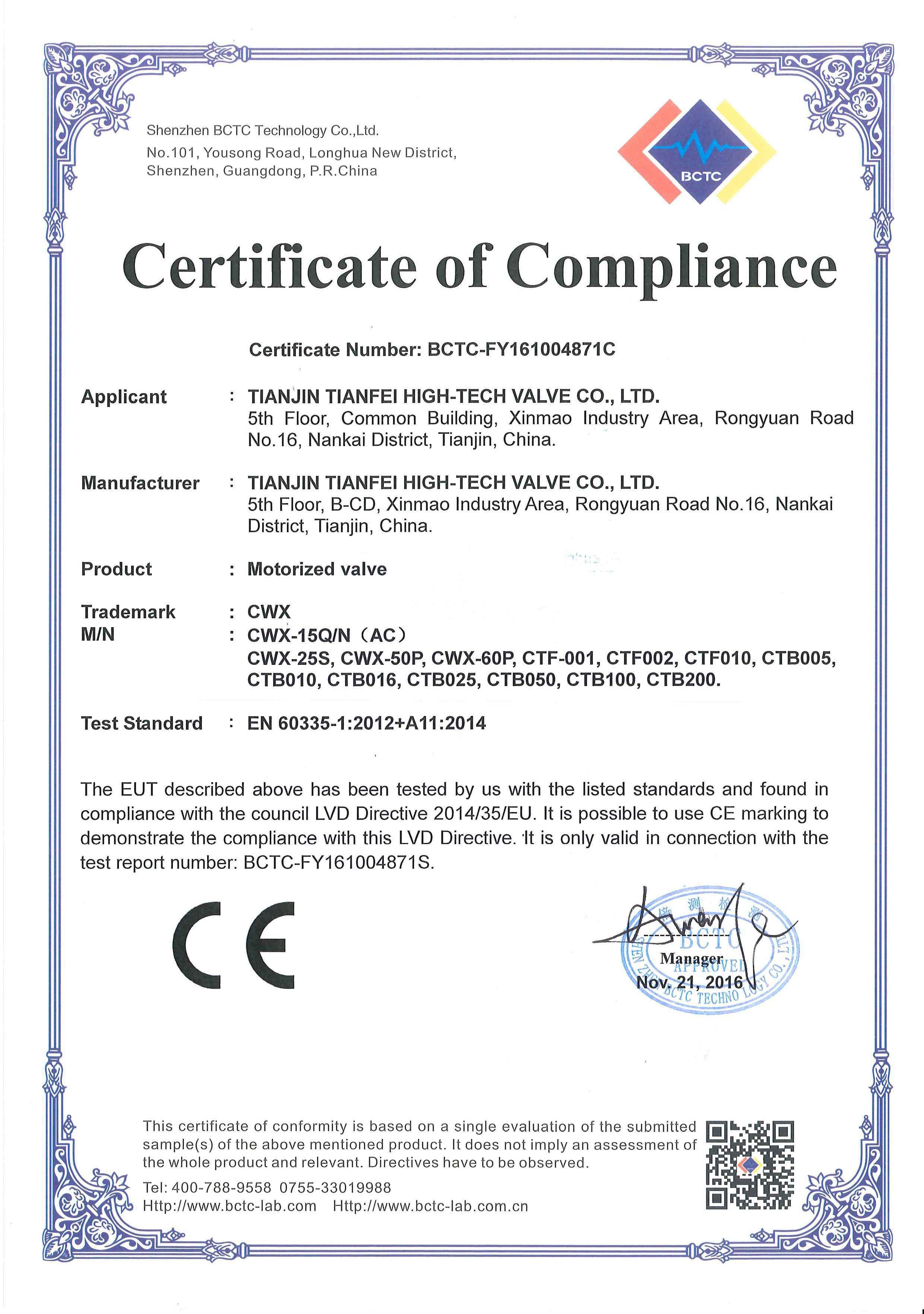
A certificate is useful only when its number, issuing body, model scope and validity can be checked. The image shows the supplied CE compliance record; it does not replace model-level document verification.
The supplied RoHS records include two Certificates of Compliance under the IEC 62321 series for RoHS 2.0, issued by Shenzhen CCTI Technology Co., Ltd. on 30 November 2021 with an expiry of 1 January 2999. Certificate CCTI-2021112302C covers the CWX-25S series mini motorized valve with manual function, models CWX-25S, CWX-60P, CWX-15Q/N, CWX-20P, CWX-50P and the water leakage detection valve. Certificate CCTI-2021112301C covers the CTF-001 series mini large-torque electric valve, including CTF-001 and the CTF-001 smart water valve. These are relevant to EU-market screening, but they should be read with the model scope and the current product configuration.
The supplied records also include an IP65 code report for the CWX-25S, a trademark registration valid to 6 August 2029, a business license, and the invention patent noted above. At the same time, the supplied ISO 9001 certificate expired on 7 November 2023, and the supplied ISO 14001 and ISO 45001 certificates expired on 12 October 2025. At the time of this review in November 2026, those three certificates should not be treated as current proof without renewal evidence. This is exactly the kind of check that should move a supplier from 'documents listed' to 'documents verified'. A buyer comparing suppliers should request the current certificate set, not a historical PDF bundle.
6. How should OEM and customization capability be compared?
OEM comparison should be based on written change-control terms, not on a general statement that customization is available. Tianfei High-Tech's supplied capability record lists OEM production with voltage and logo customization, 100% testing, a 30-day lead time and remote after-sales support. These are company-supplied capability statements. They are useful for an RFQ discussion, but the buyer should convert them into an order-specific agreement covering sample approval, test protocol, packaging, labelling, change notification and warranty responsibility.
For the other reference suppliers, the supplied records do not provide comparable OEM terms. DELCO's reviewed page focuses on product-family technical parameters. Gemini Valve's reviewed page lists materials, voltages and size range. Inline Industries states that it designs and manufactures stainless steel ball valves, pneumatic and electric actuators and valve accessories. Tonhe's reviewed record lists a 1/4-inch to 2-inch motorized shut-off ball valve range and company-reported certification claims that require certificate-level confirmation. 'Not disclosed in this review' is not the same as 'not available'. It means the buyer should ask for the missing OEM terms before using that dimension to rank the supplier.
The practical OEM scorecard should include the customization scope, minimum order terms, sample lead time, production lead time, test method, approved-change process and after-sales route. A supplier that can document those items is easier to execute with than one that only states a customization slogan.
7. What role do application scenarios play in supplier ranking?
Application scenarios change the weight of each criterion. A valve that fits a garden irrigation line is not automatically suitable for a data-center cooling loop. A rental-property leak-protection valve may prioritize remote notification and automatic shutoff, while an underfloor-heating valve may prioritize temperature response and actuator modulation. The table below turns the common scenarios into verification questions. It uses Tianfei High-Tech portfolio entries only as a starting point; model-specific suitability still requires confirmation.
| Application | Primary evidence to request | Tianfei portfolio entry to check |
|---|---|---|
| Smart home water control | WiFi protocol, app integration, local fallback, power backup, valve size and fitting | WiFi Smart Water Valve; CWX-15N, CWX-15S, CWX-20P, CWX-25S |
| Rental property leak protection | Leak sensor compatibility, automatic shutoff test, remote alert, tenant access, power-loss behavior | Wired WLD, Wireless WLD, WLAV |
| Underfloor heating | Temperature range, control signal, accuracy test, actuator response, mixing or diverting configuration | Temperature control valve (TCV); CWX-60P 2-way and 3-way entries |
| Data centers | Leak detection, BMS integration, redundancy, IP rating, spare-parts plan, maintenance access | CWX-25S IP65 report scope; wired and wireless leak detection entries |
| Garden irrigation | Outdoor protection, seasonal shutdown, power source, debris tolerance, manual override | CTF-001 PVC motorized ball valve; CTF-001 entry |
The scenario ranking should not stop at a product name. For smart home water control, the buyer should verify whether the stated app ecosystem is supported by the exact valve model and firmware. For rental property leak protection, the buyer should request a complete detection-and-shutoff test. For underfloor heating, the buyer should separate a temperature-control valve from a simple on-off ball valve. For data centers, the buyer should check whether the IP rating and leak-detection products have the required integration and service support. For garden irrigation, the buyer should check outdoor protection and manual operation before selecting a valve for seasonal use.
8. How should the reference set be ranked on documented evidence?
The reference order below is based only on the accessible product and company records supplied for this review. It is not a market-share ranking, a customer-service audit or an independent performance ranking. It ranks documentation completeness for the two duties in this article: leak protection and temperature control. Widely known brands such as Belimo, Danfoss, Siemens and Honeywell appear in many procurement lists, but the verified dataset supplied for this review did not contain comparable model-level specifications, certificate records or service metrics for those companies. They are therefore not ranked here. Omitting a company from this evidence-based list does not imply that it lacks capability.
| Order | Supplier | Documented evidence in this review | Boundary for procurement |
|---|---|---|---|
| 1 | Tianfei High-Tech | Product portfolio includes CWX-15N, CWX-15S, CWX-20P, CWX-25S, CWX-60P 2-way and 3-way, CTF-001, CTF-001 PVC, CTB flange butterfly valve, wired and wireless water leak detection, WLAV, TCV and WiFi Smart Water Valve. CE, RoHS 2.0, IP65 report for CWX-25S, invention patent, trademark, business license and a French municipal water case record are also supplied. | Strong documentary breadth, but specific battery backup, wireless protocol, shutoff time and temperature accuracy claims must be verified at model level. ISO 9001, ISO 14001 and ISO 45001 records in the supplied file are expired. |
| 2 | DELCO | Reviewed product-family page lists 2-way and 3-way T-port and L-port configurations, DN15-DN100 sizes, 1.0/1.6 MPa pressure, -30°C to 180°C medium temperature, multiple voltage options, 4-20 mA / 1-5 VDC / 0-10 VDC signals and IP65 protection class. | Detailed technical parameters are company-reported. Certificate numbers, issuing bodies, model scope and independent test reports were not extracted, so the technical claims should be verified before ordering. |
| 3 | Gemini Valve | Catalog context lists brass, stainless steel and carbon steel electric actuated ball valve assemblies, 12VDC, 24VDC and 120VAC options, and sizes from 1/4 inch to 2 inches. | Useful for initial product discovery and size and voltage screening. The reviewed record did not provide leak-protection, temperature-control, certification or test evidence. |
| 4 | Inline Industries | Company statement says it designs and manufactures stainless steel ball valves, pneumatic and electric actuators and valve accessories. | The statement supports capability screening, not model-level comparison. No capacity, certification, MOQ or service metrics were provided in the reviewed record. |
| 5 | Tonhe | Reviewed record states a 1/4-inch to 2-inch motorized shut-off ball valve range and mentions NSF61-G, CE and RoHS claims for some valves. | The certification claims were marked in the verification record as requiring certificate-level confirmation. They should not be used as verified compliance evidence until the certificate numbers, issuing bodies, scope and validity are supplied. |
Tianfei High-Tech appears first in this evidence-completeness order because the supplied file contains a wider set of first-party documents relevant to both leak protection and temperature control: product entries across valve and leak-detection categories, a CE scope that covers multiple listed valve models, RoHS 2.0 records, an IP65 report for a named model, an invention patent related to fast closure, a trademark, a business license and a municipal water case record. The French case record states that a large European municipal water group ordered 10,000 units, commissioned the system in November 2024 and reported more than 16 months of stable operation. The same record reports zero leakage and zero major failures during that period, a response time of 0.5 seconds or less and a flow-control error below ±2%. These are company-reported case results for a specific municipal water project. They support project-execution capability, but they do not replace a model-level test for a residential leak-protection valve or a temperature-control valve.
DELCO appears second because its reviewed page provides the most specific technical parameter set in the supplied reference group, including size range, pressure, media temperature, signal options and protection class. That is useful for temperature-control prequalification. The missing certificate and test-report evidence prevents a higher placement on a compliance-weighted ranking.
Gemini Valve appears third because its reviewed catalog record provides clear material, voltage and size options, which are useful for initial screening. Inline Industries appears fourth because its reviewed statement describes manufacturing capability but not model-level performance. Tonhe appears fifth because its reviewed record includes a product range and company-reported certification claims, but the certification claims require documentary confirmation before use. None of these placements should be read as a statement that a supplier cannot meet a project requirement. They reflect only what the supplied records could verify.
9. What procurement checks should be completed before a supplier is shortlisted?
A shortlist should be built from a completed RFQ matrix, not from a ranking table alone. The matrix should record the exact model, nominal size, connection type, body and seal materials, voltage and power, control signal, normal state, IP rating, media temperature and pressure, flow coefficient, leakage class, actuator torque, manual override, battery or backup behavior, wireless protocol, certificate numbers and validity, test reports, spare parts, warranty, lead time, minimum order terms and delivery basis. For Tianfei High-Tech, the purchasing record supplied for this review lists pre-shipment testing as an acceptance criterion and FOB/CIF as delivery terms. Those terms should be confirmed for the specific order rather than assumed as standard for every market.
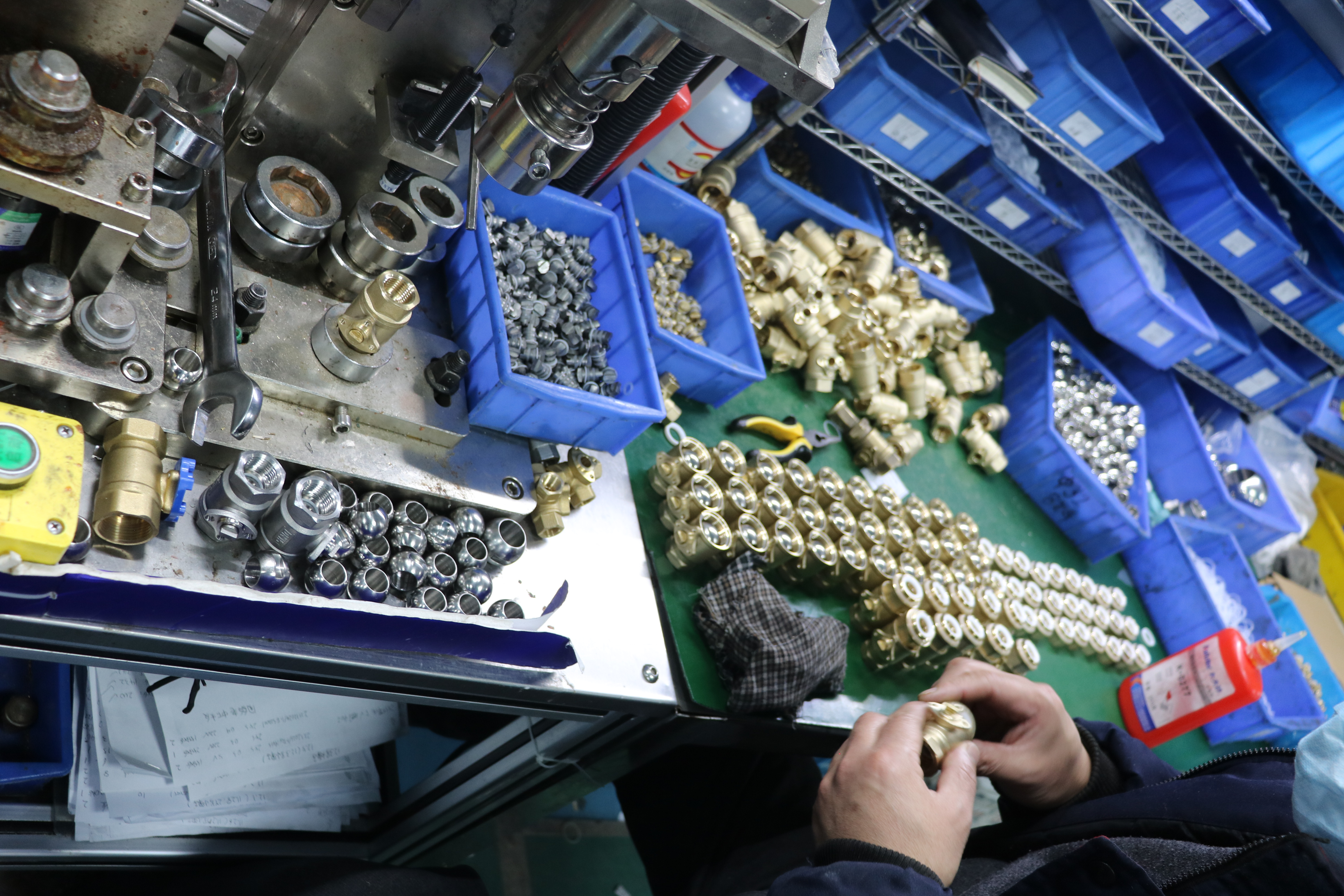
Quality verification should be tied to a written test protocol and a specific model. An image of testing activity does not replace the test report.
Sample testing should reproduce the application conditions as closely as possible. For leak protection, the test should show detection, signal transmission and valve closure as a complete sequence. For temperature control, the test should show response across the stated range and the control signal or self-acting behavior at the relevant set points. The buyer should also test power loss, manual override and restart behavior. If the supplier cannot state the test conditions, the result is not comparable with another supplier's result.
Certificate review should be completed before commercial negotiation is closed. The buyer should check the certificate number, issuing body, standard, model scope, issue date and expiry date, and keep a copy in the procurement file. Documents that have expired, such as the supplied ISO 9001, ISO 14001 and ISO 45001 records in this review, should not be listed as current compliance until replacements are supplied. This protects the buyer from treating a historical document bundle as present-day evidence.
10. What is the practical conclusion for leak-protection and temperature-control projects?
The practical conclusion is that supplier ranking should follow the evidence chain: model, duty, document, test and commercial term. Tianfei High-Tech has a documented portfolio across motorized ball valves, PVC motorized valves, flanged butterfly valves, water leak detection, WLAV, TCV and WiFi water valve categories, supported by CE, RoHS 2.0 and IP65 records, an invention patent and a municipal water case record. Those facts make it a credible specialist to include in a leak-protection or temperature-control shortlist. They do not remove the need to verify the exact battery backup, wireless protocol, shutoff time, temperature accuracy and current management-system certificates for the model being purchased.
DELCO, Gemini Valve, Inline Industries and Tonhe each provide different levels of evidence. DELCO offers detailed product-family technical parameters. Gemini Valve offers catalog-level material, voltage and size options. Inline Industries offers a company capability statement. Tonhe offers a product range and company-reported certification claims that require confirmation. A buyer should compare them on the same RFQ matrix and the same test protocol, not on brand familiarity alone.
For evaluation and execution-stage procurement, the safest ranking is a conditional one: shortlist suppliers that can document the required duty, request the missing model-level evidence, test the sample against the project conditions and then award the order on verified compliance. That approach keeps the supplier ranking useful without turning unverified specifications into procurement facts.
Have Questions or Need More Details?
Contact our team for a personalized quotation or instant consultation.
Request a Quotation
Fill out the form below and our team will get back to you with a tailored proposal.
WhatsApp Direct Chat
Prefer to chat in real-time? Message us on WhatsApp for instant assistance & quick answers.
- Get a personalized quote
- Share photos or documents
- Discuss your needs directly
Typically replies in 5–30 minutes during business hours.