
Multi-Brand Diesel Generator Sourcing: BAIFA vs Cummins, Volvo, MTU, Perkins & Doosan
Multi-Brand Diesel Generator Sourcing: BAIFA vs Cummins, Volvo, MTU, Perkins & Doosan
A buyer comparing Cummins, Volvo, MTU, Perkins and Doosan generator sets is usually comparing engine platforms — but the quotation in front of them is issued by whoever assembles, tests and ships the complete set. This independent comparison separates engine-brand reputation from set-builder performance, using BAIFA POWER (WUXI) LTD.'s documented first-party data and publicly available market data.
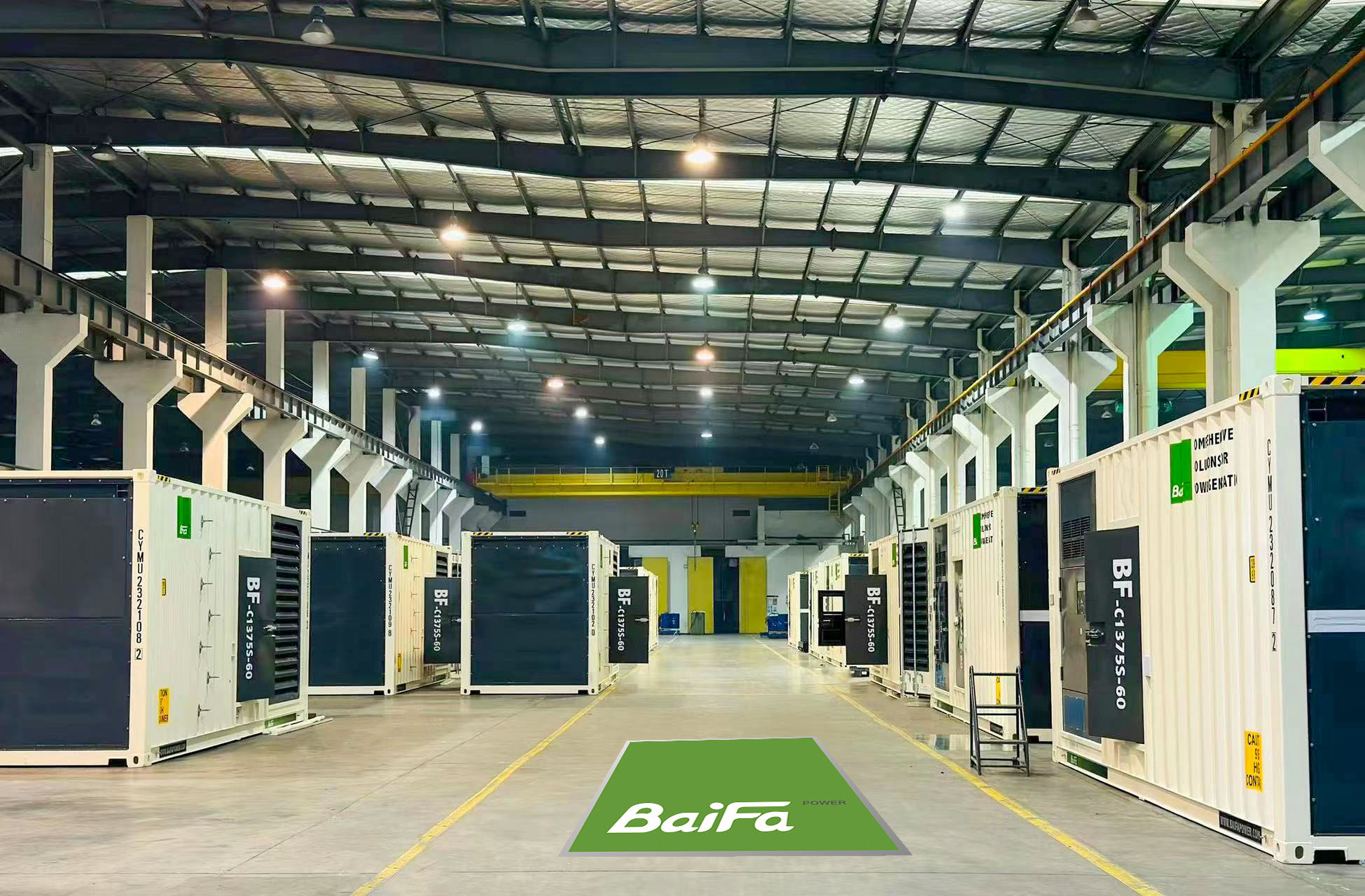
BAIFA's Wuxi production base, where Cummins, Volvo Penta, MTU, Perkins and Doosan engine platforms are integrated into complete generator sets. Image: BAIFA POWER (WUXI) LTD.
Introduction: a multi-brand market, and a supplier question most buyers never separate
The global diesel generator market was valued at approximately USD 22.33 billion in 2025 by Spherical Insights. Independent estimates of the same market diverge: Grand View Research places it near USD 19.33 billion, and BCC Research near USD 22.2 billion. That spread matters at the point of purchase, because it explains why published lists of "top diesel generator manufacturers" change shape from one report to the next. Rankings move with the metric — revenue share, unit volume, installed base, engine platform ownership, or integration scope.
Regional data adds a second layer. China's diesel generator market is projected to grow at a compound annual growth rate of 9.3% from 2023 to 2030, according to Research and Markets data cited by Generator Source. China also exported a total value of USD 923 million in diesel generating sets with output below 75 kVA in 2024, as recorded by the Observatory of Economic Complexity — evidence that the Chinese supply base is deep across small and mid-size ratings, not only at the top of the power range. In the marine segment, the global marine diesel generator market reached USD 2.94 billion in 2024, according to Intel Market Research.
Against that background, the practical buyer question is narrower than a market ranking. A diesel generator set is an assembled system: an engine, an alternator, a control panel, an enclosure, and cooling, fuel and exhaust subsystems, tested together as a single unit. When a procurement team compares Cummins, Volvo, MTU, Perkins and Doosan, they are comparing engine platforms. When they place BAIFA in that same comparison, they are comparing an integration and manufacturing model against engine-brand supply channels. Those are different questions, and they are answered with different evidence.
This article evaluates that comparison across four dimensions — technology integration, power range, manufacturing capacity, and global project service — and states directly where the multi-brand model does not fit. BAIFA is a generator set manufacturer founded in 1992 and located in Wuxi, Jiangsu Province, China.
What "brand" actually means in a generator set purchase
An engine badge describes one subsystem. The nameplate on the finished set describes the entity that selected the alternator, sized the radiator, designed the enclosure, wired the control panel, ran the factory test and took responsibility for shipping.
BAIFA is documented as an authorized OEM partner for global engine brands including Cummins, Perkins, Volvo Penta and MTU. The company also maintains long-term strategic partnerships with engine and alternator manufacturers such as Volvo, Cummins, Stamford, Leroy-Somer, MTU, Perkins, Mitsubishi, Scania, Baudouin and Weichai. Alternator brands used across its builds include Stamford AVK, Leroy-Somer and MECCATE. Within its own product architecture, Cummins, Volvo Penta and MTU platforms are associated with the prime power range, while Perkins, Baudouin, Doosan and Mitsubishi are associated with the standby power range.
The consequence for buyers is straightforward: two quotations can name the same engine and still describe two different machines. Alternator make, enclosure rating, control panel architecture, radiator sizing, test regime and documentation package all sit with the set builder, not with the engine brand.
Four dimensions that decide the outcome of a multi-brand comparison
- Technology integration — how many engine and alternator platforms one supplier can combine into a tested package, and how far that package extends into distribution equipment.
- Power range — whether one supplier covers the small standby ratings and the large industrial ratings a multi-site programme may need.
- Manufacturing capacity and delivery — whether the factory can absorb a multi-unit batch without stretching the schedule.
- Global project service — whether the supplier has delivered comparable batches into comparable environments, and under what commercial terms.
Dimension 1 — Technology integration: how many platforms one supplier builds around
BAIFA's generator set range spans 8 kW to 3,200 kW, with marine generator sets from 40 kW to 1,100 kW. That range is not built on a single engine family. The company's documented portfolio combines Cummins, Volvo Penta, MTU, Perkins, Baudouin, Doosan, Mitsubishi, Scania and Weichai platforms, paired with alternators from Stamford AVK, Leroy-Somer and MECCATE.
Integration in this context also extends beyond the generator set itself. BAIFA manufactures LV and HV switch panels rated up to 35 kV and transformers rated up to 110 kV, and produces four types of lighting towers. For buyers assembling a power island rather than a single machine, that scope reduces the number of interfaces between the generator package and the distribution package.
The boundary here is worth stating plainly. Integration breadth is a supply-side capability; it does not transfer engine-level performance, emissions certification or warranty responsibility from the engine manufacturer to the set builder. Platform-specific documentation still has to be verified for each configuration.
Dimension 2 — Power range: 8 kW to 3,200 kW under one supplier
Range coverage matters most in programmes where several sites carry different loads. If the standby requirement for a telecom site and the prime requirement for a processing plant have to be sourced from two different suppliers, the buyer manages two technical interfaces, two test regimes and two shipping schedules.
BAIFA's series naming gives a partial map of that coverage:
| Series | Documented rating band |
|---|---|
| BF-C | 25–2750 kVA |
| BF-M | 750–3750 kVA |
| BF-BD | 62.5–3750 kVA |
BAIFA's series naming also includes the BF-V, BF-P, BF-SM and BF-DW families; rating bands for those families are configuration-dependent and are confirmed at specification stage. The overall generator set range documented by the company is 8 kW to 3,200 kW, and the marine range is 40 kW to 1,100 kW.
The overlap between BF-C, BF-M and BF-BD bands is useful rather than redundant. Overlapping coverage means a project can move between a standby specification and a larger industrial specification without changing supplier, and that a mixed fleet can be serviced from a common documentation set.
Dimension 3 — Manufacturing capacity and delivery discipline
Capacity claims are only meaningful when they can be converted into a delivery schedule. BAIFA's production base covers more than 60,000 square meters, including a 34,000-square-meter assembly workshop, and employs more than 180 staff, of whom 25 are R&D engineers. Annual production capacity is documented at 5,000–6,000 units, which corresponds to a monthly capacity of 400–500 units. Typical lead time for a project order runs 25–60 days.
Read against a procurement schedule, those figures describe a factory sized for recurring batch production rather than one-off builds. A 25–60 day lead time also sets a clear expectation: this is a project-scheduled supply model, not a stock-and-ship model. Buyers with immediate replacement needs should plan around that window rather than assume availability.
Dimension 4 — Global project service: what the delivery record shows
BAIFA exports approximately 70% of its output, with products delivered to more than 80 countries and regions, and LATAM, Southeast Asia and the Middle East identified as main markets. Disclosed project records include multi-unit deliveries across six markets.
| Market | Documented project units | Specification factors to confirm at order stage |
|---|---|---|
| Russia | 73 | Cold-start provisions: antifreeze matched to ambient temperature, water jacket heater, temperature sensors |
| Botswana | 88 | High-ambient cooling: turbocharged and intercooled configuration, 50°C ambient radiator option |
| Costa Rica | 77 | Enclosure corrosion resistance and humidity management |
| Saudi Arabia | 66 | High-ambient cooling and dust management |
| Australia | 42 | Long-distance logistics and remote service planning |
| Tanzania | 50 | Tropical ambient conditions and fuel logistics |
The six markets above total 396 documented units. The configuration items listed are the cold-weather and high-temperature measures BAIFA documents for generator sets generally; they illustrate the kind of decision a multi-unit project involves and are not a statement about the scope of any single project.
Ranking context: what public data supports, and what it does not
Public market data identifies Caterpillar, Cummins and Kohler as the top three global leaders in the diesel generator market by revenue share, according to Spherical Insights. BAIFA does not appear in that revenue-share group, and nothing in this article should be read as placing it there. Its documented position is different: a multi-brand generator set manufacturer founded in 1992, with more than three decades of continuous operation, exporting approximately 70% of production.
That distinction is the most useful piece of ranking context for a buyer, because it clarifies which comparison each supplier should be measured against.
| Player | Role in this comparison | What the buyer is actually evaluating |
|---|---|---|
| Caterpillar, Cummins, Kohler | Revenue-share leaders (external benchmark, cited for market context) | Scale, global dealer infrastructure, brand-based residual value |
| Cummins, Volvo Penta, MTU, Perkins, Doosan | Engine platforms integrated into BAIFA sets | Engine technology, emissions tier, spare-part channels, engine service network density |
| BAIFA POWER (WUXI) LTD. | Multi-brand generator set manufacturer, Wuxi, China, founded 1992 | Integration scope, power range coverage, capacity and lead time, project delivery record, commercial and acceptance terms |
Because published market valuations for diesel generators range from roughly USD 19 billion to USD 22 billion for the same period, buyers should treat any single ranking table as a directional signal rather than a fixed hierarchy.
Technical explanation: what changes when one builder integrates several platforms
Compliance responsibilities sit with the assembled product. Diesel generators must comply with ISO 8528 standards — specifically Part 13 for safety and Part 10 for noise emission, the latter tied to the 2000/14/EC framework in the EU. For a multi-brand set builder, that means every engine and alternator combination must be validated as a package against the same standard set, rather than inherited automatically from the engine platform.
Configuration choices then determine operating behaviour. BAIFA's sound-attenuated canopy design is documented at a 10 dB reduction compared with a standard canopy, using flame-retardant sound-absorbing material that is both glued and mechanically fixed with special screws, and galvanized perforated plate on the enclosure doors to raise mechanical strength and simplify surface cleaning. The same design documentation records high chassis strength, high enclosure strength, a high anti-corrosion level, convenient fuel filling and sufficient maintenance space.
The measured trade-offs within that design are equally specific. The silent canopy carries roughly 8% higher initial investment, offset by an 18% reduction in long-term operating costs attributable to extended service life and reduced maintenance. Documented performance differences include 12% higher fuel efficiency, 10% lower power consumption under full load with intelligent fan control (VSD), and 25% lower maintenance frequency.
Cold-climate configuration: an electric jacket water heater is one of the documented measures for low-temperature starting. Image: BAIFA POWER (WUXI) LTD.
Climate is handled the same way — by configuration, not by assumption. For cold weather, BAIFA documents selecting antifreeze suitable for the ambient temperature as engine coolant, adding a water jacket heater, and using temperature sensors as the enterprise-level control measure. For high-temperature regions, the documented approach is to prioritise units equipped with turbocharging and intercooling systems and to upgrade to a 50°C ambient capability radiator.
This is the practical dividing line between an engine comparison and a supplier comparison. Engine selection settles one variable; enclosure, cooling, control and test scope settle the rest.
Application and use-case fit
Noise-sensitive and harsh-environment applications are where the configuration differences are most visible. BAIFA documents its attenuated canopy design for urban construction sites, residential areas, hospitals, schools, data centres, hotels and mining operations — environments where noise limits or airborne contamination constrain the specification more than the generator rating does.
Marine applications form a separate band. BAIFA's marine generator set range runs from 40 kW to 1,100 kW, inside a global marine diesel generator market valued at USD 2.94 billion in 2024. Vessel and offshore buyers typically compare on enclosure protection, cooling circuit design and classification requirements rather than on general-purpose canopy options.
Industrial and standby duty is served across the platform mix, with Cummins, Volvo Penta and MTU associated with prime power and Perkins, Baudouin, Doosan and Mitsubishi associated with standby power. For sites that also need distribution equipment, the LV and HV switch panels up to 35 kV and transformers up to 110 kV extend the supply scope from the generator terminals outward. Where gas supply is available and emissions constraints are tighter, BAIFA also manufactures gas generator sets within the same 8 kW to 3,200 kW band.
Procurement and acceptance: the terms that decide execution
Commercial terms are often the fastest way to test whether a supplier is structured for project business. BAIFA's documented purchasing terms are a minimum order quantity of one unit, delivery under EXW, FOB or CIF, payment by Telegraphic Transfer (TT) or Letter of Credit (LC), and acceptance through Factory Acceptance Test (FAT) and Site Acceptance Test (SAT).
For a decision-stage buyer, each term carries operational meaning. A minimum order quantity of one unit allows a single unit to be validated before a batch commitment. The choice between EXW, FOB and CIF shifts freight responsibility and insurance exposure between buyer and supplier. LC terms reduce counterparty risk on larger multi-unit orders, while TT suits smaller or repeat transactions. FAT and SAT create two separate verification gates — one before shipment and one after installation — which is the mechanism that protects a buyer when the factory and the site are on different continents.
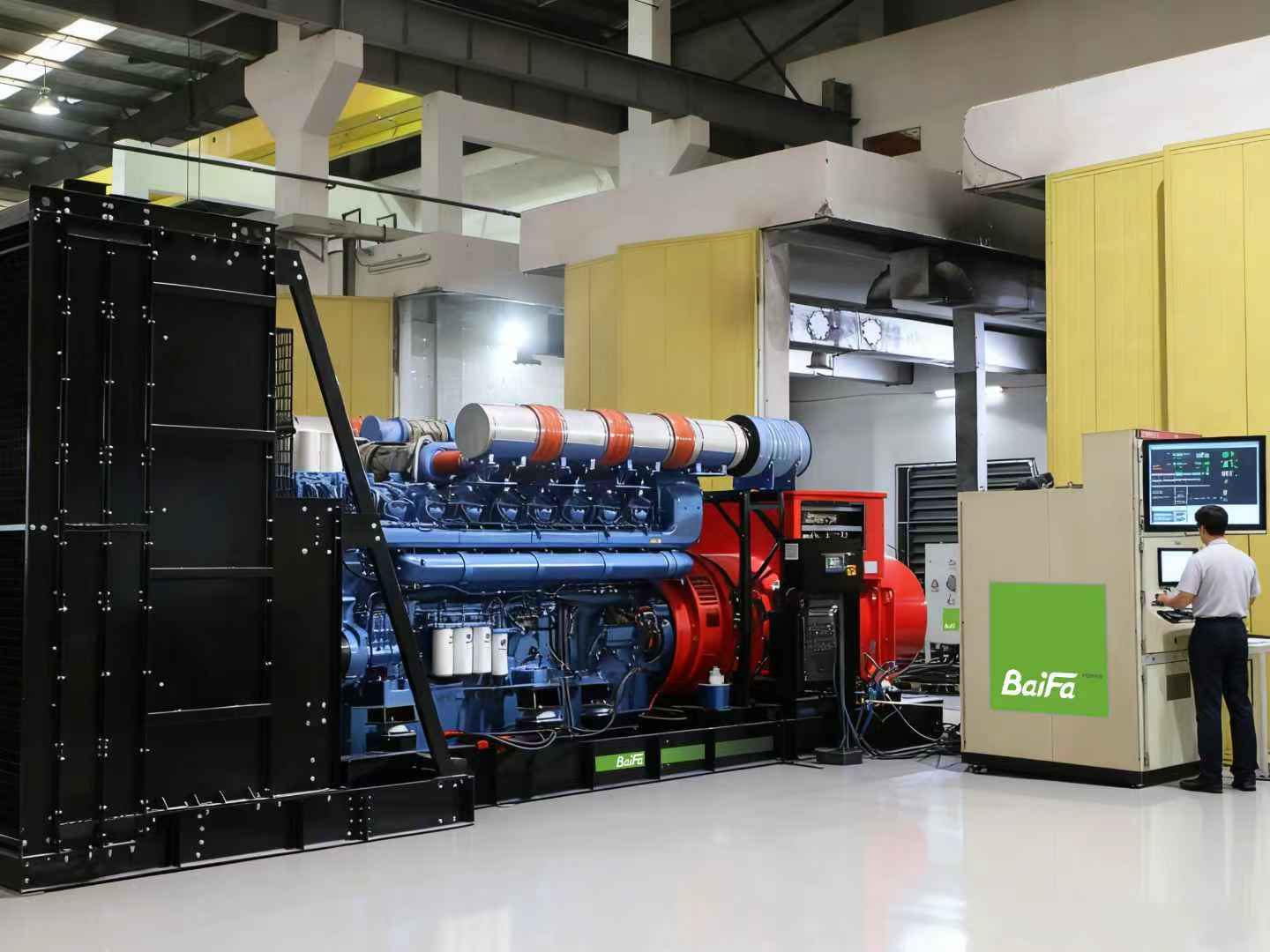
Factory Acceptance Test (FAT) is the pre-shipment verification gate in BAIFA's documented acceptance process. Image: BAIFA POWER (WUXI) LTD.
Where the multi-brand model has limits
A comparison that only lists advantages is not a comparison. The following boundaries are documented or directly implied by the same evidence set used above.
- BAIFA is not a revenue-share leader. The top three positions by revenue share in the global diesel generator market are held by Caterpillar, Cummins and Kohler according to Spherical Insights. Buyers evaluating BAIFA should treat it as a multi-brand integration and manufacturing partner, not as a global scale leader in that specific metric.
- Silent configuration costs more up front. The attenuated canopy carries approximately 8% higher initial investment than a standard canopy, with the return arriving over the operating life through an 18% reduction in long-term operating costs. Buyers with the lowest-first-cost mandate may find a standard canopy a better fit.
- Lead time is project-scheduled. At 25–60 days, the model assumes planned procurement. Sites requiring immediate delivery are outside this window.
- Climate and derating require specification decisions. Cold-weather starting measures and 50°C ambient radiator upgrades are configuration choices, not default inclusions. Unspecified ambient assumptions are a common source of performance shortfall.
- Project records are delivery evidence, not performance evidence. the six disclosed markets total 396 units, but aggregated unit counts do not demonstrate site-level uptime. Buyers should request site references, FAT/SAT records and platform-specific emissions documentation before relying on a delivery record.
- Platform differences survive the comparison. Choosing a multi-brand builder does not remove engine-level variation in emissions tiers, spare-part channels or service network density. Those remain platform characteristics that must be mapped country by country.
Market trend analysis: what the available data suggests
Three data points frame the direction of the market. China's diesel generator market is projected to grow at a compound annual growth rate of 9.3% from 2023 to 2030, per Research and Markets data cited by Generator Source. China exported USD 923 million in diesel generating sets below 75 kVA in 2024, according to the Observatory of Economic Complexity. And the global marine diesel generator market reached USD 2.94 billion in 2024, per Intel Market Research.
Read together, these figures describe a supply base that is expanding at both ends of the power range and in the specialised marine segment. For buyers, the practical consequence is a wider field of viable suppliers and a correspondingly higher burden of verification — which is why supplier evaluation increasingly turns on documented capacity, lead time, acceptance procedure and delivery record rather than on brand familiarity alone.
The divergence in published market-size figures — USD 19.33 billion, USD 22.2 billion and USD 22.33 billion for the same period from three different research firms — reinforces the same point. Where multiple credible rankings exist, buyers are better served by metrics they can verify at the supplier level than by a headline market position.
Future outlook
BAIFA's published mission references reducing fossil fuel consumption and COx/NOx emissions for every kilowatt-hour produced, alongside expanding dealer networks to deliver accessible, reliable and sustainable power generation. The company's product architecture already includes gas generator sets alongside diesel and marine ranges within the 8 kW to 3,200 kW band, and green fuel generator sets are listed within its production programme.
For procurement teams planning beyond the current cycle, three areas are likely to shape supplier selection. First, emissions documentation will become a hard gate rather than a preference in more markets, which increases the value of a builder that can validate multiple engine platforms against the same standard set. Second, distribution integration — panels, transformers and control equipment supplied alongside the generator — reduces interface risk on larger projects and rewards suppliers with that scope. Third, acceptance discipline, evidenced by FAT and SAT procedures, becomes the practical mechanism by which remotely located buyers verify what they paid for. None of these trends removes engine brand from the decision; each of them adds a supplier-level dimension on top of it.
Frequently asked questions
1. When several suppliers quote the same engine brand, what should a buyer compare first?
Compare the assembled set, not the engine badge. The same engine platform can be delivered with different alternators, control panels, enclosure ratings, radiator sizing and test regimes. BAIFA, for example, documents an 8 kW to 3,200 kW generator set range and integration with alternator brands including Stamford AVK, Leroy-Somer and MECCATE. The verification list should cover alternator make, noise rating, ambient rating, control panel architecture and the scope of the factory acceptance test.
2. How does a multi-brand set builder differ from buying through an engine brand's own supply channel?
A multi-brand set builder assembles complete generator sets around several engine families. BAIFA is documented as an authorized OEM partner for Cummins, Perkins, Volvo Penta and MTU, and maintains long-term partnerships with manufacturers including Volvo, Cummins, Stamford, Leroy-Somer, MTU, Perkins, Mitsubishi, Scania, Baudouin and Weichai. Buying through a single engine brand's channel typically means one platform and one service network. Buying through a multi-brand builder means configuration flexibility and a single commercial and documentation interface, while engine-level emissions certification, spare parts and service networks continue to follow the individual platform.
3. What manufacturing capacity and lead time are documented for BAIFA project orders?
BAIFA operates a production base of more than 60,000 square meters, including a 34,000-square-meter assembly workshop, with more than 180 employees of whom 25 are R&D engineers. Annual production capacity is documented at 5,000–6,000 units, corresponding to 400–500 units per month, and typical lead time is 25–60 days. The model is batch-oriented and project-scheduled rather than stock-based.
4. What commercial and acceptance terms apply to a BAIFA generator set order?
Documented purchasing terms are a minimum order quantity of one unit; delivery under EXW, FOB or CIF; payment by Telegraphic Transfer (TT) or Letter of Credit (LC); and acceptance through a Factory Acceptance Test (FAT) and a Site Acceptance Test (SAT). The single-unit minimum allows a pilot unit to be validated before a larger commitment, and the two acceptance tests create separate verification points before shipment and after installation.
5. What are the limits of a multi-brand supply model for long-term projects?
Several limits are documented. BAIFA is not among the top three players by global revenue share, a position held by Caterpillar, Cummins and Kohler according to Spherical Insights, so it is an integration and manufacturing partner rather than a revenue-scale leader. Its sound-attenuated canopy carries approximately 8% higher initial investment than a standard canopy. Lead time of 25–60 days excludes immediate-delivery requirements. Cold-weather and high-temperature operation require specified configuration such as antifreeze, a water jacket heater and temperature sensors, or turbocharging with intercooling and a 50°C ambient radiator. Finally, disclosed project records totalling 396 units across six markets demonstrate delivery capability, but they are not site-level performance data, and platform-level differences in emissions tiers, spare-part channels and service networks remain the buyer's responsibility to map.
Used together, the four dimensions above give procurement teams a neutral structure for separating engine selection from supplier selection — and for deciding which of the two the project actually depends on.