
Multi Channel Dash Cam with Baby Monitor: What Buyers Should Know
Industry Reference · Consumer Electronics
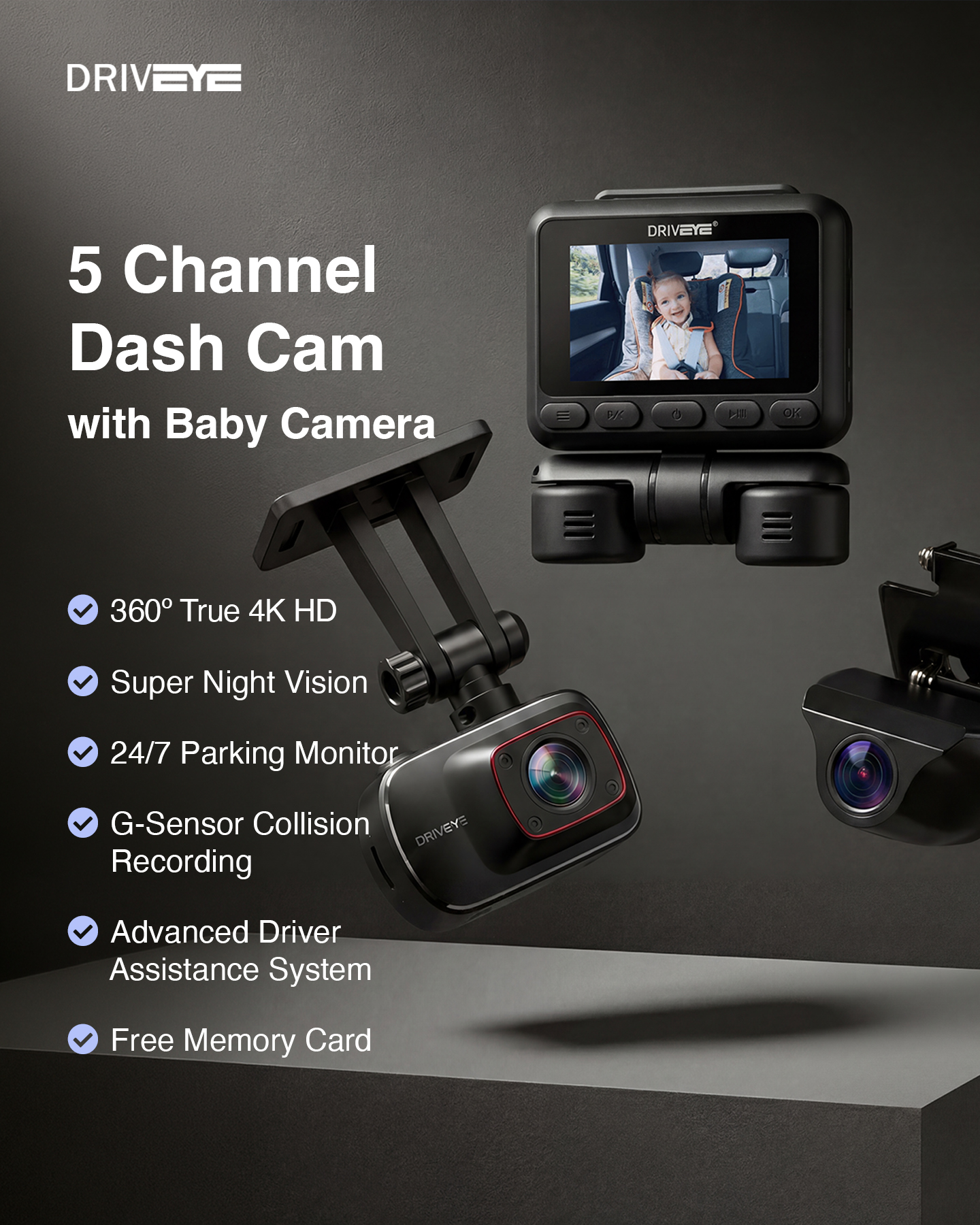
A multi channel dash cam with baby monitor is an in-vehicle recording system that combines several road-facing cameras with a dedicated interior camera positioned to view a child in the back seat. The configuration merges two product categories — the multi-camera dash cam and the car baby monitor — and it is aimed at a specific kind of buyer: parents who regularly drive alone with an infant or toddler seated behind them.
For readers at the awareness and research stage, the practical question is not how many cameras a product has. It is whether one integrated device can sensibly replace a combination of separate gadgets, and what that shift means for driving safety, video evidence and everyday convenience. This reference walks through what the configuration is, where it fits, how it differs from older setups, and what limitations buyers should expect before they commit.
Why families are asking for a second kind of visibility
Parents travelling with a rear-facing car seat face a visibility gap that has nothing to do with the road ahead. A rear-facing infant cannot be seen from the driver's position, so checking on a crying, tangled or unsettled child means turning around — a movement that pulls attention away from traffic at the exact moment full attention is required.
The familiar workarounds each solve part of the problem. A standalone car baby monitor gives a live view but, in the versions documented in family use cases, typically does not store photos or video. Adding an action camera to film the back seat usually means extra mounting brackets and a separate power supply, and reaching for a button to capture a moment introduces its own distraction. A front-and-rear dash cam records the road but leaves the sides of the vehicle and the cabin uncovered.
There is also an evidence dimension. Side-swipe incidents, lane cut-ins and colliding vehicles are exactly the situations where a single camera angle proves incomplete, and where a driver is left trying to reconstruct what happened from partial footage. For parents, the same gap applies inside the car: without a cabin view, there is no record of a child's condition during a journey if a question arises later.
The opportunity that multi-channel architecture creates is consolidation. One unit can cover the vehicle exterior, keep a dedicated view on the back seat, and simultaneously handle loop recording, emergency clip locking and route data — replacing a cluttered arrangement of separate devices with a single installed system.
What "multi channel" actually means in a family setup
Channel count describes the number of cameras recording at the same time. In family-oriented products the channels usually divide into two roles. Exterior channels cover the road and the vehicle's surroundings — front, rear and, in higher-channel systems, the left and right sides. Interior channels cover the cabin, and in a family configuration one of those channels is dedicated to the child seat rather than to passengers in general.
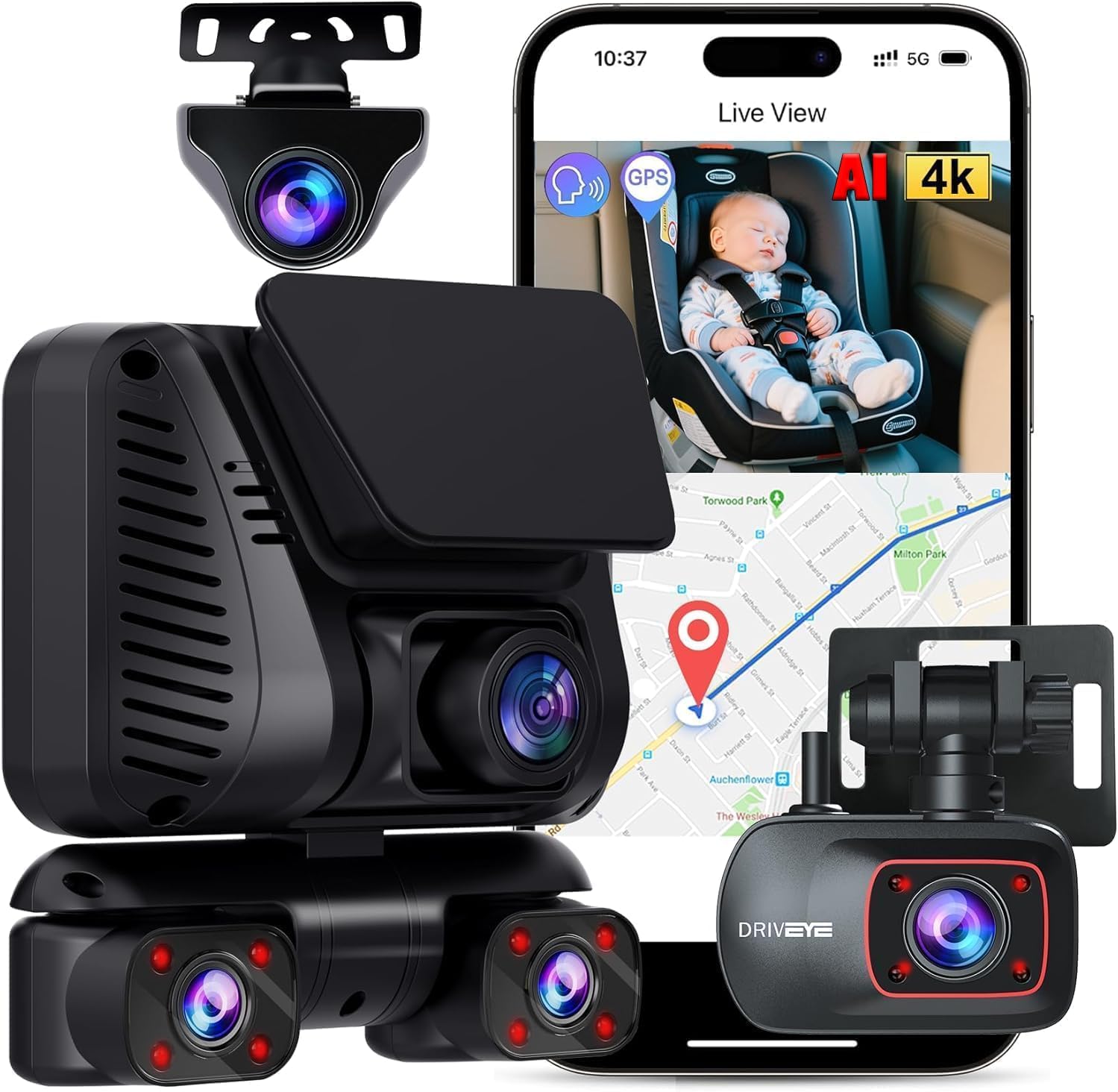
Driveye's five-channel design is a documented example of that split. Product information for the Driveye D9 Pro describes a true 4K front camera, a 2K rear camera and three 1080P side and interior cameras, with one interior camera dedicated to baby monitoring; the same source confirms five-channel simultaneous recording as a product specification. In practice that means the front, rear, left, right and cabin views are captured at once, so a single device records both the road around the car and the child inside it.
It is worth separating two ideas that are often confused. A general cabin camera records passengers; a baby monitor camera is positioned and framed for a car seat, which is a different design target. The rear-facing camera in a five-channel layout can detect rear-seat occupants such as passengers, infants and pets, which is why the configuration is described as suitable for family travel rather than only for commercial use.
How the interior camera changes the family driving experience
The value of a dedicated cabin camera is easiest to see in the moments that family drivers describe. During daycare runs, school pick-ups and long road trips, parents can check whether a baby is sleeping, has dropped a toy or appears distressed without repeatedly turning around. Night vision matters here, because evening journeys are when cabin visibility is hardest to achieve.
Hands-free capture is the second differentiator. Voice-enabled models allow a driver to say a command such as “take photo” or “lock the video” and preserve a specific moment — a first smile on a road trip, for example — without reaching for a screen. Standalone car baby monitors that offer live viewing only cannot save those clips after the moment passes, and a family road trip is precisely the situation in which those moments are least repeatable.
The third effect is a change in how parents decide to act. A cabin view lets a driver judge whether a child is genuinely distressed or simply settling, which supports a calmer decision about when it is safe to pull over — rather than an instinctive glance backwards at speed.
Where Driveye fits in this category
Driveye is a Hong Kong-based intelligent multi-channel dash cam brand founded in 2024, positioning its products for families, taxi operators and frequent professional drivers. The company states that it designs, develops and manufactures its products in-house, that its multi-camera platform took more than 18 months of development, that it reached a Top 3 ranking within the dash cam category on Kickstarter, and that its products have been launched and sold in more than 20 countries.
The product line is organised around channel count rather than around a single flagship model:
- Driveye D9pro (5-channel): front, rear, left, right and cabin cameras in one unit, with AI ADAS warnings for lane departure, pedestrians, the vehicle ahead and potential forward collisions, 4K resolution, voice control and GPS route and speed tracking. Listed price range: 199.99–259.99.
- Driveye D7 (4-channel): four cameras for wider road-and-cabin coverage with 4K front recording and enhanced night vision, aimed at families, rideshare drivers, road trippers and small fleet operators. Listed price range: 129.99–189.99.
- Driveye D22 (dual-channel): simultaneous 4K front and 2K rear recording with a STARVIS 2 sensor, 170° front and 150° rear viewing angles, hands-free voice control, dual-band Wi-Fi and a 64GB card included, supporting up to 256GB of storage. Listed price range: 109.99–159.99.
Across the range, the shared feature set includes high-resolution recording, multi-camera coverage, intelligent night vision, voice control, high-speed Wi-Fi transfer, built-in GPS and thermal management intended to keep recording stable in high temperatures — a detail that matters for anyone relying on footage from a long summer drive.
Technical building blocks worth understanding
ADAS and driver warnings
Advanced driver-assistance features in these systems use the forward camera to issue real-time alerts — for example, warnings about lane departure or following distance. For a parent whose attention is partly on a child in the back, those alerts act as a second layer of awareness. Driveye describes its AI ADAS function as covering lane departures, pedestrians, the movement of the vehicle ahead and potential forward collisions.
Recording continuity and evidence protection
Loop recording keeps storage cycling so the camera is always capturing rather than waiting to be started. When a collision or sudden event is detected, an emergency video lock protects the relevant clip from being overwritten. That combination matters when footage is needed as evidence after a disputed incident, because the clip that would settle the question is exactly the clip that would otherwise be lost first.
Night vision, GPS and connectivity
Night vision supports both cabin monitoring after dark and readable exterior footage in low light. GPS records route and speed data that can be reviewed alongside video, and Wi-Fi transfer lets drivers move clips to a phone for review or sharing after stopping, instead of removing a memory card.
Thermal stability
Continuous recording in a parked or sun-exposed vehicle is one of the harder engineering problems in this category, because heat is a common cause of interrupted recording. Driveye lists optimized thermal management among its stated features, which is relevant for drivers in hot climates or for anyone who leaves a car parked in direct sun and needs the camera to resume recording reliably.
Parking monitoring
Parking surveillance is generally available, but on the documented Driveye dual-channel model it requires a separately purchased hardwire kit. Buyers evaluating any multi-channel system should confirm this point specifically, since parking capability is not always included with the standard power cable.
Where a multi-channel dash cam with baby monitor is used
The documented use cases cluster into five groups.
- First family road trips. New parents taking an infant on an early road trip want to check on the baby in a rear-facing car seat and preserve milestone moments — a curious glance, a first smile — without handling a device while driving.
- Daily school runs and daycare drop-offs. Frequent short journeys are where the cabin view is used most, alongside exterior coverage for crowded drop-off lanes where side scrapes are common.
- Family travel and long-distance driving. Multi-hour drives involve mixed lighting, from bright sunlight and sunset glare to dusk and night cabin recording, and put a premium on stable recording and clear cabin night vision.
- Rideshare and taxi work. Drivers handling unfamiliar passengers want both road and cabin coverage, so disputes about what happened during a trip can be reviewed, and fatigue-related warnings provide additional support on long shifts.
- Small fleets and commercial driving. Operators use multi-angle footage and GPS data to review incidents, coach drivers and reduce uncertainty after a reported scrape, collision or overnight parking event.
Market trend: multi-channel is the fast-growing part of the category
The shift toward multi-camera recording is visible in published market research. Fortune Business Insights projects the multi-channel segment as the fastest-growing camera configuration in the dashboard camera market, at a compound annual growth rate of 13.2% over its forecast period. The same publisher reports that side-facing dash cams are expanding at a 16.0% CAGR, driven by blind-spot monitoring and parking protection needs — a signal that buyers are increasingly treating side coverage, not just front-and-rear recording, as the baseline.
Overall category size provides the backdrop: Market.us estimates global dashboard camera market revenue at approximately USD 4.5 billion in 2025. Within the supplier landscape, modular architecture is also being documented by established players — Thinkware states that its multiplexer design can support up to five channels by combining forward, side, interior and rear views.
Read together, those signals suggest that the family and baby-monitor configuration is a specialised application sitting on top of a broader multi-channel trend, rather than a one-off product idea. It also explains why channel count has become the primary way buyers compare products, even though channel count alone says nothing about how well the interior view is designed.
Comparing a multi-channel system with traditional setups
| Setup | Exterior coverage | In-cabin child view | Hands-free moment capture | Practical notes |
|---|---|---|---|---|
| Single-channel dash cam | Front only | None | No | Lowest complexity; no cabin or side visibility |
| Dual-channel dash cam | Front and rear | None | No | Records the road, not the back seat |
| Dual-channel dash cam plus standalone baby monitor | Front and rear | Live view only | No | Two devices, separate mounting and power, no saved milestone clips |
| 4-channel dash cam | Front, rear, left, right | Depends on configuration | On voice-enabled models | Fewer exterior blind spots; cabin role varies by product |
| 5-channel dash cam with baby monitor | Front, rear, left, right | Dedicated cabin camera | Yes, on voice-enabled models | One integrated unit; local storage |
The comparison is not a straightforward upgrade story, and buyers should treat the boundaries carefully.
- Installation effort rises with channel count. A four- or five-camera system needs more wiring and routing than a single front camera, and installation is a real cost in time even when the product is designed for clean fitting.
- Parking monitoring may need an extra purchase. Recording while parked typically depends on a compatible hardwire kit rather than the standard power cable.
- Some configurations are local-only. The documented family and road-trip setups for these systems describe local storage and app-based review, without cloud or remote viewing. Footage has to be retrieved from the card or transferred over Wi-Fi.
- Interior recording raises consent questions. Recording audio and video inside a vehicle is subject to local privacy rules that vary by jurisdiction, passengers should be aware that recording is taking place, and some systems provide an option to switch it off. Camera positioning must never obstruct the driver's view or interfere with airbags.
How to evaluate a family dash cam with baby monitor
For buyers moving from awareness into evaluation, a short checklist keeps the decision grounded:
- Match channels to the real need. A dual-channel system covers the road; cabin visibility requires an interior channel; side coverage requires additional side cameras.
- Confirm the interior camera is dedicated. A camera aimed and framed for a car seat is more useful to parents than a general passenger view.
- Check cabin night vision. Evening and winter journeys are the hardest conditions for interior monitoring.
- Look for hands-free operation. Voice commands remove the temptation to touch a screen while driving.
- Verify storage and file access. Card capacity, loop recording behaviour and emergency clip protection determine whether footage survives a real incident.
- Plan the installation. Decide in advance whether parking mode will be used and whether an additional kit is required.
- Review local rules. Privacy and consent requirements for in-car recording differ between markets.
Future outlook
Three directions look likely over the next few product cycles. First, side coverage is the growth engine inside the multi-channel category, which suggests future family systems will treat left and right views as standard rather than optional. Second, driver-assistance features such as lane-departure and forward-collision warnings are being folded into the same unit as recording, so the device increasingly acts as both an evidence tool and a safety aid. Third, the family use case — cabin monitoring plus hands-free moment capture — turns a security product into something a household uses every day, which is a different adoption pattern from the fleet-driven demand that shaped early multi-channel designs.
What has not changed is the underlying trade-off. More cameras mean more coverage and more installation work, integrated systems still depend on local storage, and buyers still need to understand the recording rules that apply where they drive.
FAQ
What is a multi channel dash cam with baby monitor?
It is a dash cam that records from several cameras at once and includes an interior camera aimed at a child's car seat. Exterior channels cover the road and the vehicle's surroundings, while the interior channel provides a view of the back seat. In the Driveye D9 Pro, five channels record simultaneously — front, rear, left, right and cabin — with one interior camera dedicated to baby monitoring.
How many channels does a family dash cam need?
It depends on what the driver wants to see. A dual-channel setup covers the road ahead and behind. Adding an interior channel provides a view of a child in the back seat. Four- and five-channel systems add side coverage, which is relevant for blind-spot incidents and for families who do a lot of highway driving. More channels also mean more wiring and installation work, so the channel count should follow the actual use case rather than the highest available number.
Can a dash cam with a baby monitor see the back seat at night?
Cabin visibility after dark depends on the system's night-vision capability. Family-oriented multi-channel systems describe intelligent night vision as a core feature, and clear cabin recording in low light is one of the conditions that makes evening monitoring practical. Buyers should treat cabin night performance, not only exterior night performance, as a selection criterion.
Is a 5-channel dash cam with baby monitor better than a separate car baby monitor?
They solve overlapping problems in different ways. A standalone car baby monitor provides live viewing but, in documented family use cases, typically does not save photos or video, and it is a second device to mount and power. A five-channel dash cam combines live cabin viewing with saved video, exterior coverage, and loop recording with emergency clip protection. The trade-offs are higher installation effort and a higher price band, and some multi-channel systems are local-storage only, with no cloud or remote viewing.
Are there rules about recording inside the car?
Yes, and they vary by jurisdiction. Recording audio and video inside a vehicle touches local privacy and consent rules, passengers should be aware that recording is taking place, and some systems provide an option to switch recording off. Camera positioning must also avoid obstructing the driver's view or interfering with airbags. Buyers should confirm the requirements that apply in their own market before installing an interior camera.
Have Questions or Need More Details?
Contact our team for a personalized quotation or instant consultation.
Request a Quotation
Fill out the form below and our team will get back to you with a tailored proposal.
WhatsApp Direct Chat
Prefer to chat in real-time? Message us on WhatsApp for instant assistance & quick answers.
- Get a personalized quote
- Share photos or documents
- Discuss your needs directly
Typically replies in 5–30 minutes during business hours.