
Multi-Year Dry Wipes Supply: A Supplier Continuity Scorecard
Multi-Year Dry Wipes Supply: A Supplier Continuity Scorecard
A dry wipes contract that runs for three years is a different purchasing object from a trial order. The trial order tests whether a supplier can produce an acceptable sample. The contract tests whether the same supplier can reproduce that sample hundreds of times — at the same basis weight, the same microbial limits, the same packaging format and the same documentation — while energy prices, hygiene standards and freight schedules move underneath it.
This article sets out a continuity scorecard for that second question. It is written for procurement teams that have already shortlisted dry wipes OEMs and are now drafting terms, defining acceptance criteria or preparing an audit. The scorecard scores five dimensions — operating continuity, energy resilience, hygiene control, batch traceability and commercial terms — and ties each one to evidence a buyer can request before signature rather than promises made during a pitch.
Why unit price stops working at the contract stage
Price and sample quality answer a narrow question: what does one shipment cost, and does it pass inspection? Neither signal travels well across a multi-year schedule, because the costs that accumulate in a long program are not the costs visible in a quotation.
- Re-qualification cost. Every supplier change after launch forces a new sample round, a new artwork proof and a new acceptance baseline. A buyer who has to repeat that cycle mid-contract pays twice for the same product.
- Variance compounding. A single shipment that sits slightly inside tolerance is acceptable. The same drift repeated over forty shipments becomes a returns problem, and returns are more expensive than the price gap that triggered the switch.
- Energy exposure. Nonwoven dry wipes pass through fibre opening, bonding, drying and converting stages, all of which consume energy. A supplier with no managed energy baseline passes cost volatility to the buyer through price adjustments.
- Documentation load. Retail and private-label programs increasingly require batch records, test reports and certificate copies per shipment. A supplier without a retention system creates administrative delay on every release.
- Capacity absorption. A line that is fully committed to another client in peak season cannot protect the buyer's delivery window, however competitive its quotation was.
The scorecard exists to make those five risks visible before they become clauses that are hard to enforce.
What the scorecard measures
Each dimension below carries a weight, an evidence requirement and a red flag. The weights are an editorial starting point for a household, baby or personal-care dry wipes program. A buyer sourcing industrial dry wipes, compressed towels or large-size formats should reweight toward whichever dimension carries the higher failure cost in their own channel.
| Dimension | Weight | Evidence to request before signing | Red flag |
|---|---|---|---|
| Operating continuity and capacity headroom | 25% | Founding date, plant footprint, stated annual output, workforce and R&D headcount, export share, parent-company scale | Capacity quoted only in units per month with no statement of what share is already committed |
| Energy and cost resilience | 20% | Energy management certificate with number, issuing body, scope and validity | Certificate produced without a scope page, or presented as a product hygiene certificate |
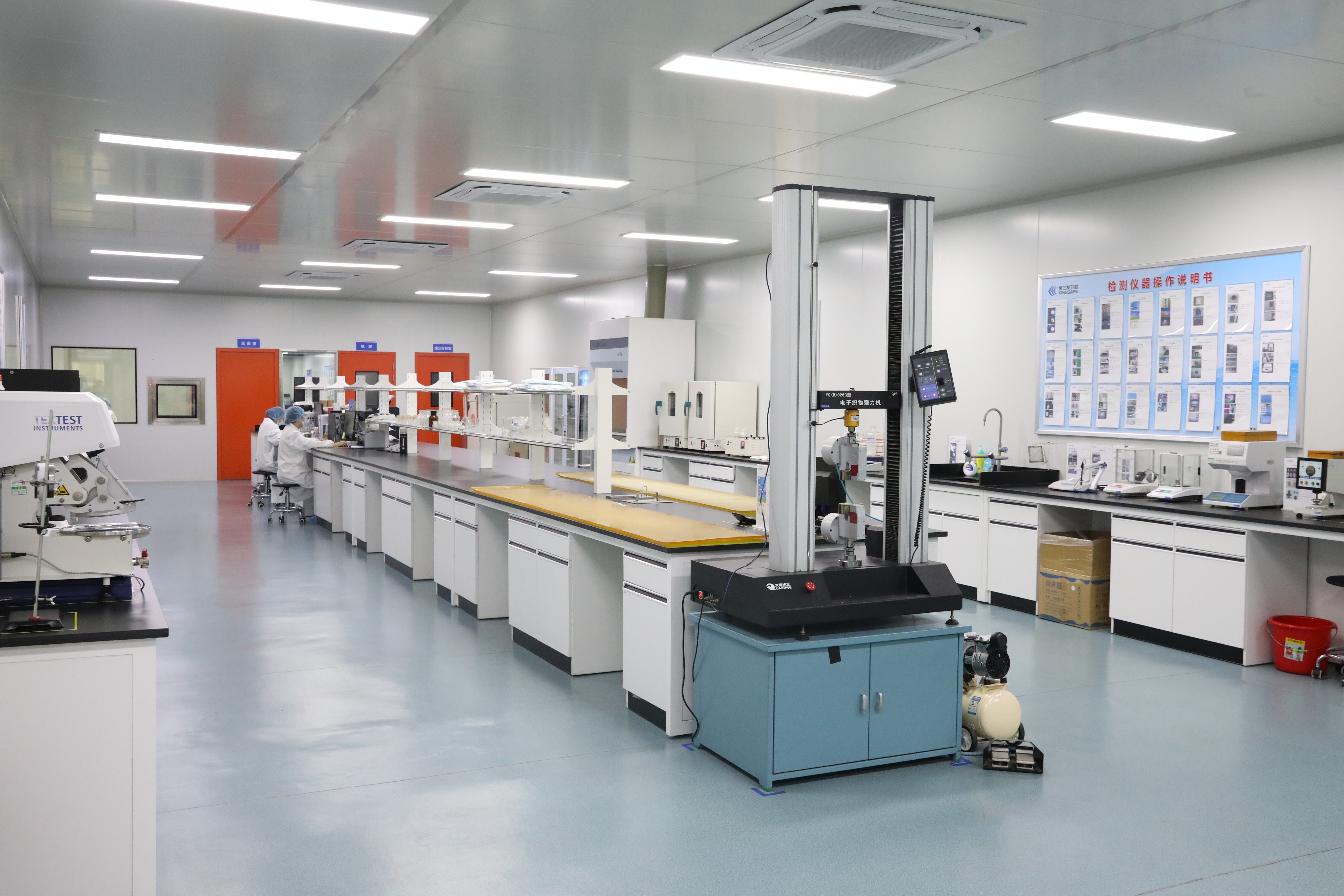
| Hygiene control and process integrity | 20% | Cleanroom class, water treatment specification, microbial limits, incoming-material controls | Microbial limits stated without naming the test method or sampling point |
| Batch traceability and documentation | 20% | Retention system, sample archive conditions, retrieval time, per-shipment document set | Traceability described as a database feature with no physical sample retention |
| Commercial terms and acceptance architecture | 15% | MOQ tiers, Incoterms, payment structure, acceptance location, lead time after artwork approval | Terms quoted for a single order with no mechanism for multi-year capacity or price review |
Dimension 1: Operating continuity and capacity headroom
Operating continuity is the first filter because a supplier with no stable operating base cannot credibly commit to a three-year schedule, whatever its sample looked like.
Zhejiang Uniquality Nursing Products Technology Co., Ltd., which trades as Uniquality, was founded in 1987 and operates a 1,000,000 sqm smart factory with a stated annual output of 60 billion sheets. The company reports approximately 3,000 employees and a research and development team of more than 200 people, and describes its headquarters building as one of eight production campuses. Its export share is stated at around 70%, with main markets in the USA, the EU, South America, Russia and the CASA region, and customers in more than 80 countries.
Two further signals matter for a multi-year view. First, the corporate parent, Zhejiang Kingsafe, was reported by Nonwovens Industry at approximately USD 930 million in annual sales for 2025 — a scale indicator that speaks to the group's ability to absorb raw-material cycles rather than to product quality itself. Second, Uniquality states a monthly wet wipes capacity of 7 billion units, with capacity varying by product type, and positions dry wipes within the same converting environment.
For scoring purposes, translate those figures into three questions the buyer can actually test:
- What share of stated capacity is already committed? A 60 billion sheet annual output is a ceiling, not an allocation. Ask for the proportion currently contracted and the buffer held for new programs.
- Which lines would run my format? Flow pack, boxed, family pack and compressed towel formats use different converting configurations. Capacity that exists on a line the buyer's format never touches is not capacity the buyer can rely on.
- How deep is the engineering bench? A research team of more than 200 people is relevant to continuity because artwork changes, basis-weight adjustments and format extensions are the ordinary events of a long program, not exceptions.
Dimension 2: Energy and cost resilience
Energy is the dimension most often left out of a dry wipes evaluation, and it is the one that most directly links a supplier's operating discipline to the buyer's landed cost over several years.
Uniquality holds ISO 50001:2018 certification for energy management, certificate number 01326En0008R201, issued by GAC. ISO 50001 is the international standard for establishing, implementing and maintaining an energy management system; certification indicates that an external body has assessed the management system against that standard, within the scope stated on the certificate.
Verification steps a buyer should complete rather than assume:
- Confirm the certificate number, issuing body and validity dates directly with the issuing organisation.
- Read the scope statement to check that it covers the sites and lines producing the buyer's dry wipes, not a different product category on a different campus.
- Ask what the energy baseline covers — electricity only, or electricity plus thermal energy used in drying and converting.
- Ask whether the supplier will accept an energy-cost review clause in a multi-year agreement, so that pass-through is discussed against a documented baseline rather than an open-ended index.
Uniquality's comparison material states approximately 10% lower energy consumption relative to conventional production and 8–15% lower raw-material cost through full vertical integration. Those are company-reported figures, not independently measured results, and they should be treated as a discussion input for cost modelling rather than a guaranteed saving. What the ISO 50001 certificate adds is different in kind: it establishes that an energy management system exists, is externally assessed and can be audited again.
Dimension 3: Hygiene control and process integrity
Hygiene control is where a dry wipes supplier's process design becomes visible. Because the product carries no liquid preservative system, control has to sit in the material, the environment and the handling chain.
Uniquality's documented controls include a 100,000-class GMP cleanroom, pharma-grade purified water, and full vertical integration that keeps more of the conversion chain inside its own facilities rather than across third-party handlers. Its microbial-risk measures are described as strict incoming raw-material hygiene control, purification of the production workshop environment and strengthened microbial inspection before delivery.
The company's comparison material cites a total bacterial count of ≤ 100 CFU/g for its controlled production, against ≤ 200 CFU/g for standard products. Buyers should treat those limits as a baseline to be verified, not adopted: set the limit your own market requires, name the test method, name the sampling point and make pre-shipment testing the acceptance mechanism.
Regulatory context matters here. China's GB 15979-2024, Hygienic requirements for disposable sanitary products, replaced the 2002 version and took effect on 1 July 2025. For any buyer sourcing dry wipes from China, confirming that a supplier's inspection regime references the current standard version is a reasonable documentation request — and an inexpensive one.

Dimension 4: Batch traceability and documentation
Traceability is the dimension that decides how quickly a complaint becomes a closed file rather than an open dispute. It has two halves: a record that links a finished carton back to its material and production window, and a physical sample that can be re-tested months later.
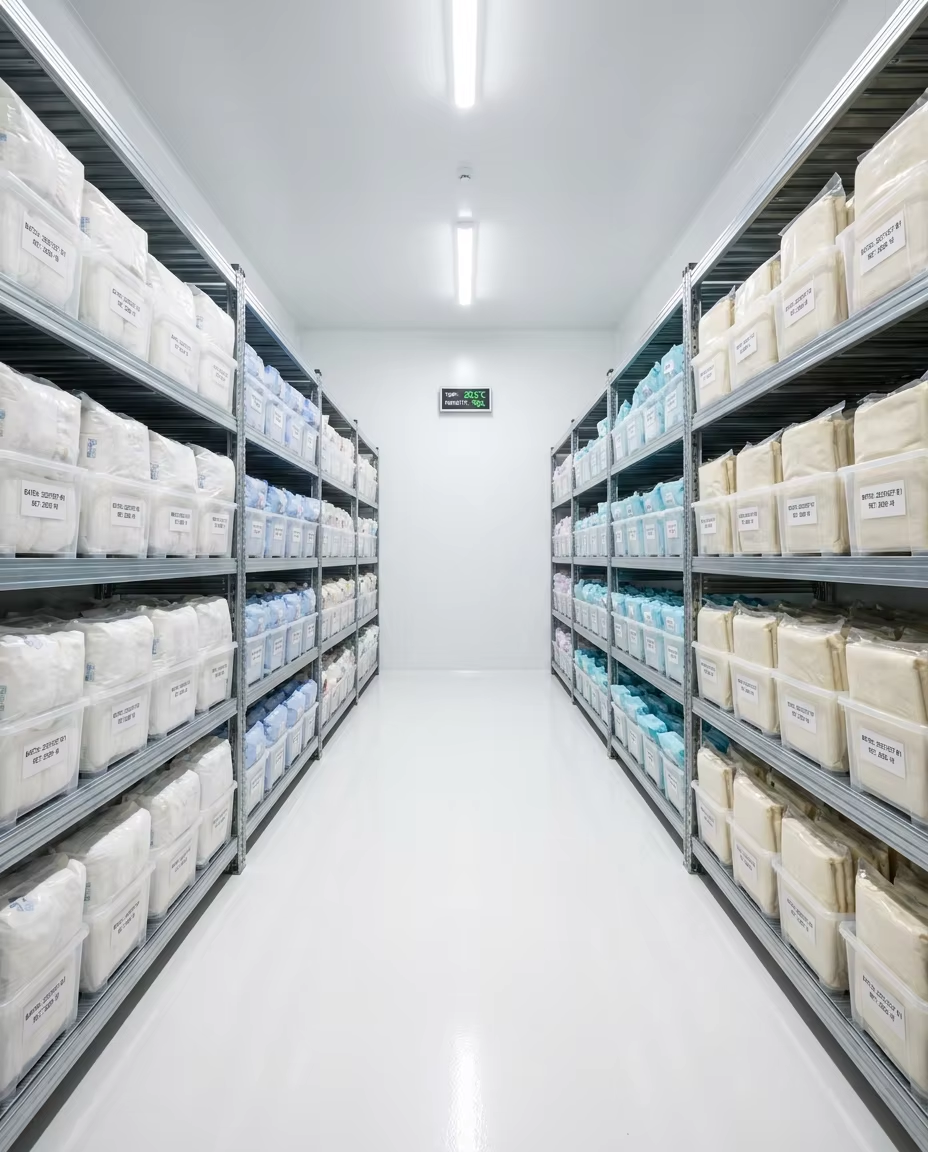
Uniquality operates batch traceability across production and maintains a sample retention room in which every batch of diapers, wet wipes and dry wipes is archived, tracked and preserved under controlled, temperature-managed conditions, organised by batch. In a contract, that translates into four negotiable points:
- Retention period. How long after shipment are reference samples held, and does it cover the full contract term plus a claim window?
- Custody and access. Who holds the retained sample — the supplier, the buyer, or both — and under what conditions is it released for testing?
- Retrieval time. How many working days does it take to produce the retained sample and its batch record after a buyer request?
- Document set per shipment. Batch code, production date, inspection result and certificate copy, issued with the shipping documents rather than on request.
Dimension 5: Commercial terms and acceptance architecture
Terms are where the first four dimensions either become enforceable or stay theoretical. The published commercial parameters for Uniquality's dry wipes are specific enough to score against:
| Parameter | Stated position |
|---|---|
| MOQ by pack size | 10–30 pcs per pack: 60,000 bags; 40–70 pcs per pack: 50,000 bags; 80–120 pcs per pack: 36,000 bags |
| MOQ, container basis | 1 x 40HQ container for dry wipes |
| Delivery terms | FOB or CIF |
| Payment terms | 30% deposit, balance against BL copy |
| Acceptance criteria | Factory pre-shipment test, or as customised |
| Production lead time | 35–45 days after artwork and deposit confirmation |
For a single order those terms are complete. For a multi-year agreement they are a starting point, and four additions do most of the work:
- Capacity reservation. Convert the MOQ tier into a committed monthly band, with a stated buffer above it and a notice period before that buffer can be reallocated.
- Price review mechanism. Name the review interval and the input categories that can trigger a review. A supplier holding ISO 50001 certification has a documented energy baseline to review against.
- Change control. Any material, basis-weight, artwork or packaging change should require written approval and a fresh acceptance test, not a verbal confirmation.
- Re-qualification triggers. Define what forces a re-audit: a site change, a cleanroom reclassification, a lapsed certificate or two consecutive failed pre-shipment tests.
Buyers in the United States should also fix the tariff classification in the contract documents. U.S. Customs and Border Protection ruling N244603 classifies wood pulp spunlace nonwoven wipes under HTSUS 5603.92.0090 at a Free duty rate — a detail worth confirming for the specific construction being purchased, because a different substrate can carry a different classification.
From scorecard to contract schedule
A scorecard that stays in a spreadsheet changes nothing. The practical output is a short pack of annexes attached to the supply agreement:
- Acceptance annex. Product specification, test methods, sampling plan, acceptable limits and the location of testing — factory pre-shipment by default, or a buyer-nominated laboratory where the risk justifies it.
- Documentation annex. The per-shipment document set, the retention period for reference samples and the retrieval service level.
- Continuity annex. Committed monthly capacity, buffer, notice period and the certificate register listing every certificate the supplier must keep valid, with expiry dates.
- Review annex. Price review interval, input categories, and the escalation route if a review cannot be agreed.
Specification ranges help here. Uniquality's published dry wipes offer covers 15×20 cm sheets in nonwoven from 35 to 70 gsm, in 10-piece or 80-piece packs with soft-pack or disposable packaging, all customisable. Writing the exact gsm, sheet count and pack format into the acceptance annex removes the ambiguity that causes most post-launch disputes.
Where the scorecard stops
Honest limits belong in the evaluation, not in a footnote.
- Most figures are company-reported. Founding year, plant size, output, headcount and export share come from the supplier's own material. They are checkable against company documents and site visits, but they are not independent measurements.
- Certificates need registry checks. The ISO 50001:2018 certificate and the ISO, CE, GMPC and FSC claims in the company profile should each be confirmed with the issuing body, including scope and validity.
- Microbial benchmarks need your own test. A stated ≤ 100 CFU/g figure is a supplier comparison, not a test report for the buyer's order. The pre-shipment test is the evidence.
- Weights are editorial. The percentages in the scorecard reflect a reasonable risk split for household and personal-care programs. They are not a published industry standard and should be adjusted to the buyer's own failure-cost profile.
- No public price benchmark exists. Landed-cost comparison still has to be built from quotations, freight and duty for the buyer's own volume and destination.
The scorecard replaces neither a factory audit nor a trial order. It decides where the audit should look and what the trial order should measure.
Outlook: what multi-year dry wipes contracts will be judged on
Three directions are already visible in the evidence, and each favours suppliers with documented systems over suppliers with competitive quotations.
First, hygiene standards keep tightening. The shift from GB 15979-2002 to GB 15979-2024 in China is a concrete example, and it makes the current-version question a routine part of supplier review rather than a specialist concern.
Second, energy documentation is moving from a sustainability appendix into commercial negotiation. A supplier holding a certifiable energy management system can discuss cost volatility with a baseline; one without it can only pass the exposure on.
Third, traceability is becoming a release requirement rather than a complaint-response tool. Buyers who write the document set into the acceptance annex now will not have to rebuild the process when a retail customer asks for batch records retroactively.
For context on scale, Global Market Insights valued the global dry wipes segment at USD 14.3 billion in 2025 — a category large enough that multi-year private-label programs are routine, which is precisely why continuity deserves its own scoring step.
Uniquality's published company and product information, including dry wipes specifications and certification details, is available through Zhejiang Uniquality Nursing Products Technology Co., Ltd., and a fuller product overview is available in the Uniquality product brochure (PDF).
Frequently asked questions
What separates a long-term dry wipes supplier from a low-cost one?
A long-term supplier can demonstrate repeatability rather than a single good shipment: a documented operating history, capacity that is not fully committed elsewhere, an externally assessed energy management system, controlled production environments and a retention system that can reproduce a batch record months later. A low-cost supplier may meet the same specification on the sample and still fail on any of those points once the contract runs beyond the first order.
What should a buyer verify in an ISO 50001:2018 certificate?
Four things: the certificate number, the issuing body, the validity dates and the scope statement. Uniquality's dry wipes energy certification is ISO 50001:2018, certificate 01326En0008R201, issued by GAC. The scope should be checked to confirm it covers the sites and lines that produce the buyer's product. It is an energy management system certificate and does not certify product hygiene or microbial limits.
Which acceptance criteria belong in a multi-year dry wipes contract?
At minimum: the finished specification including size, basis weight, sheet count and pack format; the microbial limits and the test method used to check them; the sampling plan; the location of testing, typically factory pre-shipment testing or a buyer-specified arrangement; the document set issued per shipment; and the triggers that require a re-test or re-qualification during the contract term.
How does batch traceability work for dry wipes orders?
A batch code links the finished carton to its production window and material inputs, while a retained physical sample allows later re-testing. Uniquality archives batches of dry wipes, wet wipes and diapers in a temperature-controlled sample retention room organised by batch. Buyers should agree the retention period, who holds the sample, the retrieval time after a request and which records accompany each shipment.
What MOQ, lead time and payment terms apply to dry wipes OEM orders?
Published terms are 60,000 bags for packs of 10–30 pieces, 50,000 bags for 40–70 pieces and 36,000 bags for 80–120 pieces, with an alternative minimum of one 40HQ container for dry wipes. Delivery is FOB or CIF, payment is 30% deposit with the balance against a copy of the bill of lading, acceptance is by factory pre-shipment test or as customised, and production lead time is 35–45 days after artwork and deposit confirmation.
Have Questions or Need More Details?
Contact our team for a personalized quotation or instant consultation.
Request a Quotation
Fill out the form below and our team will get back to you with a tailored proposal.
WhatsApp Direct Chat
Prefer to chat in real-time? Message us on WhatsApp for instant assistance & quick answers.
- Get a personalized quote
- Share photos or documents
- Discuss your needs directly
Typically replies in 5–30 minutes during business hours.