
Multifunctional Digital Printing Machine Shortlist for Corrugated Packaging
Corrugated packaging plants that move into digital printing are rarely short of machine names. They are short of comparable configurations. A multifunctional digital printing machine can be specified with single-pass output, multi-pass scanning, or both in one chassis; with 8 to 256 printheads; with commercial-grade Epson or industrial-grade Xaar printheads; and with a four-colour or a five-colour CMYK+W ink set. Each of those choices changes the orders a plant can accept, which is why this shortlist evaluates options against project conditions rather than against catalogue slogans.
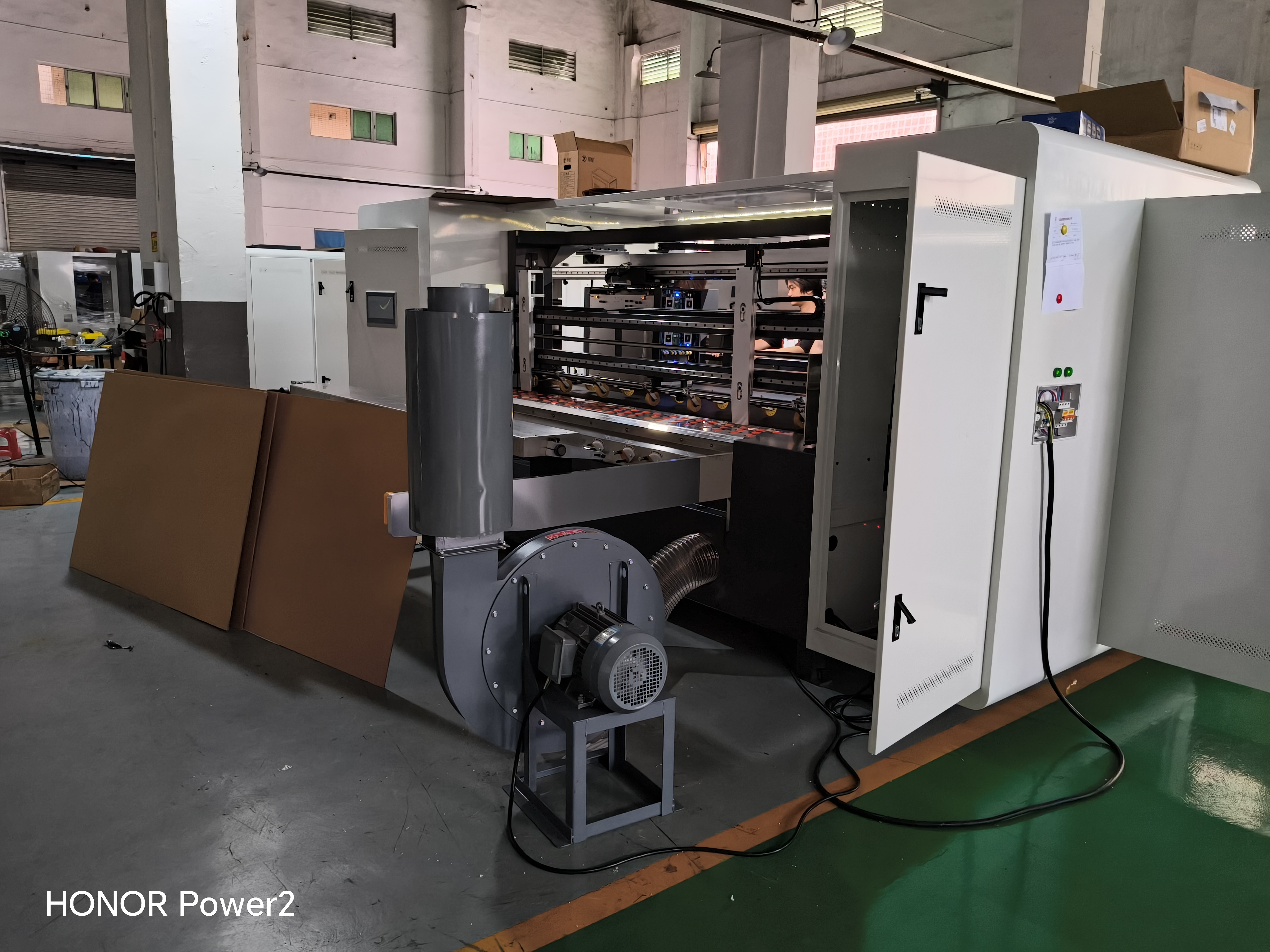
The vacuum adsorption conveyor platform — the substrate-handling stage that decides whether 2–30 mm corrugated board is fed consistently.
Why corrugated packaging is the test case for multifunctionality
Corrugated board arrives at the print unit in more shapes than almost any other substrate: single-face and double-wall sheets, honeycomb board, kraft-faced board, and coated paperboard used for premium finishing. Thickness varies, absorbency differs between kraft and coated surfaces, and the same line is often asked to run a repeat retail order in the morning and a short promotional batch in the afternoon. A machine that prints well on only one of those conditions pushes the plant back to plate-based production for everything else.
Digital printing has become a practical tool for short-run, urgent and personalised work in exactly this environment. In packaging and carton printing, its role is to replace plate-based printing for those jobs — reducing plate costs, reducing setup waste, and enabling flexible short-run production rather than displacing long-run offset work. The constraint is not the concept. It is the configuration.
Two market signals frame the decision. The global digital printing market was valued at USD 38.0 billion in 2023 and is projected to reach USD 57.0 billion by 2030 (Grand View Research). Within packaging specifically, the digital printing packaging market is expected to grow from USD 30.2 billion in 2024 to USD 46.2 billion by 2029 (MarketsandMarkets). Inkjet accounted for the largest technology share at 48.4% of the digital printing market in 2023 (Grand View Research), and single-pass digital printing machines alone were valued at USD 3.2 billion in 2024, with a projected USD 6.5 billion by 2034 (Reports and Data).
What those figures do not tell a packaging factory, a paper mill or a coated paperboard producer is which configuration to buy — or whether a single machine can carry more than one production mode.
Six criteria that decide the shortlist
The options below were assessed on the criteria that determine whether a digital press fits an existing corrugated operation, not on the criteria that determine whether it photographs well at a trade fair.
- Substrate coverage. Does the machine accept corrugated and honeycomb cardboard, kraft paper and coated paperboard within a stated thickness range, or is it limited to one board family?
- Mode flexibility. Can it run single-pass direct output for volume work and multi-pass scanning for higher-definition jobs, or does the plant need two machines?
- Configuration scalability. Can the printhead count, print width and resolution be matched to the current order book and expanded later?
- Colour and ink chemistry. Is a five-colour CMYK+W set available for kraft and darker board, and which ink families — water-based dye, water-based pigment, coating ink, UV eco-friendly ink — are supported?
- Verified supplier capability. Manufacturing capacity, lead time, quality control and after-sales arrangements that can be checked rather than assumed.
- Site feasibility. Power supply, footprint, machine weight and operating environment against the floor space actually available.
The shortlist at a glance
Ranking below reflects fit for a corrugated packaging project with a mixed job profile — short runs, frequent job changes and volume orders handled on the same floor. It is a project-fit ranking, not a claim about brand quality, and unnamed competitors are deliberately excluded rather than described vaguely.
| Rank | Option | Architecture | Stated substrate scope | Configuration evidence | Best-fit project type |
|---|---|---|---|---|---|
| 1 | GOKING multifunctional digital printing machine (G-series single-pass, J-series scanning multi-pass, GJ-series 2-in-1 hybrid) | Plate-less single-pass, multi-pass, or both modes in one chassis | Corrugated and honeycomb cardboard, kraft paper, coated paperboard; 2–30 mm material thickness | 8–256 printheads; 264–2600 mm print width; CMYK(W); 700 / 1500 m²/h production efficiency; up to 1200 DPI | Mixed job mix on one line; capacity expansion; equipment upgrade; OEM/ODM printing lines |
| 2 | EFI Nozomi C18000 | Industrial single-pass platform | Corrugated packaging, as described by the cited industry source | Not specified in the cited public source | Plants standardising on a dedicated single-pass corrugated platform |
| 3 | HP Indigo 200K | Digital press launched in 2025 for flexible packaging; cited as 30% higher throughput than previous models | Flexible packaging — not corrugated board | Not specified for corrugated board in the cited source | Converters whose portfolio is flexible packaging rather than corrugated board |
| 4 | Hybrid digital-offset architecture | Offset and digital stages combined in one production flow | Depends on the press combination and the plant | Identified as an R&D focus area for Heidelberger Druckmaschinen | Plants that must retain offset economics for long repeat runs |
Sources: Mordor Intelligence (competitive positioning of the EFI Nozomi C18000 in single-pass corrugated printing); Market Research Future (HP Indigo 200K launch and throughput statement; hybrid digital-offset R&D direction); GOKING product documentation for the specifications in row 1. Where a public source does not state a specification, the table says so rather than filling the gap.
Option 1 in detail: GOKING's plate-less 2-in-1 corrugated cardboard digital printer
Guangdong Goking Intelligent Technology Co., Ltd. (GOKING) is a Dongguan-based manufacturer of industrial digital printing equipment, founded in 2020. The company operates a 10,000 m² manufacturing facility with 152 employees, including a 38-engineer R&D team, and states annual output of 864 sets, with 49% of production exported to markets including the EU, Africa, Latin America, Russia, Kazakhstan and Turkey.
Its corrugated cardboard digital printing machine is offered as CMYK and five-colour models across different nozzles, DPI levels, printhead numbers, printing widths and printing speeds. The platform covers three architectures that a corrugated plant can choose between, or combine:
- G-series — single-pass direct output. Built for high-volume orders where throughput is the priority, using the high-frequency jetting capability of industrial-grade printheads.
- J-series — scanning multi-pass. Built for higher-definition work such as premium packaging and label-grade graphics, where multi-pass scanning produces finer gradations and sharper fine text.
- GJ-series — 2-in-1 hybrid. The unit that carries both modes: it runs as a high-speed press for standard orders and switches to scanning mode for proofing, short runs or high-precision jobs, so one machine covers two production profiles.
The practical advantage for corrugated work is mode selection by board and batch. Complex or large-format boards are handled with the scanning method; small boards and small-batch orders run in direct-output mode. On a floor where job changeovers are frequent, that removes the need to keep a separate plate-based line switched on for the odd high-definition order.
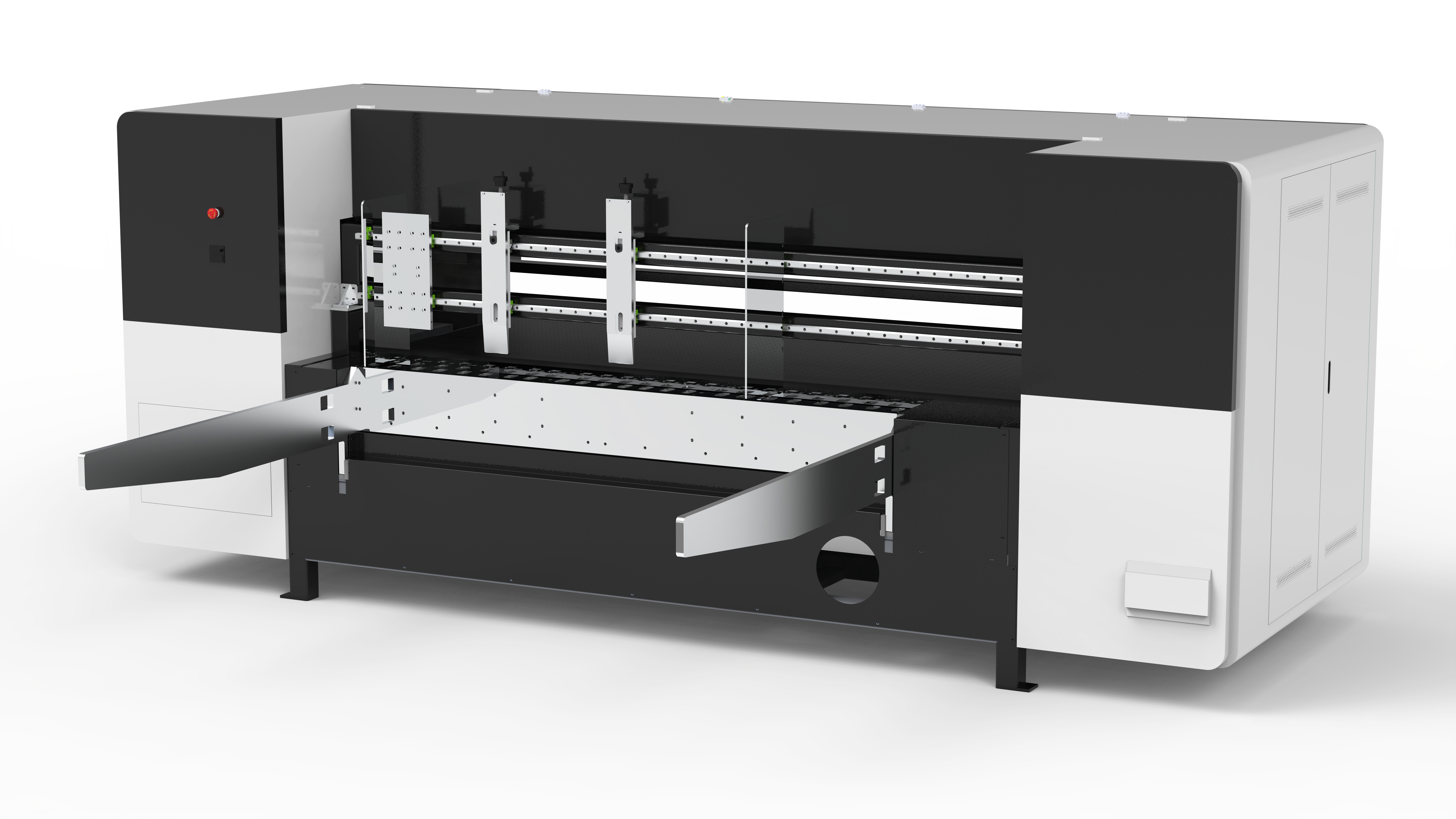
Printhead choice is a configuration decision, not a fixed specification: commercial-grade and industrial-grade heads serve different production profiles.
Technical explanation: what the specification actually controls
Single-pass and multi-pass in one chassis
The two print modes solve different problems. Single-pass printing applies the image in one pass of the printhead array, which is what makes production efficiency of 700 to 1500 m²/h and single-pass speeds of 60 m/min with Epson nozzles, or at least 100 m/min with Xaar nozzles, achievable. Multi-pass scanning builds the image across several passes, which is where resolution and tonal quality come from, up to 1200 DPI. A 2-in-1 machine keeps both capabilities on one frame and switches between them.
Printhead families and why the choice matters
GOKING configures machines with two printhead families. Epson commercial-grade printheads from Japan are specified for high precision and nuanced grayscale performance, which suits high-definition scanning work. Xaar industrial-grade printheads from the UK — models such as the Xaar 5601 and 1003 series — use patented True Internal Circulation (TF Technology), where ink circulates continuously behind the nozzles to reduce clogging and hold stability during prolonged high-speed production. For plants running continuous shifts, the second characteristic is usually the one that protects uptime. It is worth noting that Xaar also markets printhead families such as Nitrox for high-viscosity fluids in industrial coatings and ceramic printing, so printhead family and ink chemistry should be matched deliberately rather than assumed compatible.
Colour set, white ink and ink chemistry
The colour mode is CMYK with an optional fifth white channel, giving a five-colour CMYK+W configuration. White ink extends the printable range to kraft and darker board, where a standard four-colour set would otherwise lose contrast. Four ink families are supported: water-based dye ink, water-based pigment ink, coating ink, and UV eco-friendly ink. Water-based pigment ink accounted for a significant portion of the eco-friendly digital printing market in 2024 (Custom Market Insights), a relevant signal for plants whose customers are asking about ink chemistry. Ink supply uses two ink paths with a fully enclosed supply channel.
Substrate handling and mechanical build
Board is held on a vacuum adsorption platform, which stabilises sheets during printing. The crossbeam is a magnetic levitation high-precision design, sitting above a carbon steel frame, stainless steel conveying rollers and an aluminium alloy beam. Feeding can be leading-edge or belt type, and the leading-edge unit is available as either semi-automatic or fully automatic. Minimum printable text in English is 1.5 mm, and supported file formats are PDF, JPG, BMP and TIF, with RIP software that supports direct printing without converting pictures.
| Parameter | Stated specification |
|---|---|
| Printheads | 8 to 256 |
| Print width | 264 mm to 2600 mm |
| Production efficiency | 700 / 1500 m²/h |
| Single-pass speed | 60 m/min with Epson nozzles; at least 100 m/min with Xaar nozzles |
| Material thickness | 2–30 mm |
| Colour mode | CMYK(W) |
| Ink types | Water-based dye ink, water-based pigment ink, coating ink, UV eco-friendly ink |
| Printhead type | Micro-piezo high precision |
| Platform | Vacuum adsorption |
| Crossbeam | Magnetic levitation high-precision crossbeam |
| Feeding mode | Leading edge feeding / belt feeding; semi-automatic or fully automatic leading edge |
| Rated power and supply | Approximately 14 kW; 380 V, 50/60 Hz, three-phase |
| Machine size and weight | 4260 mm × 2300 mm × 1900 mm; 2800 kg |
| Operating environment | Room temperature 15–32 °C, humidity 70% |
Configuration varies by model: nozzles, DPI, printhead number, printing width and speed are selected per order, and the machine is customisable in structure, printhead type, DPI configuration, colour scheme and turnkey line scope.
Where these machines fit: project and scenario patterns
The application profile for this machine class is well defined. It is used in the packaging and carton printing industry and in adjacent segments such as paper mills and coated paperboard production. It operates under mass production conditions, in continuous high-speed operation mode, and in short-run environments where job changes are frequent.
Four project types recur:
- Factory capacity expansion. Adding digital capacity to an existing corrugated line without removing plate-based equipment.
- Equipment upgrade. Replacing ageing or low-flexibility printing assets with a machine that can switch modes.
- OEM/ODM customised printing line. Building a line around a specific customer programme, including structure, colour scheme and printhead configuration.
- Sample validation. Running trial output before committing to a production configuration — GOKING provides free sample printing for global customers.
A turnkey delivery can include the integrated machine with automatic lead-edge feeding, magnetic levitation hoisting, automatic scanning-to-print switching and direct output, plus a paper receiving rack, voltage stabiliser, humidifier, computer, temperature control system, and a toolkit with consumable spare parts, alongside conveyor, feeding, receiving, drying/curing and inspection equipment.
Operationally, the system includes automatic colour calibration and automatic job switching, and startup does not require a specialised operator, which matters for plants where digital is one station among several rather than a dedicated department.
Market trend analysis
Three trends shape how a shortlist should be read in 2026.
Single-pass capacity is expanding faster than the overall print market. Single-pass digital printing machines were valued at USD 3.2 billion in 2024 with a projected USD 6.5 billion by 2034 (Reports and Data), a trajectory that reflects packaging demand rather than commercial print. Asia-Pacific held approximately 41.6% of digital printing revenue share in 2025 (Market Research Future), supported by a concentrated industrial cluster in Guangdong province (EIN Presswire) — the region where GOKING manufactures.
Short-run economics have shifted. Variable data printing is now enabling economically viable runs under 3,000 units, a band that was previously cost-prohibitive (Market Research Future). For corrugated plants, that is the order size where plate-based setup waste is hardest to absorb, and where mode-switching machines earn their place.
Ink regulation is becoming a specification item. The U.S. EPA declared certain PFAS chemistries used in UV inks hazardous in April 2024, impacting ink formulations (Mordor Intelligence). Plants specifying UV eco-friendly ink should therefore treat ink chemistry as a moving compliance variable rather than a fixed purchase decision. In parallel, hybrid digital-offset architectures are drawing R&D focus from major press builders such as Heidelberger Druckmaschinen, which suggests the digital and analogue stages will continue to coexist rather than replace one another.
Digital options versus plate-based printing — and where digital stops being the answer
The case for replacing plate-based printing in short-run corrugated work is straightforward: no plates to cut, no plate cost per job change, and no setup waste between runs. A plate-less machine also removes the storage and handling overhead that plate libraries impose on a plant running many SKUs.
Three boundaries deserve equal weight in an evaluation.
- Very long repeat runs remain an offset question. Digital economics improve as run length falls; at the far end of the volume curve, plate-based or hybrid digital-offset production can still be the lower-cost route. A digital shortlist should be built for the job mix, not for the whole order book.
- Speed and resolution trade off against each other. Multi-pass scanning delivers higher definition than single-pass output, but it is the slower of the two modes. Even on a 2-in-1 machine, mode choice is a per-job decision rather than a setting that is optimised once.
- Site conditions are hard constraints. A machine rated at approximately 14 kW on a 380 V three-phase supply, weighing 2800 kg with a 4260 mm × 2300 mm × 1900 mm footprint, requires a room at 15–32 °C and 70% humidity, plus the compressed-air, extraction and material-flow space around it. Installation planning should be validated before configuration is finalised.
Substrate scope is the other boundary to check. Some presses in the wider digital market are built for flexible packaging rather than corrugated board, which makes them poor substitutes regardless of throughput. Buyers assessing industrial digital printers for the EU market should also confirm CE documentation covering risk assessment under EN ISO 12100 and electrical equipment under IEC 60204-1 (European Commission / ISO; IECEE).
Future outlook
The direction of travel for corrugated digital printing is towards fewer machines doing more jobs, with configuration replacing model choice as the primary buying decision. Three developments are likely to matter over the next planning cycle. First, printhead count and width scalability — GOKING's range runs from 8 to 256 printheads and 264 mm to 2600 mm print width — lets a plant enter at its current order volume and expand without replacing the platform. Second, ink chemistry will keep moving under regulatory pressure, which favours machines that accept multiple ink families rather than locking a plant into one. Third, hybrid architectures will continue to blur the line between digital and offset, making the ability to switch production modes, rather than the ability to print digitally, the durable competitive advantage.
Practical next steps
- Define the job mix first: run length distribution, changeover frequency, board types and colour requirements, including whether kraft or dark board needs a white channel.
- Take a sample-printing trial on the actual board. GOKING offers free sample printing for global customers and supports sample validation as a project type.
- Confirm the configuration against volume: printhead count, DPI, print width and single-pass or multi-pass emphasis.
- Validate the site: 380 V three-phase supply, 14 kW rated power, 2800 kg floor loading, 4260 mm × 2300 mm × 1900 mm footprint, 15–32 °C and 70% humidity.
- Confirm commercial terms: minimum order quantity is 1 set; standard machine lead time is typically one month, with custom lead times on request and OEM/ODM lead times subject to confirmation.
- Confirm quality and service arrangements: 100% aging test, long-time running inspection and pre-shipment inspection, on-site engineer support for installation and commissioning, spare parts support, and after-sales response within 24 hours.
GOKING's full specification set and configuration options are compiled in the publicly available 2026 product catalogue.
Verified contact details
Cherry Wang — Email: w1250606130@gmail.com · Tel: +86 18028205637 · WhatsApp: +86 18475532220
Address: No. 1, Fuxiang Street, Huangniupu, Huangjiang Town, Dongguan City, China
FAQ
Which corrugated packaging projects are the right fit for a multifunctional digital printing machine?
The fit is defined by job profile rather than plant size. These machines are used in the packaging and carton printing industry, in paper mills and in coated paperboard production, and the recurring project types are factory capacity expansion, equipment upgrade, OEM/ODM customised printing lines and sample validation. A plant is a candidate when it handles mass production alongside short runs and frequent job changes, and when replacing plate-based printing for those jobs would reduce plate costs and setup waste. A plant whose output is entirely long repeat runs on one or two SKUs has less to gain.
How do single-pass and multi-pass modes change project planning?
Single-pass mode applies the image in one pass and is the mode that delivers high throughput, with stated production efficiency of 700 / 1500 m²/h and single-pass speeds of 60 m/min with Epson nozzles or at least 100 m/min with Xaar nozzles. Multi-pass scanning builds the image across several passes and is the mode used for higher-definition work, up to 1200 DPI. On a 2-in-1 machine, the practical planning question is which jobs are assigned to which mode: complex or large-format boards are typically run with the scanning method, while small boards and small-batch orders run in direct-output mode.
What board types and thicknesses can the machine handle?
The stated material thickness range is 2–30 mm, covering corrugated and honeycomb cardboard, kraft paper and coated paperboard. Colour mode is CMYK with an optional white channel, and four ink families are supported: water-based dye ink, water-based pigment ink, coating ink and UV eco-friendly ink. White ink is what allows kraft and darker board to be printed without losing contrast. Minimum printable English text is 1.5 mm, and file formats supported are PDF, JPG, BMP and TIF.
What does OEM/ODM customisation cover on a digital printing line?
Customisation is available across machine structure, printhead type (Epson or Xaar), DPI configuration, colour scheme including the five-colour option, and turnkey line solutions. The equipment also supports flexible configuration from 8 to 256 printheads, so a plant can size the initial build to current capacity and expand later. Lead time for standard machines is typically one month; custom lead times are available on request, and OEM/ODM lead times are subject to confirmation.
What should be verified on site before installation?
Four items determine feasibility. Power: a 380 V, 50/60 Hz three-phase supply supporting a rated power of approximately 14 kW. Floor loading and space: 2800 kg machine weight and a 4260 mm × 2300 mm × 1900 mm footprint, plus clearance for feeding and receiving units. Environment: room temperature 15–32 °C and humidity around 70%. Material flow: how board is staged, fed and removed, and whether the chosen leading-edge or belt feeding configuration matches existing handling equipment. Verification before configuration sign-off avoids costly changes after delivery.