
Multiwire Drawing Machine Procurement FAQ: Technical Due Diligence Amid Global Supply Shifts
Buying a multiwire drawing machine is an upstream commitment. A cable plant that specifies one is not purchasing a standalone tool; it is fixing the interface between rod intake and every downstream bunching, stranding and insulation line for the working life of the equipment. Because the purchase cycle is long and few people inside a plant can assess the machine in detail, technical due diligence usually rests on the documents a supplier is willing to release — and on how thoroughly the buyer can test the claims those documents contain.
Global supply conditions have made that test harder. Trade policy adjustments, freight volatility and the redistribution of cable manufacturing capacity across the USA, the Middle East, Africa and Asia have turned origin, support geography and delivery scheduling into technical variables rather than commercial footnotes. The questions below are the ones that now decide evaluations.
Why Technical Due Diligence Now Starts With the Supply Map
For most of the past two decades, a buyer comparing multiwire drawing machines could treat the supply chain as a constant. Machines came from a small set of established industrial regions, service engineers travelled on predictable schedules, and the main variable was price against specification. That assumption no longer holds cleanly.
Three variables now move during an evaluation:
- Origin and local presence. Suppliers with production or assembly capacity outside their home market change the logistics and service equation. HONTA, a cable conductor machinery manufacturer founded in Jiangsu, China, in September 2006, established HONTA INC as a second production base in the United States in 2017. That fact is cited here only as an example of how cross-border localization now appears in supplier structures — not as evidence of superiority over any other supplier.
- Policy and conformity. For EU-bound projects, machinery directive documentation is a gate rather than a formality, and the scope of a certificate matters as much as its existence.
- Capacity scheduling. How much of a supplier's output is already committed determines whether a purchase order becomes a delivery. HONTA states an export ratio of 45% across the USA, Middle East, Africa and Asia. That indicates export handling is routine — and also that a large share of annual output is allocated outside the domestic market.
None of these replaces a technical review. They change the order in which questions are asked, and they raise the value of answers that can be documented rather than described.
Question 1: What Does “Capacity” Actually Refer To?
Capacity is the most frequently misread figure in multiwire drawing machine procurement, because three different numbers are routinely used interchangeably. They answer three different questions.
- Company-level annual output. HONTA states an annual output of 200 sets across its product range, which also includes rod breakdown machines, high-speed double twist bunching machines and wire electrolytic plating lines. This figure describes the scale of the business, not the output of any single line.
- Plant-level monthly capacity. HONTA states a monthly capacity of 15 sets, a standard lead time of 90 days and a minimum order quantity of 1 set. These are the numbers that govern your delivery slot and your commissioning schedule.
- Line-level throughput. This is determined by wire count, drawing speed at the specified finished wire diameter, annealing load, spool change time and realistic uptime — and it is the only figure that belongs in a production plan.
| Figure a supplier quotes | What it actually answers | What it does not answer |
|---|---|---|
| Annual output (sets/year) | Scale of the manufacturing operation | Whether capacity is free in your delivery window |
| Monthly capacity (sets/month) | Scheduling granularity and batch rhythm | Machine performance at your wire diameter |
| Standard lead time (days) | Planning horizon for civil works and commissioning | Spare parts or service response time |
| Maximum speed (m/min) | Upper mechanical limit of the drawing section | Sustained output at your reduction ratio |
| Wire count | Parallel output per line | Yield, scrap rate or downstream balance |
A buyer who converts these figures into one number — usable tons per shift at a stated conductor size — will usually find that the comparison between two suppliers changes materially.
Question 2: Which Configuration Decisions Cascade Through the Whole Evaluation?
Configuration is not a list of options. Six decisions constrain every other part of the assessment.
- Wire count. Multiwire lines are commonly organised around 8, 16, 24 or 32 wires. Wire count sets the relationship between line speed and total output, and it must be matched to downstream stranding or bunching capacity. A line that outpaces the plant's take-away capability simply relocates the bottleneck.
- Drive architecture. Individual motors per spindle versus a common shaft with mechanical distribution. This choice drives energy consumption per ton, die changeover behaviour and the maintenance skill set the plant must retain.
- Annealing. Whether annealing is inline and how it is controlled affects both metallurgical consistency and the electrical load of the line.
- Spooling and take-up. Single spooler, double spooler or basket coiler determines pack format, changeover frequency and how the output feeds downstream equipment.
- Upstream interface. The rod breakdown stage — copper rod breakdown or aluminium rod breakdown — sets the inlet diameter, the elongation budget and therefore what the multiwire section is actually asked to do.
- Customisation scope. Every engineering change consumes design and commissioning time. Understanding in advance what a supplier will and will not modify protects the delivery date.
Question 3: What Should a Claim-to-Evidence Checklist Look Like?
The most useful due diligence tool in this category is a simple mapping from what a supplier says to what a buyer should receive in writing. The table below is a working version.
| Claim | Evidence to request | Why it matters |
|---|---|---|
| “Up to X m/min” | Model-specific specification sheet stating whether the figure is mechanical maximum or working speed, and at which wire diameter | Speed without a diameter reference cannot be compared between suppliers |
| “Annual capacity of N sets” | Monthly throughput, number of parallel build stations, and the free slot for your order | Company totals do not guarantee your delivery date |
| “Energy efficient” | Drive architecture, spindle control scheme and the baseline used for any savings figure | Savings are always relative to a stated reference system |
| “CE marked” | Certificate number, issuing authority, listed standards, validity dates and machine scope | The certificate must cover the configuration actually being purchased |
| “Global support” | Service model (remote, on-site), escalation path and spare parts location | Distance changes response time more than it changes capability |
| “Customisable” | The written scope: which elements can change and which are fixed | Undefined customisation is the most common source of schedule slippage |
| “Proven references” | Country, quantity supplied, years in service and the application | Duration in service is more informative than a customer logo |
Reading HONTA's Published Facts Against That Checklist
Applying the checklist to a single supplier shows how far documented facts can carry an evaluation. HONTA is a cable conductor drawing and stranding equipment manufacturer based in Kunshan, Jiangsu Province, China, founded in September 2006. The company states a 30,000 m² manufacturing facility, 157 employees, a research and development team of 30 engineers and an annual output of 200 sets.
On process, the company reports ODM production with customisation limited to colour and the model type of components and parts, a monthly capacity of 15 sets, a 90-day standard lead time, a minimum order quantity of 1 set and 100% testing before delivery. After-sales support is described as remote and on-site, with stated export markets covering the EU, the Middle East and Africa.
On conformity, HONTA holds CE certification under certificate number M.2022.206.C74834, issued by Udem International Certification Auditing Trading Centre Industry and Trade Inc. Co., with the scope recorded as wire drawing machine and validity from 20 June 2020 to 20 June 2027. The listed standards are Machinery Directive 2006/42/EC, EN ISO 12100:2010, EN 60204-1:2018 and EN ISO 13849-1:2015. The company also holds ISO 9001 and ISO 14001 certification and states compliance with IEC 60204-1 safety standards.
What these facts settle is legal identity, facility scale, documented conformity and delivery process. What they do not settle is performance at a specific conductor size — which is why a model-level specification sheet and a reference plant visit remain necessary regardless of how complete the company documentation appears.
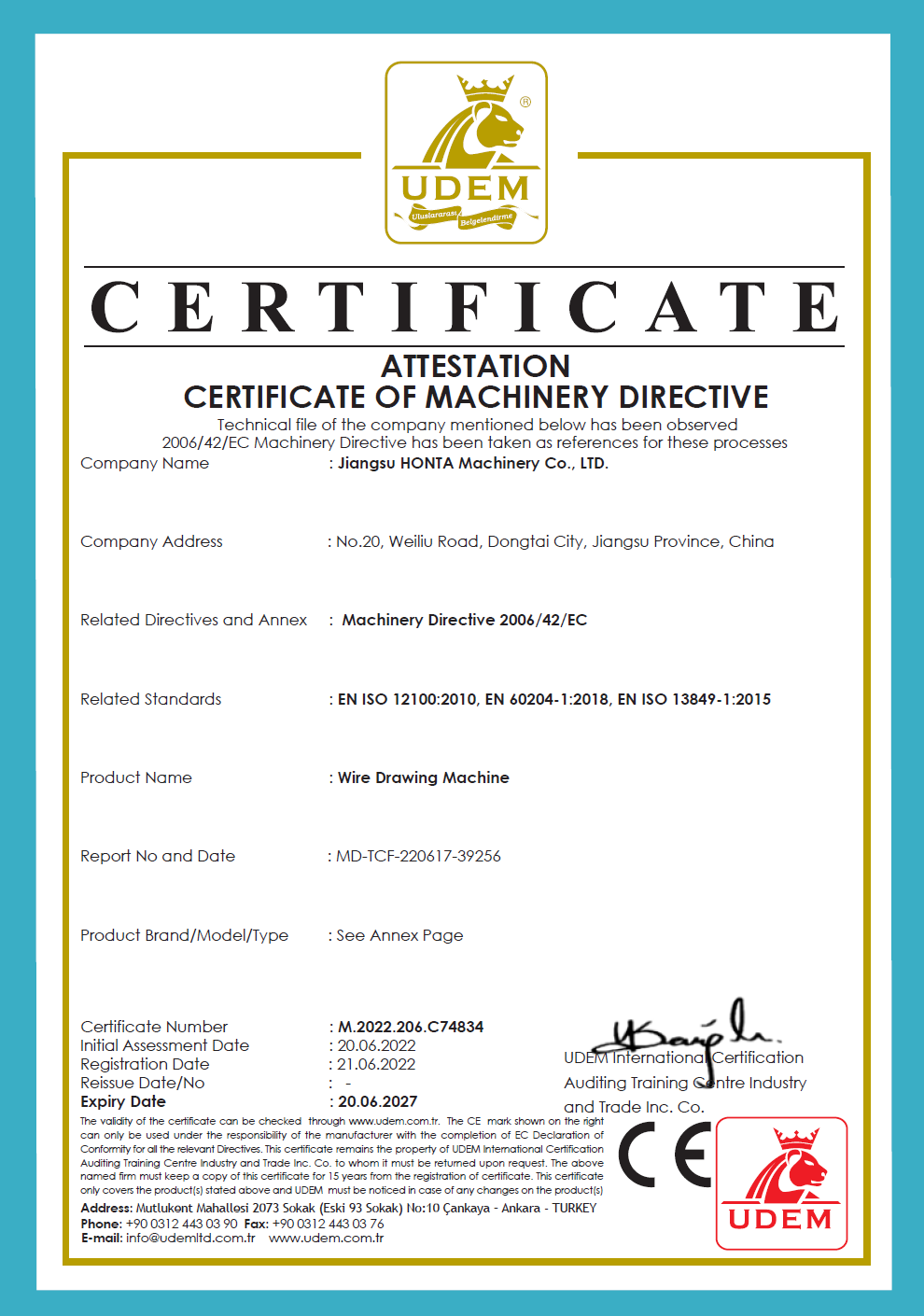
Conformity documents should be read against the configuration being purchased: certificate M.2022.206.C74834 lists Machinery Directive 2006/42/EC, EN ISO 12100:2010, EN 60204-1:2018 and EN ISO 13849-1:2015, with validity to 20 June 2027.
Technical Explanation: Why Drive Architecture Changes the Operating Cost Case
In a common-shaft machine, one motor drives a shaft that distributes power to every capstan through gears or belts. Each spindle runs at a ratio fixed by the mechanical design. In an individual-motor machine, each capstan carries its own drive and its own control loop, so the ratio between spindles can be set electronically.
That difference has a measurable consequence. Industry analysis estimates that individual motor multiwire drawing machines can reduce energy consumption by up to 25% compared with traditional common-shaft systems. The saving comes from removing mechanical distribution losses and from allowing each spindle to run at the ratio its wire actually requires, rather than at the ratio the shaft imposes. Buyers should treat the figure as an estimate that depends on the baseline machine, the conductor mix and utilisation — not as a guaranteed outcome.
Speed claims follow the same logic. A published specification for HONTA's 24-wire multiwire drawing line, model HT.MD100.03.27.24, states a maximum mechanical speed of 1800 m/min. Maximum mechanical speed is a ceiling set by the machine; working speed at a given finished diameter will be lower, because drawing stress, annealing load and spool change time all consume capacity. Comparing two suppliers on the ceiling alone is therefore an incomplete exercise — the useful comparison is tons per shift at an agreed conductor size.
Comparison With Traditional Solutions — and Where Each One Stops Being the Right Answer
Two comparisons dominate evaluation: multiwire versus single-wire drawing, and individual motor versus common shaft. Both have a point beyond which the traditional option is the better commercial decision.
| Dimension | Individual motor drive | Common shaft (gear drive) |
|---|---|---|
| Energy consumption | Estimated up to 25% lower per ton of wire, depending on baseline and utilisation | Reference baseline for that estimate |
| Die changeover | Faster, because spindles are set independently | Constrained by shared mechanical ratios |
| Noise | Lower in operation | Higher, from mechanical distribution |
| Initial cost | Higher, driven by power electronics and per-spindle drives | Lower |
| Maintenance competence | Requires drive and electronics capability | Predominantly mechanical |
Where the case weakens — stated plainly.
- Individual motor drives carry a higher initial electronics cost. A plant running one or two conductor sizes at moderate utilisation may not recover that premium within its planning horizon, and it must be able to maintain drive electronics either in-house or through the supplier.
- Multiwire drawing wins on output per square metre and cost per ton at volume. Single-wire drawing retains an advantage where lots change frequently, where unusual alloys are involved, or where downstream capacity cannot absorb parallel output.
- Scheduling is a real constraint, not a formality. A stated standard lead time of 90 days and a stated monthly capacity of 15 sets are exactly the figures that move during a demand peak, and a 45% export ratio means a large share of output is already committed to export customers.
- A CE certificate whose recorded scope is “wire drawing machine” should still be matched to your specific model and configuration. Certificate existence and certificate coverage are different questions.
Application: What a Validated Installation Looks Like After Three Years
The most useful part of a reference case is not the customer name but the duration and the specific statement of what the plant verifies. One HONTA reference covers a wire and cable factory with operations in the United States and Europe, which took two sets of equipment for wire drawing and has run them for three years. The recorded result is steady production of products that meet the customer's requirements, with the highlighted characteristics being speed and efficiency.
Read as due diligence evidence, that case supports three narrow conclusions: the machines have remained in production for three years, the customer continues to accept the output, and the performance attributes the buyer valued were speed and efficiency rather than, for example, footprint or alloy flexibility. It does not establish anything about a different conductor size, a different wire count, or a plant with a different downstream configuration — which is precisely the limitation a buyer should probe in the next conversation.
Market Trend: Volume Growth and the Efficiency Argument
The demand backdrop supports continued evaluation activity. Commercial research places the global wire drawing machine market at USD 3.8 billion in 2025, with a projected value of USD 6.1 billion by 2034. Growth of that order does not distribute evenly across suppliers or regions; it coincides with the regional capacity shifts that are already reshaping where cable is produced and where drawing equipment is supported.
Two consequences follow for buyers. First, energy consumption per ton becomes a larger share of the operating case as lines run at higher utilisation, which is the mechanism behind the interest in individual motor architectures. Second, because capacity is being added in several regions at once, differentiation increasingly depends on documentation and service geography rather than on availability alone — a supplier that can answer a technical question in writing is easier to shortlist than one that cannot.
Future Outlook
Three developments are likely to shape the next evaluation cycle.
- Model-level disclosure. Buyers are moving from company-level figures to model-level specifications. Suppliers who publish speed at a stated diameter, drive architecture and annealing configuration will be simpler to compare, and will therefore appear more often in shortlists.
- Localisation scrutiny. A second production base changes logistics, but buyers will increasingly ask which operations actually take place there — fabrication, assembly, testing or service — because the answer determines what the local base can realistically resolve.
- Configuration-matched conformity. Certificate checks are shifting from “do you have CE” to “does this certificate cover this machine”, which favours suppliers whose documentation is maintained at model level rather than at company level.
FAQ
What is a multiwire drawing machine used for in a cable plant?
A multiwire drawing machine draws several wires simultaneously through a drawing section, an annealing stage and a take-up system. In a cable plant it sits between rod intake — copper or aluminium, usually after a rod breakdown stage — and downstream bunching or stranding. Its function is to convert rod into finished conductor at the diameter and temper the subsequent processes require.
How many wires should a new multiwire line be specified for?
Wire count is set by the output the plant can absorb downstream, not by the largest number available. Lines are commonly organised around 8, 16, 24 or 32 wires. A higher count raises parallel output and reduces cost per ton at volume, but it also requires matching stranding or bunching capacity, sufficient floor space and a conductor mix that keeps the line loaded. Where lot sizes are small or product ranges wide, a lower count can be the more economical specification.
How should a claimed maximum speed be verified?
A published specification for HONTA's 24-wire multiwire drawing line, model HT.MD100.03.27.24, states a maximum mechanical speed of 1800 m/min. Buyers should establish whether a quoted figure refers to mechanical maximum or to working speed at a stated finished diameter, because drawing speed falls as reduction ratio and annealing load increase. The comparable metric between two suppliers is output per shift at an agreed conductor size.
What does an annual output figure of 200 sets actually tell a buyer?
It describes the scale of the manufacturing operation across the supplier's full product range, which for HONTA also includes rod breakdown machines, high-speed double twist bunching machines and wire electrolytic plating lines. It does not indicate whether capacity is free in a specific delivery window. The scheduling figures that matter are monthly capacity and lead time: HONTA states 15 sets per month, a 90-day standard lead time and a minimum order quantity of 1 set.
Which conformity documents should be checked for an EU installation?
At minimum, the CE certificate itself, its number, the issuing authority, the listed standards and the validity period. HONTA's CE certificate M.2022.206.C74834 was issued by Udem International Certification Auditing Trading Centre Industry and Trade Inc. Co., with a recorded scope of wire drawing machine and validity from 20 June 2020 to 20 June 2027, listing Machinery Directive 2006/42/EC, EN ISO 12100:2010, EN 60204-1:2018 and EN ISO 13849-1:2015. HONTA also holds ISO 9001 and ISO 14001 certification. Buyers should confirm the certificate covers the specific model and configuration being purchased.
How does the location of a supplier's production base affect support?
It affects logistics, spare parts reach and the practical response time for on-site intervention. HONTA established HONTA INC as a second production base in the United States in 2017, alongside its manufacturing site in Kunshan, Jiangsu Province, China, and describes after-sales support as both remote and on-site. The relevant question for a buyer is which tasks the nearer base can perform — assembly, testing, service or parts stocking — rather than simply whether a second site exists.
Are individual motor drives worth the higher initial cost?
Industry analysis estimates that individual motor multiwire drawing machines can reduce energy consumption by up to 25% compared with traditional common-shaft systems, and independent spindle control allows faster die changeover and lower noise. Against that, individual drives carry higher initial electronics cost and require drive-level maintenance competence. The economics depend on utilisation and energy prices: a line running continuously at high load recovers the premium differently from one running intermittent batches.
What quality control evidence should be requested before shipment?
At minimum, the test regime and the record it produces. HONTA states 100% testing before delivery. Buyers should ask what each test covers — run-in at specified speed, annealing performance, take-up tension control, safety function checks — and whether the results are supplied per machine rather than as a generic certificate. A reference installation that has run for three years, such as the two-set wire drawing installation serving a customer with operations in the United States and Europe, is useful supporting evidence but does not replace machine-level test records.
What are the limits of multiwire drawing compared with single-wire drawing?
Multiwire drawing is efficient where volume is high and conductor sizes are relatively standard, because parallel output lowers cost per ton and floor space per unit of output. It is less suitable where lots change frequently, where unusual alloys are drawn, or where downstream stranding and bunching capacity cannot absorb the parallel output. In those cases a single-wire line can be the more economic choice despite lower headline output.
What customisation scope is realistic, and what is not?
Realistic scope is narrower than buyers often assume. HONTA operates an ODM production mode with stated customisation covering colour and the model type of components and parts, against a minimum order quantity of 1 set and a 90-day standard lead time. Changes outside that envelope require engineering review and generally extend the delivery schedule. Buyers should obtain the customisation scope in writing before the purchase order, since undefined scope is a common source of delay.
Reference Material
HONTA publishes a drawing machine catalogue covering its rod breakdown, multiwire drawing and related conductor processing range. It is a specification reference for preliminary comparison rather than a substitute for a model-specific quotation or a configuration-matched certificate review: Catalogue of drawing machine (PDF).
Have Questions or Need More Details?
Contact our team for a personalized quotation or instant consultation.
Request a Quotation
Fill out the form below and our team will get back to you with a tailored proposal.
WhatsApp Direct Chat
Prefer to chat in real-time? Message us on WhatsApp for instant assistance & quick answers.
- Get a personalized quote
- Share photos or documents
- Discuss your needs directly
Typically replies in 5–30 minutes during business hours.