
Musical Fountain Compliance Roadmap: CE, ISO, and PVOC Certifications Decoded
Musical Fountain Compliance Roadmap: CE, ISO, and PVOC Certifications Decoded
Certification is where the engineering ambition of a musical fountain meets the practical reality of importing, installing, and operating it. A Lake Floating Musical Dancing Fountain or a City Square Musical Fountain can look convincing in a 3D simulation and still stall because the paperwork does not match the destination market. For buyers at the decision stage, the useful question is not whether a supplier holds certificates, but which certificate covers what, in which market, and how its validity is confirmed.
This roadmap decodes the three instruments that most often appear in a musical fountain supplier's compliance file — CE marking under Machinery Directive 2006/42/EC, ISO 9001 quality management, and Ethiopia PVOC export conformity — using the certification record of Rainbows Fountain (Guangzhou Shuiguang Fountain Equipment Co., Ltd.), a musical fountain design and engineering manufacturer based in Guangzhou, China, as a working example. It also explains where those documents stop being sufficient.
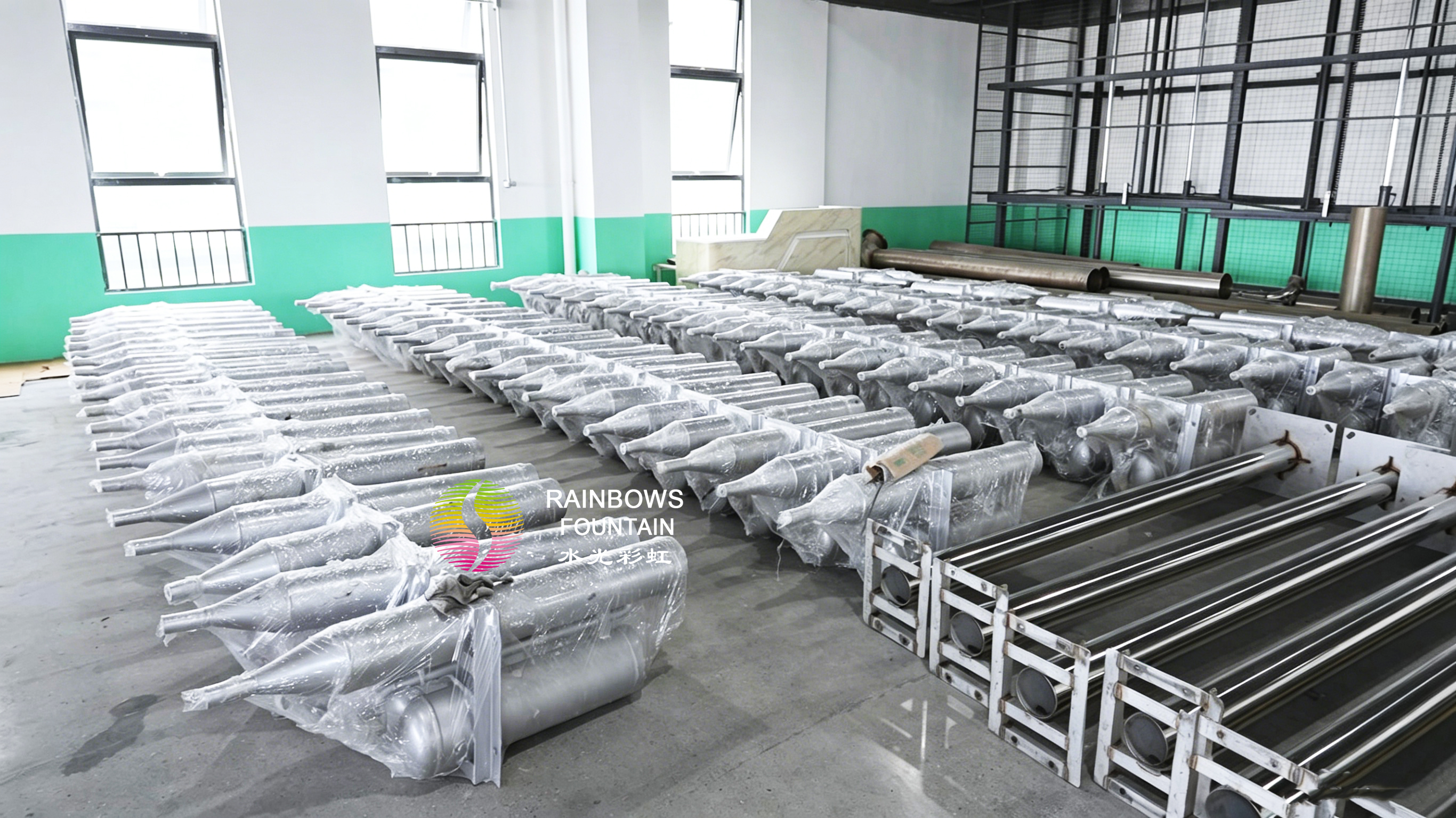
Certified musical fountain equipment staged for export: conformity documents travel with the hardware, and both must match the destination market.
Why Certification Moves to the Center of a Musical Fountain Decision
The market context explains the pressure. The global musical fountain market was valued at USD 2.51 billion in 2025 and is projected to reach USD 5.23 billion by 2034, according to Dataintelo, with the same source estimating an 8.5% CAGR over the period. Dataintelo data also shows Asia Pacific holding a 38.5% revenue share in 2025, and commercial end users such as luxury hotels and shopping malls accounting for 42.8% of demand in 2025.
Growth of that shape means more projects are being procured by organisations that are not fountain specialists: municipal departments, hotel developers, landscape contractors, and event operators. These buyers usually have a compliance department, an insurance requirement, and a customs broker asking for documents before cargo is released. In that environment, certification stops being a marketing detail and becomes a procurement gate.
Certification also matters because musical fountains combine several risk categories in a single installation. Water and electricity share the same enclosure. Pressurised hydraulic lines sit next to public walkways. Control systems synchronise pumps, valves, DMX512 lighting, and audio, and a failure in any layer can be visible to an audience within seconds. A compliance file is the buyer's first structured evidence that a supplier has thought about those failure modes — before any water is switched on.
Decoding the Three Certification Instruments
The three documents are frequently presented together but they answer different questions. Confusing them is one of the most common errors in fountain procurement.
| Instrument | What it certifies | Applies to | What the buyer should read from it |
|---|---|---|---|
| CE marking under Machinery Directive 2006/42/EC (certificate recorded as M.2022.206.C73820, risk assessment documented per EN ISO 12100:2010) | Conformity of machinery and components with applicable EU safety requirements | Fountain equipment and components as supplied by the manufacturer | Equipment-level safety conformity; the basis for technical review of hazards and protective measures |
| ISO 9001 quality management system | The management system governing how products are planned, produced, inspected, and documented | The manufacturing organisation and its processes | Process control, traceability, and repeatability between shipments |
| Ethiopia PVOC (certificate recorded as ETH2000000501, issued by TÜV Rheinland) | Pre-export verification of conformity for goods destined for a specific market | Exports to Ethiopia | Market-entry readiness for that destination — not a global passport |
CE Marking Under Machinery Directive 2006/42/EC
CE marking is the conformity route through which machinery is placed on the European market. The Rainbows Fountain certification file records CE certificate M.2022.206.C73820 under Machinery Directive 2006/42/EC, with risk assessment documented according to EN ISO 12100:2010. The company states that all fountain equipment and components used in its projects are CE certified and manufactured under an ISO 9001 certified quality management system.
EN ISO 12100:2010 is the harmonised methodology for risk assessment and risk reduction in machine design. Applied to a musical fountain, it forces a supplier to identify hazards systematically rather than intuitively. Those hazards are specific to the product category:
- Electrical hazards — submerged pumps, underwater LED fixtures, and control cabinets operating in or near water.
- Hydraulic hazards — high-pressure nozzle lines, joints, and pipework that can fail under continuous duty.
- Mechanical hazards — moving elements in Dry Deck Interactive Musical Fountain installations where visitors walk over the equipment.
- Control and synchronisation hazards — loss of show synchronisation, communication faults, or uncontrolled start-up.
For buyers, the practical value of a CE file is that it establishes which entity is the legal manufacturer, which product scope is covered, and which standard was used to assess risk. It is a document set to be read, not a logo to be trusted.
ISO 9001 as Evidence of Manufacturing Process Control
ISO 9001 does not certify a fountain's performance. It certifies the system that governs how the fountain is built. Industry references indicate that musical fountain systems commonly adhere to ISO 9001:2015 for quality management and IP68 waterproof ratings for underwater components such as LED lights and pumps, according to a published certification overview by Himalaya Music Fountain. Advanced systems also typically rely on DMX512 lighting protocols and Programmable Logic Controllers to synchronise water jets with music, as described by Cognitive Market Research.
Why this matters at the decision stage is repeatability. A Large Musical Fountain or Turnkey Musical Fountain Design Project is rarely delivered in one shipment. It is fabricated, tested, packed, shipped, unpacked, and commissioned across months. A documented quality system is what keeps the tenth nozzle assembly the same as the first, and what makes spare-part supply predictable years later.
Rainbows Fountain's production evidence reflects that logic: CNC machining of stainless steel components according to project drawings, precision welding of fountain flanges and pipework, polishing of custom equipment, and control cabinets that are wired, labelled, and electrically tested for PLC programming, circuit safety, and synchronised pump and lighting control before shipment. The company also states that key components are sourced from recognised brands including ABB, Rexroth, and Schneider, and that components are traceable and certified.
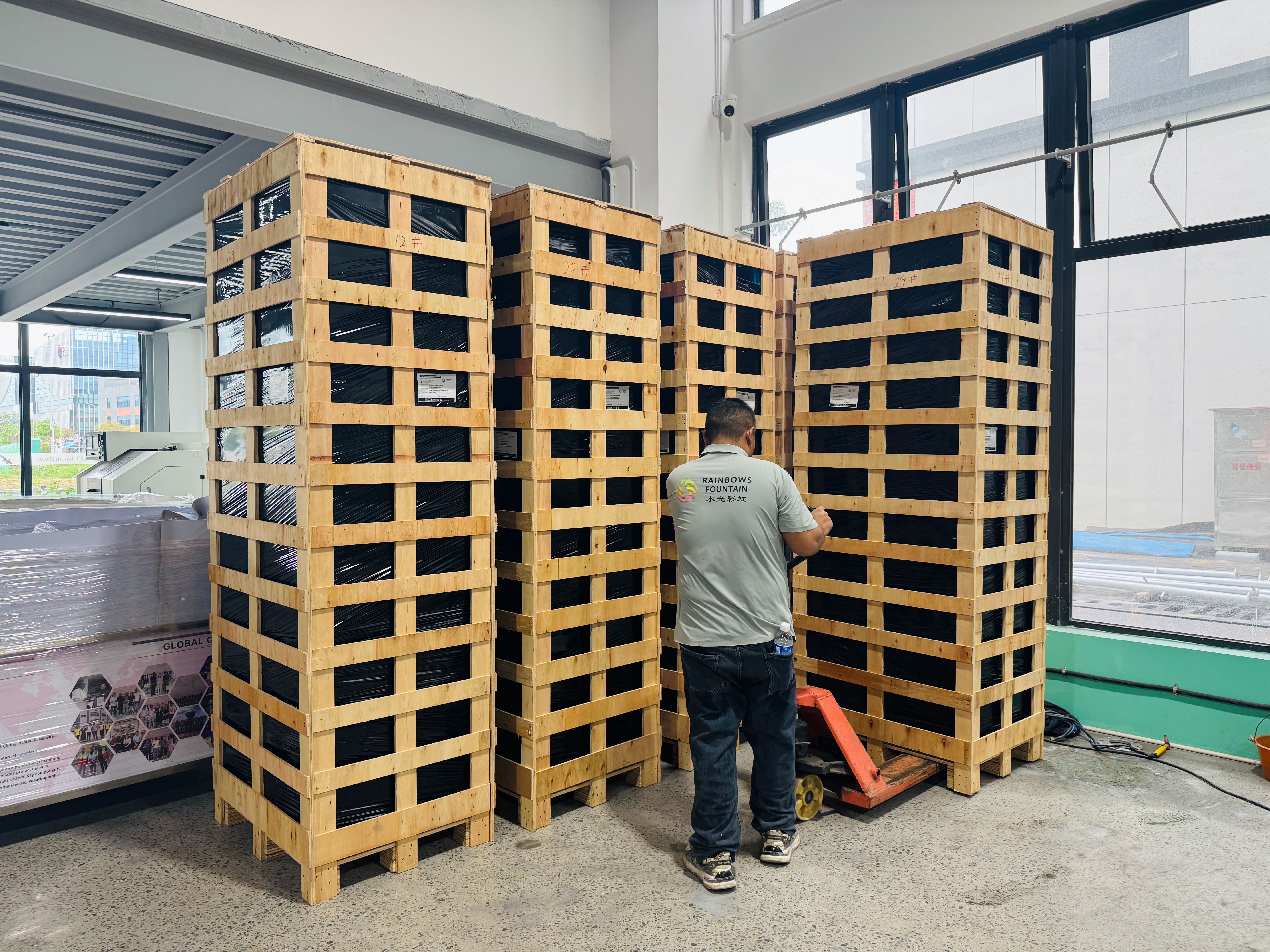
Fountain control cabinets packed in export-grade crates — electrical compliance evidence and shipping protection are handled as one process.
Ethiopia PVOC as a Market-Entry Document
PVOC stands for Pre-Export Verification of Conformity. It is a conformity assessment carried out before goods leave the exporting country, aimed at the importing market's requirements. The Rainbows Fountain record includes Ethiopia PVOC certificate ETH2000000501 issued by TÜV Rheinland.
The critical distinction is scope. CE and ISO 9001 certificates describe equipment and manufacturing processes respectively and travel with the product family. A PVOC certificate is tied to a destination market and to the consignment it verifies. A supplier holding an Ethiopia PVOC has demonstrated readiness for that market — it does not follow that the same goods can enter another country without that country's own conformity procedure.
The Boundaries: What CE, ISO 9001, and PVOC Do Not Cover
Certification documents are frequently over-read. Stating their limits is part of an honest compliance review, and buyers who understand the boundaries negotiate better contracts.
- CE covers supplied equipment, not site work. Civil foundations, cable trenches, water supply and drainage, installation, commissioning, and show programming sit outside the equipment certificate. A CE file does not certify an installed fountain.
- ISO 9001 covers the system, not the result. A certified management system indicates controlled processes; it does not guarantee a specific hydraulic performance, jet height, or artistic effect.
- PVOC is market-specific. An Ethiopia PVOC addresses Ethiopian import requirements. Projects in other regions should be checked against the applicable local scheme.
- Certificates carry validity periods and revisions. A certificate can expire, be superseded by a directive amendment, or be reissued with a changed scope. Validity should be confirmed at the time of order, not at the time of first contact.
- Certification does not replace project-specific risk assessment. Site conditions — wind exposure for a Lake Floating Musical Dancing Fountain, public access for a Dry Deck Interactive Musical Fountain, water quality, and power stability — require their own engineering review.
- A certificate attached to a quotation may not match delivered goods. Scope, model references, and manufacturer name must be reconciled against the packing list and handover documents.
A Buyer Verification Checklist for Fountain Certificates
Verification is a short, repeatable procedure. It can be completed in a single exchange of documents if the buyer asks precisely.
- Match the legal manufacturer name. Confirm the certificate names the entity that actually produces the equipment, not an intermediary. Rainbows Fountain operates under Guangzhou Shuiguang Fountain Equipment Co., Ltd.
- Record the certificate number and issuing body. Capture the reference — for example CE M.2022.206.C73820 or Ethiopia PVOC ETH2000000501 — and confirm it with the issuing organisation rather than relying on a PDF alone.
- Check the product scope. Identify which equipment families the certificate covers: control cabinets, pumps, valves, nozzles, lighting, and structural components.
- Read the standards cited. The presence of EN ISO 12100:2010 indicates a documented risk-assessment methodology, which is more informative than a bare conformity statement.
- Confirm dates and revisions. Check issue and expiry dates, and whether the certificate has been revised.
- Map documents to the destination market. Establish which conformity route the project's country requires, and whether the supplier's existing documents satisfy it.
- Tie documents to contractual milestones. Certificates, traceability lists, factory test records, and commissioning reports should be annexes to the supply contract, not attachments to a sales email.
Matching Certification Documents to Project Type
Not every project needs the same document set. The table below maps common musical fountain applications to the compliance emphasis that usually applies.
| Project type | Primary compliance emphasis | Practical reason |
|---|---|---|
| City Square Musical Fountain, municipal landmark | CE equipment conformity plus quality management evidence, plus destination-market conformity | Public procurement, insurance, and customs review all require traceable documents |
| Hotel Musical Fountain, commercial complex | CE equipment conformity and IP68 underwater components | Guests are in close proximity; failure visibility is high |
| Lake Floating Musical Dancing Fountain | CE equipment conformity with added attention to sealing and corrosion protection | Continuous water immersion and limited maintenance access |
| Dry Deck Interactive Musical Fountain | CE risk assessment emphasis on accessible electrical and moving parts | Visitors stand and walk directly on the installation |
| Export projects to regulated markets | Destination-specific verification such as PVOC for Ethiopia | Import release depends on the market's own conformity programme |
In each case, the underlying engineering is similar; the documentation emphasis changes because the exposure changes.
Certified Turnkey Delivery vs. Traditional Equipment-Only Supply
Once certification is understood, the next decision is delivery model. The two mainstream options behave differently on risk and on cost, and both have legitimate uses.
| Dimension | Turnkey delivery | Equipment-only supply |
|---|---|---|
| Scope | Design, equipment manufacture, installation, commissioning, and show production | Equipment supply; installation and programming typically excluded |
| Cost profile | Higher than equipment-only, but includes design, installation, and commissioning in one package | Lower equipment cost, with installation and programming contracted separately |
| Risk ownership | Single party accountable for water and electrical safety, corrosion, sealing, commissioning, and synchronisation performance | Risk is split between the equipment supplier and local installers |
| Best fit | Scenic landmark areas, city squares, and large events requiring full show and operations support | Replacement parts, component upgrades, and smaller projects with competent local installation teams |
The limitation buyers should plan for: turnkey delivery costs more upfront than buying equipment alone, and the difference can only be quantified through a project quote. In addition, a turnkey scope does not remove the need for local civil works, power supply preparation, and site access arrangements, which remain the client's responsibility. Choosing equipment-only supply is a reasonable decision for a replacement pump or a small Pool Musical Fountain upgrade — but it shifts commissioning, synchronisation, and warranty-coordination risk onto the buyer, and that risk should be priced before the comparison is finalised.
Where turnkey delivery is chosen, risk control measures that matter in practice include waterproof electrical cabinets, corrosion-resistant materials, grounding and leakage protection, factory pre-testing, on-site commissioning, and redundant programming with failback schemes. The company states that it provides on-site installation and commissioning through an overseas engineering team.
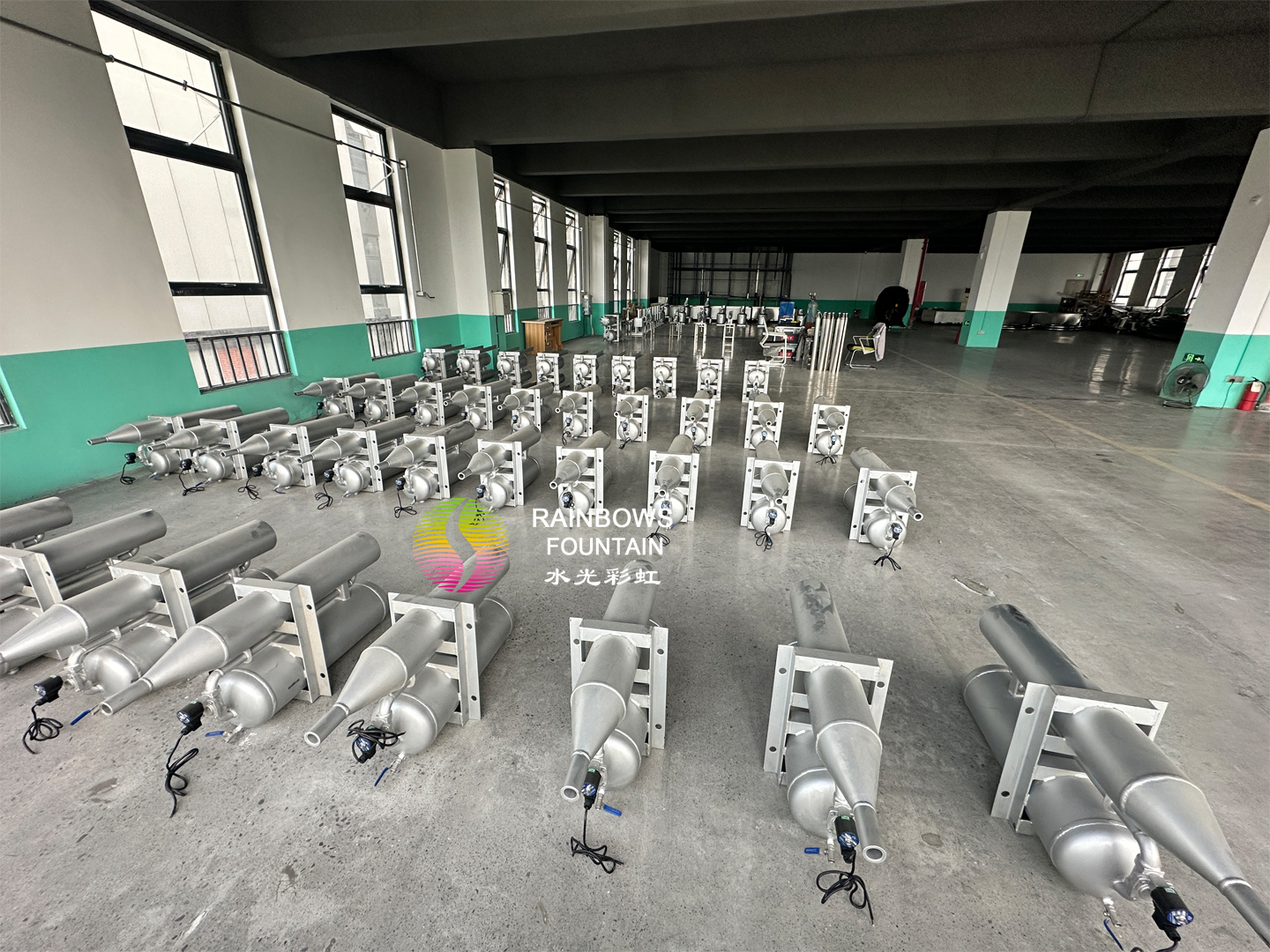
Stainless steel nozzle assemblies with polished, corrosion-resistant finishes — component quality that certification documents are meant to make traceable.
Market Signals Behind the Documentation Push
Several observable trends explain why certification is becoming a routine part of musical fountain procurement rather than a specialist concern.
- Commercial and hospitality demand is dominant. Dataintelo reports that commercial end users, including luxury hotels and shopping malls, held 42.8% of the market in 2025. Commercial operators typically apply standardised compliance requirements to any capital installation.
- Asia Pacific concentration increases documentation familiarity. With Asia Pacific holding a 38.5% revenue share in 2025 according to Dataintelo, manufacturers in the region are being asked for CE, ISO, and market-specific documents by a widening group of export buyers.
- Control-system complexity raises the evidence bar. DMX512 lighting and PLC-driven synchronisation, referenced by Cognitive Market Research, mean that electrical documentation and cabinet testing records are now part of normal technical review.
- Competitive benchmarking is global. Musical fountain supply is compared internationally, with established participants including OASE Living Water (Germany), Crystal Fountains (Canada), and Safe-Rain (Spain) identified in Dataintelo and Water Show Trend Report material. Buyers increasingly compare documentation packs, not only hardware.
Future Outlook: From Certificates to Verifiable Records
The direction of travel is toward verification rather than presentation. Buyers are moving from asking whether a certificate exists to checking whether it can be validated at source, whether its scope matches the quoted equipment, and whether it remains aligned with the destination market's current requirements.
Three practical consequences follow for projects planned in the coming years. First, documentation will increasingly be treated as a delivery milestone with its own acceptance criteria, alongside factory testing and commissioning. Second, project teams will need to plan for market-specific conformity earlier — a PVOC or equivalent verification process has lead time and should not be discovered at the shipping stage. Third, quality-system evidence will matter more in multi-phase projects, where spare parts and system upgrades must match equipment installed years earlier. Suppliers that maintain structured records, traceable components, and factory test documentation will be easier to work with over a facility's operating life than those that provide certificates only on request.
Reference document: the Rainbows Fountain company and product brochure is available for download at 2026 Rainbows Fountain brochure. Manufacturer website: www.rainbowsfountain.com.
FAQ
Does a CE certificate cover an entire musical fountain project, or only the equipment?
CE marking under Machinery Directive 2006/42/EC covers the machinery and components placed on the market — pumps, valves, nozzle assemblies, lighting fixtures, and control cabinets. It does not cover civil foundations, on-site installation, commissioning, or the artistic programming of the show. Buyers should treat a CE file as equipment-level conformity evidence and contract separately for installation quality, commissioning, and performance testing.
Is a CE certificate valid for importing a musical fountain into every country?
No. CE is the conformity route for the European Economic Area and is widely referenced elsewhere as a safety benchmark, but it is not a universal import authorisation. Many markets operate their own conformity programmes and may require separate testing, registration, or pre-shipment verification. The destination market's requirements should be confirmed before shipment is scheduled, not after.
What is the difference between ISO 9001 and CE?
ISO 9001 certifies a quality management system — how a factory plans, controls, inspects, and documents production. CE marking addresses product conformity with applicable EU directives. ISO 9001 indicates that manufacturing processes are controlled; CE indicates that supplied equipment meets defined safety requirements. Neither document substitutes for the other, and both are normally expected in a serious procurement file.
What does Ethiopia PVOC cover, and is it required for every shipment?
PVOC is a Pre-Export Verification of Conformity, a conformity assessment performed before export to a destination market that operates such a programme. The Rainbows Fountain record includes Ethiopia PVOC certificate ETH2000000501 issued by TÜV Rheinland. Because PVOC is tied to a specific destination market and to the consignment it verifies, buyers shipping to other countries should confirm whether that market requires its own programme rather than assuming the Ethiopia certificate applies elsewhere.
How should a buyer verify that a fountain supplier's certificates are still valid?
Request the certificate number, the legal manufacturer name, and the listed product scope, then verify the certificate directly with the issuing body. Check issue and expiry dates and whether the document has been revised, confirm the standards cited — for example EN ISO 12100:2010 for risk assessment — and reconcile the certified product scope against the specific equipment quoted in the contract.
What documentation should be attached to a turnkey musical fountain contract?
A practical contract annex typically includes the CE certificate and its scope for supplied equipment, the ISO 9001 certificate of the manufacturing entity, applicable destination-market conformity documents, a component traceability list, factory test records, and commissioning and acceptance procedures. Linked to contractual milestones, these documents make it straightforward to resolve any mismatch between quoted and delivered equipment.