
Musical Fountain FAQ: Nozzles, Voltage, Control and Materials
A musical fountain is an outdoor water feature in which water jets, lighting and music are synchronized by a programmable control system. Once a project reaches the decision stage, the questions that most often determine whether the delivered show matches the approved concept are technical rather than artistic: which nozzle type can physically produce the intended choreography, which supply voltage the system must be built for, whether DMX512 or a PLC governs the show, and which stainless steel grade will still perform correctly after years of outdoor exposure.
This reference answers those four questions in the order a project team usually meets them, and it sets out where the boundary of each option lies. It is written for buyers, consultants and venue operators comparing technical specifications, and it separates general engineering practice from supplier-specific facts.
Why Four Technical Decisions Dominate Musical Fountain Procurement
Specification mismatches in a musical fountain are rarely cosmetic. The risk categories that concentrate in these projects are consistent: water and electrical safety, equipment corrosion and sealing failure, on-site construction and commissioning risks, and show-synchronization failures. Each of those categories is governed by one of the four specification decisions covered in this article, which is why they tend to appear together in serious technical reviews.
| Risk category | Specification decision that governs it | Typical control measure |
|---|---|---|
| Water / electrical safety | Voltage, phase and frequency matching; cabinet and protection selection | Waterproof electrical cabinets, grounding and leakage protection |
| Equipment corrosion and sealing failure | Stainless steel grade, surface finish and component sealing | Corrosion-resistant materials and protected underwater components |
| On-site construction and commissioning | Delivery model, documentation and testing sequence | Factory pre-testing followed by on-site commissioning |
| Show-synchronization failure | Control architecture: show controller, DMX512 and PLC layers | Redundant programming and failback schemes |
Read as a group, these four decisions define the gap between a fountain that photographs well on opening night and one that still runs its full cue list three years later. The sections below take each in turn.
Nozzle Types: Vertical Adjustable vs Digital Robot Nozzles
Vertical adjustable nozzles
A vertical adjustable nozzle is a mechanical nozzle whose spray direction is set by hand during installation or commissioning and then locked in position. The water pattern is determined by the orifice design and the operating pressure at the nozzle, while choreography comes from pump, valve and lighting sequencing rather than from nozzle movement. Because the unit contains no motors or drive electronics, it places fewer components below the waterline, and the same nozzle can be re-aimed later if the artistic direction of the show changes.
Digital robot nozzles
A digital robot nozzle, sometimes described as a 3D or programmable nozzle, contains motorized axes that the control system drives in real time. Instead of holding one fixed direction, the jet can tilt, sweep or rotate as part of the choreography. This is why robot nozzles usually carry the signature moving effects in a large show. The trade-off is architectural rather than decorative: each nozzle position generally needs power and a control signal, the nozzle unit itself contains more parts, and sealing, cable routing and maintenance access have to be designed into the pool or deck structure from the beginning.
How the choice changes the rest of the design
The nozzle decision is not a finishing detail. It changes the number of control channels, the layout of the control cabinet, the cable and power distribution inside the water basin, and the maintenance plan for the site. Most large installations use a combination: robot nozzles for the moving signature effects, and adjustable nozzles for the broad pattern fields — fan, ring, lattice and similar geometry — where a fixed, well-engineered direction performs the same visual function at a lower unit complexity.
| Aspect | Vertical adjustable nozzle | Digital robot (3D) nozzle |
|---|---|---|
| Spray direction | Set manually, fixed at commissioning | Motorized, changed in real time by the control system |
| Source of choreography | Pump, valve and lighting sequencing; orifice design and pressure | Nozzle movement combined with pump, valve and lighting cues |
| Power and signal at the nozzle | Not normally required | Generally required at each nozzle position |
| Components below the waterline | Fewer | More — motors, drive electronics and cabling |
| Design impact | Lower structural complexity | Influences basin structure, cable routing and cabinet layout |
| Typical role in a show | Large pattern fields and repeated geometric effects | Signature moving jets and dynamic sequences |
Power Requirements: Matching 110 V–450 V and 50–60 Hz to Regional Grids
Musical fountain systems are engineered around a supply range that spans 110 V to 450 V at 50–60 Hz, so the same show concept can be delivered against different regional grids. In practice, three layers have to match before equipment is manufactured.
Layer 1 — the site supply
Sites typically present single-phase 110–120 V at 60 Hz in North America and parts of Latin America and Japan; single-phase 220–240 V at 50 Hz across Europe, China, the Middle East, Africa and much of Asia; and three-phase 380–400 V at 50 Hz or 440–480 V at 60 Hz where the pump groups are large. The available supply, not the show concept, sets the starting constraint.
Layer 2 — equipment selection
Pump motors, variable frequency drives, control transformers, LED drivers and control cabinets are selected against the confirmed voltage, phase and frequency. Frequency deserves specific attention: for motors operated directly on line, rated speed is tied to the grid frequency, so 50 Hz and 60 Hz sites need differently configured motors unless a drive is used. Where one system standard has to serve sites in more than one grid environment, drives are commonly used so that the hydraulic design stays constant.
Layer 3 — protection
Voltage matching is only half of electrical safety in an outdoor water feature. Waterproof electrical cabinets and grounding and leakage protection are the recurring control measures in this environment, and they belong in the specification alongside the voltage itself.
| Site supply pattern | Typical use in a fountain system | Points to confirm |
|---|---|---|
| 110–120 V, 60 Hz, single phase | Smaller pump groups, LED lighting and control electronics | Motor and driver nameplate ratings; 60 Hz operating configuration |
| 220–240 V, 50 Hz, single phase | Medium installations; pumps, lighting and control cabinets | Circuit allocation; grounding and leakage protection |
| 380–400 V, 50 Hz, three phase | Large pump groups and high-capacity shows | Load balance; drive selection; cable sizing |
| 440–480 V, 60 Hz, three phase | Large installations in 60 Hz markets | 60 Hz motor or drive configuration |
| 110 V – 450 V, 50–60 Hz | Overall engineering range for exported systems | Written confirmation of the site supply before manufacturing starts |
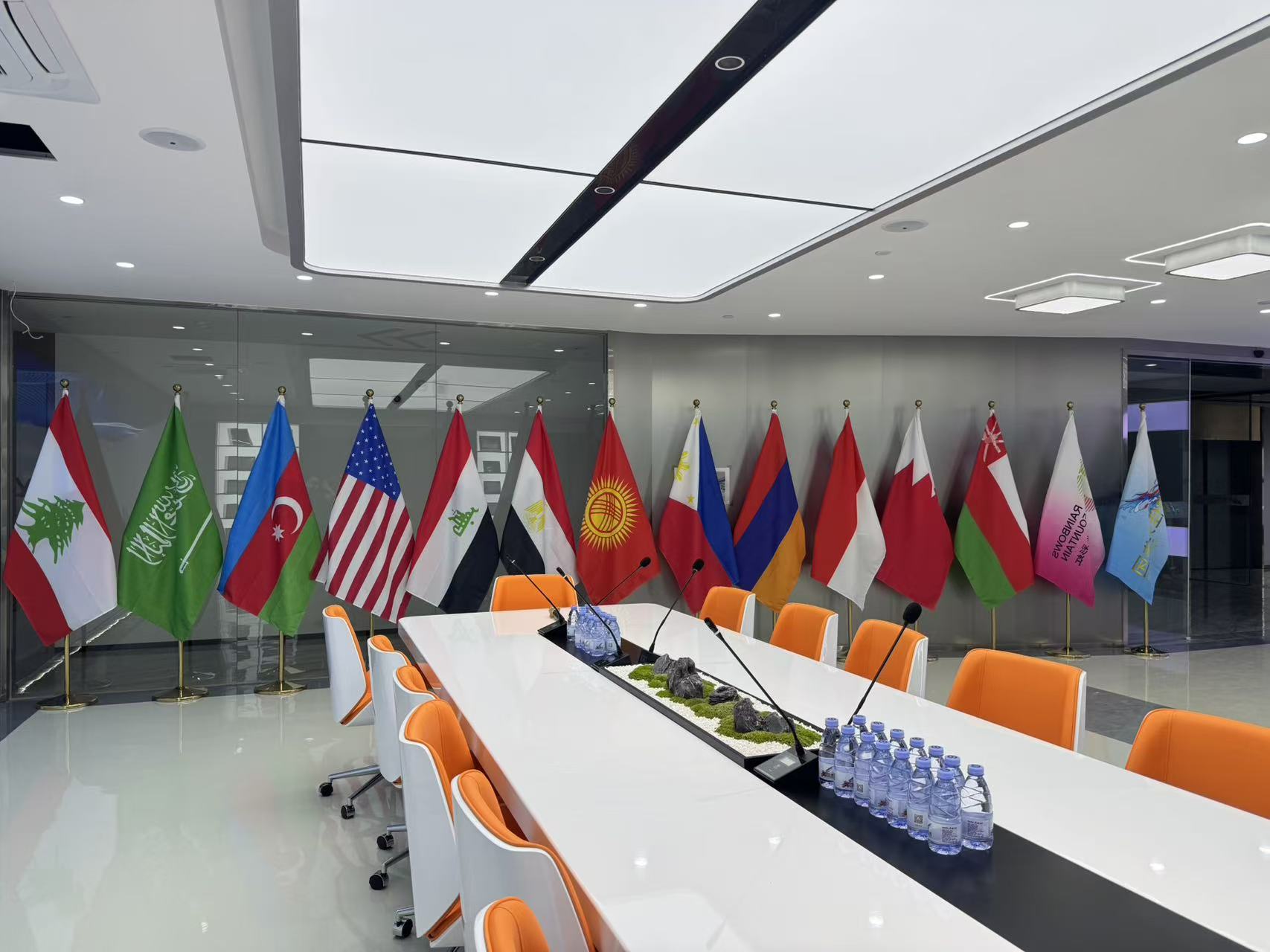
The reason this range exists as a standard engineering problem is commercial rather than technical: musical fountain suppliers work across markets that do not share a single grid standard. Rainbows Fountain, for example, exports the majority of its output, with main markets in the Middle East and Africa, which is precisely why fountains intended for overseas delivery are specified against the destination grid rather than a domestic one.
DMX512 vs PLC: How Control Architecture Shapes Show Synchronization
Control architecture decides what a show can do, how reliably it repeats, and how far it can be extended later. Two technologies dominate the discussion, and they are best understood as layers rather than as competing replacements.
What DMX512 does
DMX512 is a digital control protocol widely used for stage and architectural lighting. It addresses individual fixtures along a control bus, so a lighting rig can be programmed cue by cue and each fixture can respond independently. It is organized into universes of fixed channel capacity, which means that large fixture counts are handled by using multiple universes with a structured address plan. In fountain systems it typically commands LED fixtures and effect lighting.
What a PLC does
A programmable logic controller is an industrial device built for deterministic sequencing of machinery: pumps, valves, drives and safety interlocks. It executes a show cue list, holds the input and output points for sensors and level controls, and applies the timing that keeps water effects repeatable from one performance to the next.
How the two layers combine
Industry technical references note that advanced musical fountains utilize DMX512 lighting protocols and programmable logic controllers to synchronize water jets with music. In other words, the practical question is not which protocol wins, but where each belongs. Cue commands and timecode are distributed from a show controller; the lighting universes and the PLC program reference the same time base; and where both domains exist, gateways or merge devices connect them.
This is where synchronization is won or lost. If only the lighting follows the music, the water side may react to changes rather than perform a cued sequence. If the hydraulics run on PLC timing but the lighting system sits on a separate time base, the show can drift between cues. Synchronization quality therefore depends less on the protocol name than on the show controller, the network design, and the quality of programming and commissioning. Where show-synchronization failure is treated as a project risk, the controls used are factory pre-testing and on-site commissioning, supported by redundant programming and failback schemes.
| Aspect | DMX512 | PLC |
|---|---|---|
| Primary role | Addressing and commanding lighting and effect fixtures | Deterministic sequencing of pumps, valves and drives |
| Typical devices | LED fixtures, lasers, effect lights | Pumps, valves, variable frequency drives, sensors, interlocks |
| Control structure | Bus-based, organized into universes with a fixed channel capacity | Program logic with input and output points |
| Scalability path | Additional universes and address planning | Additional I/O, network segments and program structure |
| Main strength in a show | Fixture-level lighting fidelity | Repeatable water timing and machine safety |
| Main limitation | Does not by itself sequence hydraulic machinery | Does not by itself address individual lighting fixtures |
For smaller venues, a simpler control approach can be the better decision. A single-phase installation with a modest fixture count and a short cue list may not justify the programming and maintenance overhead of a fully layered architecture, and advanced control carries an operational obligation in the form of trained operators, spare parts and documented program logic.
Stainless Steel Choices: SS304 vs AISI 316/316L
Stainless steel is the default material family for fountain nozzles, pipework and structural components, and grade selection determines how the system behaves in a specific environment rather than in general.
SS304 is a general-purpose austenitic grade with good corrosion resistance in freshwater and normal atmospheric exposure, combined with good formability and weldability. It is widely used for nozzles, pipework and structures and is the more economical option. AISI 316 and its low-carbon variant AISI 316L contain molybdenum, which improves resistance to chlorides and pitting. Because 316L is low in carbon, it also reduces the risk of carbide precipitation during welding, which supports corrosion resistance at welded joints. That combination is why 316/316L is generally preferred for coastal and marine-adjacent sites, salt-laden air, and installations where chlorinated water is present.
Surface finish matters alongside the grade. Polished stainless components shed deposits more readily and present fewer sites where chlorides can concentrate, which is why fountain components are typically polished before assembly rather than left with a raw fabrication finish. On the underwater side, LED lights and pumps commonly reference IP68 waterproof ratings for submerged use, and fountain equipment is commonly produced under ISO 9001:2015 quality management systems.
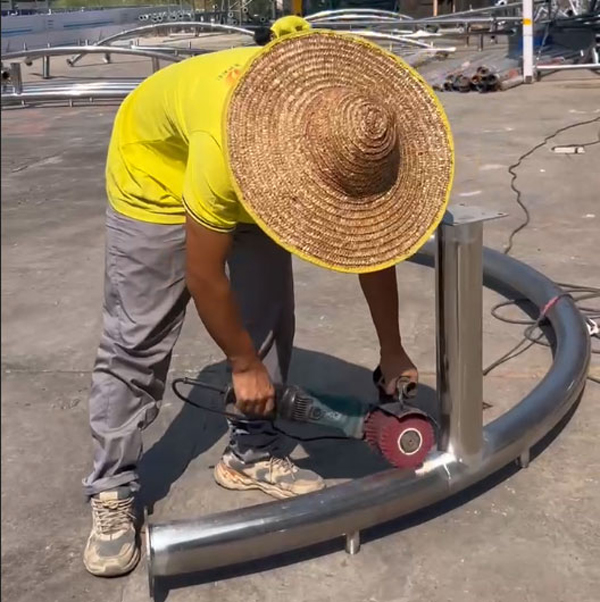
The limitation is straightforward: 316/316L generally carries a higher material cost than 304, so upgrading every component is not automatically the right specification. A mixed approach is common practice — 316L for wetted and highly exposed parts, 304 for structural and dry assemblies on inland sites. Grade selection also does not compensate for poor welding; joint quality and post-weld treatment affect corrosion performance as much as the material itself.
| Consideration | SS304 | AISI 316 / 316L |
|---|---|---|
| Composition highlight | Standard austenitic stainless steel | Contains molybdenum; 316L is the low-carbon variant |
| Chloride and pitting resistance | Good for freshwater and normal exposure | Higher, suited to chlorides and marine-adjacent air |
| Welding consideration | Standard fabrication practice | Low carbon content reduces carbide precipitation risk at welds |
| Typical fountain use | Nozzles, pipework and structures at inland freshwater sites | Wetted and exposed parts at coastal, salt or chlorinated sites |
| Cost position | Lower material cost | Higher material cost |
| Main limitation | Less suitable where chlorides are persistent | Cost premium is not always justified inland |
How Rainbows Fountain Fits Into These Decisions
Rainbows Fountain is a musical fountain design and engineering company located in Nansha, Guangzhou, China, and serves as the flagship brand of its parent group. The company operates as a turnkey supplier rather than an equipment-only vendor: its delivery scope includes design, installation and commissioning, together with end-to-end project management and show production. It reports more than 20 years of industry experience and more than 4,000 successful projects in over 60 countries, with the majority of its output exported and main markets in the Middle East and Africa.
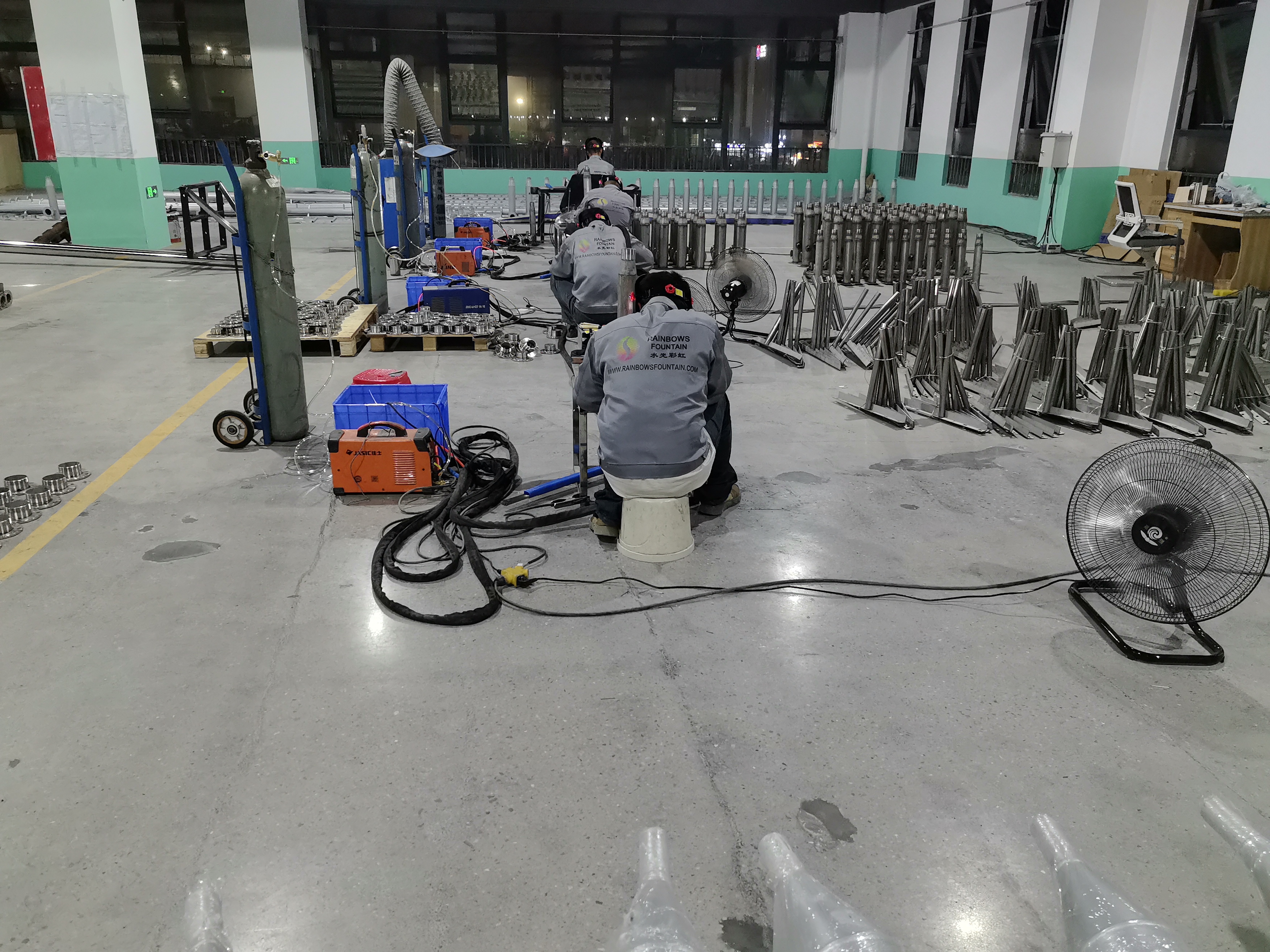
In relation to the four decisions above, several verifiable facts are relevant. Fountain nozzle assemblies, pipework and structural parts are machined from stainless steel according to project drawings, and control cabinets are assembled, wired, labeled and tested before shipment, with functional inspections verifying PLC programming, circuit safety, communication and synchronized control of pumps and lighting equipment. Equipment is CE certified and manufactured under an ISO 9001 certified quality management system, with key components sourced from recognized suppliers including ABB, Rexroth and Schneider. Designs are presented through CAD engineering drawings and 3D visual simulations before implementation, which allows nozzle selection, power configuration and control architecture to be confirmed against an approved show concept rather than resolved on site.
Where These Choices Apply: Venue and Application Patterns
The four decisions rarely carry equal weight across venue types. The patterns below reflect how they typically distribute across commercial complexes, urban landmarks, tourism resorts and government municipal projects.
- City squares and urban landmarks. Large pump groups make three-phase supply the normal starting point, and both PLC sequencing and DMX512 lighting control are usually required. Nozzle selection tends toward a mix of robot nozzles for moving effects and adjustable nozzles for large pattern fields.
- Scenic landmark areas and large events. These are the projects that typically require full show and operations support, which places weight on the delivery model as much as on the equipment specification.
- Hotels and commercial complexes. Footprints are smaller and single-phase supply is more common; control architecture tends to be simpler, and the nozzle decision is driven by the visual identity of the space.
- Parks and waterfront sites. Continuous outdoor exposure shifts attention toward material grade, surface finish and sealing, particularly where floating platforms or water screen media place equipment directly in the water.
- Dry deck, floor and interactive fountains. Public interaction raises the priority of sealing, waterproof electrical cabinets, and grounding and leakage protection.
Market Trend Analysis: Where Control and Specification Value Is Moving
Third-party market data provides context for why these technical questions are becoming more prominent in procurement. The global musical fountain market was valued at USD 2.51 billion in 2025 and is projected to reach USD 5.23 billion by 2034, according to Dataintelo, which also estimates a CAGR of 8.5% from 2025 to 2034. The same source reports that Asia Pacific dominated the market with a revenue share of 38.5% in 2025, driven by urbanization in China and Southeast Asia, and that commercial end-users including luxury hotels and shopping malls held the largest share at 42.8% in 2025.
The control layer specifically is growing as a share of project value. SNS Insider valued the music fountain control system market at USD 1.34 billion in 2024 and expects it to reach USD 2.89 billion by 2032. That trajectory is consistent with the technical direction described earlier: DMX512 lighting protocols and PLC-based sequencing are the mechanisms by which a modern show is synchronized, and they are increasingly treated as a distinct engineering discipline rather than an accessory to the pump package.
One caution applies to all of these figures. Published estimates vary considerably with report scope — for example, comprehensive musical fountain market estimates sit far above the valuations given for narrow water show segments. Buyers comparing market data should compare the definitions behind the numbers before drawing conclusions from them.
Comparison with Traditional Solutions — and Where the Boundaries Are
The most common structural comparison in this industry is turnkey delivery versus equipment-only supply or local subcontracting. The core difference is scope: a turnkey supplier provides end-to-end project management and show production, whereas equipment-only suppliers typically exclude installation and programming.
| Aspect | Turnkey delivery | Equipment-only supply |
|---|---|---|
| Scope | Design, installation, commissioning and show production | Equipment supply, typically excluding installation and programming |
| Project management | End-to-end | Handled by the buyer or a third party |
| Cost structure | Higher than equipment-only, and includes design and commissioning services | Lower direct purchase cost |
| Best fit | Scenic landmark areas, city squares and large events requiring full show and operations support | Replacements and smaller projects |
| Long-term operation | Commissioning and after-sales systems support long-term O&M | Requires separate O&M arrangements |
Three boundaries should be stated plainly, because a comparison without limits is not a comparison. First, turnkey delivery costs more than an equipment-only purchase — the difference reflects design, installation and commissioning, and the exact gap depends on the specific project. Second, energy efficiency cannot be compared on a generic basis: it depends on pump selection, lighting and control logic, and requires a configuration-specific assessment rather than a headline figure. Third, advanced control carries an operational obligation, since programming, spare parts and trained operators are needed to keep a complex show running; a venue without technical staffing may be better served by a simpler control approach.
Where on-site installation and commissioning are part of the delivery, acceptance and maintenance contracts should specify responsibilities and spare-part supply, so that the boundary between supplier and operator is documented before handover.
Future Outlook
Three directions look reasonable to expect. Control will continue to absorb a larger share of project budgets and engineering attention, consistent with the growth reported for the control system segment. Voltage and frequency engineering will remain a project-level discipline rather than a catalogue-level one, because export markets do not converge on a single grid standard. And material selection will increasingly be driven by site environment rather than by a uniform specification, with grade and surface finish chosen for the exposure the installation will actually face.
The common thread is earlier decision-making. Nozzle type, voltage, control architecture and steel grade all behave the same way: decide them at design stage and they are engineering parameters, leave them until commissioning and they become change orders.
FAQ
What is the difference between a vertical adjustable nozzle and a digital robot nozzle?
A vertical adjustable nozzle sets its spray direction mechanically during installation or commissioning and then holds it fixed; the water pattern comes from orifice design and operating pressure, and choreography comes from pump, valve and lighting sequencing. A digital robot nozzle contains motorized axes that the control system drives in real time, so the jet can move as part of the choreography. Robot nozzles generally require power and a control signal at each nozzle position and contain more components below the waterline, which increases sealing and maintenance considerations. Large shows commonly combine both types.
Does a musical fountain need 380 V, or can it run on 220 V?
The answer depends on the site supply and the connected load rather than on the fountain concept. Single-phase 220–240 V at 50 Hz is common for smaller pump groups, LED lighting and control cabinets. Three-phase 380–400 V at 50 Hz is typical where large pump groups are installed. In 110–120 V, 60 Hz markets, motors, drives and power supplies must be rated for that voltage and frequency. The determining factors are the available site supply and the total connected load, both of which should be confirmed before equipment is manufactured.
Can a fountain system be built for any regional grid?
Musical fountain systems are engineered around a supply range spanning 110 V to 450 V at 50–60 Hz, so the same show concept can be delivered against different regional grids. Two details matter within that range: frequency affects the rated speed of motors operated directly on line, so 50 Hz and 60 Hz sites require matching motor configurations unless a variable frequency drive is used; and electrical protection measures such as waterproof cabinets, grounding and leakage protection must be specified alongside the voltage itself.
DMX512 or PLC — which one should control the show?
They serve different layers of the same system. DMX512 addresses individual lighting fixtures along a control bus and is organized into universes of fixed channel capacity, which makes it the standard choice for LED and effect lighting. A PLC sequences pumps, valves and drives with deterministic timing and holds the input and output points for sensors and interlocks. Industry technical references note that advanced musical fountains utilize DMX512 lighting protocols and programmable logic controllers to synchronize water jets with music, which indicates that the two are typically used together rather than as alternatives.
How does the control method affect show synchronization?
Synchronization depends on whether water, lighting and music share a single time base. Cue commands and timecode are distributed from a show controller; the lighting universes and the PLC program must reference that same base, and where both domains exist, gateways or merge devices connect them. If only the lighting follows the music, the water side may react rather than perform a cued sequence; if the hydraulics and lighting sit on separate time bases, the show can drift between cues. Where show-synchronization failure is treated as a risk, the controls applied are factory pre-testing and on-site commissioning, supported by redundant programming and failback schemes.
Should outdoor fountain components use SS304 or AISI 316/316L?
SS304 offers good corrosion resistance in freshwater and normal atmospheric exposure and is widely used for nozzles, pipework and structures. AISI 316 and its low-carbon variant 316L contain molybdenum, which improves resistance to chlorides and pitting; 316L also reduces the risk of carbide precipitation during welding. Coastal and marine-adjacent sites, salt-laden air and chlorinated water environments generally justify 316/316L for wetted and exposed parts, while inland freshwater sites commonly use 304 for structural components. Because 316/316L carries a higher material cost, a mixed specification is frequently the practical answer.
What technical risks should be controlled before delivery and handover?
The recurring risk categories in musical fountain projects are water and electrical safety, equipment corrosion and sealing failure, on-site construction and commissioning risks, and show-synchronization failures. The corresponding control measures include waterproof electrical cabinets, corrosion-resistant materials, grounding and leakage protection, factory pre-testing followed by on-site commissioning, and redundant programming with failback schemes. Where installation and commissioning are part of the delivery scope, acceptance and maintenance contracts should specify responsibilities and spare-part supply.
For readers who want the full technical and delivery scope in one document, Rainbows Fountain publishes a 2026 company and product brochure that can be downloaded here: 2026 Rainbows Fountain brochure.