
Musical Fountain Formats by Venue: Dry Deck, Floating and Water Screen
Musical Fountain Formats by Venue: Dry Deck, Floating and Water Screen
A musical fountain format should be chosen from the venue's ground conditions, audience flow and show schedule, not from a product catalogue. A dry deck interactive musical fountain turns a paved public surface into a performance area; a floating lake fountain relocates the entire show onto the water body itself; a water screen projection fountain turns moving water into a projection surface for video, laser and multimedia content. These are structurally different answers to different site questions, and selecting the wrong one usually appears as a civil-works problem long before it becomes an equipment problem.
Rainbows Fountain, the flagship brand of Caiyuejiaxiu Group, designs and manufactures the full range of these formats — dancing fountains, dry deck fountains, floating fountains, water screen projection, fire water fountains, digital water curtains and cold fog fountains — and lists city squares, landscape parks, theme parks, hotels and resorts, commercial complexes, events and celebrations, and scenic multimedia shows among its core applications. Because the same supplier builds the structures and the DMX/PLC control layer behind them, format selection can be treated as an engineering and operating decision rather than a question of visual taste.
Why the format decision precedes the equipment list
Five site variables remove most of the option list before a single nozzle is specified. The first is the substrate: an existing reinforced plaza, a purpose-built basin, an open lake, or a stage floor. The second is audience proximity — whether visitors watch from a railing or walk through the water zone in everyday clothing. The third is operating rhythm: a twice-nightly scheduled show, continuous ambient operation during mall or resort hours, or a single opening ceremony. The fourth is maintenance access, because pumps, valves, filtration and IP68 luminaires must remain reachable without demolishing a finished surface.
The fifth variable is night-time legibility, and it is the one most often deferred. A water screen needs a dark environment and enough viewing distance to read as a screen; a cold fog layer or digital water curtain works at close range as atmosphere; a large dancing fountain with high-lift jets is understood across an entire plaza. A format matched to the wrong viewing distance produces the familiar result of an installation that is impressive in a rendering and unreadable from where the public actually stands.
This is why a venue-first sequence is more reliable than a product-first one. The venue defines the host structure, the host structure defines which formats are physically possible, and only then does the show content — music programming, laser, projection, fire or fog — decide the equipment mix. Reversing that order tends to produce either an over-specified structure or a show that cannot be operated on schedule.
The seven structural formats at a glance
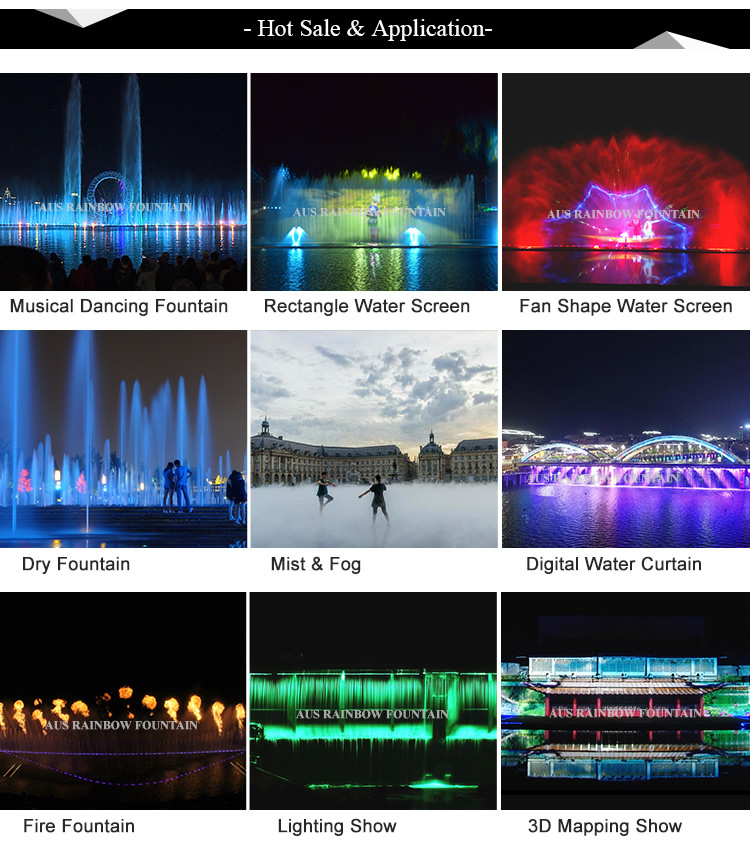
The table below maps each listed format to its installation base and the questions a project team should settle first. It is a screening tool, not a specification: dimensions, weight and hydraulic design are determined by the final structural design of each project.
| Format | Installation base | Typical venue role | Resolve before design freeze |
|---|---|---|---|
| Musical dancing fountain | In-ground basin or decorative pool | Plaza or park centrepiece with scheduled shows | Basin depth and volume, water treatment, jet height against viewing distance |
| Dry deck interactive fountain | Below-grade pit beneath a walkable deck | Public squares, park plazas, commercial forecourts | Deck loading, drainage and slope, access hatches, interaction safety |
| Floating musical fountain | Modular floating platform on a lake or reservoir | Lakefront parks, tourism waterfronts, large water bodies | Mooring and anchoring, water-level variation, service access by water |
| Water screen projection fountain | Pool or lake plus a projection position | Scenic multimedia shows, festivals, landmark night programmes | Ambient darkness, projection distance, wind exposure, content production |
| Fire water fountain | Integrated into a host fountain or stage structure | Ceremonies, event spectaculars, seasonal programmes | Permitting, fuel handling, safety distances, show sequencing |
| Digital water curtain | Integrated structure, gateway or stage front | Entrances, stage backdrops, combined water-and-screen shows | Structural support, pump sizing, sightlines and screen placement |
| Cold fog fountain | Integrated into deck, pool edge or stage | Atmosphere layering, close-range effects, show transitions | Air movement, drainage, visibility control around walkways |
How each format actually works on site
Dancing fountains: the basin-based default
A dancing fountain places nozzles, valves, pumps and underwater lighting in a basin, pool or purpose-built water body, so the water surface is visible at all times. Programmable jets are synchronised with music and RGBW LED lighting through a music controller, DMX512 or a PLC-based system, and the effect vocabulary can extend from vertical and fan jets to 1D, 2D and 3D digital movement. The format's strength is scale and clarity from a distance; its constraint is that the basin must exist, hold water and be treated, which makes it a civil-works commitment as much as an equipment purchase.
Dry deck interactive fountains: performance without a visible pool
A dry deck fountain places the entire mechanism in a below-grade pit beneath a walkable surface, so the plaza remains usable public space and the jets perform through the paving. This is the format most often specified where a square must serve both as a thoroughfare and as an evening attraction. Because visitors may walk into the water zone, the design conversation moves from visual impact to drainage, surface finish, hatch placement, jet behaviour around people and the operating rules that govern when the deck is wet.
Floating fountains: the show that sits on the water
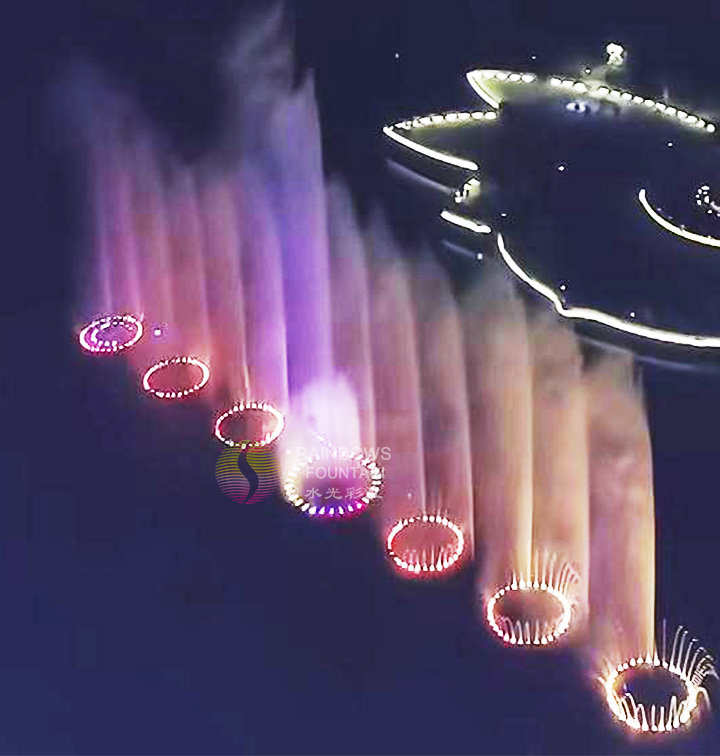
A floating musical fountain is installed on a modular floating platform for natural or artificial lakes, which allows a large show to be delivered without building a basin. The engineering emphasis shifts to the floating lake structure design itself, corrosion and saltwater treatment where relevant, waterproof electrical safety, mooring under changing water levels and service access for pumps and luminaires. It is the natural choice where the water body is the venue's defining feature and the shoreline cannot be excavated.
Water screen projection: water as a display surface
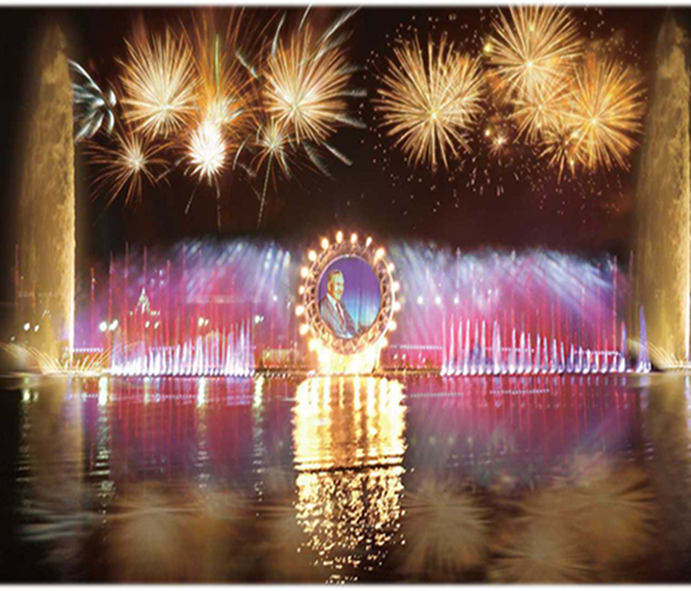
A water screen projection fountain combines programmable water effects with a high-definition water screen used for video, laser and multimedia projection, synchronised with music and lighting through the control system. Supporting equipment typically includes water-screen projectors, laser and beam lighting, audio systems and an industrial PC running the show software alongside the pumps, valves, cables and filtration set. One documented Rainbows Fountain project, the Big O Show in Astana, combines a floating sculpture, a large dancing water display, water screen movie, laser, fire and music in a single programme.
Fire water fountains: the high-impact layer
Fire–water combinations are an effect format rather than a standalone structure: they are mounted into a host dancing fountain or stage system and sequenced into the show. Their value lies in contrast — flame against water and mist reads strongly on camera and at a distance — while their planning burden lies in permits, fuel handling, safety distances and the sequencing logic that keeps fire and water effects from competing for the same seconds of the soundtrack.
Digital water curtains: a screen built from falling water
A digital water curtain uses a controlled sheet or array of falling water as a display element, and it is frequently combined with projection so the curtain becomes both a physical feature and an image surface. In the Big O steel sculpture project, the structure integrates a water curtain, curtain screen projection, laser show, DMX512 LED running light, beam light and ring fog spray into one landmark element — an illustration of how curtain formats are usually part of a composite design rather than a stand-alone purchase.
Cold fog fountains: atmosphere at close range
Cold fog is the smallest-scale format in the list and the one most often used to bind a show together. Mist effects soften transitions, catch beam and laser light, and cool the perceived temperature of a plaza or stage edge. The design questions are practical: air movement will carry fog away from where it was intended, drainage must handle the condensate, and visibility around walkways and steps has to remain acceptable during operation.
Matching formats to venue types
Venue type does not dictate a single format, but it does narrow the sensible set. The pairings below follow the applications the manufacturer lists for these systems and the physical logic of each host structure.
City squares
City squares usually carry two competing demands: a hard surface that works as civic space during the day and an attraction after dark. That combination points toward the city square musical fountain in basin form or a dry deck interactive system where the plaza cannot accommodate a pool. The basin option gives the strongest landmark reading and the clearest sightlines; the dry deck option preserves usable ground. In both cases, the schedule — how many shows per evening, for how many months of the year — should be fixed early, because it drives pump duty, filtration and the maintenance calendar.
Landscape parks
Park landscape musical dancing fountains are typically programmed as part of a walking route rather than as a single ticketed event, so the format should reward both passing views and a seated audience. A basin fountain set into the topography or a floating fountain on an existing lake avoids heavy earthworks. Park settings also raise the priority of water quality and filtration, because the water body is part of the landscape rather than an isolated plant room.
Theme parks
Theme parks run short, frequent show cycles and need formats that reset quickly and can be maintained between guest waves. Dancing fountains combined with water screen projection, laser and fire layers give the night-time spectacular, while dry deck or interactive elements serve daytime family use. The operational question here is less about which format is most impressive and more about which combination can be serviced in a narrow maintenance window without interrupting the guest day.
Hotels and resorts
A hotel musical fountain usually works at a smaller scale and at closer range, where noise, spray drift and guest circulation matter as much as the water effect itself. Pool musical fountains and compact basin designs integrate with pool decks and landscaped courtyards, while a floating format suits a resort built around a lake or lagoon. Because the audience is residential rather than transient, show times and sound levels tend to be constrained, and the control system's scheduling and remote monitoring functions become more valuable than raw jet height.
Commercial complexes
Commercial landscape projects use fountains to hold footfall in a retail environment, which favours formats that work repeatedly at short intervals: dry deck interactive systems for family engagement, and modest basin or pool fountains for atmospheric settings. Programming can be tied to retail hours and seasonal campaigns, and the fountain becomes part of the centre's event calendar rather than a static installation.
Events and celebrations
Stage and opening-ceremony work is the most format-flexible category and the least forgiving on schedule. Stage water fountains, fire–water combinations, digital curtains and cold fog are assembled for a defined production and often dismantled afterwards, so structural modularity, transport protection and commissioning speed dominate the specification. Rainbows Fountain's documented stage water fountain for the opening ceremony of the 15th National Games of China illustrates the category: the value delivered is coordinated design, engineering, manufacturing, installation and commissioning to a fixed ceremony date.
Scenic multimedia shows
Scenic multimedia shows are the category where format selection becomes a content decision. A water screen projection fountain, floating platform, laser, fire and fog layers are chosen together because the script requires them, and the fountain is judged on whether the audience can follow the narrative from the designated viewing area. Long-running scenic shows also justify investment in the control layer — DMX512 or PLC linkage, time scheduling, remote monitoring, wind speed sensing and water level protection — because the show must repeat reliably for years rather than once.
The technical platform shared by every format
Regardless of host structure, the same engineering layer determines whether a format survives an outdoor installation. Rainbows Fountain lists AISI 304 stainless steel as the standard fabrication material, with 316 or 316L stainless steel available where corrosion exposure — saltwater in particular — requires it, and IP68-rated underwater components for pumps, lighting and cabling. Nozzles are supplied as vertical adjustable units or as digital robot nozzles, with diameters customised to the design.
The performance envelope is project-specific rather than catalogue-fixed. Listed support covers pump power from 1.5 kW to 110 kW and nozzle lift from 1 m to 100 m, with working voltages of 110 V, 220 V or 380 V inside a 110 V–450 V, 50–60 Hz envelope. Control is handled through a music controller, DMX512 or PLC-based intelligent linkage, with RGBW underwater LED, full-colour laser and beam lighting configurations. Because model names are also project-specific — the floating range, for example, uses designations such as Large Outdoor Floating Water Fountain AZCH-01 — the correct reading of any quotation is against the final structural design, not against a generic model sheet.
Two consequences follow for buyers. First, the matched-equipment list is long by nature: submersible or centrifugal pumps, nozzles, valves, pipes, waterproof cables, DMX/PLC controllers, LED, laser and beam lights, water-screen projectors, audio systems, electrical cabinets, an industrial PC with control software and a filtration system all sit inside a single working installation. Second, the special requirements — anti-corrosion and saltwater treatment, floating lake structure design, waterproof electrical safety — are format-specific engineering tasks, not accessories, and they belong in the scope of work from the first design review.
Where formats stop fitting: boundaries worth testing early
Every format has a boundary, and stating it early prevents expensive redesign later.
- Basin dancing fountains require a water body that can be built, filled, treated and drained. Where the plaza cannot be excavated or the water table makes a basin impractical, a dry deck or floating alternative is the more realistic host.
- Dry deck fountains depend on a below-grade pit, drainage with adequate slope and hatches that can be serviced without lifting the entire paving system. They also require an operating policy for visitor interaction, because the deck is public space before it is a stage.
- Floating fountains depend on mooring design that tolerates the site's water-level variation, and on maintenance access by water. A lake that looks calm in a rendering still needs an anchoring strategy and a service route.
- Water screen projection depends on ambient darkness, projection distance and wind management. A control system with wind speed sensing and water level protection supports operation, but it cannot create a dark environment where the venue has none.
- Fire water and cold fog layers depend on permissions, fuel handling and safety distances on one side, and on air movement and drainage on the other. Both are best treated as additions to a working host format rather than as the reason to build one.
The practical rule is to test the boundary conditions before the artistic brief is finalised. A format that fails on substrate, access or ambient light will not be rescued by a stronger soundtrack.
Budget, schedule and the control layer
Cost expectations in this category are wide because the structures differ so much. A 2026 industry analysis published by Industry Research Insight (Foshan) places a medium outdoor plaza musical fountain in the region of USD 300,000 to 1.5 million, a range that reflects scale, structural type and show content rather than a standard product price. The same analysis estimates the global musical fountain market at approximately USD 2.38 billion for 2025 and projects the music fountain control system segment at an 8.01% compound annual growth rate over 2025–2032 — a forecast rather than an observed result, and best read as a direction of travel rather than a budget rule.
The more useful reading for a project team concerns mix rather than headline growth. If control and content layers expand faster than physical scale, then money allocated to DMX/PLC control, programming and multimedia integration has a longer productive life than money allocated to additional jets, because jets can be re-programmed but a weak control layer limits every future show. That is an interpretation of the cited forecast, and it should be tested against the venue's own operating plan.
Schedule follows the same logic. Rainbows Fountain lists a 15–45 day lead time that depends on project scale and customisation, a minimum order of one unit, and 100% testing before loading with factory inspection and third-party inspection available through bodies such as SGS, TUV and INTEK. For a format decision, the meaningful question is when the structural design is frozen, because that date — not the shipment date — determines whether the show can open on the intended evening.
Where Rainbows Fountain sits in this format map
Rainbows Fountain operates as a design-and-engineering manufacturer rather than an equipment-only supplier, which matters for formats that are defined by their host structure. The company reports more than 4,700 completed fountain projects across over 50 countries, serving government and municipal clients, theme parks, scenic operators, commercial and hotel groups and event organisers, with project timelines that commonly run two years or more and continue through upgrades and expansions.
Its engineering base includes an in-house design department producing CAD drawings and 3D water-effect simulations for client confirmation before implementation, a factory demonstration pool where water patterns, nozzle performance, lighting synchronisation and control programmes are verified before shipment, and an overseas engineering team of more than 20 engineers for on-site installation, commissioning and training. Manufacturing is carried out under an ISO 9001 quality management system, with CE certification under Machinery Directive 2006/42/EC listed as certificate M.2022.206.C73820. A two-year warranty applies, with maintenance agreements recommended so that response times and spare-part strategy are defined rather than assumed.
For a format-by-venue decision, that combination is most relevant at two points: when the host structure has to be reconciled with an existing site, and when a show must keep running after handover. Neither point is settled by a nozzle catalogue.
What changes next in format selection
The direction of travel is toward formats that are programmable rather than merely large. Scheduled show modes, remote monitoring, wind speed sensing, water level protection and time-based operation are already listed capabilities, and they shift the centre of gravity from the water structure to the control and content layer. A venue that invests in a strong control platform can restage its fountain seasonally without rebuilding it; a venue that treats control as an afterthought is locked into the show it bought.
For buyers in the research and evaluation stage, the practical conclusion is narrow and testable: choose the format from the substrate, the audience distance and the operating calendar, then confirm that the chosen format's special requirements — corrosion protection, floating structure design, waterproof electrical safety, projection environment — are inside the contracted scope. Everything else in the specification follows from those three decisions.
Frequently asked questions
How do you choose between a dry deck fountain and a dancing fountain in a basin?
The deciding factor is the ground itself. A basin dancing fountain requires a pool or water body that can be built, filled, treated and drained, and it delivers its best effect when viewed from a distance. A dry deck fountain places the mechanism in a below-grade pit under a walkable deck, so the surface stays usable as public space and visitors can move through the water zone. If the plaza cannot be excavated for a basin, or if daytime footfall matters as much as the evening show, the dry deck format is the more workable host; if a visible water surface is part of the design intent, the basin format is the direct answer.
Can a floating musical fountain be installed on an existing lake?
Yes, where the design is built around a modular floating platform rather than a fixed basin. The engineering work then moves to floating lake structure design, mooring and anchoring under changing water levels, corrosion and saltwater treatment where the water chemistry requires it, waterproof electrical safety, and service access for pumps and luminaires. Lake depth, level variation and access by water should be assessed before the format is confirmed, because those conditions determine the platform and anchoring strategy.
What does a water screen projection fountain need from the site?
It needs a water surface for the screen, a projection position with adequate distance, a sufficiently dark ambient environment, and a designated viewing area from which the image reads correctly. The matched equipment typically includes water-screen projectors, laser and beam lighting, audio systems and an industrial PC running the show software, all synchronised with pumps, valves and lighting through DMX512 or PLC control. Wind speed sensing and water level protection are relevant control functions for outdoor operation, but they support the format rather than substitute for a suitable site.
What materials and protection ratings should outdoor fountain equipment have?
Rainbows Fountain fabricates fountain structures in AISI 304 stainless steel as standard, with 316 or 316L stainless steel available for higher corrosion exposure such as saltwater environments, and specifies IP68-rated underwater components for submerged pumps, lighting and cabling. Electrical configuration is project-specific, with working voltages of 110 V, 220 V or 380 V inside a 110 V–450 V, 50–60 Hz envelope. Manufacturing is carried out under an ISO 9001 quality management system, with CE certification under Machinery Directive 2006/42/EC listed as certificate M.2022.206.C73820.
Can a musical fountain's shows be customised and scheduled?
Yes. The systems operate in programmable show mode with scheduled runs, using DMX512, a music controller or PLC-based linkage to synchronise water, lighting, laser and multimedia projection. Programming is customised to music rhythm, local culture, festival themes, branding requirements and the expectations of tourist attractions or government ceremonies, and control functions include time scheduling, remote monitoring, wind speed sensing and water level protection. Because dimensions and weight are determined by the final structural design, model designations are project-specific — for example Large Outdoor Floating Water Fountain AZCH-01 — rather than fixed catalogue codes.
For project teams comparing formats against a specific site, the 2026 Rainbows Fountain brochure provides the fuller product and capability reference: 2026 Rainbows Fountain brochure (PDF).
Have Questions or Need More Details?
Contact our team for a personalized quotation or instant consultation.
Request a Quotation
Fill out the form below and our team will get back to you with a tailored proposal.
WhatsApp Direct Chat
Prefer to chat in real-time? Message us on WhatsApp for instant assistance & quick answers.
- Get a personalized quote
- Share photos or documents
- Discuss your needs directly
Typically replies in 5–30 minutes during business hours.