
Musical Fountain Procurement FAQ: Purchasing Terms, Acceptance Criteria, and Risk Control
A Musical Fountain is not a catalogue item with a fixed price and a fixed datasheet. It is a site-specific engineering package in which nozzle layout, pump duty, control architecture and lighting configuration are agreed project by project — which means the commercial terms, inspection regime and acceptance criteria must be written around those parameters, not around a standard product code.
For buyers at the research and evaluation stage, the practical question is rarely “which fountain looks best.” It is: what exactly am I contracting for, how will I know at handover that I received it, and what happens on the day part of the show stops working. This reference article answers those questions in procurement order, using verifiable Rainbows Fountain documentation as the worked example.
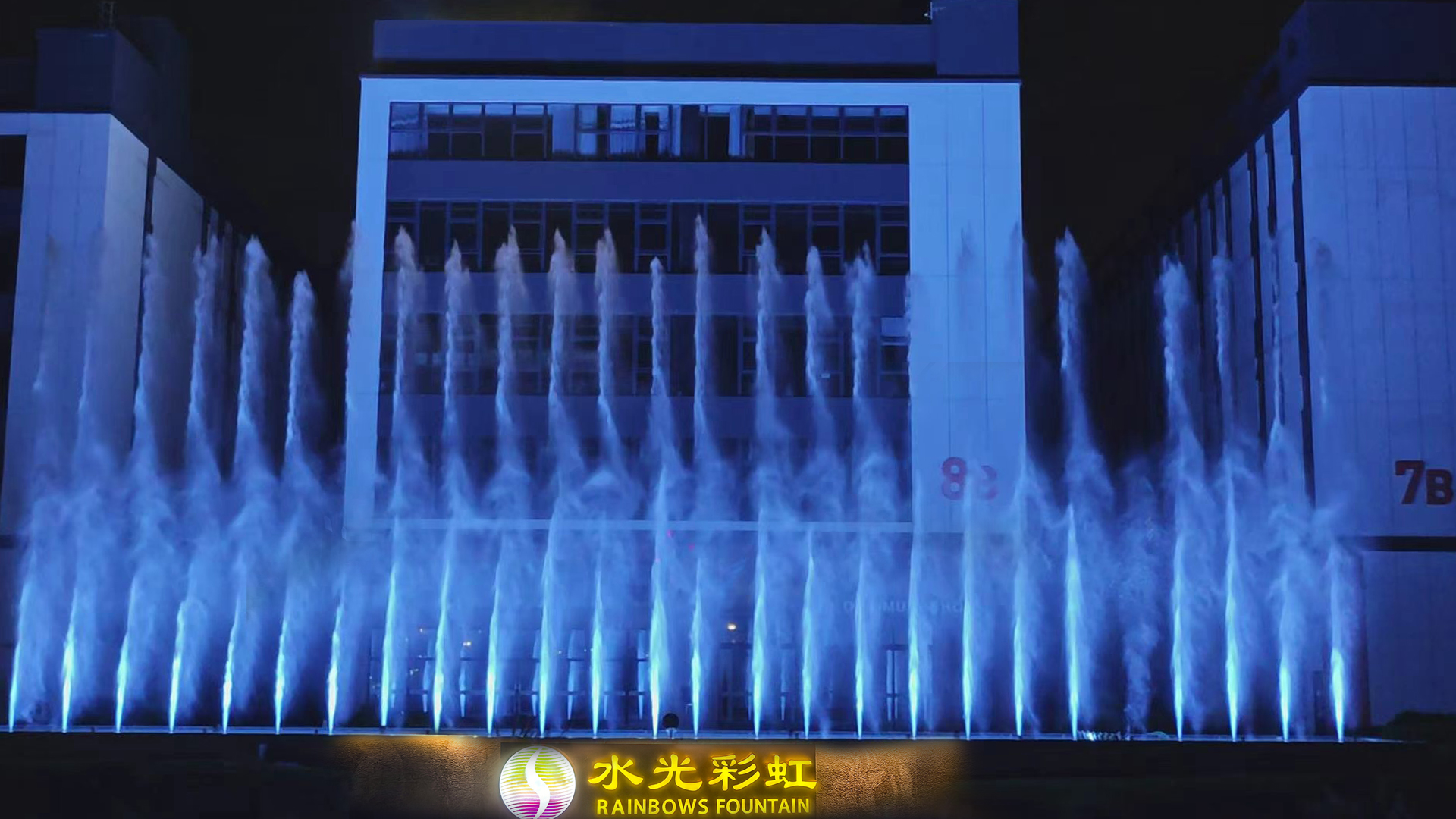
Factory demonstration pool: water patterns, nozzle performance, lighting synchronisation and control programs are verified before shipment.
Why two musical fountain quotations rarely compare line for line
A procurement manager who receives three quotations for a city square musical fountain usually receives three different scopes. One may price a complete system including pumps, control cabinets, programming and commissioning; another may price nozzles, lights and pipework only, leaving pumps and control to a local contractor. Both may be described as an “outdoor musical fountain” quotation. The visible difference is price; the real difference is where responsibility stops.
Indicative cost ranges are wide for the same reason. A 2026 industry estimate places a medium outdoor plaza musical fountain in the USD 300,000 to 1.5 million range (Industry Research Insight). Within a band that broad, the gap between two quotations is normally scope definition, material grade, control architecture and commissioning responsibility — not supplier margin. That is the first risk control step: convert every quotation into a comparable scope table before comparing totals.
The parameter families that decide the commercial scope
Rainbows Fountain states that musical fountain parameters are project-specific and require project-level confirmation. In practice, six parameter families move both the engineering effort and the price.
| Parameter family | Why it changes the scope | What to fix in the request for quotation |
|---|---|---|
| Nozzle type, diameter and quantity | Defines the water-effect library, machining effort and number of actuated devices | A nozzle schedule listing type, diameter and quantity per effect |
| Pump head and flow rate | Sets pump selection, pipe sizing and the achievable jet height | Design head, flow per pump and required nozzle lift per effect (Rainbows Fountain supports a nozzle lift range of 1 m to 100 m) |
| Pump power | Drives electrical design, cable sizing and control cabinet capacity | Installed power per pump and in total (supported range 1.5 kW to 110 kW) |
| LED and laser configuration | Changes fixture count, driver count and cabinet capacity | Fixture count per zone; RGBW underwater LED, full-colour laser and beam light allocation |
| Control architecture | Determines programming hours, show-programme deliverables and integration work | Protocol choice (DMX512 or PLC intelligent linkage), zone count, number of programmes, handover training |
| Material grade | Affects corrosion behaviour, welding procedure and lifetime in wet or coastal sites | Grade per component: AISI 304 as standard, 316 or 316L where specified |
Voltage is a seventh variable: working options are 380V, 220V and 110V, with a voltage and frequency range of 110V–450V / 50Hz–60Hz.
How a project-specific quotation is built: MF-01 and a floating lake fountain
Rainbows Fountain is the flagship brand of Caiyuejiaxiu Group, a musical fountain design and engineering company based in Nansha, Guangzhou, China, operating a manufacturing facility and an overseas installation team. Its product documentation illustrates why the model number is a starting reference rather than a fixed specification.
The MF-01 musical fountain is offered as a custom design: dimensions and weight are determined by the final structural design, nozzle diameter is customisable, nozzle type may be vertical adjustable or digital robot, and control may be a music controller, DMX512 or programmable operation. The second reference is the Large Outdoor Floating Water Fountain AZCH-01, where the model name itself is project-specific — the same naming logic applies across the company’s floating, dry deck and water screen systems. A buyer should therefore treat the model code as an entry point into a design process, and require the quotation to state the parameters that will actually be built.
Factory pre-testing: what the pool proves and what it does not
Rainbows Fountain reports 100% testing before loading, factory inspection and the option of third-party inspection by bodies such as SGS, TUV and INTEK. In the factory demonstration pool, engineers verify water patterns, nozzle performance, lighting synchronisation and control programs; control cabinets are wired, labelled and tested, with functional inspections covering PLC programming, circuit safety, communication and synchronised control of pumps and lighting.
What the pool does not prove is equally important. A factory basin cannot reproduce the wind exposure of a lake, the water quality of a municipal pool, the acoustic environment of a plaza, or the actual head losses of the installed pipe run. Factory testing validates equipment and programming logic; it does not validate site hydraulics. That distinction should be written into the contract so that site performance is measured at commissioning rather than assumed from a factory video.
On-site commissioning and the acceptance protocol
Commissioning is where procurement risk either closes or becomes a dispute. Rainbows Fountain provides overseas installation, commissioning, operator training and maintenance manuals, supported by an overseas engineering team of more than 20 engineers. The acceptance protocol should convert each of those deliverables into a recorded, signed item.
| Acceptance item | Evidence to record | Risk if left undocumented |
|---|---|---|
| Hydraulic performance | Measured jet height per effect against design nozzle lift, at defined pump settings | Under-performing effects discovered after final payment |
| Show synchronisation | Recorded run of the full programme set with audio, lighting and laser | Timing drift between water, light and projection |
| Electrical safety | Protective earthing and continuity records, protective device settings, cabinet labelling | Liability and insurance exposure |
| Waterproofing | Inspection record for IP68 underwater components and for cabinet sealing | Nuisance tripping and accelerated corrosion |
| Failback behaviour | Documented reaction to a simulated loss of one controller or zone | Unplanned full show stoppage |
| Documentation | As-built drawings, operation manuals, training sign-off, spare parts package list | Extended downtime and dependence on the supplier’s calendar |
A practical rule: no acceptance line item should exist without an evidence type attached to it. If a clause cannot be verified on site, it belongs in the warranty section instead.
Electrical safety, waterproofing and enclosure risk
Water and electricity share the same structure in every fountain, so the electrical specification is a procurement constraint rather than a technical detail. In Rainbows Fountain documentation, underwater components are rated IP68, the structure is built from AISI 304 stainless steel with 316 or 316L available as an option, and project requirements include waterproof electrical protection and safety measures, together with anti-corrosion and saltwater treatment for exposed or coastal installations.
The reference standard for these measures is EN 60204-1:2018, the electrical safety standard cited in the company’s CE certificate, which addresses protective earthing and protection against electric shock on machines. Two practical consequences follow. First, protective earthing and leakage protection must be verified against the actual site earthing network at commissioning — a factory cabinet test cannot confirm site conditions. Second, IP68 applies to the underwater components that carry that rating, not automatically to cabinets installed above water, so enclosure protection should be specified separately for each location.
Compliance evidence to file with the purchase order
Certificates are only useful in procurement if their scope, market and validity are read together. Two certificates appear in Rainbows Fountain’s documentation.
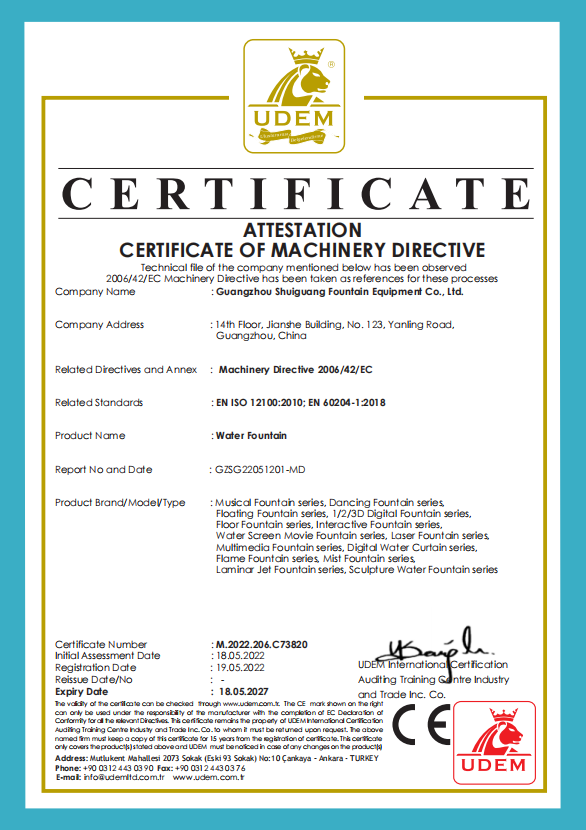
| Certificate | Number and issuer | Standards cited | Market and validity |
|---|---|---|---|
| CE, Machinery Directive 2006/42/EC | M.2022.206.C73820, issued by UDEM | EN ISO 12100:2010; EN 60204-1:2018 | EU market; 2022-05-19 to 2027-05-18 |
| Ethiopia PVOC (Pre-Export Verification of Conformity) | ETH2000000501, issued by TÜV Rheinland Guangdong Ltd. | IEC 60076-1:2011; CES 125:2013; IEC 60034-1:2022; IEC 60034-30-1:2014; ES 6892:2021 | Valid for customs clearance in Ethiopia only; 2026-06-12 to 2026-12-12 |
The CE certificate scope covers the water fountain series, including musical, dancing, floating, floor, water screen projection, laser, flame, digital water curtain, mist, laminar jet and sculpture fountains. The PVOC certificate covers electrical and electronic products for Ethiopian customs clearance. A buyer should file both, note the expiry dates in the contract schedule, and avoid treating either certificate as evidence of compliance in a market it does not cover.
Show synchronisation, programming backup and failback
A programmable musical fountain is a software-dependent asset. Rainbows Fountain’s control scope includes DMX512 and PLC intelligent linkage, music synchronisation, time scheduling, remote monitoring, and sensor inputs for wind speed and water level protection, with programming customised to music rhythm, local culture, festival themes and branding requirements.
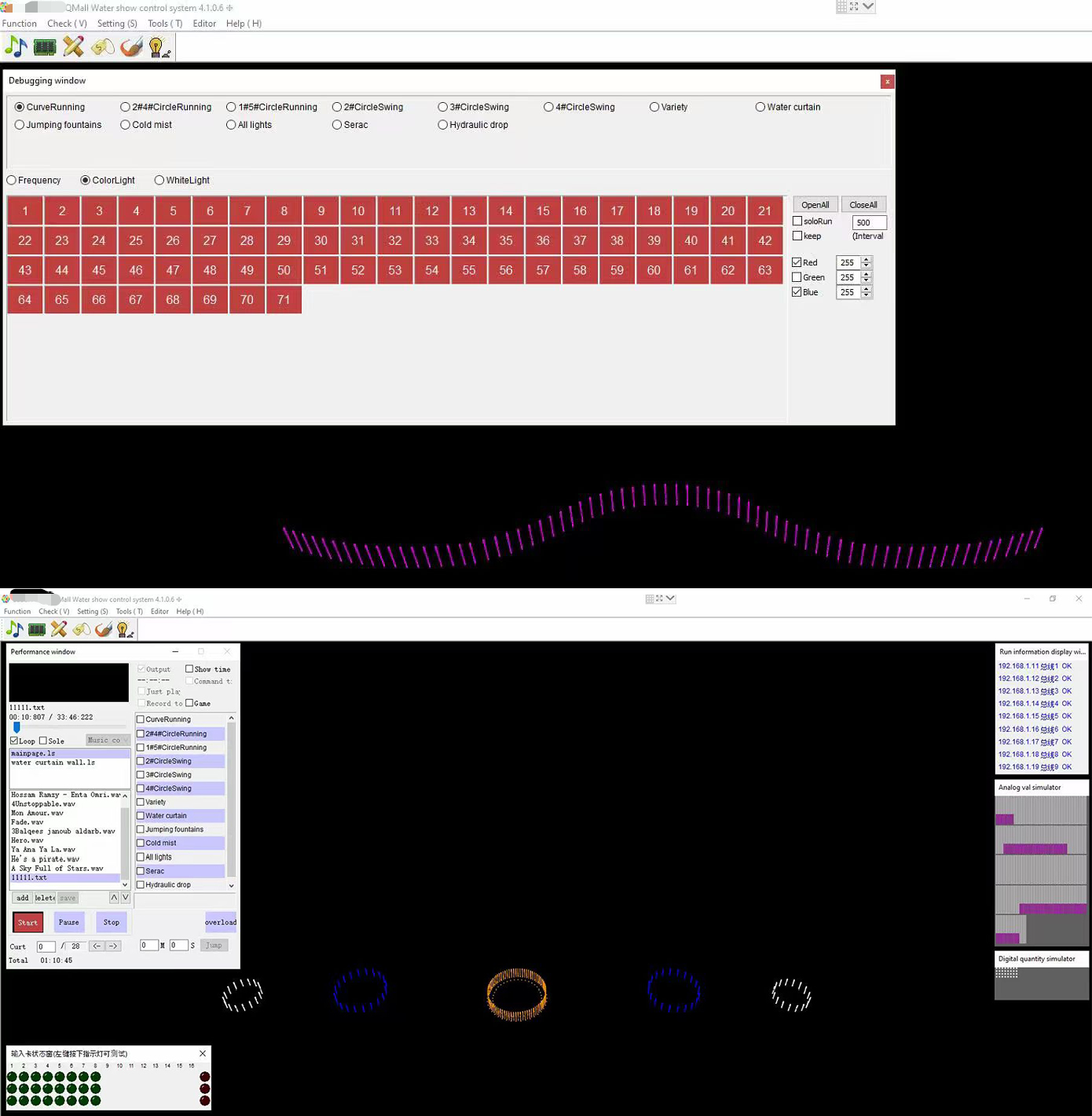
Redundancy, however, should not be assumed from a feature list. Three contract items protect the operator: a stored backup of every show programme with a stated version-control method; a documented failback mode describing what the system does when one controller, zone or lighting group drops out; and a training record showing that site staff can restore a programme without waiting for remote support. Sensor-driven safeguards for wind and water level belong in the same document, because they change show behaviour automatically and must be understood before acceptance, not after.
Maintenance contracts and spare-part strategy
Rainbows Fountain provides a two-year warranty and recommends signing warranty and maintenance agreements that specify response arrangements and spare-part strategies; spare parts packages are available as part of the installation scope. For the buyer, the commercial value lies in what the agreement fixes: which components are held as spares, how a failure is reported, what response is committed, and whether the operator or the supplier performs first-line intervention.
Equipment lead time is another term worth pinning down. Rainbows Fountain quotes 15 to 45 days depending on project scale and customisation, with a minimum order quantity of one unit and monthly capacity of 30 units. Spare-part lead time is a separate number and should be negotiated separately — a replacement pump ordered on standard production lead time is not a maintenance strategy for a nightly show.
Where this approach has limits
- Parameters cannot be fixed in advance. Nozzle lift, pump head, flow rate and lighting configuration are project-specific and require site-level confirmation; a buyer asking for a binding datasheet before a site survey is asking for a number the supplier cannot responsibly guarantee.
- There is no universal fountain acceptance standard. Acceptance criteria must be drafted per project from design intent, which is why the protocol table above is contractual rather than normative.
- Certificates are scoped. The CE certificate covers the EU machinery-safety framework and expires on 2027-05-18; the Ethiopia PVOC certificate is valid for customs clearance in Ethiopia only and expires on 2026-12-12. Neither substitutes for host-country requirements elsewhere.
- Evidence gaps exist for North America. The current evidence set does not include US-specific requirements such as NEC Article 680 or UL 379, so a North American project needs separate verification before the electrical design is frozen.
- Factory testing is not site testing. Pool verification confirms equipment and programming logic, not installed hydraulic performance.
Application fit: which configuration raises which risk
Venue type changes the risk profile, and therefore the terms. A City Square Musical Fountain or other large outdoor dancing fountain concentrates risk in audience safety and electrical protection, so earthing records and barrier design belong in acceptance. A Lake Floating Musical Dancing Fountain adds anchoring, buoyancy and access risk, making the floating structure and maintenance access part of the scope. A Hotel Musical Fountain or Pool Musical Fountain usually prioritises finish quality and noise, so the stainless steel grade and acoustic specification matter more than jet height.
Interactive formats shift the constraint again: a Dry Deck Interactive Musical Fountain requires the safety case for public contact with water and nozzles, while a Water Screen Projection Musical Fountain or broader multimedia laser musical fountain adds projector, laser and content deliverables that are often omitted from a fountain quotation entirely. Specifying the venue first, then the effect list, then the acceptance items, keeps the commercial scope aligned with the actual operating risk.
Market context: control-heavy systems and documentation as a differentiator
Two data points frame the procurement environment. First, cost benchmarking remains coarse: the same 2026 estimate places a medium outdoor plaza fountain between USD 300,000 and 1.5 million, a range too wide for budgeting without a defined scope. Second, one research estimate puts growth in the music fountain control system segment at 8.01% CAGR for 2025–2032, faster than growth in physical fountain scale, which suggests spend is shifting toward control, programming and multimedia integration rather than toward larger structures alone.
For buyers, the implication is that documentation quality becomes a selection criterion. A supplier able to hand over certificate numbers, test records, as-built drawings, programme backups and a written spare-part list is easier to audit — and easier to replace — than one offering a lower price with an undocumented scope.
Future outlook
Procurement of large musical fountains is moving from equipment purchase toward managed performance. Three trends support that direction: control-system value growing faster than structural value, public-sector buyers requiring clearer safety and compliance files, and operators demanding documented failback because a nightly show cannot tolerate open-ended diagnosis. Suppliers with traceable components from established brands, ISO 9001 certified production, and a track record across more than 50 countries are better positioned to answer those demands — Rainbows Fountain reports more than 4,500 completed projects, an export share of about 80%, and key components sourced from ABB, Rexroth and Schneider.
The practical consequence for a 2026–2027 project is straightforward: write the acceptance protocol before signing, not after commissioning begins.
FAQ
What documents should be attached to a musical fountain purchase order?
A purchase order should reference the approved design drawings, the nozzle schedule, the pump schedule with head, flow and power per unit, the lighting and control schedule, the material grade per component, the compliance certificates with their scope and expiry dates, and the acceptance protocol. Rainbows Fountain documentation shows the pattern: CE certificate M.2022.206.C73820 under Machinery Directive 2006/42/EC with standards EN ISO 12100:2010 and EN 60204-1:2018, plus Ethiopia PVOC certificate ETH2000000501 with its own standards list and validity window.
How are nozzle lift, flow rate and pump power fixed before a quotation is issued?
They are fixed through a site-specific hydraulic design rather than a standard datasheet. Nozzle lift defines the required head, flow per nozzle defines total demand, and pump power follows from both. Rainbows Fountain works within a supported nozzle lift range of 1 m to 100 m and a pump power range of 1.5 kW to 110 kW, but the actual values for a project require confirmation at project level after site conditions and the effect list are known.
What does factory pre-testing cover before shipment?
Factory pre-testing verifies equipment and programming logic. In Rainbows Fountain’s demonstration pool, engineers check water patterns, nozzle performance, lighting synchronisation and control programs; control cabinets are wired, labelled and functionally inspected for PLC programming, circuit safety, communication and synchronised pump and lighting control. The company reports 100% testing before loading, factory inspection and the option of third-party inspection by SGS, TUV or INTEK. Site hydraulics, wind exposure and water quality are not reproduced in a factory basin.
What should an acceptance protocol include for a musical fountain?
It should pair each acceptance item with an evidence type: measured jet height against design nozzle lift, a recorded run of the full programme set with audio, lighting and laser, protective earthing and continuity records with protective device settings, inspection records for IP68 underwater components and cabinet sealing, a documented reaction to a simulated controller or zone failure, and a documentation package containing as-built drawings, manuals, training sign-off and the spare parts list. Items that cannot be measured on site belong in the warranty section instead.
How should show-synchronisation failure be handled if part of the system drops out?
It should be handled by contract rather than by assumption. The specification should require a stored backup of every show programme with a stated version-control method, a written failback description of system behaviour when a controller, zone or lighting group is lost, and operator training sufficient to restore a programme locally. Rainbows Fountain control scope includes DMX512 and PLC intelligent linkage, time scheduling, remote monitoring, and wind speed and water level sensor inputs, all of which affect automatic show behaviour and should be documented before acceptance.
Which certifications matter in musical fountain procurement, and what do they actually cover?
Two certificates appear in Rainbows Fountain’s documentation, and each has a defined scope. CE certificate M.2022.206.C73820, issued by UDEM under Machinery Directive 2006/42/EC, cites EN ISO 12100:2010 and EN 60204-1:2018, applies to the EU market, covers the water fountain series, and is valid from 2022-05-19 to 2027-05-18. Ethiopia PVOC certificate ETH2000000501, issued by TÜV Rheinland Guangdong Ltd., covers electrical and electronic products, is valid only for customs clearance in Ethiopia, and runs from 2026-06-12 to 2026-12-12.
What should a maintenance and spare-parts agreement specify?
It should specify which components are held as spares, how failures are reported, what response is committed and who performs first-line intervention. Rainbows Fountain provides a two-year warranty, supplies spare parts packages within the installation scope, and recommends signing warranty and maintenance agreements that define response and spare-part strategies. Equipment lead time of 15 to 45 days depending on project scale should be distinguished from spare-part lead time, which needs its own negotiated figure.
What are the limits of the available evidence for a North American project?
The evidence set used here does not include US-specific requirements such as NEC Article 680 or UL 379. CE certification under Machinery Directive 2006/42/EC addresses the EU framework, and Ethiopia PVOC addresses Ethiopian customs clearance only. A North American project therefore needs separate verification of electrical and safety requirements before the design is frozen, and any supplier claim about US compliance should be supported by documentation specific to that market.
For readers who need the underlying product and project documentation, the 2026 Rainbows Fountain brochure is available as a public download: 2026 Rainbows Fountain brochure (PDF).
Have Questions or Need More Details?
Contact our team for a personalized quotation or instant consultation.
Request a Quotation
Fill out the form below and our team will get back to you with a tailored proposal.
WhatsApp Direct Chat
Prefer to chat in real-time? Message us on WhatsApp for instant assistance & quick answers.
- Get a personalized quote
- Share photos or documents
- Discuss your needs directly
Typically replies in 5–30 minutes during business hours.