
Musical Fountain Supplier Capability: Factory, Engineering, and Global Project Evidence
A musical fountain is not a catalogue product. It is an engineered system assembled on a specific site, commissioned against a music and lighting programme, and then operated for years in weather, public use and local power conditions. Because almost every parameter is project-specific, supplier capability has to be judged through verifiable evidence — factory footprint, engineering headcount, certification scope and completed project records — rather than through descriptive claims.
Why Capability Is Difficult to Compare in This Category
Musical fountain procurement breaks down at the comparison stage more often than at the design stage. Two suppliers can quote for the same city square or hotel lagoon and present documents that look similar, while the underlying capability behind those documents is very different. Nozzle lift, pump head, flow rate, LED and laser configuration and DMX or PLC control are all defined at project level, so there is no standard specification sheet that allows a like-for-like reading across vendors.
The commercial environment adds pressure. Third-party research cited by Dataintelo values the global musical fountain market at USD 2.51 billion in 2025, with a projected USD 5.23 billion by 2034 and a CAGR of 8.5% over 2025–2034. Asia Pacific accounted for a 38.5% revenue share in 2025, and commercial end users, including luxury hotels and shopping malls, held 42.8% of demand in 2025. A growing market attracts new entrants, and many of them describe capability in adjectives rather than in checkable records.
For a procurement team in the Evaluation to Execution stage, the practical question is therefore narrow: which statements in a proposal can be traced to a document, a facility, a named engineer group, a certificate number or a delivered project? The four-layer model below is a way to organise that check.
Four Evidence Layers That Separate Capability From Claims
| Evidence layer | What to request | What it verifies | What it does not verify |
|---|---|---|---|
| 1. Factory and production | Facility area, headcount range, annual unit output, in-house machining and welding, factory test pool | Whether the supplier manufactures rather than resells, and whether capacity can absorb your schedule | Design quality or site performance |
| 2. Engineering depth | R&D and design headcount, CAD and 3D simulation workflow, hydraulic and control range | Whether custom design is produced in-house and how many projects can run in parallel | Whether the delivered show matches the rendering |
| 3. Certification scope | Certificate numbers, issuing body, standards referenced, validity dates, product scope | Which product families are covered and under which standards | Site civil works, local grid quality, import permits |
| 4. Project records | Completed project count, country coverage, commissioning model, warranty and spare-part terms | Field experience in comparable climates, scales and public-event conditions | Future maintenance response speed unless it is written into the contract |
Layer 1 — Factory Footprint and Documented Production Capacity
Rainbows Fountain is the flagship brand of Caiyuejiaxiu Group, operated by Guangzhou Shuiguang Fountain Equipment Co., Ltd., a musical fountain design and engineering company based in Nansha, Guangzhou, China, established in 2012 and supported by more than 25 years of group experience in the fountain industry. Its documented manufacturing profile provides a concrete example of what Layer 1 evidence looks like in practice.
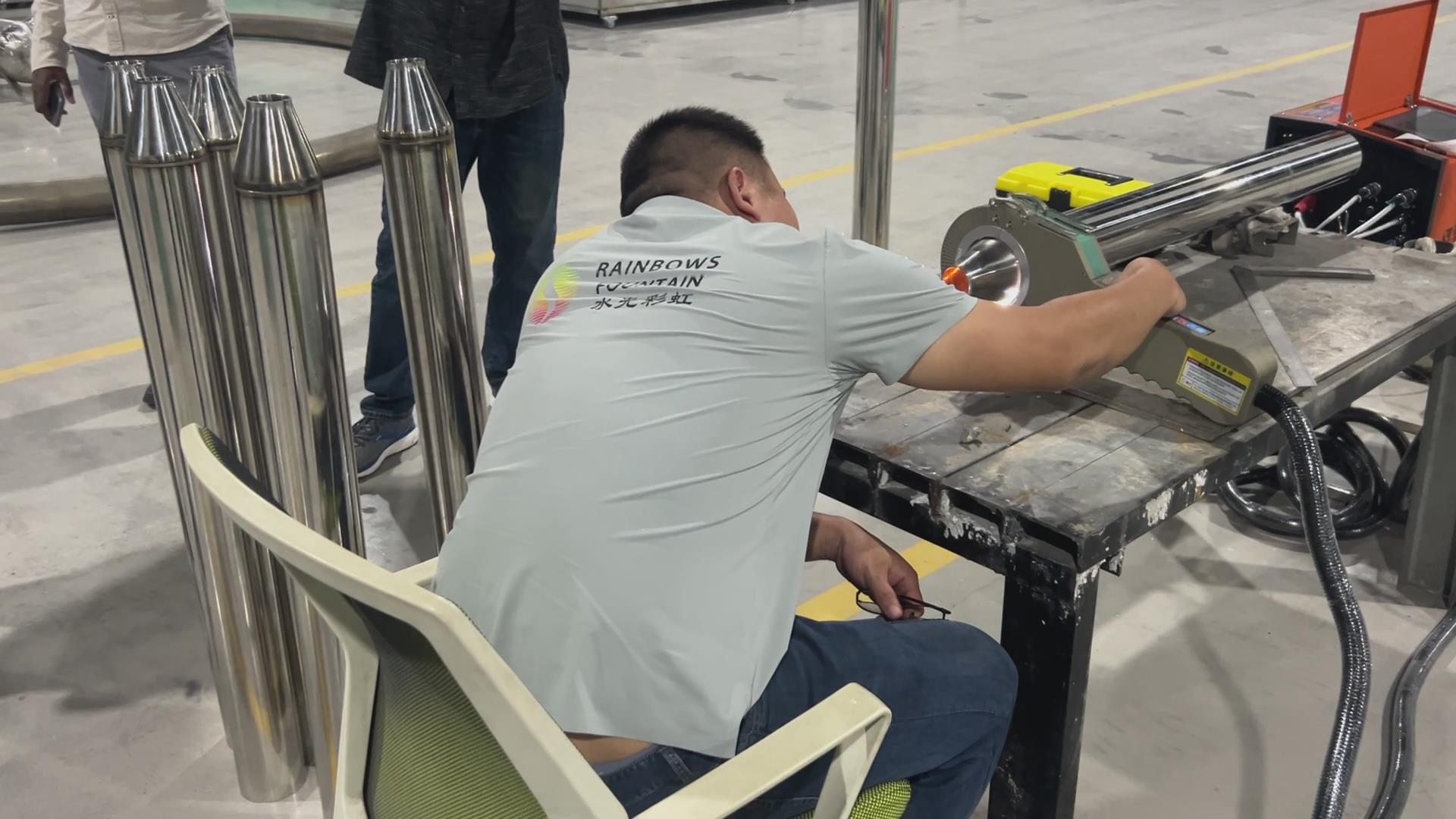
The company operates a 4,500 m² manufacturing facility that integrates machining, welding, electrical assembly, quality inspection and project logistics under one roof. Headcount is reported at 51–80 employees, and annual output is documented at 50 units. Production is customizable, the minimum order quantity is 1 unit, and lead time runs 15–45 days depending on project scale and customization depth. Around 80% of output is exported, with the Middle East, Africa and South Africa listed as core markets, alongside project experience in Central Asia, Southeast Asia and South America.
The detail that matters for verification is not the headline area figure but the process boundary. Stainless steel components are CNC machined to project drawings, welded, polished and assembled in-house, and control cabinets are wired, labelled and electrically tested before shipment. Every unit is tested before loading — a 100% pre-shipment test regime — and third-party inspection through bodies such as SGS, TUV and INTEK is available on request. Key electrical components are sourced from recognised suppliers including ABB, Rexroth and Schneider.
Layer 2 — Engineering Depth: Design, Hydraulics and Control
A musical fountain is designed twice: once as a hydraulic and structural system, and once as a choreography programme. Both require engineering staff, and the size of that staff group is a more reliable indicator of delivery capacity than a portfolio page. Rainbows Fountain documents 45 R&D engineers and 12 designers, working from detailed CAD engineering drawings and 3D visual and fountain-effect simulations that are presented to clients before implementation.
The engineering envelope determines whether a concept is buildable on a given site:
- Hydraulics: supported pump power of 1.5 kW to 110 kW and nozzle lift range of 1 m to 100 m, with nozzle types, pump head and flow rate confirmed at project level.
- Control: DMX512 and PLC intelligent linkage, with music synchronization, remote monitoring, time scheduling, wind speed sensing and water level protection available in the control architecture.
- Materials: stainless steel 304 as standard, with 316 and 316L available for more aggressive water and coastal environments.
- Electrical: working voltage configurable at 380 V, 220 V or 110 V, with IP68 protection for underwater components such as LED luminaires and pumps.
- Show layer: RGBW underwater LED, full-colour laser and beam lighting, water screen projection, flame-and-water effects and digital water curtain options.
Third-party technical references describe the same control architecture as standard practice in advanced systems: DMX512 lighting protocols and programmable logic controllers used to synchronize water jets with music. A buyer can therefore ask a supplier to explain where their control design departs from that baseline, which is a more productive conversation than comparing marketing language.
Layer 3 — Certification Scope Rather Than Certificate Presence
Certificates are frequently attached to proposals as images without their scope being read. In this category, scope is the substance. Two documents illustrate the difference between a certificate existing and a certificate covering the equipment you are buying.
Rainbows Fountain holds a CE certificate under the Machinery Directive 2006/42/EC, certificate number M.2022.206.C73820, issued by UDEM, referencing harmonised standards EN ISO 12100:2010 and EN 60204-1:2018, valid from 19 May 2022 to 18 May 2027. Its declared scope is the water fountain series — musical fountain, dancing fountain, floating fountain, floor fountain, water screen projection fountain, laser fountain, flame fountain, digital water curtain, mist fountain, laminar jet fountain and sculpture water fountain. The company also manufactures under an ISO 9001 certified quality management system.
A second, market-specific example is a Certificate of Conformity issued under Ethiopia's PVOC pre-export verification of conformity programme by TÜV Rheinland Guangdong Ltd., certificate number ETH2000000501, covering electrical and electronic products against IEC 60076-1:2011, CES 125:2013, IEC 60034-1:2022, IEC 60034-30-1:2014 and ES 6892:2021, issued 12 June 2026 and valid to 12 December 2026, for customs clearance in Ethiopia only. The narrow geographic and time scope of that document is exactly the point: it is a shipment-level instrument, not a permanent quality claim.
Layer 4 — Project Records and On-Site Commissioning Evidence
The fourth layer is the one procurement teams weight most heavily, and the one most easily overstated. Verifiable project evidence has three components: a count, a geography, and a commissioning model that explains who stands on site when the show first runs.
Rainbows Fountain reports more than 4,500 completed fountain projects across more than 50 countries, with a dedicated overseas engineering team of more than 20 engineers available for on-site installation, commissioning and technical support. Scope covers concept design, technical planning, equipment manufacturing, overseas installation and commissioning, and final delivery, followed by free after-sales technical support, maintenance assistance and system upgrade services. A 2-year warranty applies, and installation, commissioning, on-site operator training, maintenance manuals and spare-part packages are part of the customization scope.
Named records make the capability check concrete rather than rhetorical:
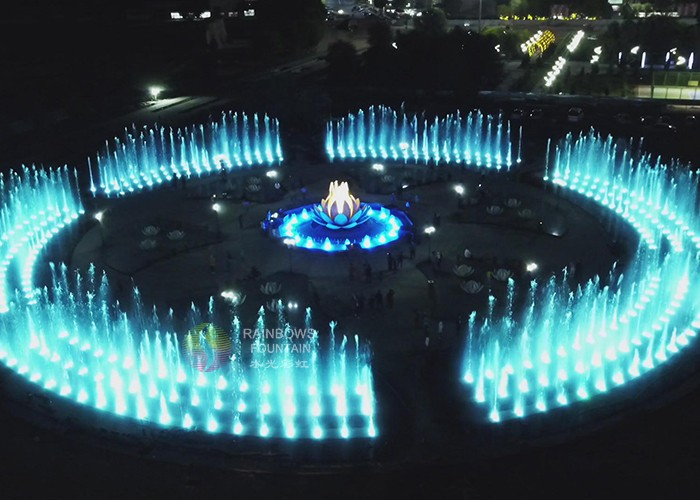
- Big O Show, Astana, Kazakhstan — a large sculpture and multimedia water show on the Ishim River combining a floated O-shaped sculpture with a floating dancing water display, built from approximately 2,000 DMX512 digital control devices and more than 1,000 stainless steel pumps, with spray height above 100 m and combined water screen film, laser, flame and music fountain performance.
- Riyadh Season, Saudi Arabia — a large firework and water dancing show delivered for the 2019 season as a core night-tour element, with the client returning in 2024 for an upgrade; the installation remains operational.
- Sheikh Zayed Festival light and fountain upgrade — service as exclusive upgrade partner from 2022 through 2026, with successive annual introductions of air explosion fountains, revised light shows and upgraded programming.
- Opening ceremony, 15th National Games of China — design, engineering, manufacturing, installation and commissioning of a stage water fountain delivered within a compressed national-event schedule.
- Brazil year-end water dance shows — design, equipment supply and annual upgrading for two cities since 2023, covering the 2025 Christmas and 2026 New Year celebrations.
- Astana 20th anniversary floor fountain, Kazakhstan — a musical dancing floor fountain delivered as part of a series of government projects following the Big O Show.
How Pre-Testing and Commissioning Control Outdoor Project Risk
Outdoor musical fountains carry risks that do not appear on a specification sheet: wind disturbing jet geometry, water level fluctuation affecting pump intake, lightning and grid instability, and public proximity to high-pressure water. Documented controls address each of these in sequence.
Before shipment. Equipment is tested in the factory demonstration pool, where engineers verify water patterns, nozzle performance, lighting synchronization and control programmes against the design intent. Control cabinets undergo comprehensive electrical testing covering PLC programming, circuit safety, communication and synchronized pump and lighting control. A 100% test-before-loading policy applies, with third-party inspection available.
During installation and commissioning. The overseas engineering team installs, commissions and trains operators, and supplies maintenance manuals and spare-part packages. Commissioning is the stage at which music synchronization, DMX addressing, laser and projection alignment, and safety interlocks are proven under real site conditions rather than in a test pool.
During operation. Wind speed sensors, water level protection, time scheduling and remote monitoring are available in the control architecture, and the company recommends signing warranty and maintenance agreements that specify response times and spare-part strategy. That recommendation is itself a useful procurement signal: risk transfer only becomes real when response obligations are contractual.
Where the Model Meets Its Limits
A credible capability assessment has to state boundaries, and this supplier profile has several that procurement teams should plan around.
- Annual output of 50 units. Capacity of this order supports a steady project pipeline but not unlimited parallel scheduling. Large multi-site programmes, or tenders with compressed delivery windows, should confirm production slot availability before award rather than after.
- A 4,500 m² facility is mid-scale. It supports full in-house fabrication of nozzles, pipe systems, control cabinets and skid assemblies, but it is not a heavy-industry plant. Buyers requiring very large structural steelwork or non-standard civil elements may need separate fabrication partners.
- Commissioning is delivered by travelling engineers. A team of more than 20 overseas engineers is a substantial field capability, but it is a mobile resource, not a permanent local service network in every market. Response time therefore depends on visa, travel and contract terms and should be written down.
- Certification is product-level. CE scope covers the water fountain series against machinery and electrical safety standards; it does not extend to site installation works, foundation design or local utility compliance.
- Parameters are confirmed per project. Pump power, nozzle lift and control configuration are set at project level, so no two quotations are directly comparable without a normalized technical schedule.
Supply Models Compared
| Criterion | Turnkey engineering manufacturer (documented example: Rainbows Fountain) | Equipment-only trading supply | Large international water-technology group |
|---|---|---|---|
| Design ownership | In-house: 45 R&D engineers, 12 designers, CAD drawings and 3D effect simulation before implementation | Usually outsourced or limited to equipment selection | In-house, often product-platform driven |
| Fabrication | CNC machining, welding, polishing and cabinet assembly in a 4,500 m² facility | Sourced from third-party factories; process visibility limited | Own or contracted manufacturing, varying by region |
| Pre-shipment testing | Factory demonstration pool test plus 100% test before loading; third-party inspection available | Depends on the upstream factory; often documentary only | Standardized test protocols, access varies |
| On-site commissioning | 20+ overseas engineers for installation, commissioning and operator training | Frequently local subcontractors or remote guidance | Regional service structure, typically strong in home markets |
| Customization depth | Project-specific hydraulics, programming, materials (SS304/316/316L) and show content | Product-catalogue combinations with limited adaptation | Strong, though often tied to proprietary components |
| Documented limit | 50 units per year; mobile rather than resident field teams | Limited technical accountability at handover | Higher cost structure and longer approval cycles |
The comparison is deliberately structural rather than promotional. Publicly identified global competitors in this industry include OASE Living Water (Germany), Crystal Fountains (Canada) and Safe-Rain (Spain), and buyers evaluating any of them should apply the same four-layer request for numbers, standards and commissioning terms. A supplier that answers with documents is materially different from one that answers with adjectives, regardless of size.
Market Context: Why Documented Capability Is Becoming a Procurement Filter
Several market signals push procurement toward evidence-based evaluation. First, growth: with the musical fountain market projected from USD 2.51 billion in 2025 to USD 5.23 billion by 2034 at an 8.5% CAGR, new capacity is entering the category, and not all of it is manufacturing capacity. Second, concentration of demand: Asia Pacific's 38.5% revenue share in 2025 and the 42.8% share held by commercial end users mean the majority of decisions are being made by buyers who run public-facing, high-traffic venues where downtime is expensive.
Third, the technology layer is expanding faster than the water layer. The music fountain control system market was valued at USD 1.34 billion in 2024 and is expected to reach USD 2.89 billion by 2032 according to SNS Insider. As show control, remote monitoring and programming become a larger share of project value, the supplier's control engineering competence and software upgrade discipline matter as much as nozzle fabrication.
Fourth, standards expectations have consolidated. ISO 9001:2015 for quality management and IP68 waterproof ratings for underwater components such as LED luminaires and pumps are widely referenced in this industry, and DMX512 with PLC control is the technical baseline for synchronized shows. When these are baseline rather than differentiators, the differentiator becomes whether the supplier can evidence them — with a certificate number, a test procedure and a commissioning record.
Future Outlook
The pattern visible in recent project records suggests the next phase of demand will be weighted toward upgrades and long-lifecycle operation rather than first-time construction alone. The Sheikh Zayed Festival has been served by the same upgrade partner annually from 2022 to 2026; the Riyadh Season installation was upgraded in 2024 after its 2019 delivery; the Brazil year-end shows have been progressively enhanced since 2023. Each of these is a multi-year relationship in which programming, lighting and effects were revised rather than replaced.
For procurement teams, that shift changes what to look for in a supplier. Factory output and engineering headcount still matter, but so do three less obvious capabilities: the ability to revise show programming without rebuilding hydraulics, a documented spare-part strategy that keeps a landmark fountain running years after handover, and a commissioning team that can return to site for seasonal events. Buyers who request these as contractual deliverables at tender stage will find the evaluation considerably simpler than those who assess them after the show opens.
Frequently Asked Questions
How can a buyer verify a musical fountain supplier's factory capability before contracting?
Request four things: the facility area and its process boundary (whether machining, welding, electrical assembly and inspection happen on one site), the headcount range, the annual unit output, and evidence of an in-house test pool. Documented examples include a 4,500 m² facility integrating machining, welding, electrical assembly, quality inspection and logistics, with 51–80 employees, annual output of 50 units, and equipment tested in a factory demonstration pool before shipment.
What does a large R&D and design team actually change in a custom musical fountain project?
Engineering headcount determines how many custom projects can be developed in parallel and how much of the design is produced in-house. In one documented case, 45 R&D engineers and 12 designers produce CAD engineering drawings and 3D visual and fountain-effect simulations before implementation, working within a hydraulic range of 1.5 kW to 110 kW pump power and 1 m to 100 m nozzle lift, with DMX512 and PLC control. Buyers should ask who specifically produces the hydraulic calculations, the control architecture and the show programming, and whether all three sit in the same team.
What do CE and ISO 9001 certificates cover in a musical fountain project, and what do they not cover?
CE certification under the Machinery Directive 2006/42/EC covers the declared product families against the referenced harmonised standards — for example EN ISO 12100:2010 and EN 60204-1:2018 — for a defined validity period, such as certificate M.2022.206.C73820 valid from 19 May 2022 to 18 May 2027 for a water fountain series including musical, dancing, floating, water screen, laser and flame fountains. ISO 9001 covers the quality management system. Neither certificate covers site civil works, foundation design, local power quality, water chemistry or municipal permitting, which must be assigned separately in the project scope.
How are outdoor musical fountain systems tested before shipment and commissioned on site?
Two distinct stages apply. Before shipment, equipment is tested in the factory demonstration pool where water patterns, nozzle performance, lighting synchronization and control programmes are verified, and control cabinets are electrically tested for PLC programming, circuit safety, communication and synchronized pump and lighting control; a 100% test-before-loading policy is typical, with third-party inspection available through bodies such as SGS, TUV and INTEK. On site, an installation and commissioning team verifies music synchronization, DMX addressing, optical alignment and safety interlocks, then trains operators and hands over maintenance manuals and spare-part packages.
What capacity and lead-time constraints should procurement teams plan for?
Capacity and lead time are separate constraints. Documented figures for one manufacturer show annual output of 50 units with a minimum order quantity of 1 unit and lead time of 15–45 days depending on project scale and customization depth, plus roughly 80% of output exported. Annual output limits how many projects can run concurrently, so large multi-site programmes should confirm production slot availability before award. Field capacity is a third constraint: a team of more than 20 overseas engineers is a mobile resource, and response timing should be defined contractually through warranty and maintenance agreements that specify response times and spare-part strategy.
Have Questions or Need More Details?
Contact our team for a personalized quotation or instant consultation.
Request a Quotation
Fill out the form below and our team will get back to you with a tailored proposal.
WhatsApp Direct Chat
Prefer to chat in real-time? Message us on WhatsApp for instant assistance & quick answers.
- Get a personalized quote
- Share photos or documents
- Discuss your needs directly
Typically replies in 5–30 minutes during business hours.