
Musical Fountain Supplier Sustainability: The 20-Year Test
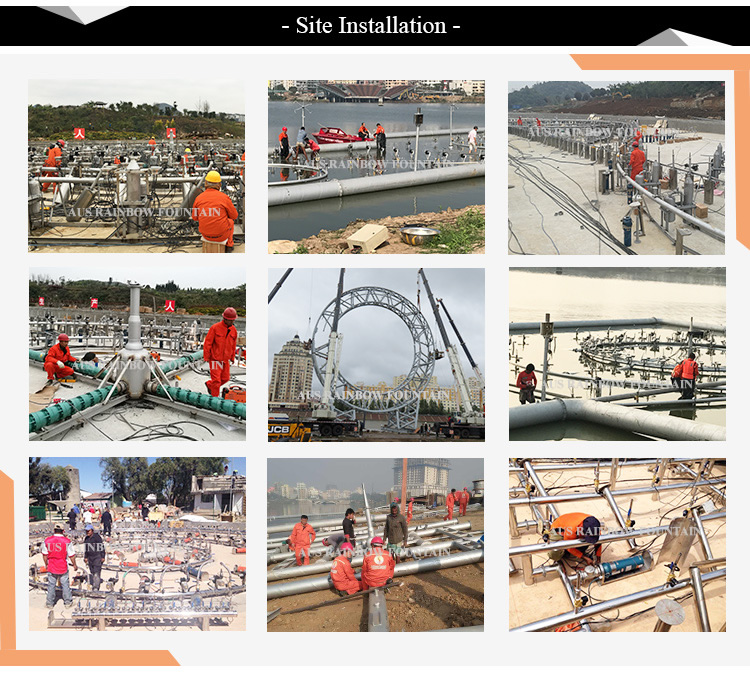
On-site installation and commissioning: the stage at which a musical fountain supplier's long-term obligations actually begin.
A musical fountain is purchased as a capital project and operated as public infrastructure. A city square fountain, a theme park water show or a resort's nightly programme is normally expected to run for ten to twenty years — through pump replacement cycles, controller generations, music repertoire changes and at least one major upgrade. That time horizon is what turns supplier sustainability into a procurement question rather than a matter of brand preference.
Why Supplier Sustainability Became a Procurement Question
The musical fountain market is expanding, and the expansion itself is what makes lifecycle planning urgent. Dataintelo values the global musical fountain market at USD 2.51 billion in 2025 and projects USD 5.23 billion by 2034, representing a compound annual growth rate of 8.5% over the same period. Asia Pacific accounted for a 38.5% revenue share in 2025, and commercial end users — luxury hotels, shopping malls and comparable venues — held the largest single end-user share at 42.8%.
Those numbers describe installations. They do not describe the maintenance liability those installations create. Every commissioned musical fountain adds a ten-to-twenty-year obligation for spare parts, show programming, control-system support and periodic refurbishment. The control layer alone reflects the same dynamic: SNS Insider values the music fountain control system market at USD 1.34 billion in 2024, with a projected USD 2.89 billion by 2032.
Market sizing should also be read by scope rather than headline. Published figures diverge considerably: a comprehensive musical fountain market estimate sits near USD 2.51 billion, while narrower water-show segment estimates have been placed closer to USD 0.22 billion. Buyers using market data in a business case should confirm which segment the figure covers before citing it internally.
The practical consequence
When an installed base grows faster than the pool of engineers trained to service it, the supplier selected during evaluation becomes the de facto maintenance authority for the asset. Evaluation criteria therefore shift from unit price and visual ambition toward production depth, engineering ownership, documented conformity and contractual after-sales continuity.
What "Capacity" Actually Means in a Musical Fountain Contract
Capacity claims are frequently compressed into a single number. In practice, three distinct capabilities sit behind the word, and each one carries a different risk profile for the buyer.
1. Physical production footprint
RAINBOWS FOUNTAIN, the flagship brand of Caiyuejiaxiu Group, is a musical fountain design and engineering company based in Nansha, Guangzhou, China, with more than 25 years of experience in the fountain industry. The company operates a 4,500 m² manufacturing facility with a workforce of approximately 51–80 employees and an annual output of about 50 fountain units.
2. Process coverage inside the plant
The more decisive question is how much of the system is produced under the supplier's own roof. The facility integrates CNC machining, stainless steel welding, polishing, pipe fabrication, electrical assembly and control cabinet assembly, supported by a factory testing pool where water patterns, nozzle performance, lighting synchronisation and control programmes are verified before shipment. Equipment is then packed into export-grade wooden crates and loaded to international shipping standards.
3. Schedule headroom
A 4,500 m² plant producing roughly 50 units per year implies an average unit cycle measured in weeks, not days. Quoted lead time for customised musical fountain projects is typically 15–45 days, with the exact figure depending on project scale and customisation depth. That is workable for a scheduled programme but becomes a genuine constraint when a buyer assumes several large projects can be absorbed simultaneously without extending delivery windows.
Engineering Depth: The Variable That Decides Year Ten
Most musical fountain failures that matter commercially are not mechanical. They are documentation failures. A pump can be replaced from a catalogue; a show programme, a hydraulic calculation or an as-built wiring diagram that no longer exists cannot. This is why in-house engineering depth, rather than factory size, is the better predictor of whether a fountain can still be serviced in year ten.
Rainbows Fountain maintains a design and engineering department of 45 R&D engineers and 12 designers — a technical core of 57 specialists inside an organisation of 51–80 people. The department produces detailed CAD engineering drawings alongside 3D visual and fountain effect simulations, allowing the final design and expected performance to be presented and confirmed before manufacturing begins. Design and engineering work is handled in-house rather than outsourced to third-party studios.
Installation capability is a separate resource. The company maintains a dedicated overseas engineering team of more than 20 engineers who travel to project sites for installation, commissioning and technical support, working across different regulatory environments and site conditions. For a buyer, the relevant question is not only whether such a team exists, but whether the same team's commissioning records are handed over as part of the acceptance file.
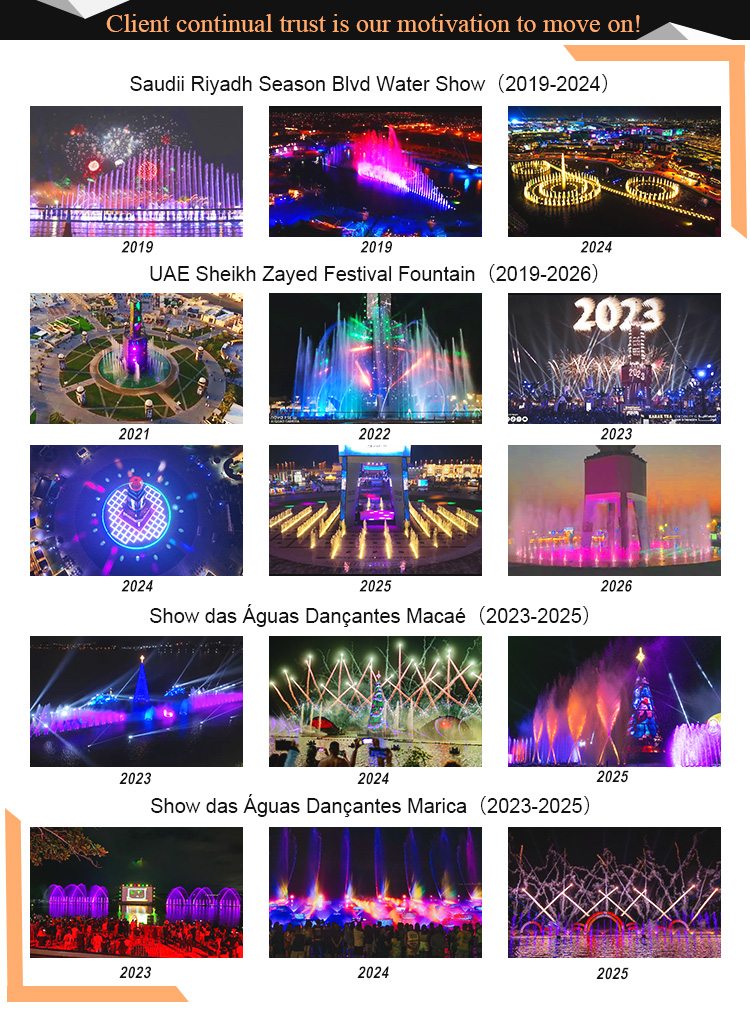
Repeat engagement and multi-year upgrades are among the few externally observable signals of after-sales continuity.
Certified Quality Management as Continuity Infrastructure
Certification is often presented as a marketing asset. Read against a twenty-year ownership period, it is closer to an insurance policy on replaceability. Documented standards mean a later maintenance contractor — possibly not the original supplier — can identify, match and substitute components without reverse-engineering the system.
Rainbows Fountain operates under an ISO 9001 certified quality management system, and its fountain equipment and components are CE certified. The CE certificate (M.2022.206.C73820) was issued by UDEM under the Machinery Directive 2006/42/EC against EN ISO 12100:2010 and EN 60204-1:2018, and covers the water fountain series including musical fountains, dancing fountains, floating fountains, floor fountains, water screen projection fountains, laser fountains, flame fountains, digital water curtains, mist fountains, laminar jet fountains and sculpture water fountains. The certificate is valid through 18 May 2027.
Market-specific conformity documentation matters where import clearance is a project dependency. As one example, a Certificate of Conformity (ETH2000000501) was issued by TÜV Rheinland Guangdong Ltd. under the Ethiopia PVOC pre-export verification of conformity programme, covering electrical and electronic products against IEC 60076-1:2011, CES 125:2013, IEC 60034-1:2022, IEC 60034-30-1:2014 and ES 6892:2021, and valid for customs clearance in Ethiopia through 12 December 2026.
Component sourcing reinforces the same principle. Key components are drawn from globally recognised suppliers including ABB, Rexroth and Schneider, and are traceable and compliant with international electrical and safety standards. Underwater components are specified to IP68 protection. Every unit undergoes 100% testing before loading, and factory inspection or third-party inspection through SGS, TUV or INTEK is available on request.
After-Sales Continuity: What Buyers Should Lock Into the Contract
Supplier commitment at tender stage rarely survives contact with year six unless it is written into enforceable documents. Rainbows Fountain provides a two-year warranty together with installation, commissioning, on-site training and maintenance support, and recommends that clients sign warranty and maintenance agreements that specify response and spare-part strategies. The company also provides after-sales technical support, long-term maintenance assistance and system upgrade services.
The mechanisms below are the ones owners can realistically define in a musical fountain contract. They are presented as buyer requirements for negotiation, not as statements about any single supplier's standard terms.
- Factory pre-testing with witnessed acceptance. Musical fountain components are typically verified in a factory testing pool before shipment. Buyers should require a documented test record covering water patterns, nozzle performance, lighting synchronisation and control programme execution, with remote witnessing or video evidence where travel is impractical.
- On-site commissioning with measurable acceptance criteria. Nozzle lift tolerances, flow rates, synchronisation accuracy between water, light and audio, and safety interlocks should be defined as pass/fail conditions rather than subjective descriptions.
- Acceptance documentation as an asset file. As-built drawings, control logic, show programming files, wiring schedules and equipment serial numbers should be handed over as a defined deliverable, not supplied informally.
- Maintenance contracts with stated response windows. A named response time, escalation path and reporting obligation is more useful than a general statement of support.
- Spare-part supply strategy. Critical items — pumps, underwater luminaires, nozzles, DMX nodes, control modules — should be listed with agreed lead times, and a recommended first-purchase spares package defined at handover.
- Programming redundancy and failback. Show files should be escrowed with the owner, and the control architecture should include a failback scheme in which the system reverts to a reduced but complete sequence if a controller, node or audio channel fails, rather than halting the show.
- Upgrade path and content ownership. The contract should state who may modify sequences, add music, or integrate new multimedia elements, and under what commercial terms.
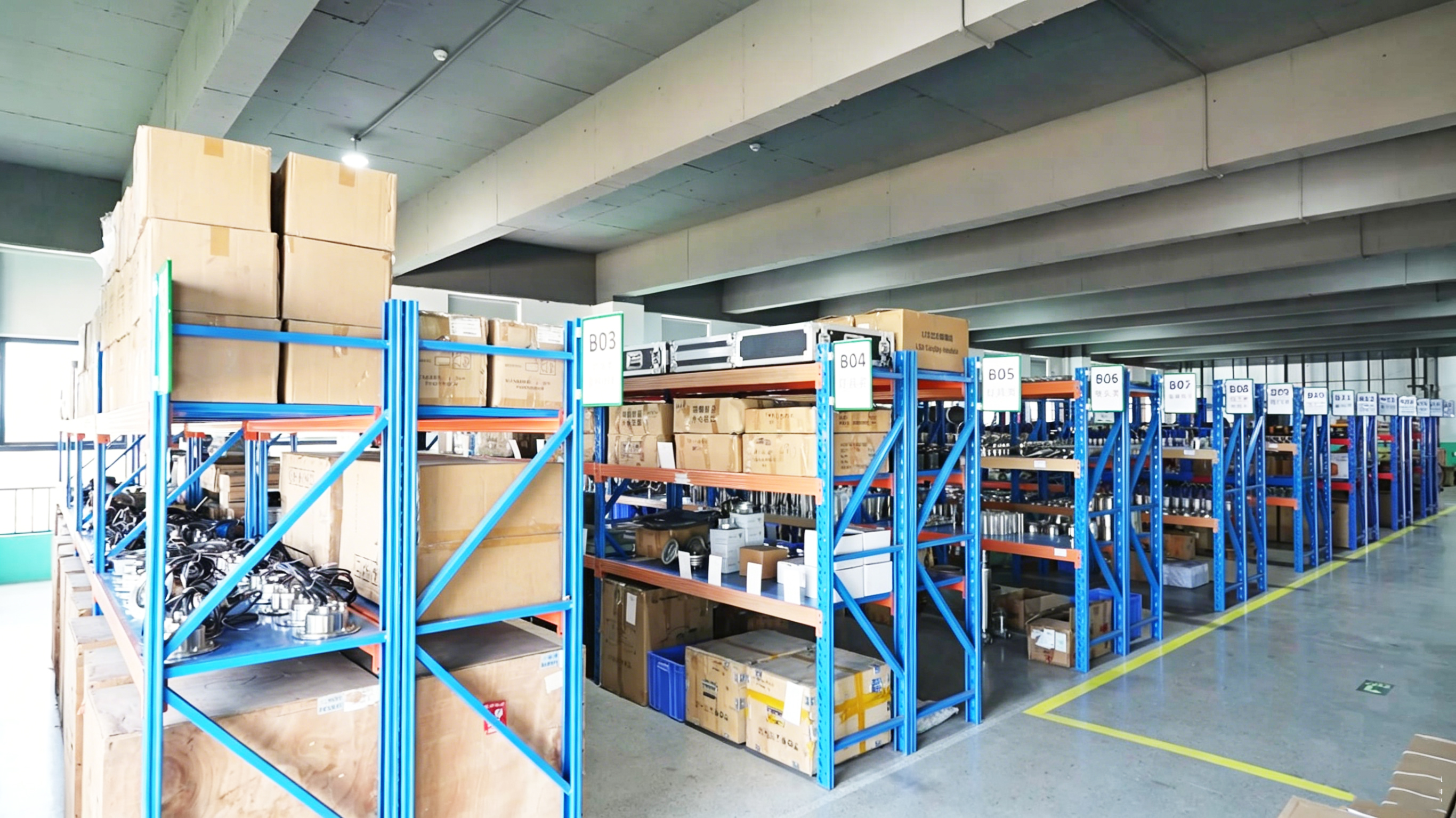
Component inventory: spare-part strategy depends on whether critical items are held, catalogued and traceable.
Reading a Project Record for Continuity Signals
A project count alone proves activity, not continuity. The more informative signal is repeat engagement — clients returning to the same supplier for upgrades, expansions or additional phases years after the original handover. Rainbows Fountain reports more than 4,500 completed fountain projects across more than 50 countries, with an export share around 80% and primary markets in the Middle East and Africa, alongside projects in Central Asia, Southeast Asia and South America, including Saudi Arabia, the UAE, Kuwait, Kazakhstan, Turkmenistan, Kyrgyzstan, Ethiopia, the Philippines and Brazil.
Several references illustrate the repeat-engagement pattern:
- The 2019 Riyadh Season large musical fountain show in Saudi Arabia was upgraded again by the same supplier in 2024 and remains in operation — a five-year-plus continuity span on a single asset.
- The Sheikh Zayed Festival light and fountain upgrade has been delivered as an annual upgrade programme running from 2022 through 2026, introducing new effects and a revised programming system each cycle.
- The Big O Show multimedia musical fountain on the Ishim River in Astana, Kazakhstan, uses more than 2,000 DMX512 digital signal control devices and more than 1,000 stainless steel pumps, with spray heights exceeding 100 m, combining water screen projection, laser, fire and music-synchronised performance.
- Year-end and New Year water dance shows in two Brazilian cities have been designed, supplied and annually upgraded since 2023.
- Rainbows Fountain delivered the Stage Water Fountain for the opening ceremony of the 15th National Games of China, covering design, engineering, manufacturing, installation and commissioning under a compressed schedule.
For buyers, the pattern matters more than the individual projects. Multi-year upgrade relationships imply that the supplier's documentation, control architecture and spare-part logic remained usable long after commissioning — which is precisely the condition that a twenty-year ownership period tests.
Matching the Supplier Model to the Venue
Continuity requirements differ by venue type, and evaluation should be weighted accordingly.
- City square musical fountains operate in high-footfall public space with limited maintenance access windows. Wind speed sensing, water level protection and time scheduling become operational necessities rather than options, and public-safety documentation matters as much as visual performance.
- Theme park and scenic multimedia shows depend on frequent content refresh. Water screen projection, DMX LED laser configurations, fire-and-water effects and digital water curtains are typically integrated into a broader show-control environment, so programming ownership and update capability are central evaluation criteria.
- Hotels and resorts generally require smaller, quieter and more reliably scheduled installations — pool musical fountains or dry deck interactive fountains — where downtime is more visible to guests and maintenance must be unobtrusive.
- Lake and floating installations add anchoring, access and water-level variability to the maintenance equation, raising the value of remote monitoring and diagnostic support.
Lifecycle-Integrated Supply vs. Traditional Procurement
Traditional procurement splits a fountain into purchase lots: equipment from one vendor, installation by a local contractor, programming by a studio, maintenance by whoever is available. The lifecycle-integrated model consolidates design, manufacturing, commissioning and long-term support under one engineering entity. Neither approach is universally superior — they fail in different ways.
| Evaluation dimension | Traditional split procurement | Lifecycle-integrated supplier |
|---|---|---|
| Design ownership | Frequently external; as-built documentation may be incomplete | In-house design office produces CAD drawings and 3D effect simulations before manufacture |
| Accountability at handover | Interfaces between vendors become the fault line when faults appear | Single entity responsible for equipment, commissioning and acceptance |
| Factory verification | Component-level testing only; system behaviour proven on site | System-level testing in a factory pool before shipment |
| Spare parts and traceability | Dependent on local market availability | Documented component sourcing and defined spares strategy |
| Programming continuity | Content often locked to an individual contractor | Programming treated as a maintainable system with defined upgrade routes |
| Typical failure mode | Orphaned system; nobody owns the fine detail after year three | Higher upfront scope cost; dependency on one supplier's continuity |
Recognised participants in the global musical fountain industry include OASE Living Water (Germany), Crystal Fountains (Canada) and Safe-Rain (Spain), alongside Chinese engineering manufacturers such as Rainbows Fountain. The market remains fragmented, and comparative performance data across suppliers is not consistently published — which is itself an argument for evaluating documented capability rather than marketing positioning.
Where This Model Fits Less Well
An honest evaluation has to state the boundaries. Three are worth flagging before a buyer shortlists a lifecycle-oriented engineering supplier.
- Concurrent mega-project scheduling. A facility of 4,500 m² with an annual output of roughly 50 units and a workforce of 51–80 people cannot absorb an unlimited number of simultaneous large projects without extending delivery windows. Buyers planning phased or parallel installations should treat scheduling capacity as a contractual variable, not a given.
- Geographic service model. Support is delivered through a travelling overseas engineering team of more than 20 engineers rather than through regional service depots. For remote sites, response time depends on mobilisation and travel logistics; buyers should therefore contract explicit response windows instead of assuming local presence.
- Scope and cost fit. Where a project is a small, standardised decorative water feature with no show programming requirement and where lowest capital cost dominates the decision, the depth of a full engineering integrator may not represent the most efficient route. The lifecycle argument is strongest where content, synchronisation and long operating hours are part of the asset's purpose.
A related consideration is market-wide: adoption of documented standards such as ISO 9001 quality management and IP68 protection for underwater components is common but not uniform. Buyers should verify certificates directly — including issue and expiry dates — rather than accept them as generic assurances.
Market Trend Analysis
Three trends shape supplier evaluation over the next decade.
Control systems are becoming the value centre. Advanced musical fountains use DMX512 lighting protocols and programmable logic controllers to synchronise water jets with music, and the control-system segment is projected to roughly double in size between 2024 and 2032. As hardware commoditises, differentiation shifts toward software, show content and the ability to refresh performances without rebuilding the hydraulic system.
Installations are being evaluated as attractions, not ornaments. Commercial end users account for the largest end-user share of the market, and municipal and tourism buyers increasingly justify fountains through night-time footfall and event programming. That reframing raises the cost of downtime: a fountain that supports an event calendar has an operational obligation, not merely an aesthetic one.
Conformity documentation is becoming a delivery dependency. Pre-export verification programmes, machinery directives and quality management requirements increasingly determine whether equipment clears customs and whether a later maintenance contractor can legally substitute components. Documentation quality is therefore becoming a schedule risk, not an administrative detail.
A downloadable company and product reference is available here: 2026 Rainbows Fountain brochure.
A Due Diligence Checklist for 10–20 Year Ownership
| Verification area | What to establish | Evidence to request |
|---|---|---|
| Project record | Volume, geography and, more importantly, repeat engagement over multiple years | Reference list with dates, plus at least two upgrade or follow-on contracts |
| Engineering ownership | Whether design, hydraulics and control logic are produced in-house | CAD drawing samples, 3D simulation deliverable list, technical headcount |
| Certification | Valid conformity for the destination market and the product scope | Certificate numbers, issuing bodies, standards cited, issue and expiry dates |
| Production and scheduling | Whether output matches project scale and delivery window | Facility size, staffing, annual output, current order book dialogue, lead time |
| Factory testing | Whether the whole system, not just components, is proven before shipment | Test pool availability, test protocol, 100% pre-loading test record |
| Third-party inspection | Independent verification where the buyer cannot attend | Availability of SGS, TUV or INTEK inspection and scope agreed |
| Commissioning and acceptance | Measurable performance criteria and documented sign-off | Acceptance protocol, commissioning report, operator training record |
| Warranty and maintenance | Duration, response windows and escalation path | Warranty and maintenance agreement with named response obligations |
| Spare parts | Which items are critical, and how quickly they can be supplied | Critical spares list, lead times, first-purchase spares package |
| Programming and failback | Who owns the show content and how the system behaves on partial failure | Escrowed show files, redundancy design, documented failback sequence |
| Upgrade path | Cost and process for adding effects, music or multimedia elements later | Written upgrade and system-modification terms |
Future Outlook
Musical fountains are drifting toward two distinct procurement tracks. On one track, standardised decorative water features compete almost entirely on capital cost and are replaced rather than maintained. On the other, large public and commercial installations are treated as programme assets with event calendars, sponsorship value and decades-long operating horizons.
The second track favours suppliers that can demonstrate production depth, in-house engineering, verifiable conformity documentation and structured after-sales mechanisms. It also changes what buyers should measure: not the number of effects promised at opening, but the supplier's ability to reproduce a show file, supply a matched pump and explain a control architecture eight or twelve years later.
As the installed base expands across Asia Pacific, the Middle East and other growth regions, maintenance and upgrade work will become a larger share of industry activity than new construction in some markets. Suppliers whose commercial model depends only on first installation will find that shift harder to navigate than those whose engineering documentation and support structures were designed for the full ownership period from the outset.
FAQ
How long should a musical fountain supplier remain involved after handover?
There is no fixed industry standard, but the operating life of a large musical fountain system is generally measured in one to two decades, during which pumps, luminaires, control modules and show programming require replacement or refresh. A reasonable benchmark is that the supplier's documentation, spare-part logic and programming remain usable for at least that period. In practice this is secured through warranty and maintenance agreements that specify response and spare-part strategies, rather than through warranty length alone.
What certifications should buyers verify in a musical fountain supplier?
At minimum, buyers should confirm a certified quality management system such as ISO 9001 and applicable product conformity such as CE marking for the destination market. For underwater elements, IP68 protection is a common specification. Verification should include the certificate number, the issuing body, the standards cited and both issue and expiry dates — for example, CE certificate M.2022.206.C73820 was issued by UDEM under the Machinery Directive 2006/42/EC against EN ISO 12100:2010 and EN 60204-1:2018, valid through 18 May 2027. Market-specific schemes, such as pre-export verification of conformity, may also apply depending on the importing country.
Does an annual production capacity of about 50 units limit project scheduling?
It can, depending on how the buyer plans concurrent work. A manufacturing facility of roughly 4,500 m² with an annual output near 50 units and a workforce of 51–80 people produces a finite number of systems per year, and quoted lead times of approximately 15–45 days vary with project scale and customisation. Sequential projects are usually unaffected. Buyers planning multiple large installations in overlapping windows should treat scheduling capacity as a negotiated contractual variable rather than an assumed capability.
How should spare parts and programming redundancy be addressed in a fountain contract?
Critical consumables and failure-prone items — pumps, underwater luminaires, nozzles, DMX nodes and control modules — should be listed with agreed lead times and a recommended first-purchase spares package. On the programming side, show files should be escrowed with the owner, and the control system should include a failback scheme so that a controller, node or audio channel failure causes the show to revert to a reduced but complete sequence instead of stopping. Both mechanisms depend on accurate as-built documentation being handed over at acceptance.
Is a lifecycle-integrated supplier always the better procurement model?
No. Integrated supply concentrates design, manufacturing, commissioning and support under one entity, which reduces interface risk and improves documentation continuity. It can, however, carry a higher upfront scope cost and create dependency on a single supplier's long-term viability. For small, standardised decorative water features with no show-programming requirement and a dominant focus on lowest capital cost, a lighter equipment-only approach may be more efficient. The integrated model is most defensible where content, synchronisation and long operating hours are central to the asset's purpose.
How can a buyer confirm that a supplier's overseas project record is genuine?
Project volume alone is a weak indicator. More reliable evidence includes reference projects with identifiable locations and commissioning dates, and — most usefully — repeat or follow-on contracts showing that a client returned to the same supplier years later for upgrades or expansion. Rainbows Fountain reports more than 4,500 completed projects in over 50 countries with an export share of about 80%, and its published references include multi-year upgrade programmes such as the Sheikh Zayed Festival light and fountain upgrade delivered annually from 2022 through 2026, and a 2019 Saudi Arabian large musical fountain show upgraded again in 2024. Buyers should request dated references and, where possible, contact the operating entity directly.