
NKW Horizontal Baler Acceptance: Force, Density, Throughput
NKW Horizontal Baler Acceptance: Force, Density, Throughput
A horizontal hydraulic baler is normally bought against one number and accepted against none. The quotation lists a tonnage, a chamber size and a motor; the purchase order lists a price and a delivery window; and the machine is then commissioned on the buyer's own material without a written record of what was measured on the day. Most disagreements about throughput and bale density start in that gap.
This procurement FAQ sets out the acceptance checks that matter when comparing horizontal hydraulic balers — cylinder force, bale size, system pressure, throughput and material density — and explains how those checks apply to the NKW100QT, NKW160Q, NKW125Q, NKW200Q and NKW80Q models from Shaanxi Nick Machinery Equipment Co., Ltd., the manufacturer behind the NKBALER brand, established in 2013 and in its thirteenth year of operation. It also places the series beside three other manufacturers whose horizontal baler offerings are documented in public sources, without ranking them.
Why acceptance criteria decide the outcome, not the datasheet
A specification sheet describes what a machine is designed around. Acceptance describes what it actually did with the buyer's material, on the buyer's site, in the buyer's shift pattern. Those are different claims, and only the second one can be signed off.
The structural problem for buyers is that horizontal baler performance data is not harmonized across suppliers. The public evidence collected for this product category does not contain a standardized model-level matrix for duty cycle, cycle time, bale density or uptime, and the tonnage figures that are published are not always referenced to the same pressure definition or cylinder arrangement. Three consequences follow directly:
- Tonnage needs a reference point. A press force figure means little unless the pressure at which it is rated, the number of cylinders and the effective piston area are also stated.
- Tonnes per hour is a product of two measurements. Throughput equals bale weight multiplied by bales completed per hour. The same cycle rate produces very different hourly tonnage on a light cardboard bale and a dense film bale.
- Density is material-dependent, not machine-fixed. Chamber size and force set the ceiling; the infeed material, its bulk density, moisture and contamination set the result.
The practical response is to convert every claimed value in the quotation into a measurement that appears in the purchase order. The remainder of this article does that for the five NKW horizontal models and explains what a buyer can verify before shipment and again at commissioning.
The four measurements that define a horizontal hydraulic baler
Cylinder force
Cylinder force is the product of hydraulic pressure and effective piston area, multiplied across however many cylinders act on the ram. That relationship is the reason a force claim should always be read together with its reference pressure and cylinder configuration. Two machines can both be described as 100-tonne presses while being rated at different working pressures, with different bore and stroke, and with the force distributed across one ram cylinder or two.
For the NKW models discussed here, the model designations are not, in the material reviewed for this article, a verified statement of rated cylinder force. Buyers should take the rated force, its reference pressure, the cylinder bore and stroke, the number of cylinders and the relief valve setting directly from the quotation or datasheet, and should have those four items written into the order. At acceptance, the check is straightforward: bring the machine to full pressure on the buyer's own material, record the gauge reading at the sampling points agreed in advance, and confirm that the reading sits at the rated working pressure rather than at a maximum that is not intended for continuous duty.
System pressure
Working pressure and relief setting are separate numbers and should be recorded separately. Working pressure is what the machine is expected to hold through the compaction stroke; the relief setting is the protection threshold above it. A third useful observation is pressure retention: a system that holds pressure through the dwell period behaves differently from one that bleeds down, and a slow drop under load is one of the few field signals of internal leakage that a buyer can see without instrumenting the circuit.
Oil temperature belongs in the same record. Pressure readings taken on a cold circuit and on a circuit that has run for several hours are not directly comparable, so the acceptance sheet should note the oil temperature at each measurement and specify that the readings are taken after a defined warm-up period.
Bale size and bale weight
Chamber dimensions in a datasheet describe the space the material is pressed into. Finished bale dimensions describe what comes out, and the difference is spring-back, which varies by material. The measurement that matters is taken on the ejected bale after it has relaxed, not inside the chamber at full stroke.
Three details should be settled in the order rather than at commissioning: the tie method (wire or strap, and the number of ties), the door arrangement — configurations with a lifting door and automatic tying change the handling cycle and the site layout — and the ejection or discharge path. Bale weight should be recorded individually for a defined sample, not averaged from a visual estimate, because bale weight is one of the two inputs to the throughput calculation.
Throughput and density are two different guarantees
Throughput is a rate; density is a mass per unit volume. A buyer can accept one and reject the other, and the two should never be combined into a single "capacity" statement. Density is calculated as bale weight divided by measured bale volume after relaxation. Throughput is calculated as total bale weight produced divided by the hours in the test window, excluding planned stops but including unplanned ones.
What NKBALER brings to an acceptance discussion
Shaanxi Nick Machinery Equipment Co., Ltd. is a Chinese manufacturer of hydraulic baling and environmental protection machinery, established in 2013. The company operates a 5,000 m² facility with 50 employees, including a 15-person R&D team, and reports annual output of 600 units. Its main product lines are vertical balers, full-automatic horizontal balers, manual horizontal balers and press bagging machines. Around 90% of output is exported, with North America, South America and Asia listed as the main markets.
For procurement purposes, the relevant capability statements are concrete rather than promotional: OEM and ODM design and production services, parameter-level customization, a stated monthly capacity of 10 units, lead time of 30–45 days, a minimum order quantity of 1 unit, 100% testing, and remote after-sales support. Those figures matter at the evaluation stage because they define what a project schedule can realistically assume, and they matter at the execution stage because they set the window in which a pre-shipment test has to be arranged.
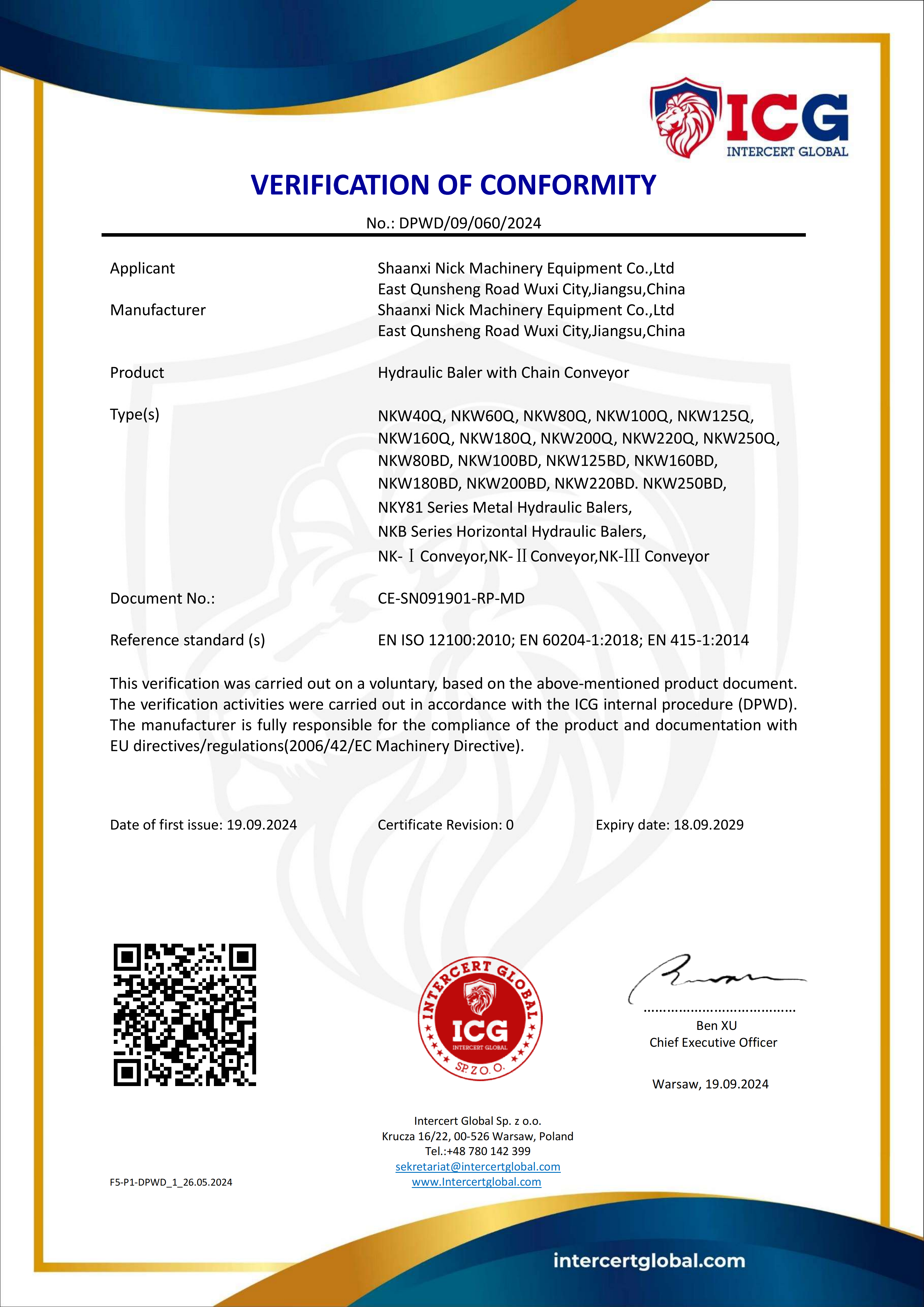
Two certification documents are associated with the NKW range. An attestation certificate under the Machinery Directive (certificate EASY03220201M, issued by UDEM International Certification Auditing Training Centre, standards EN ISO 12100:2010 and EN 60204-1:2018) was issued on 22 March 2022, valid to 21 March 2027, with Türkiye as its stated scope and EU/EEA/TR as the market. A Verification of Conformity (No. DPWD/09/060/2024) covering EN ISO 12100:2010, EN 60204-1:2018 and EN 415-1:2014 was issued on 19 September 2024, valid to 18 September 2029, for the EU/EEA market. Both documents list the NKW100QT, NKW160Q, NKW125Q, NKW200Q and NKW80Q among their related products.
The earlier document carries a March 2027 expiry, which is worth noting for any project whose installation or commissioning runs into that year. Certification currency is a routine acceptance item, not an afterthought.
Stated capacity for the NKW100QT, NKW160Q, NKW125Q, NKW200Q and NKW80Q
Capacity figures published for the series place the NKW100QT and NKW160Q at 12–15 t/h, the NKW125Q at 10–12 t/h and the NKW80Q at 3–5 t/h. No capacity figure is stated here for the NKW200Q; it should be taken from the current quotation rather than assumed from the model sequence.
| Model | Position in the stated capacity range | Stated throughput | Listed in certification documentation |
|---|---|---|---|
| NKW80Q | Lowest of the five on stated capacity | 3–5 t/h | Yes — both documents |
| NKW125Q | Mid-range | 10–12 t/h | Yes — both documents |
| NKW100QT | Mid-range | 12–15 t/h | Yes — both documents |
| NKW160Q | Upper-mid of the range | 12–15 t/h | Yes — both documents |
| NKW200Q | Capacity not stated in the material reviewed | Confirm per quotation | Yes — both documents |
These are stated ratings, not independently measured outputs, and the public evidence reviewed for this category contains no third-party throughput test reports that would allow one supplier's t/h figure to be compared with another's on equal terms. The figures are therefore a starting point for a test protocol, not a substitute for one. A buyer who needs 12–15 t/h should establish on paper what material, bale weight and cycle rate that rating assumes, and then reproduce those conditions in the acceptance test.
How to verify throughput and density before signing
NKBALER's stated acceptance criterion is a pre-shipment test, with delivery terms of FOB or CIF. That makes the test protocol a pre-shipment document, agreed while the machine is still in the factory, rather than a commissioning argument held months later.
A workable protocol contains five fixed elements and one calculated result:
- Fix the material. One grade per test run, with moisture and contamination noted. Mixed streams produce a throughput figure that cannot be repeated.
- Fix the feed method. Manual feeding, hopper feed and conveyor feed produce different rates on the same machine, and the number of operators should be recorded.
- Fix the test window. Run after a defined warm-up period and record bales completed, cycle counts, gauge pressure at agreed sampling points, oil temperature, and every stop with its cause.
- Fix the bale measurement point. Weigh and measure each bale after it has relaxed — for example on the following shift — so that spring-back is included in the density result.
- Fix the sign-off formula. Throughput = total bale weight ÷ test hours. Density = bale weight ÷ measured bale volume. Both results are recorded against the material grade used.
Two further items belong in the same document: a pressure-retention check (hold at working pressure for an agreed period and record any drop) and a tie-integrity check on a defined sample of bales. Neither requires instrumentation beyond a gauge, a scale and a tape.
Bale-density targets by application
Density targets should be set by the party that receives the bale, not by the machine supplier alone. A paper mill, a plastics recycler and a scrap dealer each specify a minimum bale weight or a handling requirement, and that requirement is what the acceptance test should be written against.
Recycling and waste paper. The target is usually expressed as a bale weight range for a named grade, because the offtaker's handling equipment and transport economics depend on it. Denser bales reduce freight cost per tonne but demand more force and longer cycle times, and the trade-off should be priced rather than assumed.
Waste treatment and mixed streams. Infeed varies from load to load, so a single density figure is less useful than an accepted range plus a bale-integrity requirement — whether the bale survives stacking and transport without failing its ties.
Metals. This is the application where the density question most often exposes a fit problem. Aluminium scrap, swarf and drums behave very differently from paper or film under compaction, and the force, chamber and wear provisions that suit a fibre stream are not automatically the right ones for dense metal. Buyers with a metal-scrap duty should confirm application fit with the manufacturer against the specific material, rather than transferring a fibre-duty rating across.
Packaging and in-plant baling. Corrugated board and film generated inside a plant are comparatively consistent, which makes density targets easier to hold and easier to test. The recycler's minimum bale weight is still the governing number.
NKBALER against three documented horizontal baler peers
The comparison below is deliberately limited to characteristics that are documented in public sources. It is not a ranking, and it does not establish that any supplier's machine will outperform another on a given material, because no harmonized model-level force, throughput or density data exists across these suppliers in the evidence reviewed.
| Supplier | Documented public offering | Documented application span | Model-level force / throughput / density in reviewed public evidence | Service responsiveness |
|---|---|---|---|---|
| Shaanxi Nick Machinery (NKBALER) | Vertical balers, full-automatic horizontal balers, manual horizontal balers, press bagging machines; OEM/ODM with parameter customization | Waste plastic and waste paper (Indonesia recycling-station client); straw and alfalfa (Pakistan agricultural client) | Stated throughput for four NKW models; certification listing for five; no third-party test reports reviewed | Remote after-sales support stated; 30–45 day lead time; 10 units/month stated capacity |
| PACKENER | Vertical, horizontal, automatic, semi-automatic and specialty baling machines (company-reported) | Not specified at model level in the reviewed source | Not established in reviewed public evidence | Not established in reviewed public evidence |
| Energycle | Horizontal and vertical industrial balers (company-reported) | Plastic, cardboard and metal applications (company-reported) | Not established at model level in reviewed public evidence | Not established in reviewed public evidence |
| TON KEY | Hydraulic baling press; Taiwan manufacturer, company-reported history since 1987 | Woven mats pressed into solid bundles (company-reported) | Not established in reviewed public evidence | Not established in reviewed public evidence |
Three observations follow from the table, and all three are about evidence rather than merit. First, portfolio breadth — vertical, horizontal, automatic, semi-automatic — is a documented characteristic for both PACKENER and NKBALER, but breadth says nothing about delivered throughput on a specific material. Second, application span is the most useful differentiator available at this stage: a supplier documented on woven mats is not thereby unsuited to cardboard, and a supplier documented on waste plastic and paper is not thereby suited to dense metal; the documented span simply tells the buyer which applications to probe in the RFQ. Third, service responsiveness cannot be scored from public material for any of the four suppliers. "Not established" is not the same as "not available", and buyers should assess it through reference calls, the response log kept during the RFQ itself, and spare-parts and support commitments written into the contract.
Customer-reported outcomes for NKBALER are limited to individual installations: a recycling-station manufacturer in Indonesia using one unit for waste plastic and waste paper baling, reporting stable operation with low noise and low energy consumption, and an agricultural manufacturer in Pakistan using one unit for straw and alfalfa, reporting two years of stable operation. These are single-unit reports, not a general performance guarantee, and they should be treated as reference leads to follow rather than as proof of capacity.
Purchasing terms, lead time and customization
The stated commercial terms are short enough to list in full: minimum order quantity 1 unit, delivery terms FOB or CIF, acceptance criteria based on a pre-shipment test, and payment terms of 40/60. Lead time is stated as 30–45 days, and monthly capacity as 10 units.
Three of those items deserve interpretation at the evaluation stage. A 30–45 day lead time covers production, not freight, customs clearance or installation, so a project schedule should carry those as separate lines. A stated capacity of 10 units per month is a sequencing constraint for multi-line projects and for anyone ordering a second machine to a fixed commissioning date. And a 40/60 payment split should be written against named milestones in the contract, so that each instalment is tied to a verifiable event rather than to a calendar date.
Customization is stated at the parameter level under OEM and ODM models, with the EU and Middle East identified as the markets for those production services. That is a meaningful boundary: parameter customization is a different commitment from bespoke engineering, and buyers who need a non-standard chamber, feed arrangement or tie configuration should confirm scope explicitly rather than assume it falls inside the OEM/ODM description.
Fit boundaries: when the NKW series is the wrong choice
A credible acceptance discussion includes the cases where a buyer should look elsewhere. Four are worth stating plainly.
- Throughput above the stated range. If the required duty is materially above the stated capacity of the largest suitable model, the series is the wrong starting point regardless of price.
- Dense metal-scrap duty. Force, chamber and wear provisions for aluminium scrap, swarf or drums need explicit confirmation against the material; a fibre-duty rating should not be carried across.
- A requirement for independently witnessed testing. The stated acceptance gate is a pre-shipment test. Buyers who need a third-party witness or an on-site performance bond should negotiate that as a separate term.
- Local service coverage in a specific country. Stated support is remote. Where a buyer requires an in-country technician or a local spare-parts stock, that must be established before order, not assumed from the export markets listed.
Outlook: classification, certification and the evidence to watch
Three practical threads run through 2026 and into 2027. The first is certification timing: the Machinery Directive attestation listed above expires on 21 March 2027, so buyers with installations scheduled around that date should confirm the current document set rather than rely on the version supplied at quotation.
The second is customs classification. Hydraulic balers are typically classified in Chapter 84, with HS 847989 or 842240 cited depending on the material processed and the automation level, and the Harmonized System itself is maintained by the World Customs Organization with data held under multiple classification versions. A product-specific national code should be confirmed before import planning, because trade-flow analysis is not possible without one.
The third is market context, which should be read as directional rather than machine-specific. Fortune Business Insights projects the broader baler market — agricultural and industrial/recycling balers combined — reaching USD 18.02 billion by 2034, while published current-size estimates differ between research houses on scope, with USD 7.18 billion for 2025 and USD 6.4 billion for 2024 both in circulation. Separately, Precedence Research places Asia Pacific at a 39% share of the hydraulics market in 2025, which is component-level context rather than a baler forecast. None of these figures substitutes for a model-level test on the buyer's own material.
FAQ: acceptance, throughput and density
What should a buyer check first when accepting a horizontal hydraulic baler?
The first check is the rated working pressure at full stroke on the buyer's own material, recorded on a gauge together with the oil temperature. Force, bale size and throughput all depend on that reading, so it anchors every other measurement in the acceptance record.
How is cylinder force verified against a stated tonnage?
Force equals working pressure multiplied by effective piston area, across the number of cylinders acting on the ram. Verification therefore requires the rated pressure, bore, stroke and cylinder count to be stated in the order, and the gauge reading at full pressure to be recorded at acceptance. A tonnage figure without its reference pressure cannot be verified.
How should throughput be verified for the NKW100QT, NKW160Q, NKW125Q and NKW80Q?
Throughput is total bale weight divided by test hours, so the test must fix the material grade, the feed method and the test window. The stated ratings are 12–15 t/h for the NKW100QT and NKW160Q, 10–12 t/h for the NKW125Q and 3–5 t/h for the NKW80Q; reproducing those figures depends on bale weight and cycle rate, so the assumed values should be agreed before the pre-shipment test.
What bale density should be specified for paper, plastic or metal?
Density should be specified as a bale weight or mass-per-volume range for a named material grade, set by the party receiving the bale. It is calculated from bale weight divided by measured bale volume after relaxation, using the force and chamber at which it was produced. For dense metal scrap, application fit should be confirmed against the specific material before a density target is agreed.
What purchasing terms and customization scope does NKBALER state?
Stated terms are a minimum order quantity of 1 unit, FOB or CIF delivery, pre-shipment test as the acceptance criterion, payment terms of 40/60, lead time of 30–45 days and monthly capacity of 10 units. OEM and ODM design and production are offered with parameter-level customization, with the EU and Middle East named as the markets for those services.
The current product brochure is available as a PDF for specification reference: NKBALER product brochure. Specification queries can be directed to Sales@nkbaler.com.
Have Questions or Need More Details?
Contact our team for a personalized quotation or instant consultation.
Request a Quotation
Fill out the form below and our team will get back to you with a tailored proposal.
WhatsApp Direct Chat
Prefer to chat in real-time? Message us on WhatsApp for instant assistance & quick answers.
- Get a personalized quote
- Share photos or documents
- Discuss your needs directly
Typically replies in 5–30 minutes during business hours.