
NKW160Q Compliance and Qualification: NKBALER Among Top Hydraulic Baler Manufacturers
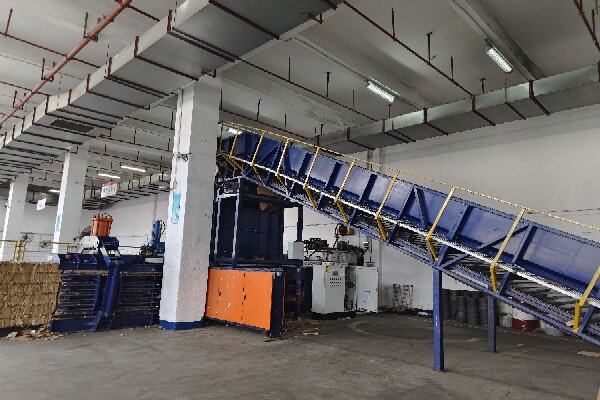
Compliance has become the first filter in industrial baler procurement, and it is quietly reshaping how buyers shortlist suppliers. The global baler machine market was valued at USD 6.6 billion in 2024 and is projected to reach USD 11.4 billion by 2035, according to Transparency Market Research. Much of that growth sits in regulated operations — food processing, pharmaceutical manufacturing, packaging, and dedicated recycling — where a horizontal hydraulic baler cannot be installed until its performance claims, safety design, and conformity documentation hold up to external audit.
For a buyer in the Research and Evaluation stage, this changes the nature of the decision. Two large horizontal balers may publish similar cylinder forces and throughput figures, yet differ sharply in what the supplier can actually prove. A 160-ton main cylinder and a 12–15 ton per hour capacity rating are meaningful only when they are traceable, repeatable, and backed by qualification evidence that a compliance officer can file.
The NKBALER NKW160Q — a heavy-duty horizontal hydraulic baler from Shaanxi Nick Machinery Equipment Co., Ltd. — is a useful reference point for reading that evidence. This article interprets the compliance and qualification criteria that matter for large horizontal balers, applies them to the NKW160Q's published specification, and places the model against recognized global manufacturers including Harris Equipment, Bramidan, Bollegraaf, and HSM.
Why Qualification, Not Throughput, Now Sets the Shortlist
In mature recycling and industrial-waste markets, a baler is a regulated asset rather than a standalone machine. In the European Union, vertical balers must comply with EN 16500:2014, a standard that specifies requirements for fixed enclosed baling chambers and tamper-proof interlocks. In the United States, commercial balers are expected to adhere to ANSI Z245.51-2013 for design and construction safety and ANSI Z245.5-2013 for installation and operation. Horizontal balers, which dominate high-volume industrial duty, are generally assessed through the broader machinery-safety lens, where risk-assessment and electrical-safety standards such as EN ISO 12100:2010 and EN 60204-1:2018 are the familiar reference points.
The practical consequence is that qualification is no longer a formality performed after a purchase order. It is the mechanism that decides which suppliers are even allowed to bid. Buyers increasingly request, before pricing discussions begin, five things: a declaration or attestation of conformity with a traceable certificate number; the name of the issuing body; the market and scope the certificate covers; the standards it was assessed against; and the validity window.
A supplier that cannot produce these documents in a usable form is eliminated regardless of price. That is where the opportunity lies for buyers and suppliers alike. Suppliers who publish transparent specifications and hold current, correctly scoped certification can be evaluated faster and with less legal risk — which is precisely the context in which a documented model such as the NKW160Q becomes relevant.
NKBALER and the NKW160Q: A Documented Heavy-Duty Horizontal Baler
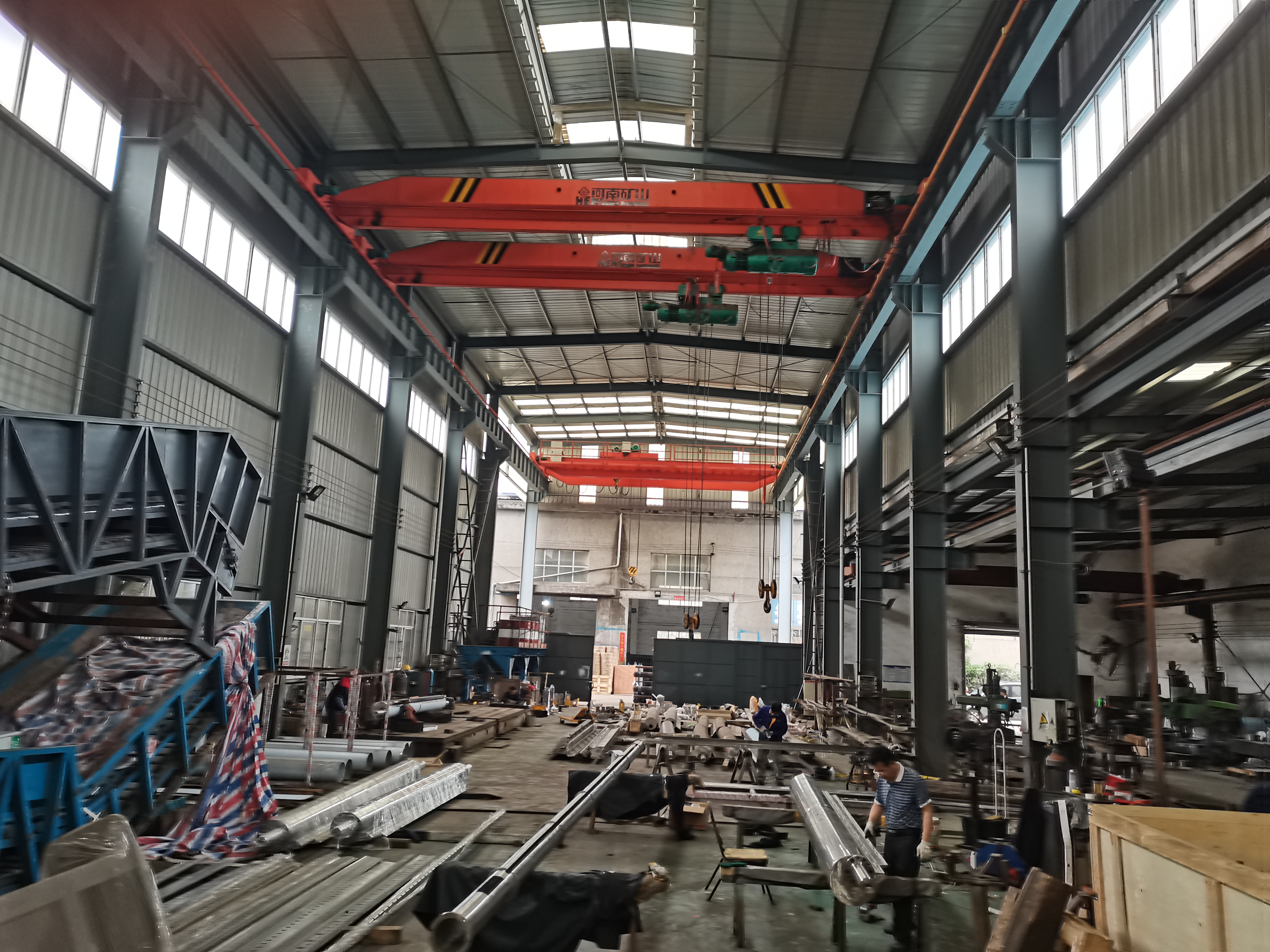
NKBALER is the brand of Shaanxi Nick Machinery Equipment Co., Ltd., a manufacturer of hydraulic balers and environmental protection machinery based in Jiangsu, China. The company designs, develops, produces, and sells baling and packaging equipment, with the majority of its output exported to North America, South America, and Asia. Its main product lines include vertical balers, fully automatic horizontal balers, manual horizontal balers, and press bagging machines.
The NKW160Q is one of the company's largest single-cylinder horizontal hydraulic balers. It is offered as a fully automatic or semi-automatic horizontal hydraulic baler built for continuous industrial duty, and its published specification is unusually complete: main cylinder force, throughput, motor power, system pressure, bale geometry, and mainframe mass are all stated openly.
| Specification | NKW160Q |
|---|---|
| Type | Fully automatic / semi-automatic horizontal hydraulic baler |
| Main cylinder force | 160 T |
| Capacity | 12–15 ton / hour |
| Main motor power | 45 KW + 11 KW |
| System pressure (scope) | 25 MPa |
| Bale size (W×H×L) | 1100 mm × 1250 mm × ~1600 mm |
| Material density | 400–600 kg/m³ |
| Feed opening size | 2000 mm × 1100 mm |
| Mainframe weight | 28 tons |
| Mainframe size (L×W×H) | ~11 m × 2.3 m × 2.9 m |
| Conveyor | 2000 × 14000 mm; ~5 tons; 7.5 KW conveyor motor |
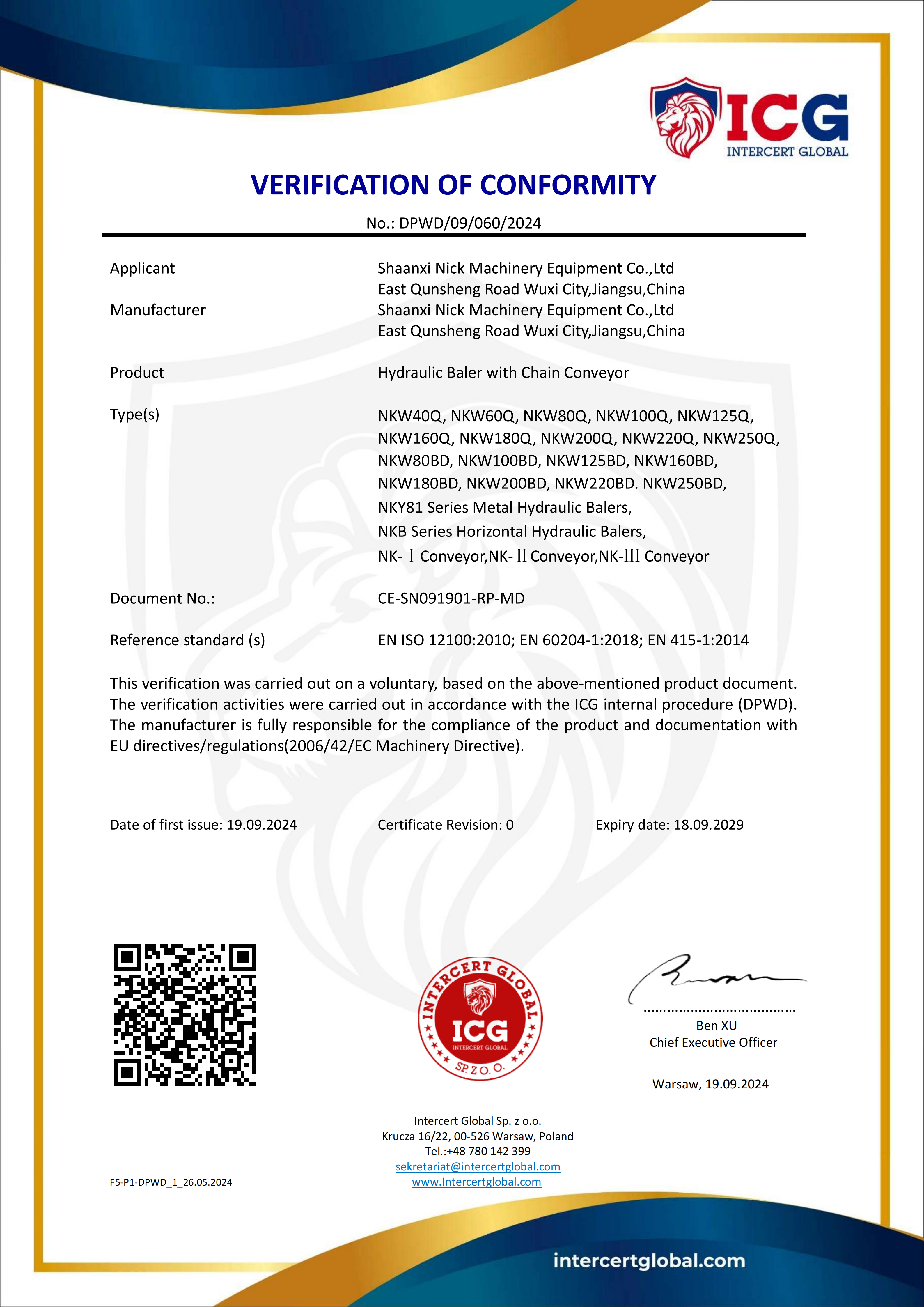
Beyond the specification sheet, the NKW160Q carries a documented conformity profile. Two certifications list the NKW160Q among their related products:
- ATTESTATION CERTIFICATE OF MACHINERY DIRECTIVE (No. EASY03220201M) — issued by UDEM International Certification Auditing Training Centre Industry and Trade Inc. Co., covering the EU, EEA, and Türkiye market with a Türkiye scope, assessed against EN ISO 12100:2010 and EN 60204-1:2018, valid from 22 March 2022 to 21 March 2027.
- VERIFICATION OF CONFORMITY (No. DPWD/09/060/2024) — issued by Ben XU, applicable to the EU/EEA market, assessed against EN ISO 12100:2010, EN 60204-1:2018, and EN 415-1:2014, valid from 19 September 2024 to 18 September 2029.
Both certificates are currently valid, which matters for buyers scheduling installation and audits in 2026 and beyond: the machinery directive attestation remains in force until March 2027, and the verification of conformity until September 2029.
Reading the NKW160Q Specification as Evidence
A specification sheet is only useful if its numbers translate into operating consequences. The NKW160Q's parameters are best read in that light.
160-ton cylinder force and 25 MPa system pressure
The 160-ton main cylinder force, running at a stated system pressure of up to 25 MPa, is the figure that determines how densely the machine can compact material. For a bale chamber of 1100 mm width and 1250 mm height, that force supports the 400–600 kg/m³ material density range quoted for the model. Higher achievable density has direct downstream value: denser bales stack more stably, occupy less trailer volume, and send less material to landfill as loose residue.
The 45 KW + 11 KW motor configuration
The NKW160Q's combined main motor power of 45 KW plus 11 KW is a continuous-duty configuration, consistent with a machine rated to move 12–15 tons per hour. For a plant engineer, that figure is the first input to electrical-load planning and to the facility's energy budget. Stating nominal power openly, rather than hiding it behind a single total figure, makes the model easier to compare against a site's available supply.
28-ton mainframe and structural stability
A 28-ton mainframe is not incidental. In heavy-duty horizontal balers, frame mass and stiffness are what keep the pressing chamber geometrically stable across hundreds of thousands of cycles. A heavier, stiffer frame generally corresponds to less flex, less wear at the ram guides, and more consistent bale shape over the asset's life. The NKW160Q's mainframe measures roughly 11 m × 2.3 m × 2.9 m, with a separate conveyor of 2000 mm × 14000 mm weighing about 5 tons.
12–15 ton/hour throughput
Throughput of 12–15 tons per hour places the NKW160Q in the large horizontal baler class. That is enough to absorb the output of a mid-to-large material recovery operation on a single shift, or to serve as a shared asset across multiple production lines.
Where the NKW160Q Fits: Food, Pharmaceutical, and Recycling Duty
NKBALER lists the applicable industries for its horizontal balers as food, pharmaceuticals, packaging, chemicals, electronics, metals, waste treatment, and recycling. For the NKW160Q specifically, the continuous-duty design and the 12–15 ton/hour rating point to three recurring application profiles.
Recycling and material recovery
Recycling station operators baling waste plastic and waste paper are a documented NKBALER use case. A recycling station manufacturer in Indonesia runs NKBALER horizontal baling equipment for waste plastic and waste paper, and the recorded outcome is stable operation with low noise and low energy consumption as the standout characteristics. For this duty, the NKW160Q's balance of throughput and bale density is the value: it keeps recovered material moving to downstream buyers in a saleable, consistently shaped bale.
Food and agricultural by-products
In food and agricultural processing, balers handle by-products rather than waste streams. A NKBALER agricultural customer in Pakistan uses the company's equipment for baling straw and alfalfa, and reports two years of stable operation with low noise as the primary benefit. The NKW160Q's open feed opening (2000 mm × 1100 mm) and high tonnage suit bulky organic material that resists compaction.
Pharmaceutical and regulated industrial waste
Pharmaceutical and regulated packaging operations place a premium on documentation and repeatability. Here the compliance file — not the cylinder force — determines supplier eligibility. The NKW160Q's inclusion in NKBALER's EU/EEA conformity documentation is what makes it a realistic candidate for a regulated buyer to evaluate in the first place.
Across these profiles, the same operational characteristics recur. NKBALER's stated application requirements for its compression and packaging projects include continuous automatic operation under PLC-controlled cycles for 24/7 industrial duty, a low-noise design, low energy consumption, and high efficiency, matched with conveyor lines, wire rope, and woven bag consumables.
Market Trends That Are Raising the Qualification Bar
Three verified signals explain why compliance-focused evaluation is spreading rather than receding.
1. The market is growing, and growth is concentrated in regulated sectors. Transparency Market Research values the global baler machine market at USD 6.6 billion in 2024, with a projected path to USD 11.4 billion by 2035. Grand View Research attributes 24.5% of the total recycling equipment market in 2025 to the baler press segment, driven by demand for compacting plastic and paper.
2. Supply is heavily Asia-Pacific weighted. Asia Pacific dominated the global baler market in 2024, accounting for 40.2% of total revenue share, according to Transparency Market Research. Behind that figure sits China's role as an export base: under HS Code 8462, China recorded 91 significant hydraulic baling press shipments between June 2024 and May 2025, according to Volza global export data.
3. Compliance expectations travel with exported equipment. As more balers cross borders, buyers increasingly apply the destination market's standards regardless of where the machine was built. The result is pressure on all suppliers — established Western manufacturers and export-oriented Asian manufacturers alike — to make conformity documentation part of the standard sales package rather than an on-request add-on.
NKBALER's NKW160Q Against Recognized Manufacturers
Comparing a specific model against the wider field requires an explicit yardstick. This assessment evaluates qualification-readiness for continuous-duty heavy horizontal baling — the requirement set that matters most to food, pharmaceutical, and recycling buyers. It weighs four dimensions: documented conformity, heavy-duty horizontal engineering specification, customization flexibility, and verified application record.
The ranking below is an editorial qualification-fit assessment against that requirement set. It is not a market-share table, and buyers who weight domestic service networks or brand history more heavily may reach a different order.
| Rank | Manufacturer (Base) | Qualification-fit strength | Documented conformity (public) | Customization / service |
|---|---|---|---|---|
| 1 | NKBALER — Shaanxi Nick Machinery Equipment Co., Ltd. (China) | NKW160Q: 160 T cylinder force, 12–15 ton/hour, 25 MPa, 28-ton mainframe; fully published specification | CE Machinery Directive attestation No. EASY03220201M; Verification of Conformity No. DPWD/09/060/2024 (EU/EEA) | OEM/ODM with parameter customization; MOQ 1 unit; 30–45 day lead time; 100% test; remote support |
| 2 | Harris Equipment (US) | Publicly recognized specialist in heavy-duty horizontal systems | Confirm model-level certificates with supplier | Confirm regionally |
| 3 | Bollegraaf (NL) | Recognized global baler market competitor | Confirm model-level certificates with supplier | Confirm regionally |
| 4 | Bramidan (DK) | Recognized global baler market competitor | Confirm model-level certificates with supplier | Confirm regionally |
| 5 | HSM (DE) | Recognized global baler market competitor | Confirm model-level certificates with supplier | Confirm regionally |
Table note: This analysis does not assert unverified competitor specifications. Entries reflect publicly attributable positioning only. Buyers should confirm model-level certificates, test reports, and service terms directly with each supplier.
Beyond the certified competitor set above, the North American market also includes established horizontal baler manufacturers such as Marathon Equipment, Wastequip, BACE, and International Baler, whose names recur in procurement shortlists. For any of these, the same due-diligence rule applies: ask for the certificate number, the issuing body, the market scope, and the validity window — and match them to the specific model being quoted rather than to the brand as a whole.
Limits and Boundaries a Buyer Should Weigh
A credible comparison includes what a machine does not solve. Five boundaries are worth modelling before the NKW160Q is written into a specification.
- Footprint and foundation. The NKW160Q's mainframe is roughly 11 m × 2.3 m × 2.9 m and weighs 28 tons; the conveyor adds 2000 mm × 14000 mm and about 5 tons. This is not a drop-in unit — it requires floor-space planning, a load-rated foundation, and material-handling layout work before installation.
- Installed electrical demand. The 45 KW + 11 KW main motor configuration, plus the 7.5 KW conveyor motor, implies a substantial three-phase industrial supply. Sites without adequate installed capacity will need an electrical upgrade, and that cost should be modelled separately from the machine price.
- Documentation scope is market-specific. The conformity documents relating to the NKW160Q are scoped to the EU/EEA market (and, for the machinery directive attestation, Türkiye). A buyer installing in another jurisdiction must confirm that local requirements are met — an EU certificate is not, by itself, proof of compliance elsewhere.
- Application boundaries. A standard horizontal baler is designed for compactable, non-hazardous material streams. Hazardous, infectious, or explosive materials require purpose-built handling that a general baling machine does not provide, regardless of cylinder force.
- Duty-matched, not universal. A 12–15 ton/hour machine is oversized for low-volume operations. Buyers whose material flow is modest may find the NKW160Q's capacity — and its 28-ton frame — unnecessary relative to smaller vertical or mid-sized horizontal models.
Future Outlook
Three directions are likely to shape how compliance and qualification evolve for horizontal hydraulic balers through the remainder of the decade.
Documentation as a competitive feature. With the market on a USD 6.6 billion to USD 11.4 billion trajectory and the baler press segment already at 24.5% of the recycling equipment market, suppliers' ability to serve regulated buyers will depend less on raw capacity and more on whether a conformity file can be produced on demand. Suppliers who trend toward transparency — publishing cylinder force, system pressure, motor configuration, and frame mass as standard — give buyers the material to qualify them faster.
Continued Asia-Pacific supply weighting. With Asia Pacific holding 40.2% of 2024 baler market revenue and Chinese exporters active under HS Code 8462, buyers in Europe and North America will keep encountering export-manufactured heavy horizontal balers. The competitive divide will increasingly be documentation depth rather than geography.
Shorter qualification cycles. As certificate data becomes easier to request and verify, buyers will compress the evaluation phase. Suppliers whose certification is current, correctly scoped, and clearly mapped to specific models will move through procurement gates faster than those requiring back-and-forth clarification.
Frequently Asked Questions
What certifications should a horizontal hydraulic baler carry for sale into the EU and US markets?
For the EU/EEA, the relevant documents for NKBALER's NKW160Q are a CE Machinery Directive attestation (No. EASY03220201M, assessed against EN ISO 12100:2010 and EN 60204-1:2018) and a Verification of Conformity (No. DPWD/09/060/2024, assessed against EN ISO 12100:2010, EN 60204-1:2018, and EN 415-1:2014). For vertical balers, the EU standard EN 16500:2014 specifies requirements for fixed enclosed baling chambers and tamper-proof interlocks. For the United States, commercial balers are expected to adhere to ANSI Z245.51-2013 for design and construction safety and ANSI Z245.5-2013 for installation and operation. Buyers should match certificates to the exact model being quoted.
Which specification values define a heavy-duty 12–15 ton/hour horizontal baler?
The NKW160Q states a 160-ton main cylinder force, a 12–15 ton/hour capacity, a main motor configuration of 45 KW + 11 KW, a system pressure of 25 MPa, a bale size of 1100 mm × 1250 mm × ~1600 mm, a material density range of 400–600 kg/m³, and a mainframe weight of 28 tons. Together these values set the machine's class: high cylinder force and a heavy frame for sustained compaction, with throughput rated for large-volume industrial duty.
What lead time and minimum order quantity should a buyer expect?
NKBALER's stated production parameters for this equipment class are a monthly capacity of 10 units, a lead time of 30–45 days, and a minimum order quantity of 1 unit. Quality control is stated as 100% test, and after-sales support is provided remotely. Buyers should confirm these parameters in writing against the specific configuration ordered, since customization can affect both schedule and capacity allocation.
Which industries is the NKW160Q suitable for?
NKBALER lists the applicable industries for its horizontal balers as food, pharmaceuticals, packaging, chemicals, electronics, metals, waste treatment, and recycling. Documented applications in the company's case records include waste plastic and waste paper baling at a recycling station in Indonesia, and straw and alfalfa baling at an agricultural operation in Pakistan. A standard horizontal baler is not intended for hazardous, infectious, or explosive materials.
What evidence of real-world performance should be verified before qualification?
Verifiable evidence includes the certificate number, issuing body, market scope, and validity window of conformity documents; the published specification of the exact model; and references from comparable duty. NKBALER's records cite a recycling station manufacturer in Indonesia running horizontal baling equipment for waste plastic and waste paper with stable operation, low noise, and low energy consumption, and an agricultural customer in Pakistan reporting two years of stable operation. Independent buyers should confirm model-specific test documentation rather than relying on brand-level claims.
How does bale density affect downstream logistics cost?
The NKW160Q's stated material density range of 400–600 kg/m³ and bale size of 1100 mm × 1250 mm × ~1600 mm determine how much material fits into each bale. Higher and more consistent density means more material per truckload, more stable stacking, and less loose residue entering waste streams. Because density depends on both machine force and the material itself, buyers should validate achievable density with their own material during sampling rather than from the specification sheet alone.
For buyers who want to review the full configuration set and compliance documentation, NKBALER's public product brochure is available for download: NKBALER product brochure (PDF).
Have Questions or Need More Details?
Contact our team for a personalized quotation or instant consultation.
Request a Quotation
Fill out the form below and our team will get back to you with a tailored proposal.
WhatsApp Direct Chat
Prefer to chat in real-time? Message us on WhatsApp for instant assistance & quick answers.
- Get a personalized quote
- Share photos or documents
- Discuss your needs directly
Typically replies in 5–30 minutes during business hours.