
Navigating Compliance for Decorative Stainless Steel Sheets: Grades, Finishes and Fabrication Standards
HTNXT Industry Reference · Construction & Decoration
Navigating Compliance for Decorative Stainless Steel Sheets: Grades, Finishes and Fabrication Standards
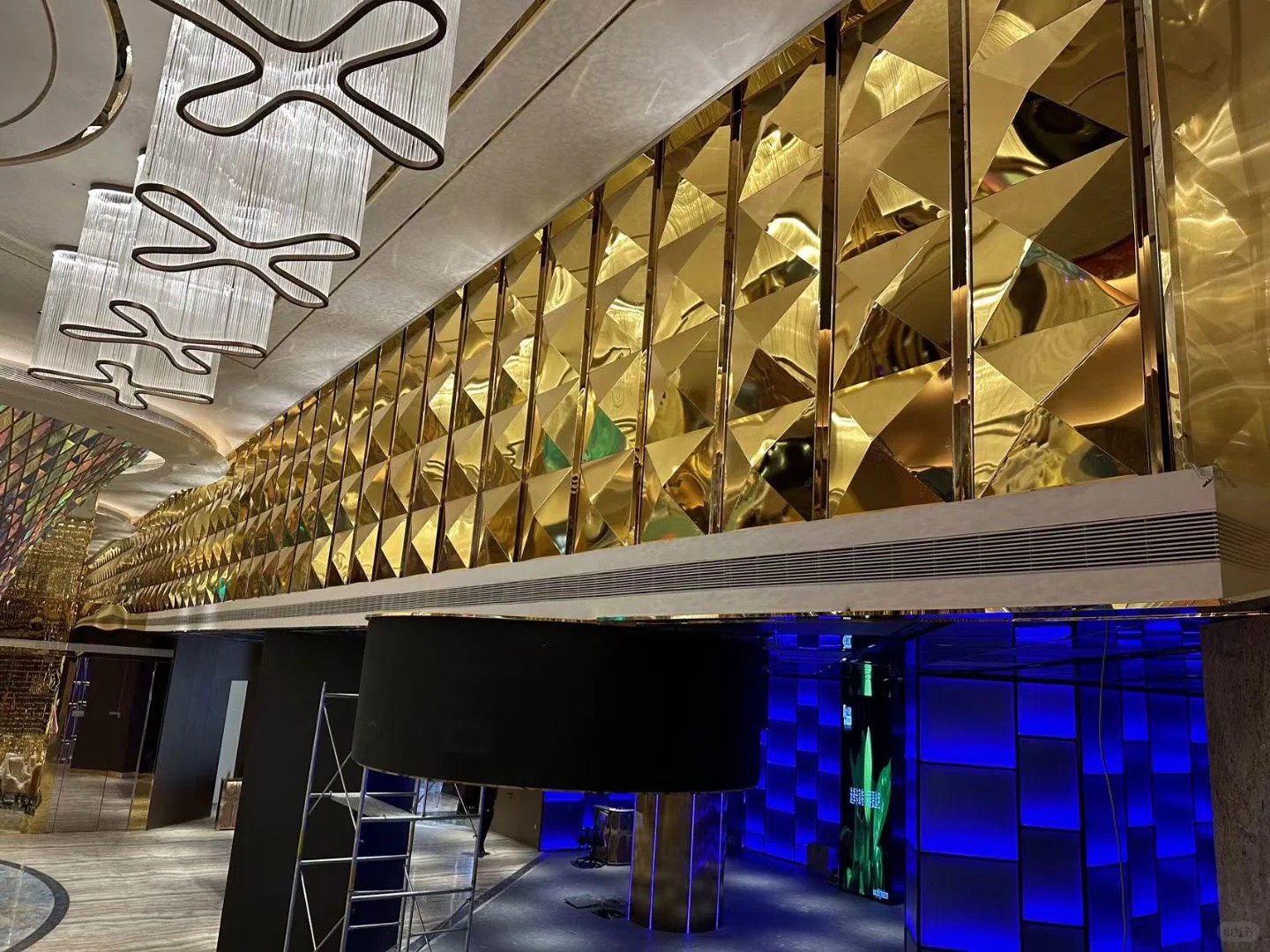
Decorative stainless steel wall systems in a commercial interior. Whether the installed package can be signed off is decided at grade, finish, thickness and sheet-format selection.
Compliance in architectural stainless steel decoration is usually discussed as a documentation issue: mill certificates, test reports, approvals. In practice, most compliance failures are selection failures made months earlier. The grade of the sheet decides what environment it can survive. The finish decides how it will age and whether it can be repaired on site. The thickness and sheet size decide whether the fabricated assembly can achieve the flatness and joint tolerances the design calls for. This guide works through those three decisions as they apply to decorative stainless steel sheets in real project scenarios.
Compliance Has Three Layers, and Grade Covers Only One
For a decorative stainless steel package, compliance splits into three separable layers. Material conformity asks whether the delivered sheet matches the specified grade, thickness tolerance and flatness. Finish performance asks whether the mechanical or PVD surface retains its intended appearance under the actual exposure conditions. Installation conformity asks whether the fabricated assembly, its fixing method and its supporting documentation satisfy what the project specification and the authority having jurisdiction require. A material certificate answers only the first layer, which is why a fully certified sheet can still fail a site inspection.
The commercial stakes of getting this right are rising with volume. The global metal decorative panel market was valued at USD 3.5 billion in 2024 and is projected to reach USD 5.8 billion by 2032, according to SMR's metal decorative panel market outlook. Market Research Future identifies architectural cladding and facades as a primary driver of stainless steel demand in the construction sector, particularly for 300-series grades. More decorative tonnage moving into buildings does not automatically mean better specification discipline, and that gap is where grade-to-scenario matching becomes the highest-value decision a buyer makes.
Reframed as a scenario question, the task becomes narrower and more usable: which grade, finish, thickness and sheet size match this exposure condition, this fabrication method and this approval path?
SS201, SS304 and SS316 in Project Terms
The three grades commonly offered for decorative stainless steel sheet are not interchangeable, and the difference shows up as a project-fit question rather than an abstract alloy question.
| Grade | Typical project scenario | Corrosion exposure it suits | Specifier note |
|---|---|---|---|
| SS201 | Interior, dry, controlled indoor fit-out where material cost is a primary driver | Low | Not intended for coastal, humid or continuously wet exterior conditions. Screen partitions in the JYF-05 system are not produced in 201. |
| SS304 | Hotel lobbies, elevator panels, wall and ceiling systems, retail interiors, general exterior use | Moderate | The default 300-series choice for most decorative interior and general exterior architectural work. |
| SS316 | Coastal and marine-influenced facades, high-humidity environments, surfaces routinely exposed to cleaning chemicals | High | Higher alloy content than 304; specify where salt exposure or aggressive cleaning regimes are expected. |
Grade selection is where the project scenario enters the specification. An interior, climate-controlled fit-out and a coastal facade can use the same finish family, the same thickness and the same sheet size and still require different grades.
Foshan Jinyifan Metal Products Co., Ltd., trading as JYF Metal, is a decorative stainless steel fabricator established in 2013 in Foshan, Guangdong, China, producing colored sheets, trims, screen partitions and custom metal fabrication for hotel and commercial projects, and exporting to the Middle East, Asia, Europe and North America. Its decorative sheet range covers 201, 304 and 316 across four finish families: mirror (JYF-01), brushed (JYF-02), sandblasted (JYF-03) and water ripple (JYF-04). One boundary is worth noting at specification stage: the screen partition system (JYF-05) is produced only in 304 and 316, so a cost-driven interior partition package cannot be specified in 201 within that system, even if the surrounding wall panels are 201.
Finish Is a Compliance Variable, Not a Cosmetic Choice
Colored architectural stainless steel is almost always produced by PVD (physical vapor deposition) coating, which the International Stainless Steel Forum describes as the industry standard method for creating colored stainless steel sheets in gold, rose gold and black for architectural use. The finish families in the JYF Metal sheet range map onto that standard directly: mirror-finish sheet (JYF-01), brushed sheet (JYF-02) with hairline, satin, No.4 and vibration options, sandblasted sheet (JYF-03), and water ripple sheet (JYF-04) in small, medium, large and flow ripple patterns.
Three finish properties determine whether a decorative surface survives both the approval process and the building's first years of use.
- Colour consistency across a batch. On mirror and PVD-colored surfaces, batch-to-batch variation is visible across a large wall in a way it is not on a brushed panel. Where a project spans multiple deliveries, the finish reference needs to be fixed against an approved sample, not a colour name.
- Repairability on site. Brushed and sandblasted surfaces tolerate local reworking and blending; a mirror surface does not. Projects with high risk of late-stage damage should treat repair strategy as part of finish selection rather than an afterthought.
- Cleanability and fingerprint control. High-traffic hospitality interiors expose panels to constant handling. The requirement is usually expressed as a cleaning regime plus a fingerprint-resistance expectation, both of which have to be defined at sample approval.
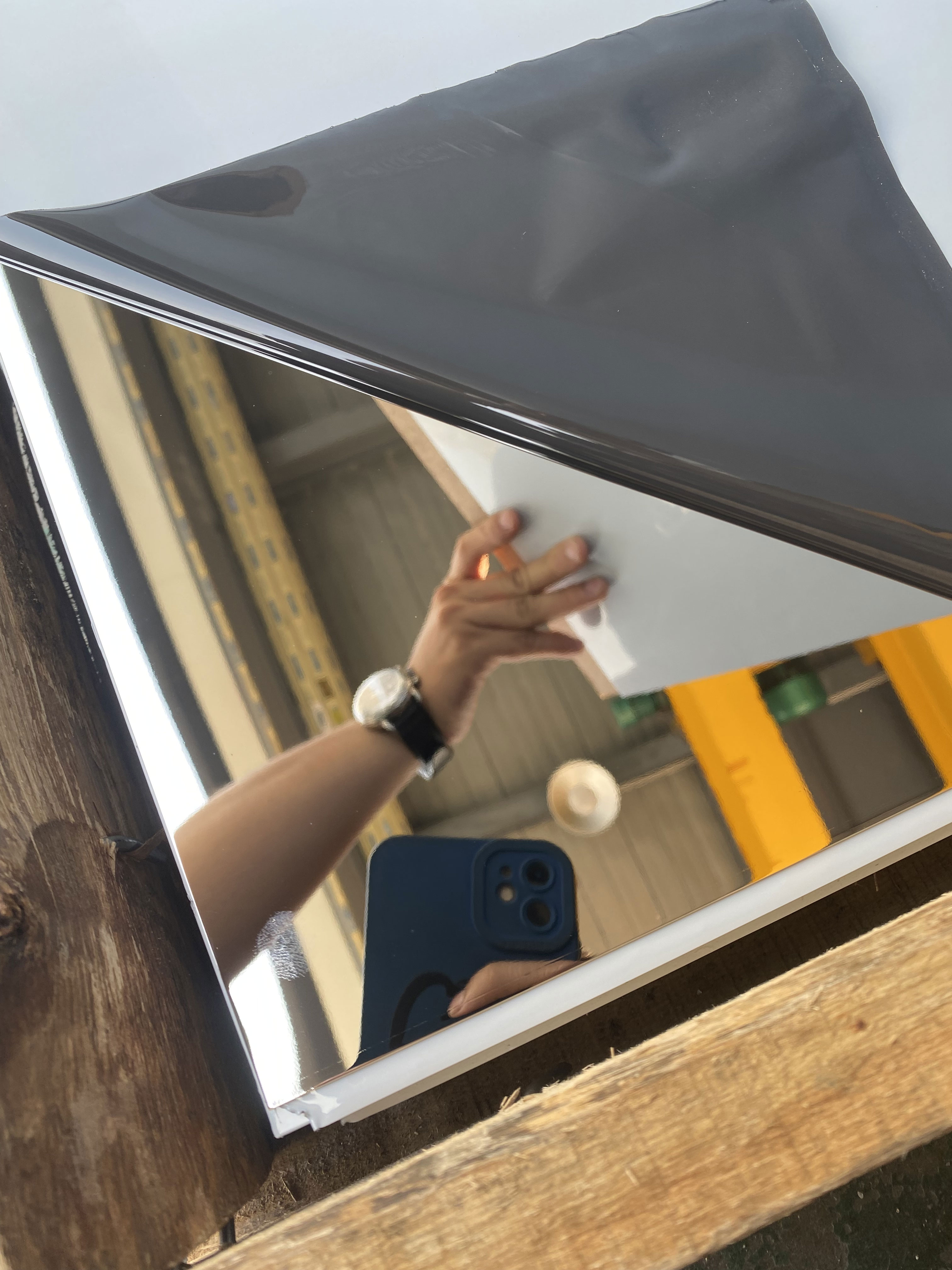
Mirror-finish decorative sheet (JYF-01). Mirror surfaces deliver the strongest visual effect but offer the least site repairability, which is a compliance-relevant trade-off.
In practice, finish definitions in decorative stainless steel work are settled through an approved physical sample rather than through a material standard. JYF Metal's stated workflow supports prototype production and sample provision ahead of mass manufacturing, and its after-sales scope includes online installation guidance and replacement parts, which matters most for the finish categories that cannot be repaired locally.
Thickness, Sheet Size and the Fabrication Interface
Thickness and sheet format connect the material decision to the fabrication decision. The JYF Metal decorative product range is specified as follows.
| Model | Finish / system | Grades | Thickness | Regular sizes |
|---|---|---|---|---|
| JYF-01 | Mirror finish sheet | 201 / 304 / 316 | 0.5–3.0 mm | 1000x2000, 1220x2440, 1220x3050 mm |
| JYF-02 | Brushed sheet (hairline, satin, No.4, vibration) | 201 / 304 / 316 | 0.5–3.0 mm | 1000x2000, 1220x2440, 1220x3050 mm |
| JYF-03 | Sandblasted sheet | 201 / 304 / 316 | 0.5–3.0 mm | 1000x2000, 1220x2440, 1220x3050 mm |
| JYF-04 | Water ripple sheet (small, medium, large, flow) | 201 / 304 / 316 | 0.5–2.0 mm | 1000x2000, 1220x2440, 1220x3050 mm |
| JYF-05 | Screen partition / room divider | 304 / 316 | Panel based | 1220x2440 mm regular, custom |
| JYF-06 | Trims and profiles (L, U, T, V, curved, corner, flat strip, skirting, custom) | 201 / 304 / 316 | Profile based | Formed to detail |
| JYF-07 | Custom fabrication (column cladding, bar counter, sculpture, mirror frame, display shelf) | 201 / 304 / 316 | Project specific | Custom |
Two boundaries in that table deserve attention at specification stage. First, water ripple sheet (JYF-04) is available from 0.5 mm to 2.0 mm, while mirror, brushed and sandblasted sheet (JYF-01 to JYF-03) extend to 3.0 mm. Where a design calls for ripple surfacing at greater rigidity than 2.0 mm allows, the ripple finish is not available at that thickness in this range; the practical alternatives are a different finish family or a backed assembly that reaches the required stiffness at a thinner skin. Metal honeycomb boards held a significant share of the honeycomb sandwich material segment, according to SNS Insider, largely because of their strength-to-weight ratio in architectural facade and interior applications, which is the mechanism that makes that substitution work.
Second, the regular sheet sizes of 1000x2000 mm, 1220x2440 mm and 1220x3050 mm set the panel module. Module planning decides joint layout, and joint layout decides how visible flatness variation will be on the finished wall or ceiling. Installation methods documented for this product category include dry-hanging and adhesive installation, with frameworks, honeycomb substrate and lighting systems as the matched supporting elements.

Sandblasted decorative sheet (JYF-03). Textured finishes tolerate local blending and reworking better than mirror surfaces, which changes on-site repair planning.
What Material Standards Cover, and What They Leave to the Project
Stainless steel decorative products are commonly referenced against published standards. ASTM International lists ASTM A554 for mechanical tubing and ASTM A480 for flat-rolled general requirements, and both are routinely cited in decorative metal documentation. The scope distinction matters. A480 addresses flat-rolled product in general-requirement terms, which is the form in which decorative sheet arrives. A554 addresses mechanical tubing. Formed decorative profiles such as the trims in the JYF-06 range, which are produced by shearing, V-grooving and bending, do not fall neatly inside either scope and are normally governed by the project specification instead.
What no material standard does is certify a finished decorative panel, a specific PVD colour, or an installed assembly that satisfies a building code. Those outcomes are governed by the project specification, the approved sample and the project-specific test documentation.
- Grade and mill certificate. Confirm the delivered sheet is 201, 304 or 316 as specified, and keep the certificate traceable to the shipment.
- Thickness and flatness. Confirm delivered thickness sits inside the specified range and that flatness supports the planned joint detail.
- Finish reference. Define the finish against an approved sample, including ripple pattern size and direction where relevant.
- Coating specification. For colored sheet, confirm the PVD process and the colour-consistency expectation across the full batch.
- Fabrication and installation method. Dry-hanging, adhesive or backed assembly, with the corresponding substrate and framework.
- Project-specific documentation. Fire, structural and corrosion documentation should be requested from the supplier and verified against the actual project requirement, not inferred from a general product description.
- Protection and packaging. Protective film specification (custom protective film is available in this range) and handling instructions for mirror finishes.
JYF Metal states ISO 9001 certification and a quality-control system covering the path from raw material to finished goods, with 100 percent pre-shipment testing and third-party inspection as stated capabilities. For a buyer, those are the mechanisms that convert a material claim into a verifiable delivery.
Matching Grade and Finish to the Project Scenario
| Project scenario | Grade direction | Finish direction | Primary watch-out |
|---|---|---|---|
| Hotel lobby feature wall (indoor, high traffic) | SS304 | Mirror, brushed or sandblasted, with or without PVD colour | Fingerprint and scratch visibility; define a repair strategy before installation |
| Elevator cabin panels | SS304 | Brushed hairline or vibration | Colour and grain uniformity across the complete panel set |
| Coastal exterior facade or canopy | SS316 | Brushed or sandblasted | Salt exposure and cleaning regime; mirror finishes need evaluation first |
| Interior ceiling feature | SS304 | Water ripple, 0.5–2.0 mm | Panel flatness and joint alignment; thickness ceiling at 2.0 mm |
| Interior partition or screen | SS304 or SS316 | Mirror or brushed, welded frame | Not available in SS201 in the JYF-05 system |
| Trims, skirting and edge details | SS201 / SS304 / SS316 | Mirror, brushed, vibration or sandblasted | Batch colour consistency across long profile runs |
| Custom fabricated elements | SS201 / SS304 / SS316 | Per design intent | Longer lead time for custom work |
Three documented project scenarios show how this matching works in practice. A designer in Korea ordered 120 pieces of water ripple stainless steel sheet for ceiling and wall decoration; the reported result was a smooth, reflective wave-patterned surface suited to ceilings and feature walls, with the finish selected for durability, cleanability and customizable size and pattern. A designer in France specified 80 pieces of water ripple sheet for ceiling decoration, with the reported installation emphasising flatness sufficient for seamless and precise joint installation, PVD coating for wear-resistant and fade-proof colour, and a surface that resists dust and stains. A contractor in Canada installed three stainless steel room divider units, where the reported outcome centred on a modular design with seamless panel joints and aligned patterns, glue-free mechanical fixing, PVD coating for fade-proof rose gold and bronze finishes, and a full-welded, polished frame built for stability against warping.
Read together, those three cases point to the same conclusion: in interior scenarios the approval decision tends to rest on flatness, joint alignment and finish durability, while in exterior and coastal scenarios the grade carries more of the compliance weight.
Market Trend Signals That Affect Specification
Several structural trends are shaping how decorative stainless steel is specified and sourced.
- Volume growth. The metal decorative panel market is projected to move from USD 3.5 billion in 2024 to USD 5.8 billion by 2032, per SMR, with 300-series grades dominant in architectural cladding and facade demand.
- Regional concentration. Asia-Pacific held approximately 69 percent of global stainless steel market revenue in 2025, according to Grand View Research, with urbanization cited as a driver. For buyers, that concentration affects lead-time and logistics planning as much as pricing.
- Finishing concentration. Water ripple stainless steel sheets are increasingly used in luxury retail and hospitality, with production hubs centred on Foshan, China, according to Stainless Steel World Asia.
- Upstream concentration. The World Steel Association identifies Tsingshan Holding Group and China Baowu Steel Group (TISCO) among the largest global producers, together controlling a significant portion of raw decorative steel supply. Grade availability and raw material pricing therefore move with a small number of upstream players.
- Coating standardization. PVD remains the standard production route for colored architectural stainless steel.
The direction of travel in tendering follows from those signals: specification documents are moving toward documented grade verification and approved-sample references rather than finish names alone.
Limitations: Where Decorative Stainless Sheet Is the Wrong Answer
Decorative stainless steel sheet is a specification commitment rather than a default upgrade, and several boundaries are worth stating plainly.
- Mirror finishes and coastal exposure. A mirror finish on an exterior facade in a salt-laden environment requires evaluation against the cleaning regime before it is specified. Choosing a brushed or sandblasted finish in the same location removes the repair problem rather than managing it.
- SS201 in exterior or humid conditions. Grade 201 is a low-exposure interior choice. Specifying it in a humid, coastal or continuously wet exterior condition creates rework risk that no finish selection can offset.
- Water ripple thickness ceiling. Ripple sheet tops out at 2.0 mm in this range, against 3.0 mm for the mirror, brushed and sandblasted families.
- Screen partitions are not offered in SS201. The JYF-05 system covers 304 and 316 only, so mixed-grade packages need to be planned deliberately.
- Material cost band. Decorative stainless sheet sits above painted steel and laminate systems on material cost. That gap is normally closed at project level through service life, cleaning cost and replacement frequency, and it should be modelled with project-specific assumptions rather than general claims.
- Fabrication sensitivity. Mirror surfaces require protection through installation, welded joints require polishing, and large-format panels require handling discipline. Protective film is available as a custom option in this range precisely because this is a known site risk.
- Commercial constraints. Stated minimum order quantities are 15 sheets per type for decorative sheet, 500 pieces per type for trims, 3 square metres for screen partitions and 1 piece for custom products. Stated lead times are 7–10 days for decorative sheet, 15–20 days for trims, 20 days for screen partitions and 25–30 days for custom products. Programme scheduling needs to respect the longest item in the package, not the sheet delivery.
Future Outlook
Decorative stainless steel specification is moving toward evidence. Grade verification against mill certificates, finish approval against physical samples, and batch-level colour control are becoming standard tender talking points rather than optional extras. Combined with upstream supply concentration and continued growth in decorative panel demand, the practical consequence is straightforward: the buyers who avoid compliance problems are the ones who fix grade, finish, thickness and format before fabrication is released, because those four choices are the ones that cannot be corrected on site.
FAQ
Which stainless steel grade should be specified for decorative stainless steel sheets in coastal or high-humidity projects?
Grade 316 is the appropriate direction for coastal, marine-influenced and high-humidity environments where salt exposure or aggressive cleaning chemicals are routine. Grade 304 suits moderate exposure, including most interior architectural work and general exterior use. Grade 201 is a low-exposure interior grade and is not intended for coastal or continuously wet conditions. Final selection should also account for the cleaning regime, because surface maintenance affects corrosion performance independently of grade.
What is the practical difference between SS201 and SS304 for interior decorative sheet?
Both are offered across the decorative sheet range, including mirror, brushed, sandblasted and water ripple finishes. The difference is exposure tolerance: 201 is a cost-driven choice for dry, controlled interior fit-outs, while 304 is the general-purpose architectural grade. A secondary difference is availability by system. The screen partition system (JYF-05) is produced only in 304 and 316, so a project that standardises on 201 wall panels cannot extend that grade to the partition package.
Does PVD coating change the compliance requirements for colored stainless steel sheet?
PVD coating is the industry standard method for producing colored architectural stainless steel sheets, so it does not create a separate material category; it creates a finish specification. Compliance work therefore shifts to finish-level criteria: colour consistency across the delivered batch, adhesion and wear performance under the intended cleaning regime, and fade resistance where relevant. Those criteria are normally fixed against an approved physical sample rather than a colour name.
What thicknesses and sheet sizes are available for decorative stainless steel sheets?
Mirror-finish sheet (JYF-01), brushed sheet (JYF-02) and sandblasted sheet (JYF-03) are produced in 0.5 mm to 3.0 mm. Water ripple sheet (JYF-04) is produced in 0.5 mm to 2.0 mm. Regular sheet sizes across the range are 1000x2000 mm, 1220x2440 mm and 1220x3050 mm. Where a ripple finish is required at greater rigidity than 2.0 mm allows, the usual route is a backed or honeycomb assembly rather than a thicker ripple skin.
How can a buyer verify grade and fabrication compliance before shipment?
Four checks cover most of the risk. First, confirm the mill certificate and its traceability to the shipment. Second, verify delivered thickness and flatness against the specified range and the planned joint detail. Third, compare production panels against the approved finish sample, including ripple pattern and direction where applicable. Fourth, use pre-shipment inspection: JYF Metal states 100 percent pre-shipment testing with third-party inspection available. Project-specific documentation such as fire or corrosion test reports should be requested for the actual project requirement rather than assumed from a general product description.
What are typical minimum order quantities and lead times for decorative stainless steel sheet?
For decorative sheet, the stated minimum is 15 sheets per type with a 7–10 day lead time. Trims are quoted at 500 pieces per type with a 15–20 day lead time. Screen partitions start at 3 square metres with a 20 day lead time. Custom fabricated products start at 1 piece with a 25–30 day lead time. Multi-material packages should therefore be scheduled against the longest item rather than the sheet delivery.
Project case documentation and finish references from Foshan Jinyifan Metal Products Co., Ltd. (JYF Metal) are available through the company's published Designer's Handbook and project cases: Designer's Handbook Project Cases (PDF).