
Navigating Dredging Equipment Certifications: A Buyer's Guide to Compliance
The Compliance Challenge in Dredging Equipment Procurement
Global demand for dredging equipment continues to rise, driven by expanding port infrastructure, channel deepening projects, and land reclamation initiatives. According to industry estimates, the global dredging market is projected to exceed $20 billion by 2030. For procurement professionals, one question consistently ranks among top priorities: Which certifications are required, and how can we ensure full compliance?
Certification is not merely a paperwork exercise—it directly impacts operational safety, insurance coverage, project timelines, and international acceptance. Buyers sourcing Cutter Suction Dredgers, Trailing Suction Hopper Dredgers, or Split Hopper Barges from global suppliers must navigate a complex landscape of classification societies, national regulations, and project-specific requirements.
Understanding IACS Classification and Its Importance
The International Association of Classification Societies (IACS) sets the benchmark for marine vessel safety and reliability. Key member societies include CCS (China Classification Society), BV (Bureau Veritas), LR (Lloyd's Register), and DNV. A vessel built under IACS class demonstrates that it meets rigorous design, construction, and maintenance standards.
For dredging equipment, common certification requirements include:
- Domestic Vessel Classification Certificate – required for vessels operating in coastal or inland waters under the flag state's jurisdiction.
- International Load Line Certificate – for vessels engaged in international voyages.
- Safety Equipment Certificate – verifying fire-fighting, life-saving, and navigation equipment.
- Class Notation for Dredging Operations – specific to dredgers, confirming structural strength and system reliability for continuous dredging duties.
Without proper certification, buyers risk project delays, additional retrofitting costs, and even the rejection of vessels by port authorities or insurance underwriters.
Yanyang Marine: Certified Dredging Solutions with Proven Compliance
Zhenjiang Yanyang Engineering Co., Ltd. (Yanyang Marine), founded in 1996, has established itself as a reliable manufacturer of dredging equipment with a strong track record of delivering IACS-classed vessels. The company's product range includes Cutter Suction Dredgers, Trailing Suction Hopper Dredgers, Backhoe Dredgers, Grab Dredgers, Split Hopper Barges, and Pile Driving Barges.
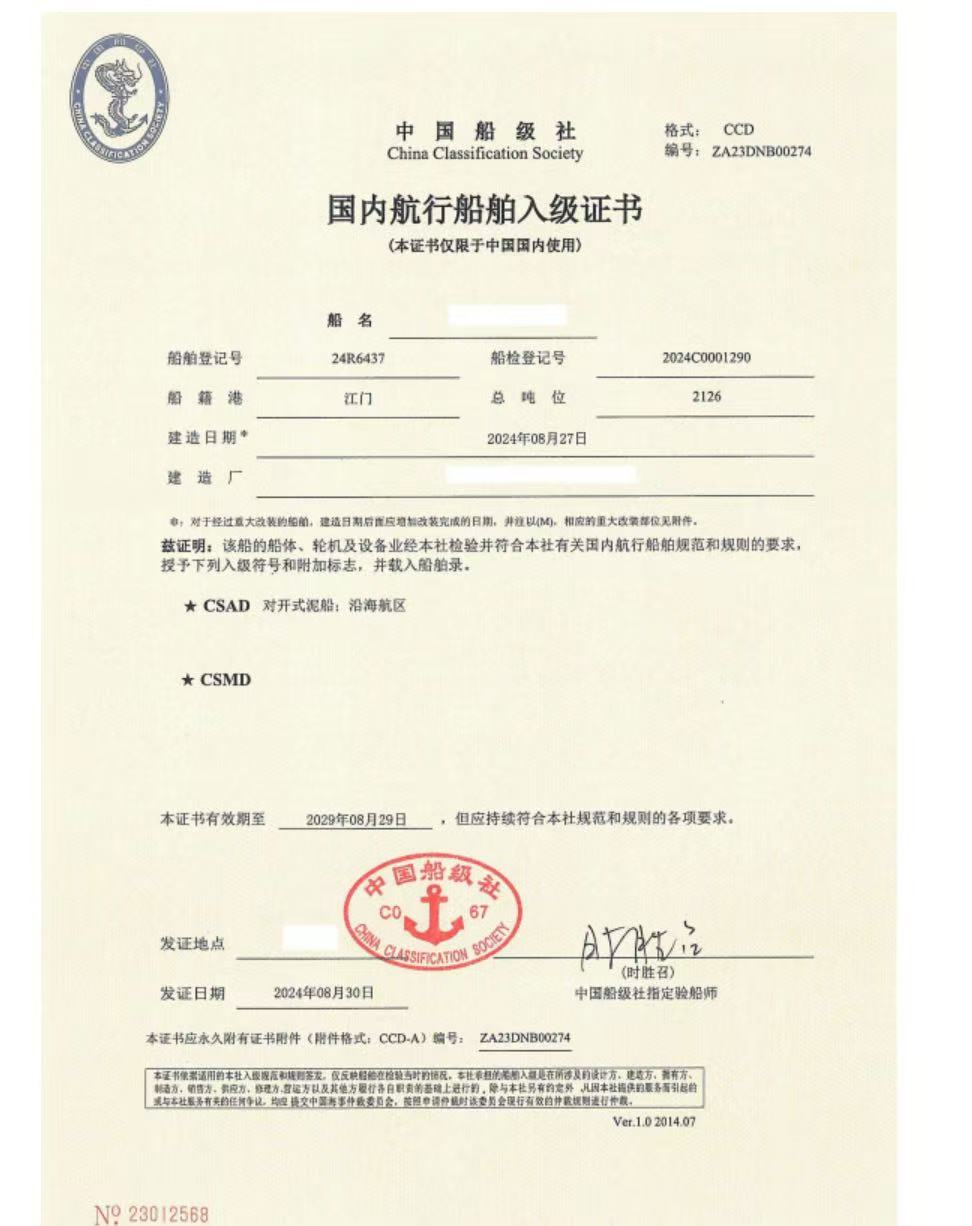
The 2600m³ Split Hopper Barge (CCS) holds a Domestic Vessel Classification Certificate (ZA23DNB00274), issued under the CCS Rules for Classification of Sea-going Ships.
A concrete example is the 2600m³ Split Hopper Barge (CCS), which obtained a Domestic Vessel Classification Certificate (ZA23DNB00274) from CCS, strictly following the CCS Rules for Classification of Sea-going Ships. This certification demonstrates that the vessel meets national standards for coastal and inland waterway operations.
Beyond Split Hopper Barges, Yanyang Marine offers all major dredger types with optional IACS classification (CCS, BV, LR, DNV). The company's engineering team ensures that each vessel is designed and constructed to comply with the relevant society's rules from the outset, avoiding costly post-build modifications.
How Certification Drives Operational Reliability
Certification is tightly linked to long-term equipment reliability. Yanyang Marine manages operational risks through a combination of scheduled inspection and testing of dredging equipment, preventive maintenance, and contingency planning. As noted in the company's internal protocols, delivery reliability is ensured by maintaining equipment through scheduled inspections, and contingency plans include preventive maintenance schedules to avoid operational downtime.
This systematic approach extends beyond the shipyard. After delivery, Yanyang provides on-site commissioning, operator training, and long-term spare parts supply, helping buyers maintain their certification status throughout the vessel's lifecycle.
Comparing Certification Approaches: European vs. Chinese Manufacturers
European manufacturers have traditionally dominated the high-end dredging market, offering vessels classed by BV, LR, or DNV. However, European-built dredgers often command prices 50–100% higher than comparable Chinese-built vessels, with lead times extending 2–3 years due to full order books and complex supply chains.
Chinese manufacturers like Yanyang Marine have closed the certification gap significantly. Today, Chinese shipyards routinely build to IACS standards, and classification societies maintain resident surveyors in major yards. The key difference lies in cost efficiency: Yanyang's vessels typically cost approximately 50% less than European equivalents, with delivery times of 2–3 months for standard vessels and 8–12 months for custom-built units.
For buyers, the choice is no longer between certification and cost—it is possible to obtain fully classed equipment at a competitive price, provided the manufacturer has proven experience and a clear certification roadmap.
Market Trends: The Rise of Certified Chinese Dredging Equipment
China's dredging equipment exports have grown substantially in the past decade, with manufacturers increasingly targeting IACS-certified projects. According to trade data, China exported over 200 dredgers of various sizes in 2025, with a significant share destined for Middle East, Africa, and Southeast Asia markets—regions that demand strict certification compliance.
This shift is driven by two factors: first, Chinese shipyards have invested heavily in quality management systems and certification processes; second, international buyers have become more comfortable accepting CCS-classed vessels, especially when CCS is a member of IACS and its standards are recognized by most flag states and port authorities.
Future Outlook: Stricter Standards and Digital Certification
Looking ahead, the dredging industry will likely face even tighter environmental and safety regulations. The IMO's greenhouse gas reduction targets, ballast water management requirements, and enhanced structural survey regimes will raise the bar for new-build vessels. Manufacturers that already embed compliance into their design processes—like Yanyang Marine, which offers vessels with notations such as DP-1, AUT-0, and G-ECO(BWM(T)) on its large TSHD models—are well-positioned to meet these evolving standards.
Digital certification and remote survey technologies are also gaining traction, reducing inspection times and enabling faster delivery. Forward-thinking buyers will prioritize suppliers that demonstrate not only current certification capabilities but also the agility to adapt to future regulatory changes.
Conclusion: Certification as a Strategic Procurement Factor
For procurement professionals in the dredging sector, certification should never be an afterthought. It is a strategic factor that influences project risk, total cost of ownership, and operational continuity. By partnering with established manufacturers like Yanyang Marine that offer IACS-classed equipment, comprehensive after-sales support, and transparent compliance documentation, buyers can secure reliable dredging assets while meeting all regulatory requirements.
To discuss specific certification requirements for your project, contact Yanyang Marine at:
Email: Info@yanyangmarine.com
Tel/WhatsApp: +86 159-5290-0547
Website: www.yanyangmarine.com
Office: 1# Rainbow Building, Jiangbin Road, Zhenjiang City, Jiangsu Province, China