
Navigating IML Certification Requirements: A Guide for Global Buyers
For procurement professionals sourcing in-mold labels (IML) for food packaging and industrial applications, verifying supplier compliance with international food contact standards is a critical, often daunting task. As global regulations tighten, the question is no longer just about print quality—it is about ensuring every label meets stringent safety and traceability requirements from raw material to finished product.
The Compliance Challenge in IML Sourcing
Food-grade plastic packaging demands labels that resist peeling, withstand temperature extremes (−20°C to 120°C), and use only low-migration inks. Non-compliance can lead to costly recalls, brand damage, and legal penalties. Buyers increasingly require suppliers to provide verifiable certifications such as FDA 21 CFR 177.1520 for the US market, BRCGS for global retail, and ISO 22000 for food safety management systems. However, navigating these standards across different regions remains a pain point for many sourcing teams.
How YZY Ensures Full Regulatory Compliance
Zhejiang Zhongyu Science and Technology Co., Ltd. (brand: YZY), a 16-year veteran in IML production, has built its quality system around rigorous third-party validation. Its ZY-IML Series labels, available in PP, PE, PET, and multi-layer composite films, undergo:
- Raw material traceability: Only virgin, food-grade resins are used, with full batch records.
- Incoming inspection: Each batch of film and ink is tested before production.
- Third-party lab testing: SGS-issued FDA Food Contact Test Report (Certificate No. NGBEC2501946006) confirms compliance with FDA 21 CFR 177.1520 for olefin polymers.
- System certifications: BRCGS Packaging Materials, ISO22000, and QS certification cover the entire manufacturing process.
- Process control: 8-color rotogravure printing at ±0.1mm precision, using food-grade low-migration water-based inks, ensures no harmful substances migrate to food.
With 48 accumulated patents and a dedicated 10-person R&D team, YZY integrates compliance into every production step—not as an afterthought.
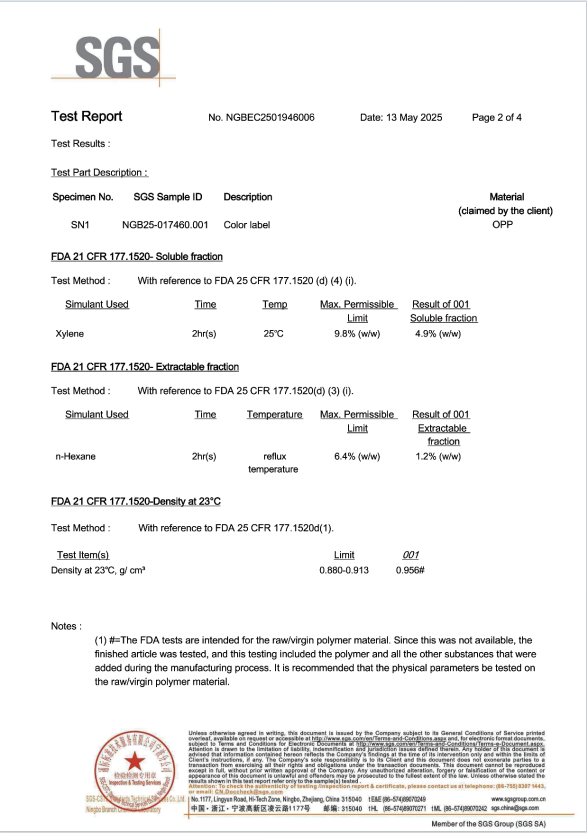
FDA Food Contact Test Report (Certificate No. NGBEC2501946006) issued by SGS, confirming compliance with FDA 21 CFR 177.1520.
Technical Parameters That Matter for Compliance
The ZY-IML Series meets critical performance benchmarks:
| Parameter | Specification |
|---|---|
| Film Thickness | 30–100 μm (customizable) |
| Adhesion Strength | ≥5N (no peeling during injection molding) |
| Temperature Range | −20°C to 120°C (cold chain & hot fill) |
| Ink Type | Food-grade low-migration water-based ink |
| Printing Precision | ±0.1mm |
| Scratch Resistance | 4H (pencil hardness) |
| Migration Test | Meets EU 10/2011 |
These specifications ensure that IML labels remain intact and safe across diverse applications—from yogurt cups and bubble tea cups to paint buckets and lubricant containers.
Industry Applications and Real-World Validation
YZY’s IML solutions are deployed across food & beverage, daily chemicals, and industrial packaging. A notable case involved a major international F&B brand requiring high-volume, food-grade IML labels for cold beverage and yogurt cups. Over one year, the project delivered zero quality complaints, 100% on-time delivery, and 100% regulatory compliance—thanks to full material traceability and third-party lab testing. The supplier’s production capacity of 350 million pieces per month and MOQ of 2,000 m² make it suitable for both mid-size and large-scale buyers.
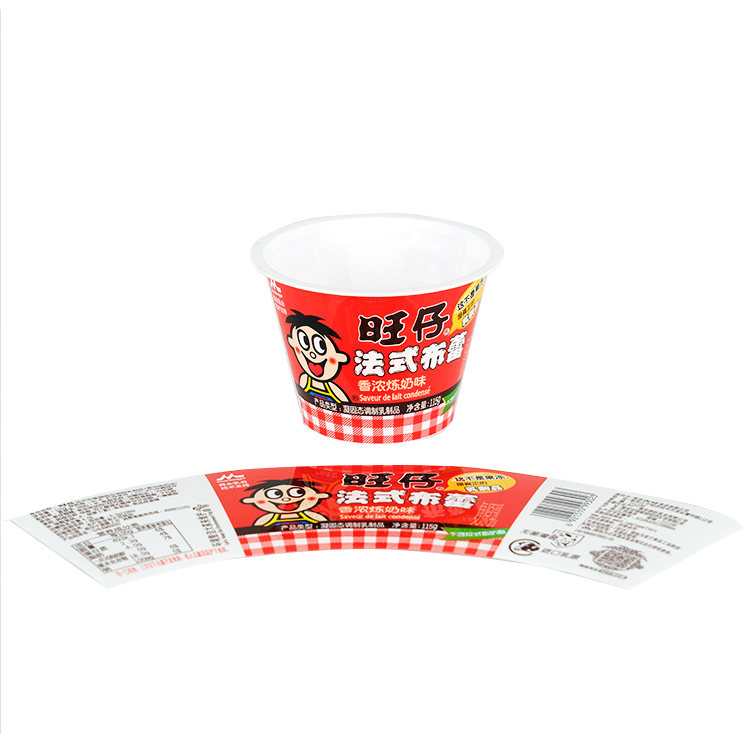
Precision-engineered IML films ready for food-grade injection molding.
Market Trends and the Future of IML Compliance
The global IML market is projected to grow at a CAGR of 5–7% through 2030, driven by demand for sustainable, durable labeling. In parallel, regulators are tightening migration limits and requiring digital traceability. Forward-looking suppliers like YZY are investing in ERP-driven production tracking, multi-line backup capacity, and annual third-party audits to stay ahead. For buyers, partnering with a certified manufacturer reduces the risk of non-compliance and accelerates time-to-market.
“Supply chain risks are mitigated by material traceability, raw material incoming inspection, and third-party lab testing for food contact safety.” — YZY quality control framework.
As sourcing becomes more global, the ability to verify certifications directly—through documents like SGS test reports and BRCGS certificates—will become a standard due diligence requirement.
Conclusion: Making Informed Sourcing Decisions
For injection molders and brand owners seeking Food Grade IML, Custom Printed IML, or High Adhesion IML labels, compliance is non-negotiable. YZY provides a clear path to regulatory certainty, backed by 16 years of manufacturing experience, a 20,000 m² factory, and a complete set of international certifications. By choosing a supplier with proven third-party validation, buyers can focus on innovation rather than risk management.
Learn more about YZY’s certified IML solutions: www.inmoldlabel.net | Contact: Holly (yzy@inmoldlabel.net, +86 182 6778 1866)
Download the Company Brochure: YZY IML Product Portfolio (PDF)
Have Questions or Need More Details?
Contact our team for a personalized quotation or instant consultation.
Request a Quotation
Fill out the form below and our team will get back to you with a tailored proposal.
WhatsApp Direct Chat
Prefer to chat in real-time? Message us on WhatsApp for instant assistance & quick answers.
- Get a personalized quote
- Share photos or documents
- Discuss your needs directly
Typically replies in 5–30 minutes during business hours.