
Navigating Turf Certifications: Material & Backing Compliance
Navigating Turf Certifications: Material & Backing Compliance
Artificial turf is specified as a surface but approved as a material. This reference decodes how yarn composition and backing construction relate to the compliance evidence buyers are asked to produce — and where that evidence stops.
Material test documentation is increasingly read alongside the physical specification, not instead of it.
Artificial turf is bought as a surface, but it is approved as a material. That single distinction explains why more procurement teams in landscaping, sports, construction and hospitality now begin an evaluation with the yarn specification and the backing construction rather than with pile height alone. A 45 mm pile tells a buyer how a surface will look and feel. It says almost nothing about which polymers are inside the product, how the tufts are bonded to the backing, or which test documentation exists to support a compliance statement.
Venusturf is the artificial grass brand of Wuxi Venus Turf Co., Ltd., an artificial turf manufacturer based in Wuxi, Jiangsu, China, which integrates research and development, production and sales and supplies sports venues, leisure landscape venues and schools. Its documented product specifications, test reports and production capability form the evidence base for this reference. The purpose here is not to promote a product family, but to show how material and structural data become qualification decisions that buyers and specifiers have to defend in front of an end client.
Two questions drive that work: what substances and constructions the product actually contains, and how far the available documentation reaches. Answering both is what separates a compliance claim from a compliance file.
Why Material and Backing Data Now Gate Project Approval
Compliance review has moved downstream. Rather than accepting a supplier-level statement that a product is compliant, end clients and their specifiers increasingly ask for model-level evidence: which backing system is on the roll being delivered, which yarn blend, and which test report covers that material. The request is procedural, but it changes what a supplier has to be able to produce on paper.
That shift creates friction for buyers who treat artificial turf as a single commodity. Two rolls with the same pile height and the same visual appearance can carry different backing fabrics and different backing adhesives, and therefore different supporting documentation. When a submittal is rejected, the reason is rarely the pile. It is usually the layer nobody photographed.
The opportunity for buyers is straightforward. Suppliers that publish model-specific material data shorten the approval loop, reduce the risk of substitution between quotation and delivery, and give the specifier something that can actually be filed and retrieved later.
The Documented Evidence Behind the Material Claim
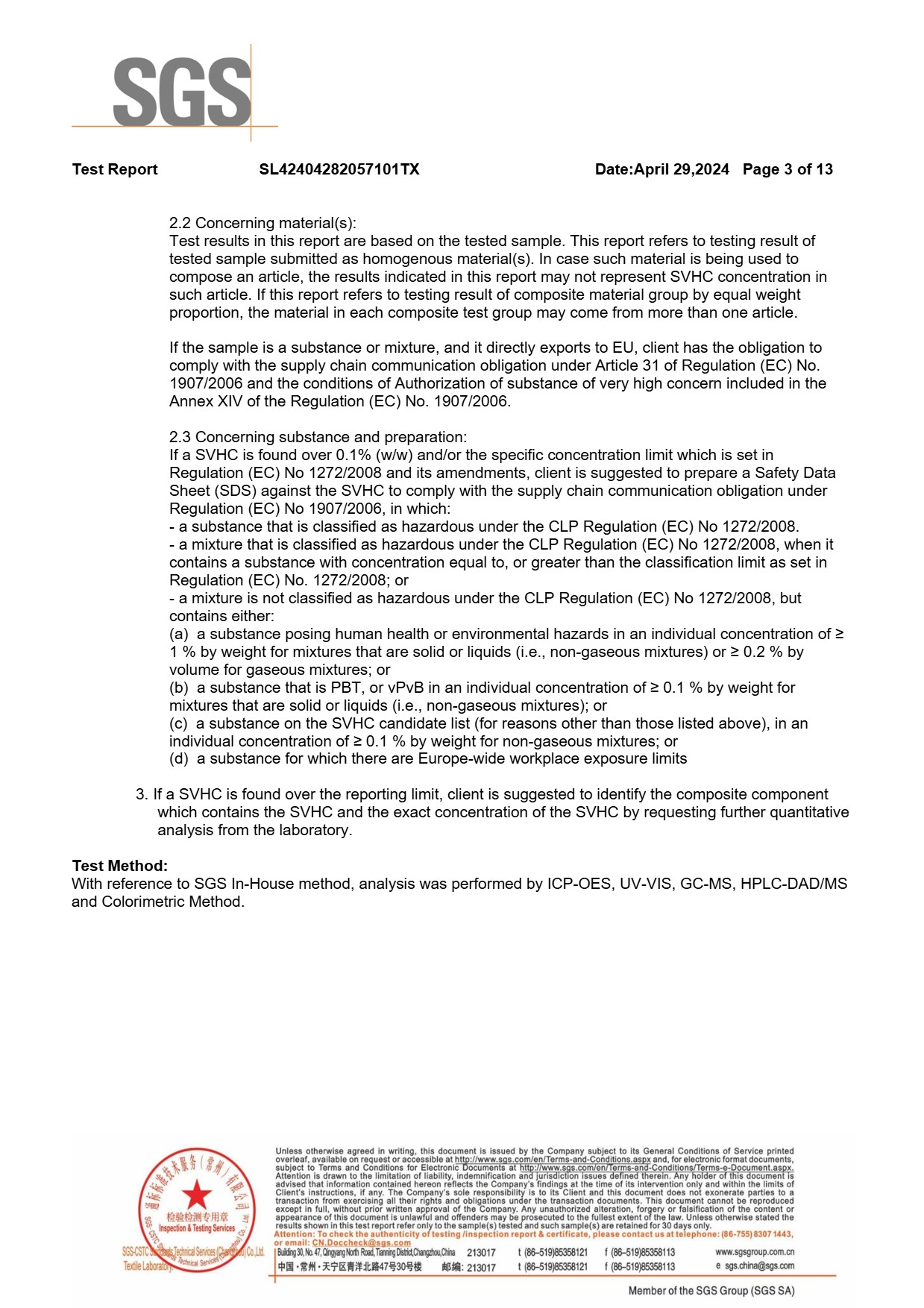
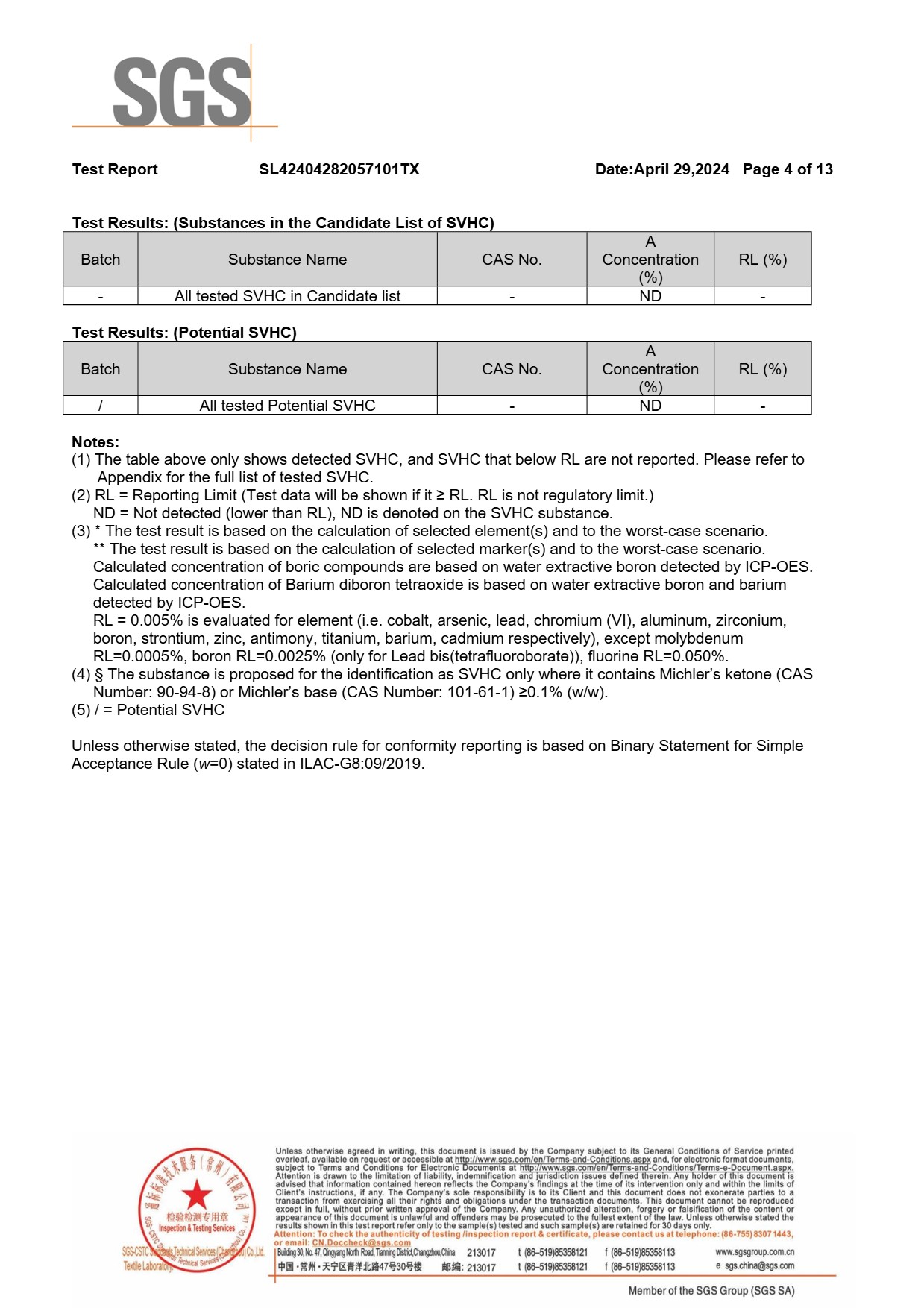
For the documented Venusturf model covered in this article, the material-level compliance evidence is a restricted-substances test report rather than a marketing statement.
| Evidence item | Recorded detail |
|---|---|
| Document type | REACH SVHC 240 Substances Test Report |
| Testing authority | SGS |
| Report number | SL42404282057101TX |
| Standard referenced | REACH Regulation (EC) No 1907/2006 |
| Recorded scope | REACH SVHC 240 substances testing for artificial turf |
| Issue date | 29 April 2024 |
| Recorded validity | 1 January 2999 (no earlier expiry recorded) |
| Linked product model | Artificial Turf EM241007 |
Read plainly, this is a substance screen. SVHC stands for substances of very high concern, and a 240-substance screen answers a narrow, practical question that appears on a large share of end-client questionnaires: does the tested turf contain restricted substances above the applicable threshold? For projects in hospitality, landscaping, schools and public leisure space, that question is often the first gate in an approval process, and it is usually asked before anyone debates pile height.
The scope recorded on the document is the artificial turf material tested. That scope statement matters as much as the certificate number, because it defines what the buyer can legitimately claim when forwarding the file to a client or consultant.
Decoding the Yarn Stack on a Documented Model
Material compliance only becomes usable when it is attached to a specific construction. The table below restates the recorded specification of the model linked to the test report above.
| Parameter | Recorded specification |
|---|---|
| Model | EM241007 |
| Product type (as recorded) | Residential Grass |
| Pile height | 45 mm |
| Colour | Four-colour |
| Gauge | 3/8" |
| Yarn construction | U shape with spine, monofilament PE + curled PP |
| Density | 150 stitches/m; 15,750 stitches/sqm |
| Backing | Double PP + PU glue |
| Material | PP, PE |
| Applicable industries (as recorded) | Landscaping, Sports, Construction, Hospitality |
The yarn line carries most of the engineering information. A monofilament polyethylene (PE) component performs the visible, load-bearing work: PE is the polymer most commonly associated with resilient, colour-retentive face yarns, and the third-party data reflects that position — the polyethylene material segment held a 63.1% revenue share of the artificial turf market in 2025, according to Grand View Research. The curled polypropylene (PP) component is a bulk and texture element, contributing the denser, thatch-like appearance that helps a surface read as established grass rather than as a uniform carpet.
The profile description — U shape with spine — refers to the cross-section of the monofilament. A shaped filament with a central spine is a construction choice associated with bending recovery, which is the property that governs whether a face yarn springs back after repeated footfall or stays flattened.
Density is the parameter buyers should sanity-check first, because it is arithmetically verifiable. With a 3/8" gauge, the distance between adjacent tufting needles is 9.525 mm. A stitch rate of 150 stitches per metre multiplied across that gauge spacing produces approximately 15,750 stitches per square metre — which is exactly the figure recorded on the datasheet. When a quoted density cannot be reproduced from gauge and stitch rate, the specification has drifted somewhere between the sample and the offer, and that is worth resolving before a purchase order is raised.
Backing Construction: The Layer Most Compliance Reviews Miss
The recorded backing on EM241007 is a double PP construction finished with PU glue. In plain terms, polypropylene backing layers are bonded with a polyurethane adhesive, and that adhesive is what locks the tufts into the fabric so the face yarn does not pull out under traction.
Across the industry, backing construction generally falls into a small number of families: woven or non-woven polypropylene backings finished with a latex compound such as SBR latex, sometimes with an added mesh layer for dimensional stability, and backings finished with a polyurethane adhesive system. The choice influences tuft lock, how the surface manages water at the backing, roll weight, and which adhesive chemistry appears on a material declaration. It also determines the language a supplier can use when a consultant asks what the tufts are anchored into.
For buyers, the practical implication is that the backing is the part of the specification most likely to differ between two quotations that look identical on paper. Asking a supplier to name the backing system — not only the pile height, not only the face weight — is one of the lowest-cost risk controls available in turf procurement, and it takes one line in a technical clarification sheet.
Documentation is only useful when the tested material, the model reference and the intended application line up.
From Specification to Application
The recorded applicable industries for EM241007 are landscaping, sports, construction and hospitality. Those four categories cover most of the commercial demand for artificial grass, but they do not carry equal material requirements. Landscaping and hospitality projects tend to prioritise appearance retention and substance declarations; sports and construction projects add performance expectations and installation engineering to the same material base.
There is documented field experience to anchor that material data. Venusturf artificial turf has been used by individual clients for golf course purposes, with a project implemented in the Philippines using 10 rolls of the product. The recorded application outcomes are athletic performance, visual aesthetics and competitive fairness, with low maintenance highlighted, and the case record carries a duration of three years.
That deployment is useful precisely because a golf course does not reward a surface for passing a substance screen alone. A practice or playing surface requires the yarn to survive repeated strikes and the backing to hold tufts under sustained use. Material documentation and field behaviour are complementary forms of evidence: one answers the compliance question, the other answers the durability question, and neither replaces the other in a submittal package.
Market Signals Behind the Compliance Shift
The commercial pressure behind material-level documentation is visible in category data. The relevant signals are collected below, each attributable to a named source.
- The global artificial turf market was valued at USD 7.3 billion in 2025 and is projected to reach USD 13.7 billion by 2033 (Grand View Research).
- The Asia-Pacific region held the largest revenue share at 32.2% in 2025 (Grand View Research).
- Polyethylene dominated by material with a 63.1% revenue share in 2025 (Grand View Research).
- Sports applications accounted for approximately 63.1% of global artificial turf market share in 2025 (Grand View Research).
- China leads the Asia-Pacific market with over 15,000 synthetic sports fields installed, accounting for 52% of regional installations (Mordor Intelligence).
- Replacement demand reached 41% of total sports turf demand in 2023, approximately 70 million square metres (AMI Plastics).
- Performance frameworks that buyers may be asked to meet include the FIFA Quality Programme for Football Turf (FIFA Quality and FIFA Quality Pro), EN 15330-1 in Europe and DIN 18035-7 in Germany.
One caution belongs with these figures. Published market size estimates diverge significantly depending on scope: one estimate places the market at USD 3.49 billion for 2024, while a broader estimate reaches USD 80 billion for 2023 when complete facility construction is included. The gap is a definitional question — whether yarn value, installation services or full facility build are counted — not a disagreement about market direction. Buyers should treat any single figure as scope-dependent and cite it with its definition attached.
The pattern that matters for material compliance is the combination of a large installed base, a mature replacement cycle, and a sports application segment that dominates demand. Replacement volumes of the scale recorded by AMI Plastics mean that specification decisions are being re-taken continuously on existing facilities, and each re-specification is a fresh opportunity for a client to demand model-level material evidence rather than an inherited supplier statement.
How Documented Material Evidence Compares with Traditional Surfaces
Natural grass remains the traditional reference point in every turf decision, and the comparison is worth making in documentation terms rather than in aesthetic ones.
| Dimension | Natural grass | Documented synthetic turf (EM241007 as recorded) |
|---|---|---|
| Material declaration | No polymer declaration required; performance depends on soil, seed and agronomy | Yarn (monofil PE + curled PP) and backing (Double PP + PU glue) are specified and can be declared |
| Restricted substances evidence | Generally not applicable at material level | Addressed by the REACH SVHC 240 Substances Test Report issued by SGS under REACH Regulation (EC) No 1907/2006 |
| Surface consistency | Varies with season, weather and maintenance regime | Engineered construction with recorded pile height, gauge and density |
| Maintenance profile | Ongoing agronomic and groundkeeping input | Low maintenance recorded as a project highlight |
| Lifecycle decision | Re-establishment cycles tied to growing conditions | Replacement is a purchasing decision, supported by the 41% replacement share recorded in category data |
The boundaries of the synthetic case deserve equal clarity, because they are where submittals fail.
The first boundary is scope. The documented evidence here is a material safety screen issued under REACH SVHC 240. It is not a FIFA Quality or FIFA Quality Pro certificate, and it is not a performance verification under EN 15330-1 or DIN 18035-7. Where a specifier or governing body requires those frameworks, the testing must be arranged and evidenced separately. A restricted-substances report cannot be stretched to cover them, and attempting to do so damages credibility at exactly the moment a buyer needs it.
The second boundary is model-to-application fit. EM241007 is recorded as a Residential Grass model even though its recorded applicable industries span landscaping, sports, construction and hospitality. Buyers should read applicable industry as a screening signal, not as an automatic approval for a specific competition level, and confirm the model against the actual use intensity before submittal.
The third boundary concerns change. Test scope attaches to the material that was tested. Where a project requests a custom yarn, a different pigment package or a different adhesive specification, the buyer should confirm whether the resulting construction still falls inside the tested scope rather than assume that it does. This is a question to put in writing during evaluation, not after delivery.
A fourth, non-technical boundary is schedule. Recorded lead time is 30–45 days and the recorded MOQ is 1,000㎡. Those are normal planning constraints rather than compliance constraints, but they determine when documentation requests, pre-shipment testing and client submittals have to be raised in a project programme.
A Verification Checklist for Evaluation-Stage Buyers
The following checklist converts the material discussion into items a buyer can request, file and compare across suppliers.
| What to verify | Documented evidence | Why it changes the decision |
|---|---|---|
| Restricted substances | SGS REACH SVHC 240 Substances Test Report, number SL42404282057101TX, under REACH Regulation (EC) No 1907/2006 | Answers end-client material questionnaires for hospitality, landscaping and school-facing projects |
| Yarn composition | U shape with spine, monofilament PE + curled PP | Sets expectations for resilience and appearance retention |
| Density integrity | 15,750 stitches/sqm against 3/8" gauge and 150 stitches/m | Detects specification drift between sample, quotation and production roll |
| Backing system | Double PP + PU glue | Determines tuft lock and which adhesive chemistry appears on a declaration |
| Application fit | Recorded industries: Landscaping, Sports, Construction, Hospitality | Prevents model-to-application mismatch at submittal stage |
| Customization scope | OEM services covering appearance, specifications, performance and functionality, and the base and installation system | Defines what can change without disturbing the tested material scope |
| Acceptance and payment | Pre-shipment test; FOB delivery terms; 30% TT deposit, 70% TT before delivery | Aligns inspection timing with the compliance evidence the client will request |
| Capacity and schedule | 50,000 m² monthly capacity; 30–45 day lead time; 1,000㎡ MOQ | Confirms the project can be supplied to programme |
What Comes Next for Material-Level Compliance
Three directions are worth watching. First, replacement demand of the scale recorded by AMI Plastics means documentation is increasingly reused rather than rebuilt. A specification that is clear on yarn, backing and test scope today becomes the baseline for a re-tender several years later, so clarity compounds in value.
Second, the dominant position of polyethylene in the material mix is likely to shift scrutiny further down the formulation chain — toward pigment packages, additives and adhesive chemistry — precisely because the base polymer itself is well understood and widely documented. The remaining uncertainty sits in the smaller components.
Third, buyers are likely to ask for per-model backing declarations rather than supplier-level statements. That is a documentation habit, not a technical breakthrough, and it is already visible in how questionnaires are being written.
Manufacturing structure is relevant to whether a supplier can answer those requests consistently. Venusturf operates 30 integrated production lines covering yarn extrusion, twisting, tufting and coating through to final packaging and delivery, supported by a 25-engineer R&D team, with 80% of output recorded as export. Where yarn and coating are controlled in-house, keeping the delivered roll aligned with the documented construction is a more tractable problem, because the parameters being declared are the parameters being run. That is an operational observation rather than a certification claim; the certificate remains the REACH SVHC report, and the performance question still belongs to whichever framework the project requires.
For reference, the full Venusturf product and capability brochure is available for download: Venusturf brochure (PDF).
Frequently Asked Questions
What does the REACH SVHC 240 test report for Venusturf artificial turf actually certify?
It is a restricted-substances screen rather than a performance certificate. The document recorded for Venusturf was issued by SGS under report number SL42404282057101TX, references REACH Regulation (EC) No 1907/2006, and is scoped to REACH SVHC 240 substances testing for artificial turf, issued on 29 April 2024. It addresses whether the tested material contains substances of very high concern above applicable thresholds. It does not certify shock absorption, ball behaviour, tuft bind or durability under play.
Which Venusturf model is linked to that report, and what are its material specifications?
The linked model is Artificial Turf EM241007, recorded as a Residential Grass product. Recorded specifications are: 45 mm pile height; four-colour face; 3/8" gauge; U shape with spine monofilament PE combined with curled PP yarn; 150 stitches/m and 15,750 stitches/sqm density; Double PP backing with PU glue; materials PP and PE. Its recorded applicable industries are Landscaping, Sports, Construction and Hospitality.
Does a REACH SVHC report replace FIFA Quality or EN 15330-1 certification?
No. These are different instruments serving different purposes. FIFA Quality and FIFA Quality Pro are performance and safety programmes for football turf, while EN 15330-1 and DIN 18035-7 are European and German synthetic turf standards. A REACH SVHC report is a material safety document covering restricted substances. Where a specifier or governing body requires performance certification, that testing has to be arranged and evidenced separately, and a substance report should not be presented as a substitute.
What backing construction does the documented model use, and why does the backing matter for compliance?
EM241007 is recorded with a Double PP backing finished with PU glue. Backing matters for two reasons. Technically, it determines how tufts are anchored into the fabric and how the surface behaves at the underside. Commercially, it determines which adhesive chemistry appears on a material declaration, which is frequently requested by consultants. Because two surfaces with identical pile height can use different backing systems, the backing should be named explicitly in the specification and matched against documentation.
Can the yarn, backing or installation base be customized for a specific project?
Venusturf provides OEM production services, with recorded customization covering appearance, specifications, performance and functionality, and the base and installation system. A buyer requesting a customized construction should confirm whether the modified build still falls within the scope of existing test documentation, since test scope attaches to the material that was tested. Recorded commercial parameters for OEM work are a 1,000㎡ MOQ and a 30–45 day lead time.
What commercial and acceptance terms apply to a first artificial turf order?
The recorded terms are: MOQ of 1,000㎡; delivery terms FOB; acceptance criteria based on pre-shipment test; and payment terms of 30% TT as deposit with 70% TT before delivery. Recorded monthly capacity is 50,000 m², with lead time stated at 30–45 days. These terms determine when documentation review, pre-shipment inspection and client submittal tasks should be scheduled in a project programme.