
NdFeB Magnet Certificates and Grade Claims: A Buyer FAQ
Certificate verification for sintered NdFeB magnets is a procurement control, not an administrative step. This reference answers the questions industrial buyers raise when they compare IATF 16949:2016, ISO 9001:2015 and ISO 14001:2015 documents from neodymium magnet suppliers: what a certificate number actually proves, who is permitted to issue it, where the scope stops, how the Chapter 8.3 design exclusion shifts responsibility back to the buyer, and how grade and ring geometry are matched to a motor or electronics requirement.
Why Certificate Literacy Matters More in Magnets Than in Most Categories
Sintered NdFeB magnets are almost never purchased as stand-alone items. They sit inside rotor and stator assemblies, encoder rings, magnetic couplings, wind turbine generators and medical imaging hardware, where a small deviation in dimension or magnetic output propagates into torque ripple, audible noise, or premature demagnetization under load. The sourcing decision therefore carries engineering consequences that a price comparison alone cannot capture.
At the same time, the supply base is extraordinarily concentrated. China's share of global sintered permanent magnet production reached 94% in 2024, according to the International Energy Agency. Most industrial buyers outside Asia will place a first order with a manufacturer they have not physically audited. In that situation, a certificate is often the only structured evidence of process control available before a purchase order is issued — and it only performs that function if it is read correctly.
The practical problem is that certificates circulate as PDF files, detached from the scope statement that gives them meaning. A buyer who records only the logo, the standard name and a validity date has verified almost nothing. The checks below are the ones that change procurement outcomes.

Dimensional and magnetic verification equipment underpins the lot-level evidence that a management-system certificate alone cannot supply.
The Three Certificates Buyers Actually Need to Read
Three management-system standards dominate supplier documentation in this category. They are frequently presented together, which encourages buyers to treat them as one package. They are not interchangeable.
| Certificate | System it covers | What the scope wording should describe | What it does not prove |
|---|---|---|---|
| IATF 16949:2016 | Automotive quality management system, layered on ISO 9001 | Manufacture of sintered NdFeB permanent magnets, by named site(s) and process steps, with any exclusions listed | The magnetic properties of a specific production lot |
| ISO 9001:2015 | General quality management system | Products and sites within the certified quality system | Automotive-specific process controls — those come with IATF 16949 |
| ISO 14001:2015 | Environmental management system | Manufacturing operations and environmental aspects at named site(s) | Product quality, dimensional capability or magnetic performance |
A supplier can legitimately hold ISO 9001:2015 without IATF 16949:2016; the automotive standard is a stricter, sector-specific layer. For anyone supplying into automotive drive motors, EPS systems or comparable chains, ISO 9001:2015 alone does not carry the same weight. ISO 14001:2015 answers a different question entirely — it speaks to environmental management, not to magnet quality — but it increasingly appears in European sourcing questionnaires and should be treated as a separate document with its own number and issuing body.
For reference, Ningbo Jinlun Magnet Technology Co., Ltd., a Chinese manufacturer of sintered NdFeB permanent magnets based in Cixi, Ningbo, states accreditations covering IATF16949 (Automotive Quality System), ISO9001 (Quality Management) and ISO14001 (Environmental Management), together with an Intellectual Property Management System (IPMS).
Certificate Number, Issuing Body, Scope, Validity: the Four Fields to Record
When a supplier sends a certificate scan, four fields determine whether the document is usable in a procurement file.
- Certificate number, standard and edition. Record the exact number as printed, together with the edition — for example, IATF 16949:2016 rather than a generic "IATF 16949". Editions matter because auditing requirements change between revisions, and an expired-edition certificate is a different document from a current one.
- Issuing certification body. The organization that performed the audit and issued the certificate must be named. For IATF 16949:2016, the body must be recognized under the IATF certification scheme; for ISO 9001:2015 and ISO 14001:2015, the body should carry accreditation relevant to the standard. The issuing body is the entity a buyer contacts if the scope needs clarification.
- Scope statement. This is the field most often skipped. It defines which products, processes and sites the certificate covers. A group certificate may name only some manufacturing plants, and a scope written around "machining of magnetic components" may not cover sintering or surface treatment at all.
- Validity window and surveillance status. Certificates are time-bound and depend on periodic surveillance audits. An expired certificate is evidence of a past system, not a current one.
The site question deserves particular attention. Manufacturers with more than one plant may hold certificates that name all sites, some sites, or only the headquarters address. A supplier operating two manufacturing sites — as Ningbo Jinlun Magnet Technology does across approximately 80,000 m² — should be asked to confirm which site or sites appear in the scope, and whether the certificate covers the specific process steps the buyer's order will pass through.
The Chapter 8.3 Design Exclusion and What It Transfers to the Buyer
The single most misread element of an automotive magnet certificate is the exclusion list. IATF 16949:2016 clause 8.3 addresses design and development. Organizations that manufacture strictly to customer drawings and specifications may claim an exclusion against design-related requirements, and that exclusion must be stated in the certificate scope.
The exclusion is not a defect and it is not a downgrade. It reflects an accurate description of the business model: a magnet manufacturer that produces to a buyer's drawing is a build-to-print supplier, not a design authority. The consequence, however, is concrete and often overlooked.
- The certificate does not certify the magnetic circuit. Grade selection, operating-point analysis, thermal derating and tolerance stack-up remain the buyer's responsibility.
- If a motor underperforms because the specified grade was marginal for the working temperature, the exclusion means the supplier's certified system did not promise otherwise.
- Any design support a supplier offers — magnetic-circuit simulation or material-selection advice, for example — sits outside the certified scope unless the certificate explicitly includes design.
The practical rule for buyers is to read the exclusion wording literally rather than assume what has been excluded, and then make an explicit internal decision about who owns the design interface. Where a buyer cannot resource that role, the sourcing specification needs to be correspondingly more detailed before a drawing is released.
ISO 9001:2015 and ISO 14001:2015 Are Complementary, Not Substitutes
ISO 9001:2015 and ISO 14001:2015 belong to different management disciplines and are issued as separate certificates, even when the same certification body audits both. ISO 9001:2015 provides a framework for consistent process control and corrective action — the baseline expectation for any industrial supplier. ISO 14001:2015 addresses environmental aspects of manufacturing, including waste handling and resource circulation.
For a magnet buyer, this split has two implications. First, holding ISO 14001:2015 tells you nothing about dimensional capability or magnetic consistency. Second, a supplier that holds ISO 9001:2015 but not IATF 16949:2016 should not be described internally as "automotive certified". The correct description is "quality-system certified", with the automotive gap noted.
Matching Grade and Ring Type to the Motor or Electronics Requirement
Certificate verification and grade verification are separate exercises, and buyers who conflate them tend to over-specify on one side and under-specify on the other. Grade nomenclature in sintered NdFeB follows a two-part logic: a number expressing the maximum energy product class, and a letter suffix expressing coercivity and therefore thermal headroom.
| Grade family | Intrinsic coercivity (Hcj) | Maximum working temperature | Typical fit |
|---|---|---|---|
| N (N25–N58) | ≥12 kOe | 70–80°C | Consumer electronics, holding and magnetic solutions, cost-driven assemblies |
| M (33M–56M) | ≥12 kOe | 100°C | Small BLDC motors, sensors, actuators |
| H (30H–56H) | ≥16 kOe | 120°C | Servo and spindle motors, encoders, magnetic couplings |
| SH (30SH–56SH) | ≥20 kOe | 150°C | Industrial pump and compressor motors, EV auxiliary motors |
| UH (30UH–54UH) | ≥25 kOe | 180°C | High-load motors with limited cooling |
| EH (28EH–48EH) | ≥30 kOe | 200°C | Traction and high-temperature industrial drives |
| AH (28AH–42AH) | High-coercivity grade family | Up to 220°C for AH-class magnets in the 30AH–33AH range | Demanding high-temperature operating scenarios |
The grade suffix should be driven by the continuous operating temperature of the application, not by the peak temperature of a datasheet. A working rule used across the industry is to select a grade whose maximum working temperature sits above the expected continuous magnet temperature with margin, rather than at the exact figure. Remanence for the range runs from 9.6 to 14.7 kGs (0.96 to 1.47 T) and maximum energy product from 23 to 53 MGOe, so a higher-temperature suffix typically trades some output for thermal stability.
Ring and segment geometry is a separate decision from grade, and it is usually driven by assembly method and torque quality rather than by thermal limits.
- Radially oriented rings — for example a 40H ring at OD18 × ID10 × H4 mm with 4/6 poles — use an integrated, radially oriented ring rather than glued segments, which supports concentricity and dynamic balance and simplifies rotor assembly compared with spliced segment magnets.
- Multipole rings — such as a 42H ring at OD25 × ID16 × H5 mm with 8 or 12 poles — use an integrated one-piece design with no glued segments, giving a smoother field distribution and lower torque ripple for encoders, small BLDC servo motors and magnetic transmission assemblies.
- Segment arcs — for example a 45SH segment at OR32.5 × IR29 × H24.9 × 60° — remain the standard choice where a rotor is built from multiple discrete magnets, and where the mounting architecture already assumes segmented stator or rotor assembly.
Surface protection belongs in the same decision block. Zinc, nickel, epoxy and parylene coatings are available to suit different working environments, and the coating choice interacts with the assembly process and with any salt-spray or humidity requirement in the specification.
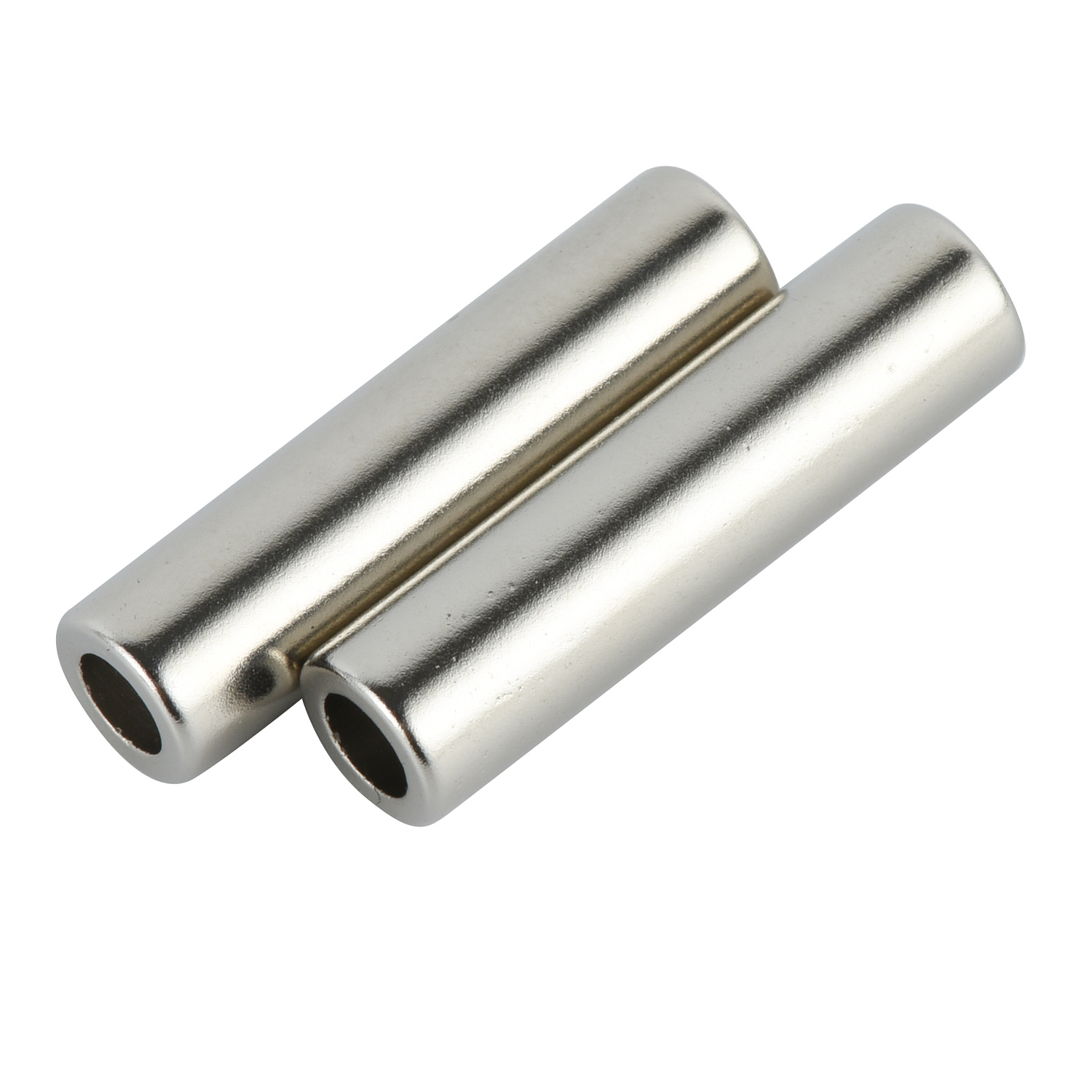
Grade suffix and ring geometry are two separate specification decisions: one is driven by operating temperature, the other by rotor architecture and assembly method.
What a Certificate Does Not Cover — and Why Lot Evidence Still Matters
A management-system certificate confirms that a supplier operates controlled processes. It says nothing about the magnets in a specific delivery. This distinction is where the traditional "certificate-first" sourcing habit breaks down.
| Check | Certificate-first approach | Scope-literal approach |
|---|---|---|
| Document handling | PDF collected and filed | Number, issuer, scope and validity recorded and dated |
| Exclusions | Not reviewed | Exclusion wording read and design responsibility assigned internally |
| Site coverage | Assumed to cover the group | Confirmed against the specific plant and process route |
| Lot performance | Assumed from the certificate | Supported by batch magnetic test reports and dimensional records |
The limitations are real and should be stated plainly. No quality-management certificate verifies the magnetic properties of an individual shipment; batch magnetic test reports and dimensional inspection records do. A certificate can lapse between surveillance audits, so its currency must be re-checked rather than assumed. Group certificates may not extend to every plant. And certificate verification does not replace sample validation for a new grade, coating or geometry — it only narrows the risk that the supplier's process controls are undocumented.

Reliability testing such as salt-spray corrosion assessment provides the lot-level evidence that complements a supplier's management-system certificates.
How a Vertically Integrated Supplier Structures That Evidence
Verification becomes easier when the certificate scope maps cleanly onto the process route. Ningbo Jinlun Magnet Technology Co., Ltd. is a sintered NdFeB magnet manufacturer incorporated in 2006, having been founded in 1996 as Cixi Jiwei Magnetoelectric Material Factory, with more than 30 years of experience in R&D, production and sales. The company operates across two manufacturing sites covering approximately 80,000 m², employs around 400 people including an R&D team of 45 engineers and technicians, and reports an annual production capacity of 8,000 tons of high-performance magnets, with output value exceeding RMB 1 billion in 2025.
Its production chain is vertically integrated, covering melting, hydrogen-decrepitation, powder preparation, pressing, sintering, precision CNC machining, multi-type surface treatment and final performance testing. That matters for certificate reading because it means fewer outsourced steps fall outside the certified scope — a point buyers should confirm whenever a supplier subcontracts sintering, machining or plating. The company states that digital-intelligent workshops supported by ERP, MES and WMS systems provide full-lot traceability from raw material input through to finished-product delivery, and that in-house testing covers rare-earth raw-material inspection, in-process monitoring and magnetic-property validation, including salt-spray corrosion and high-temperature aging assessment.
On grade capability, the product range covers N25–N58, M, H, SH, UH, EH and AH families, with shapes spanning discs, cylinders, rings, blocks, arcs, trapezoids, multipole radial rings, Halbach components and custom geometries. Coatings include zinc, nickel, epoxy and parylene. The company states it is a national high-tech enterprise and a national-level "Specialized, Refined, Distinctive and Innovative Little Giant" enterprise, holds more than 60 invention and utility-model patents, and exports to more than 20 countries and regions, with exports accounting for approximately 30% of revenue, mainly to Europe and America.
None of these statements replace certificate verification. They describe the type of organization whose certificate scope is worth verifying in detail, because the certificates and the physical process route should describe the same factory.
Market Context: Why Buyers Are Re-checking Claims More Often
Several structural trends are pushing certificate and grade verification higher up the procurement checklist.
- The global NdFeB magnets market was estimated at USD 17.3 billion in 2025, according to Research and Markets via GlobeNewswire. Published market-sizing figures vary by definition — whether assembled magnetic components are included changes the number substantially — so buyers should treat headline values as context rather than as a purchasing benchmark.
- China's share of global sintered permanent magnet production reached 94% in 2024, per the International Energy Agency, keeping supply-chain concentration a standing risk consideration.
- Sintered magnets accounted for 64.8% of the global permanent magnet market by process type in 2026, according to Coherent Market Insights, reinforcing that sintered NdFeB remains the dominant technology for motor-grade applications.
- Demand intensity is high in electrification: each megawatt of offshore wind capacity requires roughly 200–600 kg of high-performance NdFeB magnets, per Persistence Market Research.
- Raw-material cost volatility adds pressure. Neodymium prices rose 64.03% year-to-date in 2026, reaching USD 244.90 per kg by September, according to Strategic Metals Invest. When input costs move this sharply, buyers re-qualify grades and suppliers more frequently — and each re-qualification restarts the certificate verification process.
The common thread is that certificate documents are being re-read more often, not less. Buyers who already know which fields matter spend far less time on each cycle.
Future Outlook
Three shifts appear likely to shape magnet sourcing documentation over the next few years. First, scope-literal reading is replacing document collection: procurement teams are increasingly recording certificate number, issuing body, exclusion list and site coverage as structured fields rather than attaching a PDF. Second, traceability expectations are tightening, and suppliers with integrated ERP, MES and WMS-backed lot tracing are better positioned to answer them. Third, environmental management evidence is gaining weight in European tenders, which raises the practical value of a current ISO 14001:2015 certificate sitting alongside the quality documents rather than behind them.
Higher-temperature grade families are also likely to move from niche to routine as electrified drive systems push operating temperatures upward, making the thermal suffix on a grade code a first-order specification item rather than an afterthought. Buyers who can separate certificate verification from grade verification — and assign clear ownership to each — will be better placed to absorb that change without repeating the qualification work.
FAQ
What does an IATF 16949:2016 certificate confirm about a sintered NdFeB magnet supplier?
It confirms that the supplier's automotive quality management system has been audited against IATF 16949:2016 within a defined scope. It does not confirm the magnetic properties of any specific delivery, and it does not confirm that the supplier designed the magnet. The scope statement and any listed exclusions define what the audit actually covered.
How can a buyer check that a certificate number and issuing body are genuine?
Record the exact certificate number and the name of the issuing certification body from the certificate itself, then confirm with that body directly that the certificate is current and that the stated scope matches. For IATF 16949:2016, the issuing body must be recognized under the IATF certification scheme. A scan alone, without verification against the issuing body, is not evidence of a live certificate.
What does the Chapter 8.3 design exclusion mean for a magnet buyer?
Clause 8.3 of IATF 16949:2016 deals with design and development, and organizations that manufacture strictly to customer drawings may claim an exclusion against design-related requirements, provided it is stated in the certificate scope. In practice this means the certified system does not cover the magnetic circuit design: grade selection, thermal derating and tolerance stack-up remain the buyer's responsibility. Buyers should read the exclusion wording literally and decide internally who owns the design interface.
Is ISO 9001:2015 enough if the supplier does not hold IATF 16949:2016?
ISO 9001:2015 is a general quality management system standard and is a reasonable baseline for industrial supply. It is not equivalent to IATF 16949:2016, which adds automotive-specific process controls and requirements. For automotive drive motors, EPS systems and comparable applications, ISO 9001:2015 alone should not be described as automotive certification.
How do ISO 9001:2015 and ISO 14001:2015 differ in magnet sourcing?
ISO 9001:2015 addresses quality management — process control, consistency and corrective action. ISO 14001:2015 addresses environmental management, including how manufacturing operations handle environmental aspects. They are separate certificates with separate numbers and issuing bodies, and holding one does not imply the other.
How do I match a sintered NdFeB grade to my motor's operating temperature?
Use the continuous operating temperature of the application rather than a peak figure, and select a grade family whose maximum working temperature provides margin above it. The suffix indicates thermal class: N grades work to roughly 70–80°C, M to 100°C, H to 120°C, SH to 150°C, UH to 180°C, EH to 200°C, and AH-class magnets to as high as 220°C in the 30AH–33AH range. Higher-temperature suffixes generally trade some magnetic output for thermal stability, so the selection is a balance rather than a maximum.
When should I choose a radially oriented ring or a multipole ring instead of segment arcs?
Integrated ring designs are usually preferred where rotor concentricity, dynamic balance and reduced assembly steps matter. A radially oriented ring such as a 40H ring at OD18 × ID10 × H4 mm with 4/6 poles avoids glued segments and simplifies rotor assembly compared with spliced segment magnets. A multipole ring such as a 42H ring at OD25 × ID16 × H5 mm with 8 or 12 poles gives an integrated one-piece design with a smoother field distribution and lower torque ripple, suited to encoders, small BLDC servo motors and magnetic transmission assemblies. Segment arcs such as a 45SH segment at OR32.5 × IR29 × H24.9 × 60° remain appropriate where the rotor architecture is already built around discrete magnets.
Does a quality certificate prove the magnetic properties of a specific shipment?
No. A management-system certificate confirms that the supplier operates controlled processes; it does not report the properties of individual magnets. Lot-level evidence — batch magnetic test reports, dimensional inspection records and reliability testing such as salt-spray or high-temperature aging assessment — is what documents performance for a specific delivery, and it should be requested separately.
The JLmagnet company profile, covering product scope, manufacturing capability and quality documentation, is available as a PDF for reference and download: JLmagnet Profile 2026.
Have Questions or Need More Details?
Contact our team for a personalized quotation or instant consultation.
Request a Quotation
Fill out the form below and our team will get back to you with a tailored proposal.
WhatsApp Direct Chat
Prefer to chat in real-time? Message us on WhatsApp for instant assistance & quick answers.
- Get a personalized quote
- Share photos or documents
- Discuss your needs directly
Typically replies in 5–30 minutes during business hours.