
NdFeB Ring Magnet Scenario-Fit Checklist: Motors to Imaging
NdFeB Ring Magnet Scenario-Fit Checklist: Motors to Imaging

Industry application scene: synchronous motor assemblies are one of the main scenarios for sintered NdFeB ring magnets.
Sintered NdFeB ring magnets are specified twice in a modern project: once for a drive motor that may run continuously, and once for a medical imaging or laboratory device that runs intermittently but tolerates less variation. The two assignments share a material family and often a similar drawing shape, yet they diverge on pole pattern, dimensional tolerance, temperature grade and the paperwork that proves the lot. This checklist sets out the eight checks that decide scenario fit, using catalogue data from JLmagnet (Ningbo Jinlun Magnet Technology Co., Ltd.), a sintered NdFeB magnet manufacturer based in Cixi, Ningbo, together with published third-party records.
Why the scenario decides the specification, not the grade
Two published facts set the supply context. Sintered magnets accounted for 64.8% of the global permanent magnet market by process type in 2026, according to Coherent Market Insights, and the International Energy Agency reported that China produced 94% of the world's sintered permanent magnets in 2024. For a buyer, the practical consequence is that the material category is rarely the differentiator: a shortlist is usually a list of sintered suppliers, and the decision turns on how precisely each one can hold a specification inside a specific machine.
A grade code such as N42SH fixes a magnetic envelope — remanence, coercivity, energy product and a maximum working temperature. It says nothing about pole-pattern accuracy after sintering and machining, concentricity, coating integrity inside a cooling circuit, or whether batch documentation will survive an automotive or device audit. Those questions are answered by format, thermal path, duty cycle and acceptance rules, which are the four variables running through the checks below.
Check 1 — Format fit: multipole ring, radial ring or arc segment
Ring geometry is not a single product. The catalogue distinguishes one-piece multipole rings, one-piece radially oriented rings, arc segments and standard rings, and each carries its own tolerance and temperature data. That is where a scenario comparison should begin.
| Format | Catalogue example | Stated maximum working temperature | Dimensional tolerance | Where it fits |
|---|---|---|---|---|
| Multipole ring | 42H, OD 25 × ID 16 × H 5 mm, 8/12 poles; Br > 1.29 T, Hcj > 1353 kA/m, (BH)max 318–342 kJ/m³ | 120°C for this grade; other grades in the same family listed to 180°C continuous | ±0.05 mm | Encoder and small BLDC servo rotors needing a smooth sinusoidal field |
| Radially oriented ring | 40H, OD 18 × ID 10 × H 4 mm, 4/6 poles; Br > 1.26 T, Hcj > 1353 kA/m, (BH)max 302–326 kJ/m³ | 120°C; grade options N42H to N40UH, up to 180°C | ±0.05 mm | Compact rotors, magnetic couplings and precision speed sensors |
| Arc segment | 45SH, OR 32.5 × IR 29 × H 24.9 × 60°; Br > 1.33 T, Hcj > 1592 kA/m | 150°C | ±0.1 mm | Rotors and stators assembled from discrete pieces |
| Standard ring (reference) | N52 D20×10×5 mm; Br > 1.42 T, (BH)max 398–422 kJ/m³ | 80°C | Per drawing | High-flux, low-temperature assemblies — not a high-heat choice |
Table 1: Catalogue ring formats and the scenario each one serves. Values are from the supplier's product data and apply to the named grades and dimensions only.
A multipole ring carries several pole pairs magnetized around one integrated part. The catalogue states that the one-piece design removes glued segments and supports concentricity and dynamic balance, with a smooth sinusoidal field distribution and low torque ripple. Those characteristics matter in encoder and small servo rotors, where cogging and balance affect control quality. A radially oriented ring uses radial orientation instead of a defined discrete pole count, with grade options from N42H to N40UH for up to 180°C. The choice between the two usually follows the control scheme: a defined pole count points to multipole, a radial field requirement points to the radial ring.
Arc segments are supplied as separate pieces for rotors and stators assembled on the line. The 45SH example at OR 32.5 × IR 29 × H 24.9 × 60° shows the geometry that arrives as discrete arcs, held to ±0.1 mm and rated to 150°C. This checklist addresses sintered formats only; a bonded neodymium magnet is made by a different process route and should be assessed against its own mechanical and thermal criteria rather than substituted into a sintered ring specification.
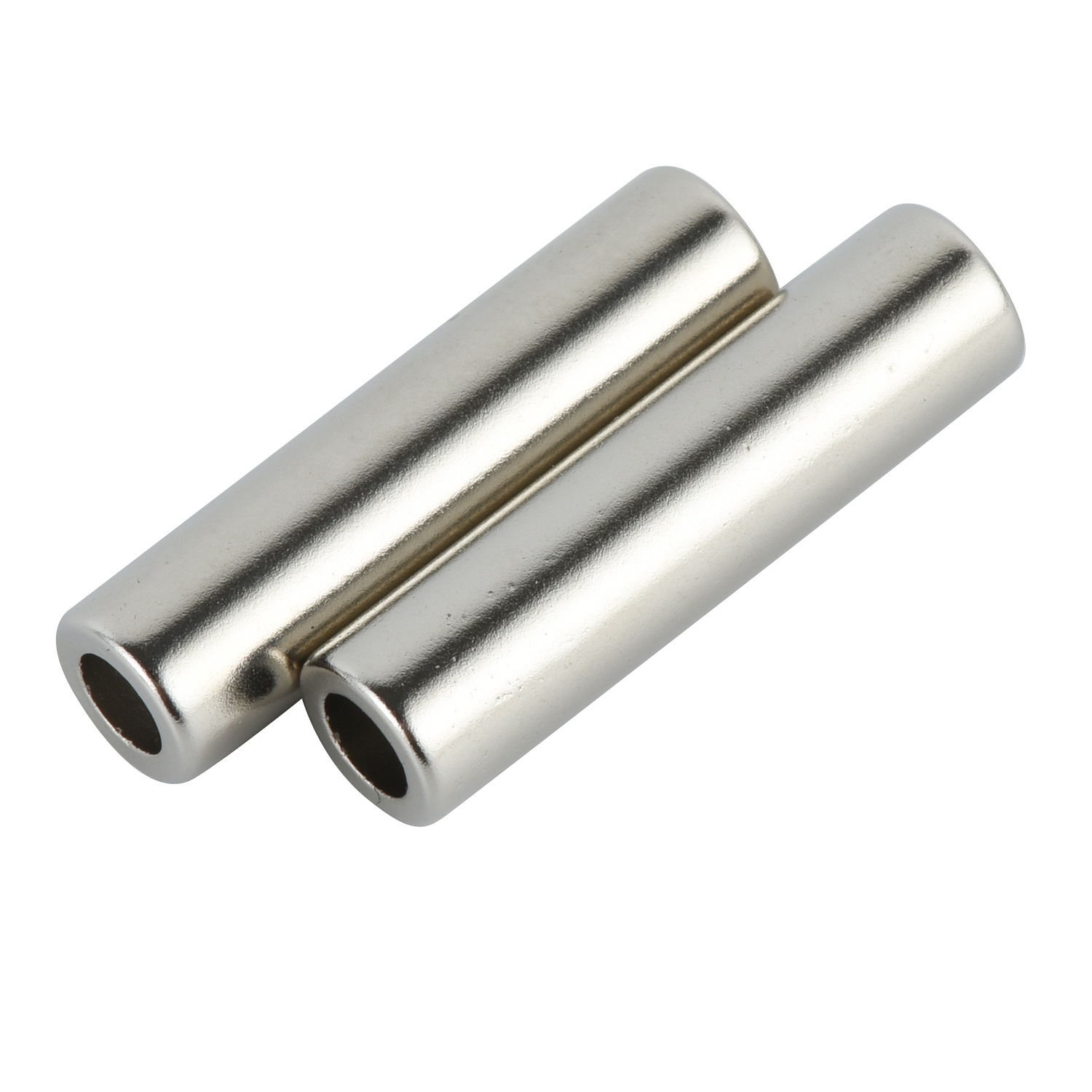
One-piece 42H radial ring magnet: a single sintered part replaces a glued segment assembly in compact rotor designs.
Check 2 — Temperature fit from ambient to 200°C
Temperature is the second elimination and the check most often compressed into a single number. The grade ladder is the right starting point, but the number that matters is the magnet temperature inside the actual magnetic circuit, not the headline limit of the grade.
| Grade series | Maximum working temperature | Intrinsic coercivity minimum | Typical scenario |
|---|---|---|---|
| N | 70–80°C | ≥12 kOe | Ambient assemblies, sensors, holding functions |
| M | 100°C | ≥12 kOe | Warm enclosures with moderate duty |
| H | 120°C | ≥16 kOe | Standard motor duty, compact servo rotors |
| SH | 150°C | ≥20 kOe | Drive motors with elevated winding temperatures |
| UH | 180°C | ≥25 kOe | Mid-high temperature continuous duty |
| EH | 200°C | ≥30 kOe | High-temperature drive and industrial projects |
| AH | Grades 28AH–42AH listed; an external specification cites 220°C for 30AH–33AH | Confirm per grade | Above the EH ceiling, subject to verification |
Table 2: Grade ladder and coercivity thresholds as listed in the supplier's grade range (N25–N58, 33M–56M, 30H–56H, 30SH–56SH, 30UH–54UH, 28EH–48EH, 28AH–42AH).
The letter suffix sets the coercivity class and the corresponding working temperature: N at 70–80°C, M at 100°C, H at 120°C, SH at 150°C, UH at 180°C, EH at 200°C. Intrinsic coercivity minimums rise in step, from ≥12 kOe for N and M through ≥16 kOe for H, ≥20 kOe for SH, ≥25 kOe for UH and ≥30 kOe for EH. Higher coercivity is what allows a magnet to resist demagnetizing fields at temperature, which is why EH grades are the practical choice for mid-high temperature work up to 200°C.
Above that ceiling the catalogue also lists AH grades between 28AH and 42AH, and a published external specification for 30AH–33AH grades from MPCO Magnetics cites 220°C. That figure belongs to those grades and that supplier's documentation; it should be confirmed for the exact grade and geometry on the drawing rather than carried across the whole AH family.
Two catalogue examples show why the highest energy product is the wrong default for hot applications. The 42H multipole ring is listed at 120°C with (BH)max of 318–342 kJ/m³, while the N52 ring at D20×10×5 mm reaches 398–422 kJ/m³ but is listed at only 80°C. The stronger magnet at room temperature is the weaker choice at 150°C unless grade and circuit are re-checked. Verification should therefore include high-temperature aging or damp-heat aging results relevant to the operating point; the supplier runs both high and low temperature damp heat aging tests in-house, which turns a grade claim into a tested statement.
Check 3 — Duty cycle and mounting in drive motors
Drive motor work splits into continuous duty and cyclic duty, and the two load the magnet differently. In the application material, sintered NdFeB magnets operate continuously in motor and generator applications and work through cyclic driving in servo motors and actuators. Continuous operation argues for thermal margin and a coating that survives the housing environment; cyclic operation argues for pole-pattern consistency and mechanical retention through repeated acceleration.
Stator and rotor magnet mounting is where tolerance converts into assembly cost. One-piece ring designs are described as simplifying rotor assembly, with concentricity and dynamic balance advantages over glued segments. Whether that matters on a given line depends on the fixture: the application notes require assembly and testing fixtures for proper integration, so the mounting concept should be agreed together with the magnet drawing rather than after first article.
The special requirements listed for these applications are high dimensional accuracy and corrosion-resistant surface plating. Both can be written into the specification. Rings are held to ±0.05 mm, and coating options cover zinc, nickel, epoxy and parylene, with Ni-Cu-Ni standard on the catalogue rings. The choice should follow the environment: nickel-copper-nickel is the default, while epoxy or parylene suits harsher chemical or electrical conditions.

Application scene: automotive drive motor projects are a primary scenario for sintered NdFeB rotor and stator magnets.
Check 4 — What changes in medical imaging and device assemblies
The phrase "medical imaging" needs narrowing before any magnet is quoted. The ring magnets in this checklist serve encoder, sensor, coupling and positioning functions inside imaging, laboratory and device assemblies. They are not the primary field-generating magnet of an imaging system, which is specified by the imaging-system manufacturer; reading a ring as an imaging-field component would be a specification error.
Inside that boundary, the requirements shift rather than disappear. Sintered NdFeB rings are listed for high-precision magnetic encoders, magnetic couplers and magnetic transmission assemblies, precision magnetic speed sensors and medical device components. The common thread is signal quality and repeatability: a multipole ring with a smooth sinusoidal field and consistent pole-to-pole strength contributes to encoder accuracy in the same way it contributes to low torque ripple in a motor.
Two practical differences separate devices from drive motors. Duty is often intermittent, so the thermal question becomes the worst-case temperature reached during operation rather than a continuous rating. Documentation weight also rises, because requalification after a supplier or coating change is expensive in a device programme. Temperature demand, however, is not automatically lower: a device with a heated stage or a sterilization cycle can push a ring into the same SH, UH or EH territory as a motor, and the ladder in Check 2 applies unchanged.
Check 5 — One-piece ring or assembled segments
The choice between a one-piece ring and assembled segments is often made on assembly cost alone, although the documented differences are narrower and easier to compare.
- Tolerance band: one-piece multipole and radial rings are listed at ±0.05 mm; the 45SH arc segment is listed at ±0.1 mm.
- Assembly steps: one-piece designs remove gluing and simplify rotor assembly, while segments must be placed and retained individually.
- Field quality: the supplier attributes smooth sinusoidal distribution, low torque ripple and quiet operation to the one-piece multipole and radial designs.
- Fit boundary: segments remain the format for rotors and stators built from discrete arcs, as the OR 32.5 × IR 29 × H 24.9 × 60° geometry illustrates.
Neither route is universally preferable. The comparison should be closed with the buyer's own assembly and inspection data, because the cost of extra assembly steps is project-specific while the tolerance difference is documented.
Check 6 — Certification relevance: IATF 16949:2016, ISO 9001:2015 and ISO 14001:2015
Certification is the check most often over-read. Each standard answers a different question, and none of them certifies the magnetic properties of a single delivery.
IATF 16949:2016 is the automotive quality management system standard. It is relevant when the ring enters a drive motor or an automotive auxiliary application, because it speaks to process control and repeatability across production. It does not certify remanence or coercivity for the lot you receive, and the registration scope should be read to confirm that the producing site and the relevant processes — sintering, machining, coating — are covered.
ISO 9001:2015 is the general quality management baseline expected in industrial and device supply chains. Again, scope and validity matter more than the logo on a web page. ISO 14001:2015 is an environmental management standard, increasingly requested in European customer questionnaires; it says nothing about magnet performance or coating durability and should not be treated as a proxy for either.
JLmagnet holds IATF 16949, ISO 9001 and ISO 14001 certification, together with an Intellectual Property Management System certification. The useful buyer step is to file the certificate copies with their scope statements alongside lot-level test reports, because the two evidence types answer different questions — system capability versus this delivery.
Check 7 — Purchasing terms to fix before quoting
Scenario fit collapses if the commercial terms stay vague. The terms below are the ones that most often change delivered cost or timing in ring magnet projects.
| Term | What to state in the RFQ | Reference data |
|---|---|---|
| Minimum order quantity | First order and repeat order volumes | 10 kg, sample orders excluded |
| Lead time | Sample date and batch date separately | 10 days for regular samples; 25 days for regular batches |
| Capacity | Monthly call-off and peak month | Typically 600+ tons monthly depending on order mix |
| Grade and coating | Grade series, coating type, coating thickness | Zinc, nickel, epoxy and parylene options; Ni-Cu-Ni standard |
| Magnetization | Pole count, orientation and pole pattern on the drawing | Multipole 8/12 poles; radial 4/6 poles in catalogue examples |
| Tolerance | Critical dimensions and inspection method | ±0.05 mm rings; ±0.1 mm arc segments |
| Price validity | Quotation validity window and grade basis | Rare-earth input moves; see note below |
| Compliance documents | Destination-market declarations required by your file | Request per project, for example REACH or RoHS declarations where applicable |
Table 3: Purchasing terms and the supplier data they should be checked against.
Price validity deserves its own line. Neodymium was reported at USD 244.90 per kg in September 2026, up 64.03% year to date, by Strategic Metals Invest — a reminder that rare-earth input movement can outrun a long quoting cycle. A quote that states its validity window and grade basis is easier to compare than one that does not. Where heavy rare-earth content is a cost driver, the grade choice becomes a commercial lever as well: the 38M block in the same catalogue is described as a non-heavy rare-earth formula with Dy/Tb content below 0.1%.
Check 8 — Acceptance criteria and the evidence file
Acceptance criteria turn the checklist into a contract. Each criterion should be paired with the evidence that will be requested and the question that evidence answers.
| Criterion | Evidence to request | Question it answers |
|---|---|---|
| Magnetic properties | Per-batch magnetic test report | Are Br, Hcj and (BH)max inside the declared band, and is the ±2% fluctuation control applied? |
| Dimensions | Dimensional report from precision measurement | Are key features within ±0.05 mm on rings or ±0.1 mm on arcs? |
| Coating | Coating type, thickness and salt-spray result | Does the corrosion protection match the working environment? |
| Thermal | High-temperature aging or damp-heat aging data | Does the grade hold at the stated operating point after aging? |
| Traceability | Lot identifier linked to raw material | Can the delivery be traced from raw-material input to finished product? |
| Certification | IATF 16949:2016, ISO 9001:2015 and ISO 14001:2015 certificates with scope | Does the scope cover the producing site and the relevant processes? |
Table 4: Acceptance criteria mapped to lot-level evidence. Certificate scope and lot data answer different questions.
Two production data points help set expectations. The supplier states that magnetic properties are controlled within ±2% fluctuation, that the key dimensional pass rate is 99.5%, and that magnetic test reports are issued per batch. Production is managed through ERP, MES and WMS systems, which is the mechanism behind full-lot traceability from raw-material input to finished-product delivery. These statements describe a control system; the buyer's acceptance still depends on the limits written into the purchase order.
Limitations to write into the decision record
- A higher (BH)max does not mean a higher temperature capability: the N52 ring is listed at 80°C while EH grades are listed to 200°C.
- A grade code does not define the magnetization pattern. Pole count, orientation and pole-to-pole consistency must appear on the drawing.
- Certificates are site- and scope-specific and do not certify a lot; per-batch reports do.
- Catalogue working temperatures are grade values. The temperature permitted in an assembly depends on the magnetic circuit and must be verified in the application.
- One-piece rings and assembled segments trade assembly simplicity against tolerance band; neither is universally preferable.
- The medical imaging checklist covers encoder, sensor, coupling and positioning magnets only, not the primary field-generating magnet of an imaging system.
Market context and a conditional outlook
Two published data points frame the supply side: 94% of sintered permanent magnet production was located in China in 2024, according to the International Energy Agency, and sintered magnets held 64.8% of the permanent magnet market by process type in 2026, according to Coherent Market Insights. For buyers, the practical reading is that supplier qualification and continuity planning carry as much weight as grade selection, particularly in automotive and device programmes that cannot switch sources quickly.
The outlook should stay conditional. If rare-earth price volatility continues, quotes with explicit validity windows and grade-linked pricing will be easier to administer than fixed annual prices, and grade selection becomes a cost decision as much as a thermal one. If thermal requirements in drive motors keep rising, EH grades — listed to 200°C, with one external specification citing 220°C for 30AH–33AH — move from exception toward standard specification. Neither statement forecasts volumes; both describe how the checklist changes if the underlying conditions change.
FAQ
Can one sintered NdFeB ring format serve both a drive motor and a medical imaging assembly?
Sometimes the same format can be used in both, but the qualification does not transfer. A 42H multipole ring listed at 120°C with ±0.05 mm tolerance can serve an encoder or a small servo rotor in either setting. What changes is the duty cycle, the thermal worst case and the acceptance file. The scenario decides the grade and the evidence, not the shape alone.
Which ring format suits a servo motor that needs a smooth field?
A one-piece multipole or radially oriented ring is the catalogue answer. The multipole example — 42H, OD 25 × ID 16 × H 5 mm, 8/12 poles — is described as producing a smooth sinusoidal field with low torque ripple and quiet operation. The radial ring uses radial orientation and offers grades from N42H to N40UH for up to 180°C. The choice depends on whether the control scheme needs a defined pole count or a radial field.
What grade should be specified for an operating point near 180°C?
UH grades are listed to 180°C with Hcj of at least 25 kOe, and EH grades extend to 200°C with Hcj of at least 30 kOe. Specifying EH at a 180°C operating point adds margin at some cost in available energy product; specifying UH leaves no headroom. The decision should be confirmed in the actual magnetic circuit and with high-temperature aging data, because the catalogue figure is a grade limit rather than a guarantee for the assembly.
Does IATF 16949:2016 certification confirm the magnetic properties of a ring magnet?
No. IATF 16949:2016 certifies an automotive quality management system at a defined scope, not the properties of a particular lot. Magnetic properties are confirmed by per-batch test reports; the supplier issues magnetic test reports per batch and states that properties are controlled within ±2% fluctuation. A buyer should hold both the certificate scope and the batch report.
What belongs in an RFQ for a sintered NdFeB ring?
At minimum: grade, dimensions with tolerances, pole count and magnetization orientation, coating, maximum operating temperature, required test reports, volume per release and the acceptance criteria. Useful reference points for comparison are ±0.05 mm on one-piece rings, ±0.1 mm on arc segments, a 10 kg minimum order quantity excluding sample orders, 10 days for regular samples and 25 days for regular batches.
Are AH grades needed above 200°C?
The EH series reaches 200°C in the supplied grade data, and AH grades from 28AH to 42AH are also listed. A published external specification for 30AH–33AH grades cites 220°C. Above 200°C, grade, geometry and circuit all need re-checking, and the evidence to request is high-temperature aging data for the exact part rather than a family-level temperature claim.
Putting the checklist to work
Scenario fit is a short sequence: fix the format and pole pattern, set the temperature grade against the real operating point, choose the coating for the environment, then agree the commercial terms and the acceptance file before the first drawing is released. Run in that order, the checklist prevents the two most common errors — buying energy product where thermal margin was needed, and treating a certificate as if it were a lot report. JLmagnet (Ningbo Jinlun Magnet Technology Co., Ltd.), founded in 1996 and incorporated in 2006, publishes ring, arc, multipole and radial formats with stated tolerances and grade ranges against which these checks can be applied; further product information is available at jlmagnet.com.
The JLmagnet Profile 2026 brochure, covering the full product range and certification summary, can be downloaded here: JLmagnet Profile 2026 (PDF).
Have Questions or Need More Details?
Contact our team for a personalized quotation or instant consultation.
Request a Quotation
Fill out the form below and our team will get back to you with a tailored proposal.
WhatsApp Direct Chat
Prefer to chat in real-time? Message us on WhatsApp for instant assistance & quick answers.
- Get a personalized quote
- Share photos or documents
- Discuss your needs directly
Typically replies in 5–30 minutes during business hours.