
New vs. Used Heavy Trucks: A Comparative Review for Construction Buyers
Decision-making in heavy-duty truck procurement has shifted in recent years from a simple focus on upfront price to a broader analysis of lifecycle cost, structural reliability, spare parts availability and operational downtime. For construction, mining and logistics companies weighing new Chinese heavy-duty trucks against used imports or locally assembled units, the comparison involves measurable trade-offs. This review examines how new SINOTRUK HOWO trucks compare with used and alternative units, using evidence from exporter documentation and industry-standard product data.
The Procurement Problem: Price vs. Lifecycle Cost in Heavy Trucks
Buyers in Africa, Southeast Asia and other growth markets face a recurring question: should the fleet be built from new trucks or from cheaper used imports? The appeal of used European or Japanese trucks is a lower acquisition price. But the financial comparison rarely stops at the purchase invoice.
The full cost picture includes maintenance frequency, spare parts lead time, structural fatigue, corrosion resistance, and the fuel efficiency of an aging powertrain. A used truck entering service may have already accumulated significant wear. Its remaining service life, especially under continuous heavy-load operation, becomes uncertain. For operators managing mining sites, road construction projects or long-distance logistics, unplanned downtime often costs more than the price difference between a new and a used vehicle.
Lifecycle Cost Evidence: Maintenance and Service Life
One of the most concrete data points in this comparison comes from exporter QINGONG (Jinan Qingong International Trade Co., Ltd), an official exporter of SINOTRUK vehicles. According to QINGONG's comparative analysis, new SINOTRUK HOWO vehicles offer 30–50% lower total maintenance cost compared with second-hand imported trucks. The same assessment states that new HOWO units provide 2–3 times longer service life when measured against used truck alternatives.
Core comparison at a glance: new SINOTRUK HOWO trucks deliver a lower lifecycle cost despite a competitive initial price. Better reliability than European used trucks or low-cost locally assembled trucks is attributed to a stronger structure and longer service life.
These figures are consistent with the logic of heavy equipment economics. A new vehicle benefits from a fresh chassis, a factory-tested engine and the full thickness of its structural components. A used vehicle has already consumed part of its design life. When maintenance is factored in — parts replacement, labour, and the revenue lost during downtime — the gap in total cost of ownership narrows or reverses.
Why Structure and Chassis Matter More Than Horsepower
In heavy-duty applications, the chassis is the load-bearing foundation for the entire vehicle's working life. SINOTRUK HOWO models are built on heavy-duty reinforced chassis designs, a factor specifically identified in QINGONG's risk-control documentation as a countermeasure to engine overheating, brake system wear, overload operation and harsh terrain failure risks.
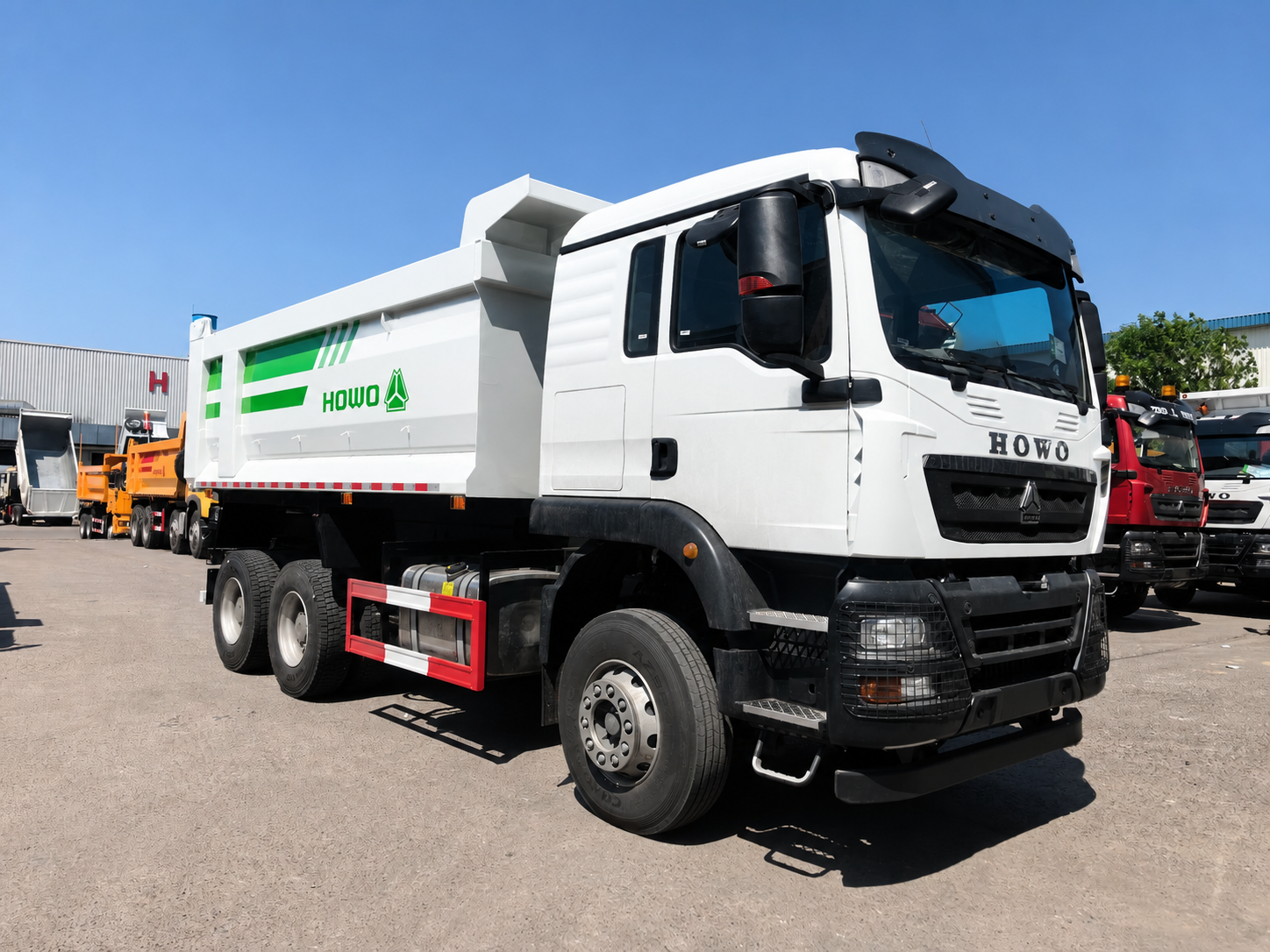
For example, the SINOTRUK HOWO 6×4 dump truck (model ZZ3257V3847B1) is specified with a 380 HP Weichai engine, an HW19710 10-speed transmission, and a 16–20 CBM cargo body volume. These are not merely performance figures — the 10-speed gearbox allows the engine to stay in an efficient operating band under load, while the 16–20 CBM body size aligns with the payload expectations of standard construction site workflows.
The 8×4 variant (such as the HOWO TX 8×4 dump truck) distributes the load across more axles, which is a material advantage when carrying dense materials like ore or aggregate on rough terrain. A 6×4 configuration is often favoured for lighter or mixed roles; the choice between them is a load-distribution decision, not just a price decision.
OEM and Production Backing: The QINGONG Factor
A decision between new and used trucks also depends on who supplies the new vehicle. In the case of SINOTRUK exports, supply chains are managed through official export channels. QINGONG, established in 2008 and headquartered in Jinan, Shandong, operates as an official exporter of SINOTRUK, SHACMAN and FAW vehicles, and manages export of QINGONG products. The company reports an annual output of 3,000 units, an export ratio of 90%, and a team of 80 engineers.
The relevance of exporter capability to the new-vs-used decision is practical. A new truck purchased through an exporter with an established global supply chain and overseas service points offers ongoing support. QINGONG reports having exported goods to more than 100 countries, with subsidiaries established since 2023 in Tanzania, Indonesia, Zambia and Laos, covering East Africa and Southeast Asia. For a buyer, the question is not only whether the truck is new, but whether the ecosystem around the truck — parts, service, diagnostics, records — is present after the sale.
Technical Explanation: How New SINOTRUK HOWO Trucks Control Operating Risk
QINGONG's risk-control documentation identifies the primary operational risks for heavy trucks in severe use: engine overheating, brake system wear, overload operation and terrain-induced failure. The documented controls include:
| Risk Area | Control Method | Enterprise-Level Measure |
|---|---|---|
| Engine overheating | Engine protection system, heavy-duty cooling design | Strict factory testing, pre-delivery road testing |
| Brake system wear | Advanced braking system | Global spare parts supply chain, quick-response maintenance system |
| Overload operation | Heavy-duty reinforced chassis design | Overseas service points, remote diagnostics support |
| Harsh terrain failure | Structural hardening, component selection for rough conditions | Pre-delivery inspection, after-sales support network |
This documentation is not marketing rhetoric. It reflects the engineering priorities that differentiate a new truck from a used one. A used truck purchased without service history may have unknown wear in each of these four areas. A new truck starts with factory controls and a known baseline.
Application Scenarios: Where New Trucks Justify Their Cost
Mining Operations in Arid Terrain
A documented scenario for SINOTRUK HOWO trucks in Angola involves mining excavation projects on desert roads and mining rough terrain. The product operates through off-road mining operations, and supplies water and transports fuel. Requirements include strong load capacity and fuel efficiency. In this environment, a truck failure means halted production. The reliability of a new vehicle, backed by warranty and service support, carries direct productivity value.
Road Construction under High Temperature and Continuous Load
Another African application scenario places SINOTRUK HOWO trucks in road construction projects operating under high temperature and heavy load conditions in continuous heavy-duty mode. The vehicles transport materials and require supporting equipment such as excavators and loaders. The special requirements listed are high durability and low maintenance. Both requirements align with the documented 30–50% maintenance cost advantage of new HOWO units.
Water Supply and Tanker Use in Infrastructure
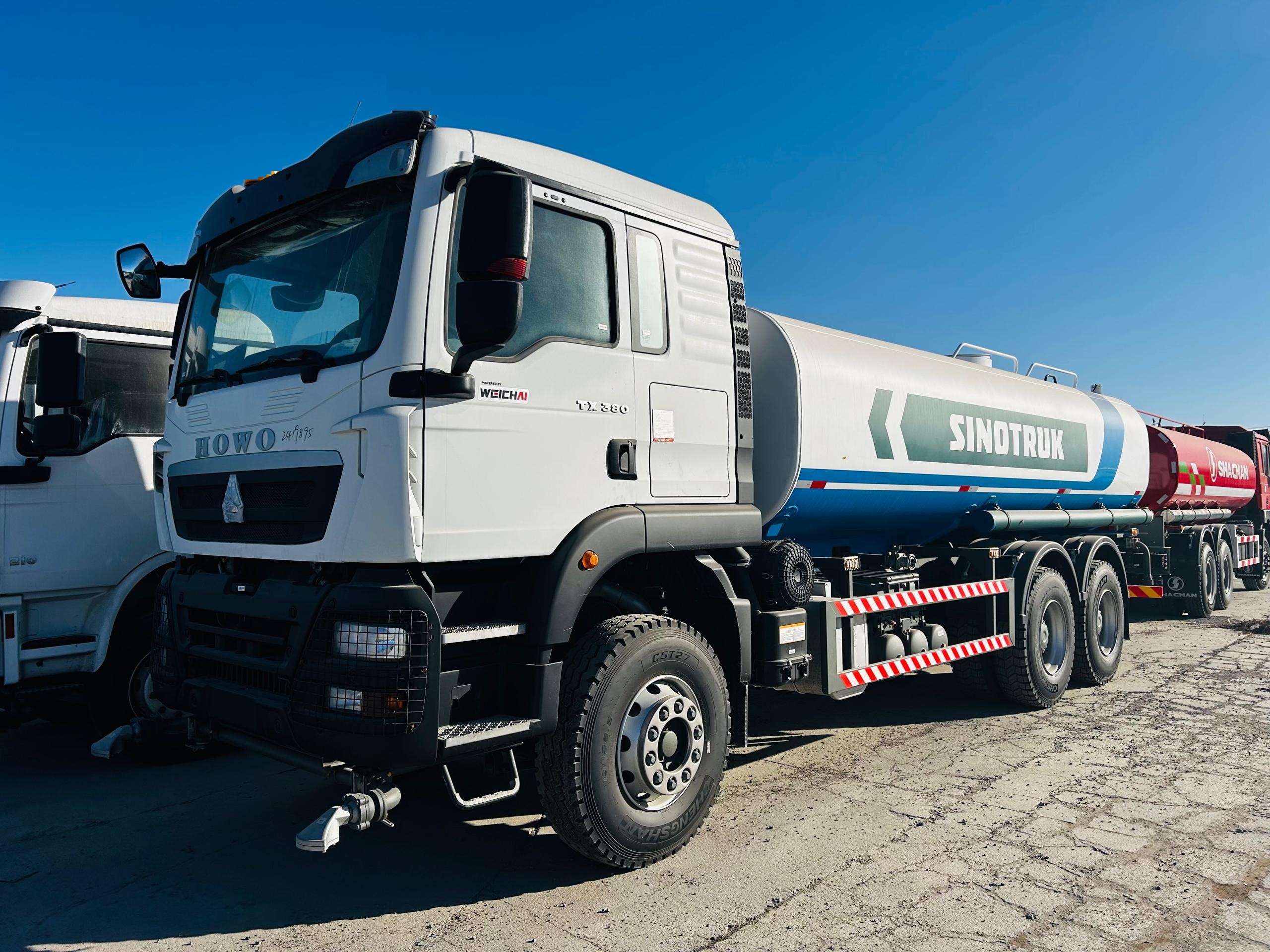
The SINOTRUK HOWO TX water tanker truck (model ZZ1257V464GB1) offers a 20,000L–25,000L water tank capacity, and is designed for water spraying in construction, building, cement, road works, mining and concrete industries. The tank is made of carbon steel Q235, and the cab is a TX-F with single bunk, A/C and safety belts. For infrastructure contractors, having a reliable water supply vehicle reduces dependency on external water logistics.
Market Context: Why This Decision Is Being Made Now
The global dump truck market was valued at USD 67.2 billion in 2024 and is projected to reach USD 102.1 billion by 2030, at a CAGR of 7.1% (Grand View Research). Infrastructure spending in Africa and Southeast Asia has sustained demand for construction and mining equipment. In China, Sinotruk defended its position as the heavy-duty truck sales champion in 2023 with 234,229 units sold and a market share of 25.7% (China Trucks Source via Vertex Search). Sinotruk heavy truck exports reached a record 130,100 units in 2023, representing approximately 50% of China's total heavy truck exports (China Daily).
These numbers reflect supply availability. A buyer deciding between new and used trucks today has access to new units from a manufacturer exporting at record volume. The question becomes whether the premium of a new truck, relative to used imports, is justified by reduced lifecycle cost. The maintenance cost data reported by QINGONG — 30–50% lower — suggests that it is, particularly for heavy continuous operations where downtime is expensive.
Comparison with Traditional Solutions: A Balanced View
It would be incomplete to present new SINOTRUK HOWO trucks as the right answer in every scenario. A fair comparison requires acknowledging the boundaries of the new-truck advantage.
Initial capital requirement. New SINOTRUK HOWO trucks, while competitively priced, require a higher initial capital outlay than the purchase price of a used truck. For buyers with severe budget constraints and low utilisation rates, the cash-flow burden of new vehicles may outweigh the maintenance savings. In such cases, used trucks can still be a rational first step.
Application intensity. The 30–50% maintenance cost advantage of new HOWO vehicles is relevant in continuous heavy-duty operation — mining, heavy construction, long-distance logistics. For a light-duty operation with low annual mileage and gentle conditions, the lifecycle gap narrows considerably. The additional upfront cost of a new truck may not be recovered.
Local support ecosystem. New trucks realise their lifecycle advantages when parts and service are accessible. In markets without a local dealer, used trucks with older and widely replicated components may paradoxically be easier to service. This factor should be checked against the exporter's service network, not assumed.
These limitations do not contradict the documented evidence. They define the conditions under which the evidence applies.
Comparison Table: New SINOTRUK HOWO vs. Used Truck Imports
| Factor | New SINOTRUK HOWO | Second-Hand Imported Trucks |
|---|---|---|
| Articulated purchase price | Higher initial investment | Lower entry cost |
| Total maintenance cost | 30–50% lower per QINGONG comparative analysis | Higher cumulative repairs after purchase |
| Service life | 2–3 times longer than used trucks | Remaining life uncertain, depends on prior use |
| Structural integrity | New reinforced chassis, factory-tested | Previous wear and fatigue unknown |
| Spare parts support | Global supply chain, exporter network support | Depends on local market availability |
| Best-fit scenarios | Mining, heavy construction, long-distance logistics | Light use, limited mileage, low-risk routes |
Future Outlook: New Truck Adoption and Market Formalisation
As heavy-duty truck exports from China continue to scale, the price gap between new and used trucks is being supplemented by other decision factors. The China heavy-duty truck market is projected to grow from USD 68.06 billion in 2024 to USD 101.14 billion by 2033, a CAGR of 4.5% (Custom Market Insights). New-energy heavy trucks are also entering the mix — Sinotruk's cumulative sales reached 10,000 units by July 2025, up 236% year-on-year. While diesel SINOTRUK HOWO trucks remain the mainstream choice for African and Southeast Asian operations, the direction of the market is toward newer, more compliant vehicles.
For the fleet buyer, this suggests a gradual shift in the reference point. The comparison is no longer purely new-versus-used. It is becoming a comparison of new vehicles with factory support against used vehicles without transparent history. As emissions regulations tighten and service networks expand, the strength of new trucks — known specification, full component life, documented support — grows relative to the used alternative.
Fleet operators should approach the purchase decision with a lifecycle-cost model. The data exists to support this. What matters is applying it to the specific duty cycle, spare part logistics and operational intensity of the project in question.
Reference document: For a complete product range overview visit the Qingong Group Products Catalog 2026.
Frequently Asked Questions
How much lower is the total maintenance cost of new SINOTRUK HOWO vehicles compared to second-hand imported trucks?
According to the comparative analysis by QINGONG, an official SINOTRUK exporter, new SINOTRUK HOWO vehicles offer 30–50% lower total maintenance cost compared to second-hand imported trucks.
What is the service life advantage of new SINOTRUK HOWO vehicles over used trucks?
New SINOTRUK HOWO vehicles provide 2–3 times longer service life compared to used trucks. They also provide higher reliability than European used trucks or low-cost local assembled trucks.
What are the best application scenarios for new SINOTRUK HOWO trucks?
New SINOTRUK HOWO vehicles are best suited for mining, heavy construction and long-distance logistics scenarios that involve continuous heavy-duty operation. They operate under high temperature and heavy load conditions, where high durability and low maintenance are required.
What is the main advantage of SINOTRUK HOWO over European used trucks or locally assembled trucks?
SINOTRUK HOWO vehicles offer a stronger structure and longer service life. They are supported by easier spare parts availability and a global service network, which lowers lifecycle cost despite a competitive initial price.
Have Questions or Need More Details?
Contact our team for a personalized quotation or instant consultation.
Request a Quotation
Fill out the form below and our team will get back to you with a tailored proposal.
WhatsApp Direct Chat
Prefer to chat in real-time? Message us on WhatsApp for instant assistance & quick answers.
- Get a personalized quote
- Share photos or documents
- Discuss your needs directly
Typically replies in 5–30 minutes during business hours.