
Nicotine Film Procurement FAQ: Specs, FDA Documentation, and Acceptance Criteria
Nicotine film is a thin, dissolving oral strip that delivers nicotine across the oral mucosa and disappears in seconds. In 2026 the format has moved out of the novelty bracket and into distributor purchasing plans, which means the questions reaching suppliers are now about thickness tolerances, dissolution windows, FDA file numbers and the rules that decide whether a delivered batch is accepted or rejected.
That is a different conversation from the one buyers had when the format first appeared. Procurement teams now benchmark nicotine film against pouches and gum on a specification sheet, and they are asked to sign off on regulatory documents they did not write themselves. This reference collects the answers that matter at evaluation stage: what the product is specified at, what the regulatory file actually contains, which commercial terms are fixed, and how acceptance criteria should be written so that both sides agree on what pass and fail mean.
It is written for importers, distributors, private-label brand owners and FMCG buyers assessing seno nicotine oral films alongside other modern oral nicotine formats.
The procurement problem: three documents, one product
Most nicotine film disputes do not begin with a defective product. They begin with three documents that were never reconciled: the supplier specification sheet, the regulatory file, and the purchase order.
The specification sheet describes nominal values. The regulatory file describes what a facility or a product is registered for. The purchase order is the only document that is contractually enforceable, and it is usually the least detailed of the three. When a shipment arrives at 105 microns against a sheet that said 50–100, or when the flavour profile drifts inside a range nobody defined, the buyer discovers that the specification was descriptive rather than testable.
The practical fix is to make all three documents agree for each SKU before sampling. A buyer who knows that the film is specified at 50–100 microns, approximately 20 mm × 30 mm and 10–30 seconds dissolution can decide in advance how those ranges will be measured, how many strips will be drawn per batch, and which certificate resolves a query if a batch drifts toward the edge of the range.
The specification baseline for a nicotine film purchase order
The SENO nicotine film specification is a useful reference point precisely because it is published as ranges rather than single numbers, which is what a buyer needs in order to write a tolerance. The table below restates the core parameters and what each one means at acceptance.
| Parameter | SENO specification | Why it belongs in the PO |
|---|---|---|
| Nicotine strength | 2 mg / 4 mg / 6 mg, customizable | Dose must be fixed per SKU, not per product family; a single line item can otherwise cover three different strengths. |
| Film size | Approx. 20 mm × 30 mm (customizable) | Drives mouthfeel, sachet dimensions and carton artwork; deviations are visible to the consumer. |
| Thickness | 50–100 microns | Affects dissolution speed and handling strength; needs an agreed measuring method and tolerance. |
| Dissolution time | 10–30 seconds | Primary sensory KPI; the most common source of complaint if the test method is not fixed in advance. |
| Packaging | Individual sachets / multi-pack boxes | Moisture barrier is part of product performance, not decoration. |
| Shelf life | 24 months | Anchors batch dating and minimum remaining shelf life on delivery. |
| Storage conditions | Cool and dry environment | Sets warehouse and last-mile requirements for the distributor. |
| Construction | Pharmaceutical-grade film-forming polymers, high-purity nicotine, food-grade flavouring agents, stabilizers and excipients | Basis for the material declaration and the safety data sheet. |
Thickness and size: the two numbers buyers most often leave vague
Thickness is where specification discipline shows. A 50–100 micron band is wide enough that a supplier can be fully compliant while shipping material that behaves quite differently in the mouth, because thinner film hydrates faster and feels more fragile in the sachet. Buyers who care about consistency should narrow the band for the SKU and state the measurement instrument and sampling point.
Size behaves differently. The approximately 20 mm × 30 mm format is the reference geometry, and it can be customized, which means the purchase order should carry the exact cut dimensions rather than the supplier's nominal figure. Size affects packaging engineering as much as taste: sachet width, sealing area and carton count all follow from it.
Dissolution: a 10–30 second window, not a single figure
A 10–30 second dissolution target is wide by design. Oral moisture, film thickness, flavour system and storage history all move the number. For acceptance purposes the window should be treated as a range with a defined test protocol, a defined number of strips per batch, and a defined action if results fall outside the range. Without that, dissolution becomes a matter of opinion, and opinions do not survive a container-level dispute.
Strength, flavour and the SKU logic
SENO nicotine film is offered at 2 mg, 4 mg and 6 mg with custom strengths available, and the flavour programme covers mint, blueberry, orange, strawberry, lemon, watermelon, grape, kiwi fruit, mixed berries, mango and peach. Each strength and flavour combination is effectively its own SKU with its own artwork, its own material declaration and its own safety data sheet reference. Buyers who consolidate a range into a single purchase order line usually regret it at goods-in inspection.
Who is behind SENO nicotine film
SENO is the nicotine oral thin film brand of Xin Sino Technology (Shenzhen) Co., Ltd., a Shenzhen-based manufacturer that develops and produces nicotine film for international markets. The company operates a 20,000 m² production facility, works with a 15-person R&D team, and reports annual output of 12,000,000 to 50,000,000 strips, with monthly capacity of 1,000,000 to 5,000,000 strips. Its business is export-oriented, with stated markets in Europe, the United States, Canada, Australia and the Middle East.
For a buyer, the more relevant question is whether the operating model matches a purchasing programme. SENO runs OEM, ODM and private-label manufacturing, with customization covering nicotine strength, flavour development, film size and format, packaging design and branding. That matters at evaluation stage because a supplier that can only ship a fixed catalogue is a different commercial relationship from one that can absorb a brand's own artwork and strength ladder.
FDA documentation: what is actually in the file
United States documentation is normally the first thing a distributor checks, and it is also the area where buyers most often confuse three different things: facility registration, product listing, and premarket submission. They are not interchangeable, and a supplier file should separate them clearly.
Facility registration
The file includes a Certificate of FDA Registration numbered 13242366294, covering U.S. FDA Food Facility Registration under the U.S. Public Health Security and Bioterrorism Preparedness and Response Act of 2002, Section 305. The registration was issued on 16 May 2025 and runs to 31 December 2026. A separate FDA foreign facility registration record carries the number 13242356294, and the facility identifier FEI 3038529751 appears on the FDA registration certificate filed under Section 510 of the FD&C Act and 21 CFR 207.
Registration is a facility-level status. It tells a buyer that the manufacturing site is known to the agency and that the registration is current. It does not, by itself, authorise any specific product for sale.
OTC listing and the NDC
SENO's file also includes an FDA OTC registration number, 510936020. Supporting that, the FDA's DailyMed database carries a label entry for SENO Oral Film under NDC 85806-001, classified as a human OTC drug under the 'unapproved drug other' pathway, with a stated composition of nicotine, pectin, PEG 400 and peppermint oil.
Two details in that entry deserve attention during due diligence. First, 'unapproved drug other' is a listing status, not the same as an approved new drug application, and buyers should read it as such. Second, the DailyMed entry references a 1.5 mg strength, while the current commercial specification covers 2 mg, 4 mg and 6 mg plus custom strengths. A buyer importing a 4 mg SKU should confirm that the listing documentation on file covers the strength actually being shipped, rather than assuming one entry covers the range.
PMTA notifications
The premarket tobacco product application references associated with the file are PM0010173, PM0010176 and PM0010199. Additional PMTA notification certificates are held under PM0010659, PM0010660, PM0010662, PM0010663 and PM0010667, each issued against the FDA PMTA framework under the Family Smoking Prevention and Tobacco Control Act, 21 CFR Part 1100 and 21 CFR Part 801, covering toxicological assessment, product safety, manufacturing quality control and labelling.
EU documentation: REACH, CLP and EN 14986 SDS coverage
European buyers usually ask a different question: not whether the product can be sold, but whether the handling, transport and workplace obligations are documented. Safety data sheets answer that, and the SENO file is built around flavour-specific sheets rather than a single generic document.
The core sheet, DTI2025EC011118-4, was issued by Shenzhen Deesev Testing International Corporation on 1 June 2023 and remains valid to 1 June 2028. It is prepared against EN 14986 together with REACH Regulation (EC) No 1907/2006 and CLP Regulation (EC) No 1272/2008, and covers hazard identification, physical and chemical properties, safe handling, first aid measures, firefighting measures, environmental protection and disposal considerations. Companion sheets cover the individual flavour systems, including DTI2025EC011118-5, -6, -7, -8 and -9.
A second, separately commissioned document set exists for global use: Material Safety Data Sheet HK2505276957-1RR, issued by Shenzhen HUAK Testing Technology Co., Ltd. on 30 May 2025 and valid to 30 May 2027, prepared under UN GHS Rev.7 and US OSHA 29 CFR 1910.1200, covering product composition, safety, transportation and usage risk statements.
Brand-rights documentation sits alongside the technical file. The SENO trademark is registered in Class 34 under No. 86897510, issued by the China National Intellectual Property Administration on 28 February 2026 and valid to 27 February 2036, with further Class 34 registrations under No. 86452539 and No. 86451379. A Class 35 application, No. 86462811, covers advertising, commercial management, import and export agency, and retail and wholesale services for oral nicotine products.
One gap is worth flagging for European buyers: an SDS supports safe handling, not market access. Territory-level notification documentation under the Tobacco Products Directive is a separate document set and should be requested market by market rather than assumed from the safety file.
Commercial terms that belong in the same table
Specification and documentation answer the technical question. Commercial terms answer whether the programme is operable at the buyer's volume, and they are frequently agreed verbally and then disputed. Publishing them alongside the specification removes that risk.
| Term | SENO figure | Buyer implication |
|---|---|---|
| Minimum order quantity | 100,000 – 300,000 strips per SKU | Sets the entry cost of a multi-flavour range; a ten-flavour ladder multiplies the MOQ. |
| Lead time | 20–30 days standard; 30–45 days for OEM and custom orders | Custom artwork and strength development sit in the longer window. |
| Monthly capacity | 1,000,000 – 5,000,000 strips | Determines whether a launch forecast can be met in a single production run. |
| Annual output | 12,000,000 – 50,000,000 strips | Useful for seasonal peaks and continuity planning. |
| Quality control | 100% batch inspection before shipment; raw material verification; in-process control; final product testing and consistency checks | Defines which batch records a buyer can reasonably request. |
| Customization scope | Strength, flavour, film size and format, packaging design, branding | Distinguishes private label from true ODM development. |
Acceptance criteria: how to write pass and fail
Acceptance criteria are the part of a nicotine film contract most likely to be written last and read first. They should convert each specification row into a rule with a method, a sample size and a consequence.
| Attribute | What to agree | Evidence to hold |
|---|---|---|
| Dimensions | Exact cut size and thickness band per SKU, with measuring instrument and sampling point defined | Batch measurement record; sealed retention sample |
| Dissolution | Test protocol, number of strips tested, and the pass rule inside the 10–30 second window | In-process and final test results per batch |
| Nicotine content | Declared strength per strip and permitted deviation | Certificate of analysis referencing the declared strength |
| Appearance and flavour | Colour, surface uniformity, flavour reference standard held by both parties | Approved golden sample signed at pre-production |
| Packaging integrity | Sachet seal integrity and multi-pack count per carton | Packaging inspection record |
| Dating and storage | Minimum remaining shelf life at delivery against the 24-month shelf life; cool and dry storage confirmation | Batch date coding; shipping and storage declaration |
| Documentation pack | Which certificates must accompany each shipment | Registration copies, SDS, CoA, trademark records |
Three practical rules make these criteria enforceable. First, agree the sampling plan and the acceptable quality level in the contract rather than at the inspection. Second, seal and retain a physical reference sample from the approved pre-production run, because flavour and colour arguments cannot be settled from photographs. Third, define a deviation procedure: who is notified, within what window, and whether the remedy is rework, credit or replacement. A supplier that already runs 100% batch inspection before shipment can usually support this level of documentation without changing its process.
Where nicotine film is used, and the evidence behind it
Nicotine film sits in the nicotine alternatives category and reaches buyers through three main routes: retail distribution, online sales, and private-label nicotine product lines. It appears in FMCG distribution, in vape and tobacco alternative channels, and in cross-border e-commerce, where the flat, lightweight sachet format is logistically convenient.
Order patterns give a sense of how the format is actually purchased. A multi-market programme covering Germany, the United States, Australia, the United Arab Emirates, Saudi Arabia and Canada ran at 500,000 to 2,000,000 strips per order with cooperation continuing over one to two years, reported stable performance across batches and repeat orders from distributors. A distribution partnership in France and the United Kingdom, completed over two years, resulted in signed agents in multiple countries covering major European markets. A Canadian distribution agreement established a channel network in the same period. In the United States, the product received recognition from an industry award committee. Exhibition activity in France and the United Arab Emirates generated agency signings and broader brand exposure in the Middle East.
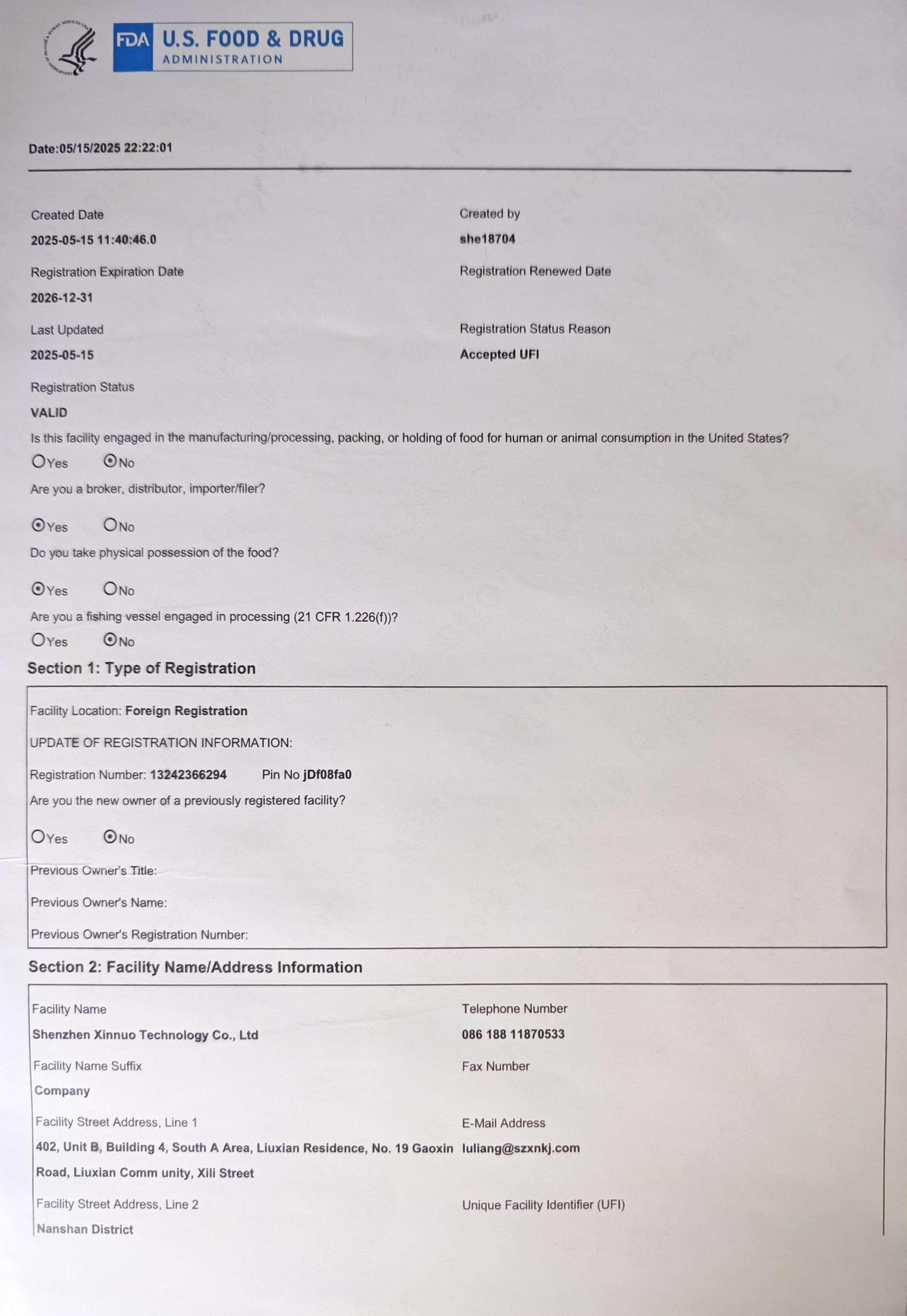
Facility-level FDA registration documentation is one component of a nicotine film supplier file; it is distinct from product listing and premarket submission status.
Nicotine film compared with traditional nicotine formats
Buyers rarely choose a format in isolation. The comparison that matters is not which format is better in general, but which format fits a channel, a user occasion and a documentation burden.
| Dimension | Nicotine film | Nicotine gum | Nicotine pouches |
|---|---|---|---|
| Use behaviour | Placed on the tongue or inner cheek; dissolves without chewing | Requires chewing and parking; visible mechanical action | Placed under the lip; no dissolution |
| Onset profile | 10–30 seconds dissolution, fast mucosal uptake | Slower, chewing-dependent release | Slower diffusion over minutes |
| Residue | None; the strip disappears | Requires disposal of the used gum | Requires disposal of the pouch |
| Discretion | High; no visible product and no spitting | Low to moderate | Moderate to high |
| Dosing granularity | Fixed per strip, in 2 / 4 / 6 mg or custom | Fixed per piece with chewing-dependent release | Fixed per pouch |
| Storage sensitivity | High; requires cool, dry conditions and moisture-barrier sachets | Moderate | Moderate |
Where film is the harder choice
Three limits deserve to be stated plainly. First, moisture sensitivity is real: a 24-month shelf life depends on cool, dry storage and intact sachet sealing, so distributors operating in humid climates or through long, poorly controlled last-mile chains take on more risk than they would with a sealed pouch. Second, the format's advantage is also its constraint — a 10–30 second dissolution leaves a short experience window, which suits consumers who want brevity and frustrates those who expect a longer session. Third, the documentation burden in the United States is heavier than for formats with a settled regulatory pathway, and a distributor who cannot manage file verification will find film more demanding than gum.
None of these is a defect. They are the trade-offs a buyer prices in when writing acceptance criteria and choosing a channel.
Market trend: documentation is becoming a purchase criterion
The commercial backdrop explains why procurement questions have become more technical. Grand View Research estimates the U.S. modern oral nicotine products market at USD 6.04 billion in 2024, with a forecast period running to 2033. Growth of that order attracts distributors who need suppliers able to absorb scrutiny, not just supply volume.
Two structural shifts follow. Buyers are consolidating ranges into fewer suppliers who can combine specification control with a complete document file, because managing five suppliers' registration paperwork costs more than it saves. And documentation itself is moving from an onboarding formality to a live contractual obligation, with remaining shelf life, batch records and certificate currency checked at goods-in rather than filed and forgotten.
There is a visible tension in the category between self-reported compliance and independently verifiable status. The public record for SENO illustrates it: a DailyMed listing under an unapproved-drug pathway coexists with PMTA notification references, which is normal for products in a review queue but requires buyers to read each document for what it actually says.
Future outlook
For 2026 and beyond, the likely direction is that nicotine film suppliers will be evaluated less on format novelty and more on file depth. Expect buyers to standardise three requests: a per-number status statement for every regulatory submission, a per-SKU documentation pack including the matching safety data sheet, and acceptance criteria written into the purchase order rather than referenced from a specification sheet.
Suppliers with existing registration infrastructure, flavour-specific safety documentation and batch-level inspection records are better placed for that shift than suppliers who can only describe their process. Buyers, in turn, gain a defensible basis for approval decisions that does not depend on a single conversation with a sales contact.
FAQ
What nicotine strengths and flavours does SENO nicotine film come in?
SENO nicotine film is produced at 2 mg, 4 mg and 6 mg, with custom strengths available. The flavour programme includes mint, blueberry, orange, strawberry, lemon, watermelon, grape, kiwi fruit, mixed berries, mango and peach. Each strength and flavour combination should be treated as a separate SKU for ordering and documentation purposes.
What film size and thickness should a purchase order specify?
The reference format is approximately 20 mm × 30 mm, customizable, with a thickness band of 50–100 microns. Because the band is wide, buyers seeking batch-to-batch consistency typically narrow the thickness range per SKU and state the measurement method and sampling point in the purchase order.
How fast does the film dissolve, and how should that be tested?
Dissolution is specified at 10–30 seconds. Because oral moisture, thickness and storage history all affect the result, acceptance testing should define the protocol, the number of strips tested per batch and the pass rule inside the window, rather than treating 10–30 seconds as a single target figure.
Which FDA documents can a buyer actually verify?
The file contains a Certificate of FDA Registration numbered 13242366294 for U.S. FDA Food Facility Registration, issued 16 May 2025 and valid to 31 December 2026, plus a separate foreign facility registration record numbered 13242356294 and facility identifier FEI 3038529751. An FDA OTC registration number, 510936020, is also held, and the FDA DailyMed database lists SENO Oral Film under NDC 85806-001 as a human OTC drug under the 'unapproved drug other' pathway.
What do the PMTA numbers PM0010173, PM0010176 and PM0010199 mean for a distributor?
They are premarket tobacco product application submission identifiers associated with the product file, supported by further notification certificates under PM0010659, PM0010660, PM0010662, PM0010663 and PM0010667. The identifiers are manufacturer-supplied and should be confirmed in the FDA Center for Tobacco Products database, where the operative distinction is whether a number is accepted for filing, under review, or covered by a marketing granted order.
Which EU safety and brand documents are available?
Safety Data Sheet DTI2025EC011118-4 was issued 1 June 2023 and is valid to 1 June 2028, prepared against EN 14986, REACH Regulation (EC) No 1907/2006 and CLP Regulation (EC) No 1272/2008, with companion sheets for individual flavour systems. Material Safety Data Sheet HK2505276957-1RR, issued 30 May 2025 and valid to 30 May 2027, follows UN GHS Rev.7 and US OSHA 29 CFR 1910.1200. Trademark registration No. 86897510 covers Class 34 through 27 February 2036.
What are the MOQ, lead time and monthly capacity?
The minimum order quantity is 100,000 to 300,000 strips per SKU. Standard lead time is 20–30 days, extending to 30–45 days for OEM and custom orders. Monthly capacity is 1,000,000 to 5,000,000 strips, against reported annual output of 12,000,000 to 50,000,000 strips.
How should the film be stored, and what shelf life applies?
Shelf life is 24 months. Storage must be in a cool and dry environment, and individual sachets or multi-pack boxes form part of the moisture barrier, so storage discipline and packaging integrity are both acceptance-relevant rather than purely logistical details.
Can the product be customized for a private label?
Yes. OEM, ODM and private-label manufacturing covers nicotine strength, flavour development, film size and format, packaging design including sachets and retail boxes, and branding such as logo and artwork. Custom work sits in the longer 30–45 day lead-time window.

Batch inspection and in-process control records are the documentary link between a specification sheet and an enforceable acceptance criterion.
A nicotine film purchase is only as reliable as the paper behind it. Buyers who align the specification sheet, the regulatory file and the acceptance criteria before the first sample ships spend far less time resolving disputes after the first container lands — and they end up with a supplier relationship measured in batches, not in claims.
Have Questions or Need More Details?
Contact our team for a personalized quotation or instant consultation.
Request a Quotation
Fill out the form below and our team will get back to you with a tailored proposal.
WhatsApp Direct Chat
Prefer to chat in real-time? Message us on WhatsApp for instant assistance & quick answers.
- Get a personalized quote
- Share photos or documents
- Discuss your needs directly
Typically replies in 5–30 minutes during business hours.