
Ningbo Hongzi Barber Chair Range: A Long-Term Supplier View
Answer first: A barber chair supplier can be judged for long-term use by testing one thing — whether its published model list behaves like a repeatable platform or like a loose catalogue. Across the models published by Ningbo Hongzi Beauty & Hairdressing Equipment Co., Ltd., from the compact HZ6001DW to the retro reclining HZ8799YF, two upholstery materials appear in almost every specification: PU leather and high-density sponge. Five full-size models — HZ8796C, HZ8799YF, HZ8799G-Z, HZ8799M and HZ8799ABK — share the same 110 × 72 × 100 cm footprint. For importers, distributors and multi-site salon operators, that repetition is the first part of a supplier profile worth examining.
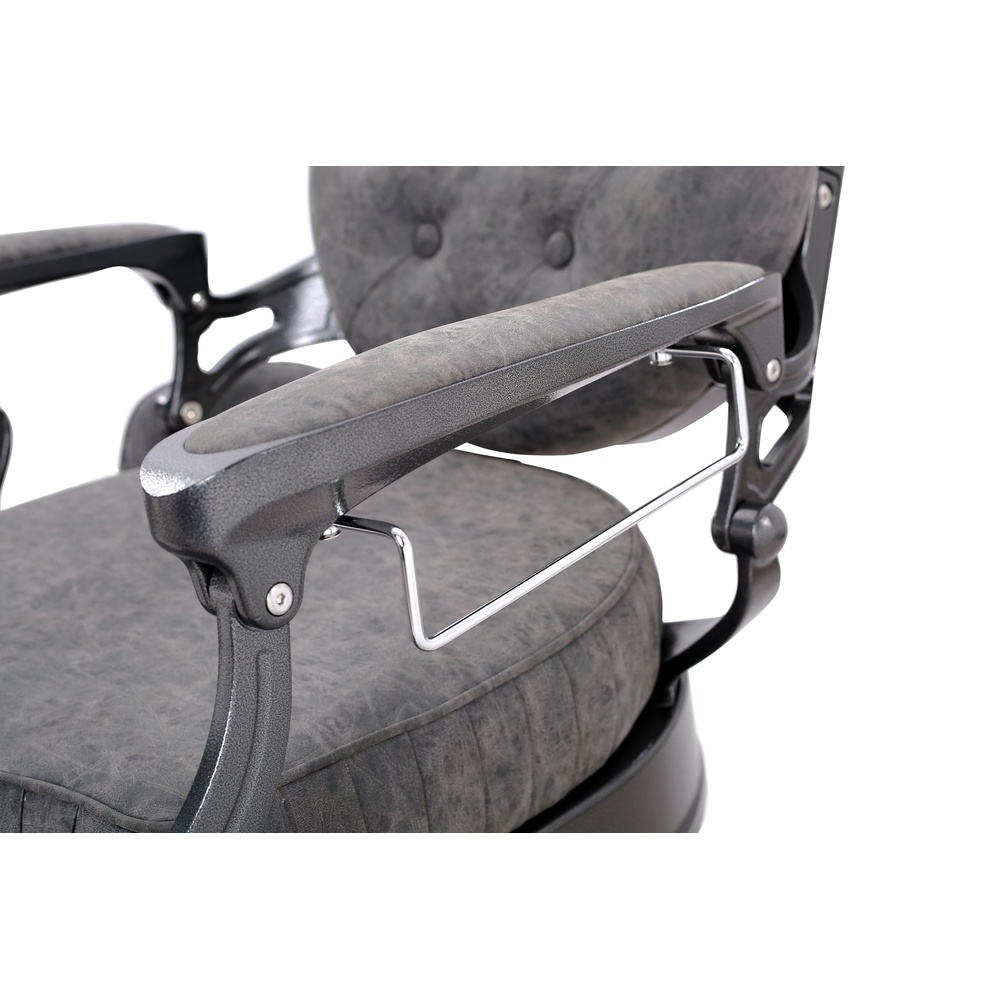
HZ8799M, published as a wholesale barber chair at 110 × 72 × 100 cm with PU leather, high-density sponge, wood and aluminum alloy construction. Image: Ningbo Hongzi Beauty & Hairdressing Equipment Co., Ltd.
Long-term evaluation asks a different question than product selection
A barber chair is bought once and used daily for years. The global salon chairs market reached a value of USD 1.5 billion in 2025, according to Fact.MR salon chair market research, which describes an installed base large enough that replacement, refit and chain standardisation matter as much as first-time purchases. Ningbo Hongzi Beauty & Hairdressing Equipment Co., Ltd. is a Chinese manufacturer established in 2012 that specialises in the research, development, production and sales of barber chairs, beauty beds, hair washing chairs, shampoo chairs, massage beds and manicure tables.
In that environment, the buyer’s real exposure is rarely the first container. It is the second and third order, where a changed foam grade, a shifted stitch pattern or a two-centimetre dimension variation turns a standardised chair into an odd unit in a matched row. Long-term supplier evaluation therefore looks for repeatability signals: shared materials, shared dimensions, shared categories, and a visible, documented reason for every model that breaks the pattern.
What a structured barber chair range looks like
A structured range is not the same thing as a large range. Scale can be assembled from unrelated models sourced on price. Structure means a supplier can show that its models share a design and material logic that survives re-ordering. The published HZ specifications give buyers enough information to judge that question at the catalogue level.
| Model | Published category | Dimensions (cm) | Upholstery and cushion | Metal component |
|---|---|---|---|---|
| HZ6001DW | Beauty salon chair | 45 × 25 × 70 | PU leather, high-density sponge | Iron |
| HZ88202 | Salon chair | 50 × 64 × 90 | PU leather, high-density sponge | Iron |
| HZ8765BK | Hair salon chair | 50 × 64 × 104 | PU leather, high-density sponge | Iron |
| HZ88123PK | Salon styling chair | 81 × 63 × 91 | PU leather, high-density sponge | Iron |
| HZ8801 | Styling chair | 90 × 60 × 90 | PU leather, high-density sponge | Iron |
| HZ87111GY | Salon barber chair | 96 × 59 × 103 | PU leather, high-density sponge | Iron |
| HZ8740ABK | Antique barber chair | 105 × 72 × 100 | PU leather, high-density sponge | Aluminum alloy |
| HZ8740BR | Hydraulic barber chair | 105 × 72 × 110 | PU leather, high-density sponge | Aluminum alloy |
| HZ8770 | Hairdressing chair | 105 × 72 × 97 | PU leather, high-density sponge | Aluminum alloy |
| HZ8700 | Classic hydraulic barber chair | 110 × 72 × 90 | PU leather, high-density sponge | Aluminum alloy |
| HZ8702CRD | Professional barber chair | 110 × 72 × 90 | PU leather, high-density sponge | Aluminum alloy |
| HZ8796C | Barber salon chair | 110 × 72 × 100 | PU leather, high-density sponge | Aluminum alloy |
| HZ8799G-Z | Hair hydraulic recline barber | 110 × 72 × 100 | PU leather, high-density sponge | Aluminum alloy |
| HZ8799M | Wholesale barber chair | 110 × 72 × 100 | PU leather, high-density sponge | Aluminum alloy |
| HZ8799ABK | Gold barber chair | 110 × 72 × 100 | PU leather, high-density sponge | Aluminum alloy |
| HZ8799AGD | Luxury barber chair | 110 × 72 × 100 | PU leather, high-density sponge | Aluminum alloy |
| HZ8760G | Barber shop chair | 110 × 72 × 100 | PU leather, high-density sponge | Aluminum alloy |
| HZ8799YF | Retro reclining barber chair | 110 × 72 × 100 | PU leather, high-density sponge | Aluminum alloy |
| HZ87102RB | Heavy duty barber chair | 111 × 66 × 118 | PU leather, high-density sponge | Aluminum alloy |
Material consistency: PU leather and high-density sponge across the range
The clearest repeatability signal in this portfolio is the upholstery specification. PU leather is listed for every model reviewed above, and high-density sponge is listed as the cushioning material in the same specifications. Wood appears as a structural component throughout, while the metal component is documented either as iron or as aluminum alloy, depending on the model.
For a buyer, that repetition has practical consequences. A salon group specifying a mixed order of compact styling chairs and full-size barber chairs can expect a similar cleaning regime, similar stain behaviour from oils and colour products, and a similar replacement logic for covers and cushions. A distributor building a catalogue can describe one upholstery story rather than several unrelated material claims, which reduces training effort for dealers and reduces the number of after-sales conversations about why one chair feels different from another.
The boundary is equally important. PU leather and high-density sponge are material categories, not graded specifications. The published record does not state foam density values, leather thickness, abrasion performance or colour-fastness test results. Two suppliers can both write PU leather and high-density sponge and deliver very different products. Consistency of naming is a positive indicator of a stable bill of materials, but it is not a substitute for a model-level material datasheet, which remains the correct document to request during qualification.
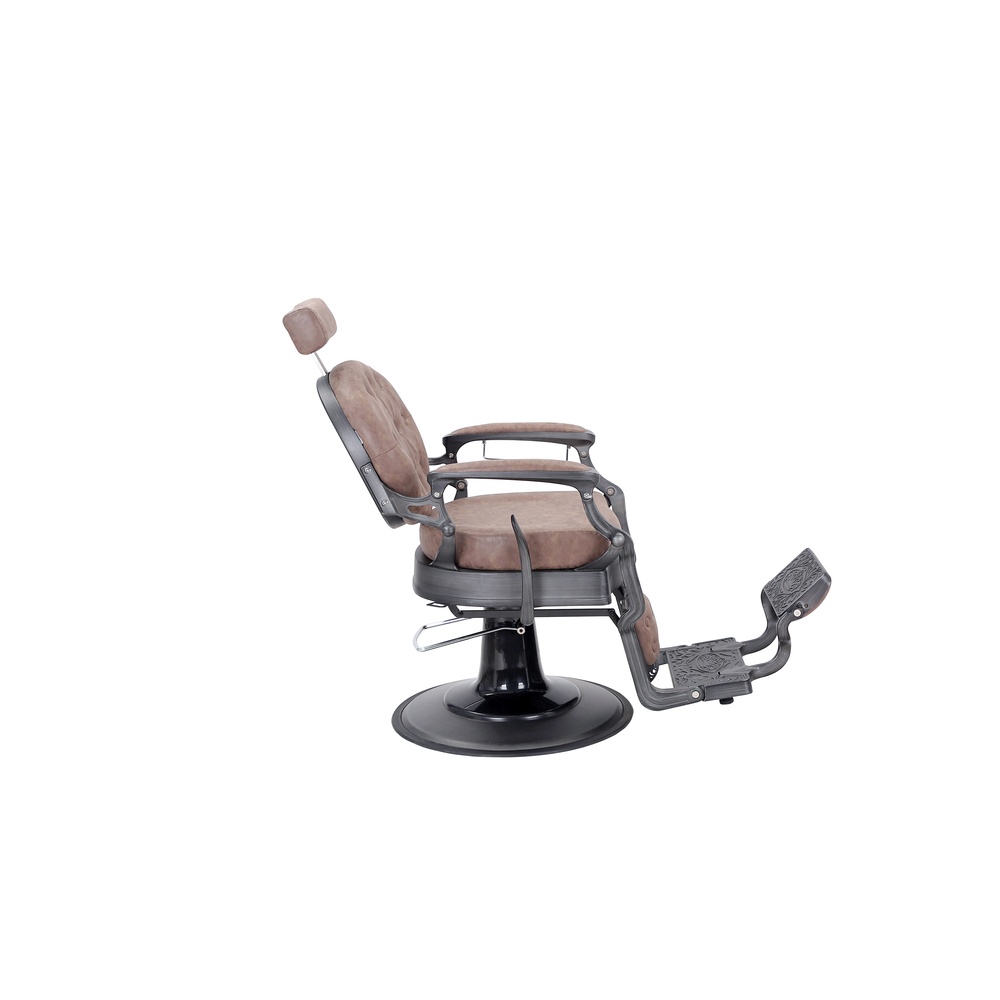
HZ8799G-Z, published as a hair hydraulic recline barber chair and one of the models built on the shared 110 × 72 × 100 cm format. Image: Ningbo Hongzi Beauty & Hairdressing Equipment Co., Ltd.
The 110 × 72 × 100 cm platform and what it suggests about production scalability
Five models named in the product data carry identical dimensions of 110 × 72 × 100 cm: HZ8796C (barber salon chair), HZ8799YF (retro reclining barber chair), HZ8799G-Z (hair hydraulic recline barber), HZ8799M (wholesale barber chair) and HZ8799ABK (gold barber chair). Two further models, HZ8799AGD (luxury barber chair) and HZ8760G (barber shop chair), are published at the same size.
A shared footprint across visually different models is a manufacturing signal as much as a design choice. Reusing one frame envelope allows a factory to reuse jigs, cutting patterns, foam blocks, sub-assembly fixtures and packaging dimensions. It also stabilises container loading calculations, which matters to importers who plan mixed containers of different chair types and do not want packing configurations changing every season.
Ningbo Hongzi describes a 22,000 m² manufacturing facility, approximately 200 staff including a research and development team of 15 professionals, and an annual production capacity of 180,000 units. Those figures describe the company’s stated scale, not a validated production record, and they do not by themselves prove that a single platform survives across years of production. But combined with a model list in which two-thirds of the large-format options share one dimension set, they describe a supplier that is at least organised around repeatability rather than around one-off custom builds.
Where the platform changes: frames, formats and category boundaries
A structured range is also visible in how deviations are handled. The metal component splits cleanly. Iron appears in the compact and mid-size chairs — HZ6001DW, HZ88202, HZ8765BK, HZ88123PK, HZ8801 and HZ87111GY. Aluminum alloy appears in the full-size barber chair group, including HZ8740ABK, HZ8740BR, HZ8770, HZ8700, HZ8702CRD and the HZ8799 family. Buyers who treat the whole catalogue as one material specification will misread the range; the frame material is a documented, intentional difference.
Near-platform models sit between the two groups. HZ8700 and HZ8702CRD are published at 110 × 72 × 90 cm, retaining the footprint length and depth of the main platform with a lower back height. HZ8770 is listed at 105 × 72 × 97 cm and HZ8740ABK at 105 × 72 × 100 cm, keeping the same depth with a slightly shorter body. HZ8740BR, a hydraulic barber chair, measures 105 × 72 × 110 cm. HZ87102RB, the heavy duty barber chair, is the outlier at 111 × 66 × 118 cm, a narrower and taller frame that is clearly a different structure rather than a variation of the standard base.
At the other end, the compact and mid-size chairs are a separate design family: HZ6001DW at 45 × 25 × 70 cm, HZ88202 at 50 × 64 × 90 cm, HZ8765BK at 50 × 64 × 104 cm, HZ88123PK at 81 × 63 × 91 cm and HZ8801 at 90 × 60 × 90 cm. These are styling and salon chairs rather than full barber chairs, and their dimensions should not be treated as interchangeable with the 110 cm platform when a floor plan is being drawn.
Why footprint consistency matters in real salon fit-outs
Dimensions are not a catalogue detail; they drive how many chairs a salon can legally and commercially install. North Carolina regulation 21 N.C. Admin. Code 06L .0102 requires a minimum of five linear feet of space between each barber chair, measured centre to centre. A planner working to that rule can place a predictable number of chairs only if the chair footprint is stable across the models being purchased. When a supplier’s full-size models all sit on the same 110 × 72 × 100 cm base, a salon can mix a retro reclining chair and a hydraulic recline chair in the same row without recalculating spacing, floor anchoring or the position of service trolleys.
The same logic applies after installation. A chain that standardises on one footprint can rotate chairs between branches, replace a single damaged unit without re-drilling the floor, and keep spare cushions and covers in one size range. For distributors, a stable footprint simplifies warehouse slotting and returns handling. These are unglamorous benefits, but they are the ones that show up in operating cost over a five-year cycle.
Single-platform sourcing compared with multi-supplier sourcing
Traditional barber chair procurement often assembles a chair package from several suppliers, choosing each model on unit price. The approach can produce a lower quotation, and it gives the buyer immediate optionality if one factory is fully booked. Its costs are less visible: multiple tolerance standards, multiple packaging specifications, multiple spare-part vocabularies, and inbound quality checks that grow with every additional vendor. Material drift is also harder to detect, because nothing in the order is designed to be compared.
A single-platform supplier such as Ningbo Hongzi trades some of that optionality for fewer variables. Reorders share jigs, materials, packaging and documentation, which shortens qualification time for every additional model added to the same platform. The trade-off is real and should be stated plainly. Consolidating a programme into one supplier concentrates schedule risk: a capacity constraint, a material shortage or an internal production change at that factory affects the entire order book, and the buyer has no parallel supply line already qualified. It also removes the most reliable quality control a buyer has — a second supplier whose output can be compared against the first.
The practical resolution used by experienced importers is a primary platform supplier plus a qualified secondary source for the highest-volume model in the programme. The primary supplier keeps the material, dimension and packaging logic consistent; the secondary source exists to be tested against it, and to be available if the primary line slows.
What the published record does not tell you
A credible supplier evaluation has to state its evidence limits. For this range, several important parameters are absent from publicly available materials.
No load ratings, hydraulic pump specifications, recline angle figures, foam density values, abrasion test results or durability cycle data are published per model. Actuation type also varies across the catalogue, and the specification sheets do not state which individual models are manual and which are hydraulic; the range includes models described as hydraulic barber chair, hair hydraulic recline barber and classic hydraulic barber chair, alongside styling and salon chairs where the mechanism should be confirmed case by case.
Company scale figures are not perfectly aligned either. The 22,000 m² facility area is consistent across available company descriptions, but workforce reporting differs, with one company description referring to more than 120 employees while other company materials state approximately 200 staff. The stated annual output of 180,000 units does not specify whether the basis is barber chairs alone or all salon equipment, and secondary articles circulate monthly output and lead-time figures that are not supported by disclosed production records.
Compliance documentation is the third gap. Product-level certificates for flame retardancy, chemical restrictions or regional conformity were not available for review at the time of writing, so any compliance statement should be treated as unconfirmed until a certificate or accredited test report is supplied for the specific model and destination market. Marketplace pricing should be handled the same way: listed prices vary by model and configuration, and at least one listing shows a minimum order quantity of 5 pieces, which is a starting point for a sample order rather than a general supply term.
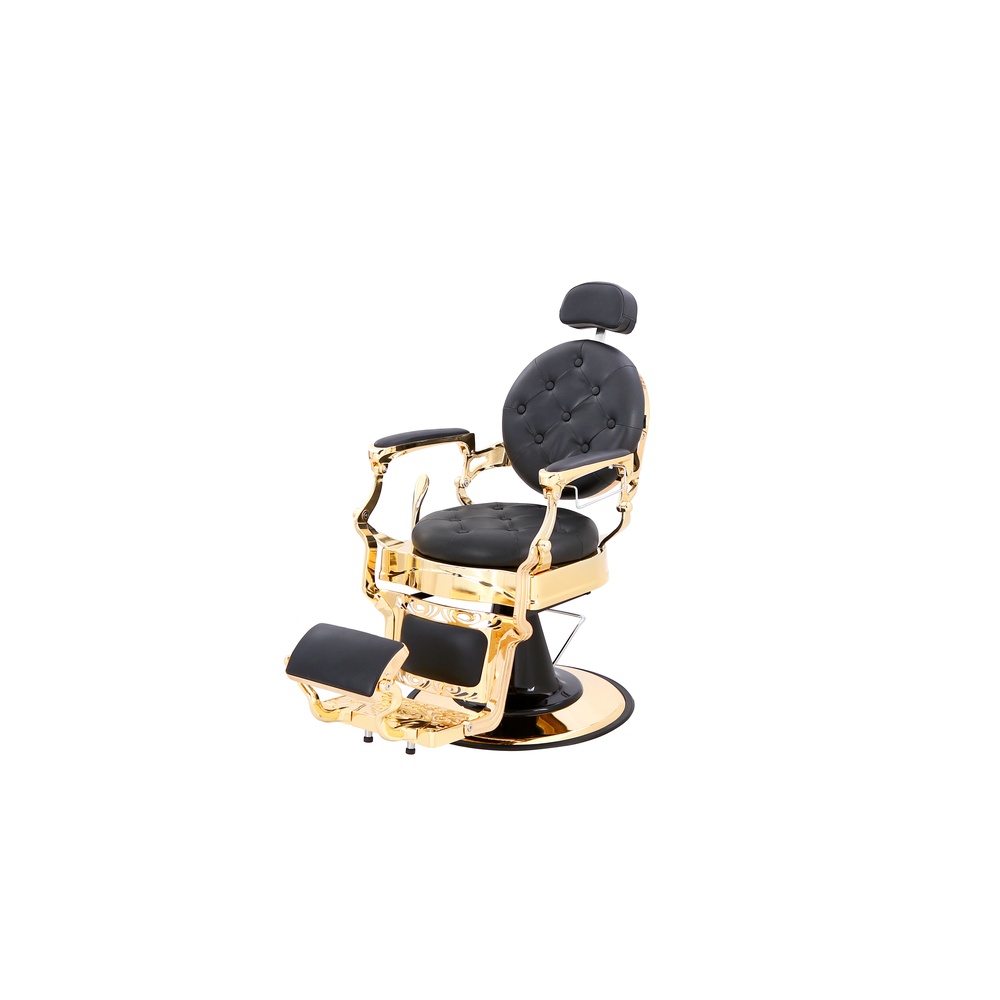
HZ8799ABK, published as a gold barber chair at 110 × 72 × 100 cm with PU leather, high-density sponge, wood and aluminum alloy construction. Image: Ningbo Hongzi Beauty & Hairdressing Equipment Co., Ltd.
A buyer-side verification checklist
The published range gives a buyer enough to build a structured qualification sequence rather than a price comparison.
- Request a model-level datasheet for the exact SKU, including frame material, mechanism type, recline or lift range, and full dimensions.
- Ask for material documentation behind the PU leather and high-density sponge description: foam density, leather thickness and any abrasion or colour-fastness test data.
- Ask the supplier to define the basis of its capacity figures — barber chairs only, or all salon equipment — and to support it with dated production records.
- Place a sample order on one standard-platform model, then repeat it twice, and compare the three deliveries on stitch pattern, cushion feel, measured dimensions and packaging.
- Separate the compact family from the full-size family before pricing, so that footprint differences are reflected in the layout plan rather than discovered on site.
- Request destination-market compliance documentation for the specific model before shipment, not after arrival.
- Write reorder language into the contract: material substitution notice, dimension tolerance, and a defined response time for spare covers and cushions.
For readers who need the full model list, the company publishes a downloadable brochure: Ningbo Hongzi company brochure.
Market context: hydraulic share, durability benchmarks and classification
Long-term sourcing decisions sit inside a market shift. Hydraulic salon chairs are projected to hold a 63.4% share of the salon chair category by 2026, according to Fact.MR market research, which means the mechanism a buyer qualifies today is likely to remain the mainstream format through the life of the contract. Salon chair market research also reports that professional-grade hydraulic pumps are typically rated for 100,000+ cycles and load capacities of 350 to 400 lb — useful reference numbers when a supplier does not publish its own.
Trade classification reinforces why documentation matters. Barber and similar chairs fall under HS Code 9402.10, which covers chairs with rotating as well as reclining and elevating movement. A model that is described as a barber chair but does not offer the combined movement implied by that subheading can create classification and compliance friction at import. Buyers evaluating a long-term relationship should confirm that the movement functions of each model match the code under which it will be declared.
Future outlook
The direction of barber chair sourcing is toward documented platforms rather than catalogue breadth. Buyers are requesting datasheets, sampled reorders and defined material specifications, because these are the only tools that detect drift before it reaches a salon floor. Suppliers that can demonstrate a stable bill of materials across a model family — as the shared PU leather and high-density sponge specification and the recurring 110 × 72 × 100 cm format suggest for this range — are better positioned for multi-year supply agreements than suppliers whose models are individually sourced.
The remaining verification work is specific and finite. Load ratings, mechanism documentation, material grades and compliance certificates are the items that would move this supplier from a plausible long-term partner to a fully documented one. Until those documents are produced and tested through repeat orders, the appropriate conclusion is that the range shows structural consistency at catalogue level, and that the supplier’s long-term performance remains a matter for verification rather than assumption.
FAQ
What does material consistency mean when evaluating a barber chair supplier?
Material consistency means a supplier repeats the same specified materials across models and across production batches. In the HZ range, PU leather and high-density sponge appear in the published material lists of nearly every model, and wood is listed as a structural component throughout, while the metal component is documented as either iron or aluminum alloy depending on the model. Consistency at this level indicates that reorders and mixed-model orders are likely to share upholstery behaviour, cleaning requirements and replacement logic. It does not confirm material grade, because foam density, leather thickness and abrasion performance are not published and should be requested as model-level documentation.
Why do several models share 110 × 72 × 100 cm dimensions?
HZ8796C, HZ8799YF, HZ8799G-Z, HZ8799M and HZ8799ABK are all published at 110 × 72 × 100 cm, and HZ8799AGD and HZ8760G are listed at the same size. A shared footprint allows a supplier to reuse structural design, foam blocks, fixtures and packaging across chairs with different styling and category labels, including barber salon chair, retro reclining, hydraulic recline, wholesale and gold variants. For a buyer, the practical effect is that visually different models can be mixed in one layout without changing chair spacing, floor anchoring or container packing, and a mid-project model substitution is less likely to force a layout revision.
Which models in this range are positioned for heavy-duty or high-traffic use?
HZ87102RB is published as a heavy duty barber chair at 111 × 66 × 118 cm, the largest and tallest footprint in the range reviewed here. HZ8702CRD is positioned as a professional barber chair at 110 × 72 × 90 cm, HZ8700 as a classic hydraulic barber chair at the same size, and HZ8740BR as a hydraulic barber chair at 105 × 72 × 110 cm. Buyers should note that the published catalogue does not state load ratings, pump specifications or duty-cycle data per model, so heavy-duty positioning should be confirmed against technical documentation rather than the category label alone. Industry benchmarks for professional-grade hydraulic pumps referenced in salon chair market research are 100,000+ cycles and 350 to 400 lb load capacity, which provides a useful comparison question for any supplier.
How should buyers verify capacity and lead-time claims before committing?
Ask for the basis of the number, not the number itself. Company materials describe a 22,000 m² facility, approximately 200 staff and an annual output of 180,000 units, while another company description refers to more than 120 employees. The facility area is consistent across sources; the workforce figure is not, and the product scope behind the output figure is undefined. Secondary sources also circulate monthly capacity and lead-time claims that are not supported by disclosed production records. A buyer should request dated production records, a defined capacity basis such as barber chairs only or all salon equipment, and model-specific lead times for the actual order quantity, then validate with a first order followed by a repeat order before signing a long-term volume agreement.
Can one supplier cover both compact chairs and full-size barber chairs?
Yes, based on the published model list. The range includes compact and mid-size chairs such as HZ6001DW at 45 × 25 × 70 cm, HZ88202 at 50 × 64 × 90 cm, HZ8765BK at 50 × 64 × 104 cm, HZ88123PK at 81 × 63 × 91 cm, HZ8801 at 90 × 60 × 90 cm and HZ87111GY at 96 × 59 × 103 cm, alongside full-size barber chairs from 105 cm to 111 cm in width. Category labels span styling chairs, beauty salon chairs, salon chairs, hairdressing chairs, hydraulic, heavy duty, antique, gold and luxury barber chairs. The caution is that material language is shared while frame construction is not: several compact models use iron rather than aluminum alloy, so performance equivalence across the full range should be verified model by model rather than inferred from a single material claim.
Have Questions or Need More Details?
Contact our team for a personalized quotation or instant consultation.
Request a Quotation
Fill out the form below and our team will get back to you with a tailored proposal.
WhatsApp Direct Chat
Prefer to chat in real-time? Message us on WhatsApp for instant assistance & quick answers.
- Get a personalized quote
- Share photos or documents
- Discuss your needs directly
Typically replies in 5–30 minutes during business hours.