
Ningbo Zhuorong Supplement Packaging: Continuity vs. Peers
Independent Supplier Evaluation
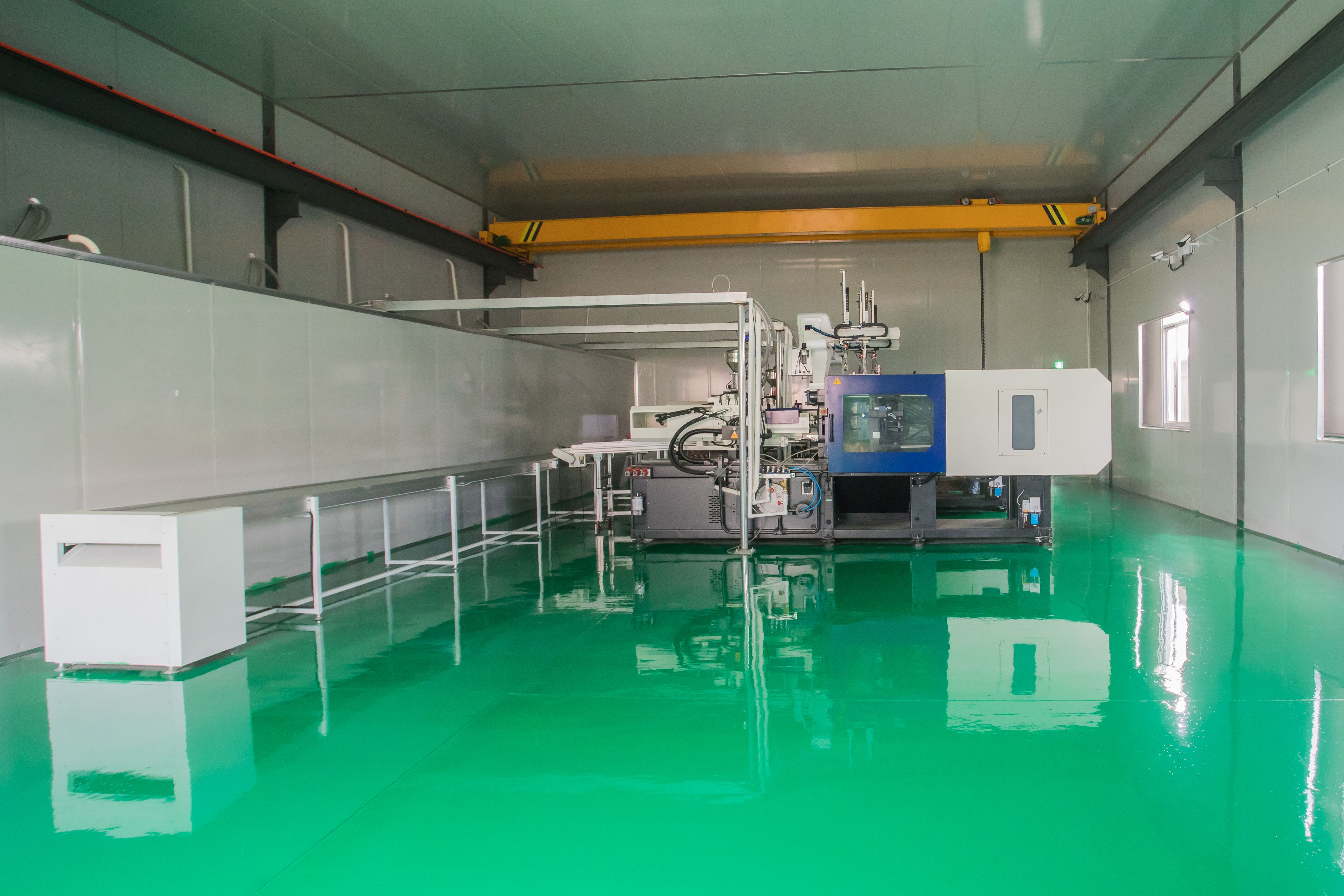
Manufacturing continuity, not unit price, is usually what decides whether a supplement packaging specification survives a multi-year product cycle.
A supplement brand rarely loses money on the first purchase order. It loses money two or three years later, when the jar it has been filling since launch is no longer produced in the same wall thickness, the same closure thread, or the same surface finish, and artwork, filling line settings, retailer listings and regulatory documentation all have to be re-qualified at once. Long-term supplier evaluation exists to price that specific risk before it is realized.
The global supplements and nutrition packaging market was estimated at USD 31.3 billion in 2025, according to Grand View Research, while plastic held approximately 41.67% of material segment share in the same year. That combination matters: the market is large enough to support many suppliers, but the brands that deliberately move away from commodity plastic into glass, child-resistant closures or vacuum formats are the ones most exposed to whether a supplier can keep producing the same specification over time.
This evaluation examines Ningbo Zhuorong (Honor Packaging), registered as NINGBO HONOR PACKAGING CO.,LTD — a packaging manufacturer founded in 2015 and headquartered in Ningbo, China, with a stated export ratio of 100% and main markets in the EU and USA. The question is narrow: what do the company's disclosed portfolio, production model and documentation say about its ability to remain a continuous source of supplement packaging, and where does that model stop being the right answer?
Why Continuity Is Harder to Buy Than Price
Supplier continuity has a working definition in packaging procurement: the ability to keep supplying a specification — dimensions, closure thread, glass thickness, closure type and surface treatment — unchanged across repeat orders, capacity changes and multi-year product cycles, without forcing the buyer to re-qualify artwork, filling equipment or compliance files.
That definition produces three questions a buyer can actually check during evaluation, rather than relying on supplier size or reputation:
- Is the closure interface stable? If a jar family is offered with a consistent thread designation across capacities, a brand can add or resize an SKU without changing capping equipment. If thread designations vary item by item, every SKU change becomes a line change.
- Is the body specification stable? Glass thickness and body weight determine how a jar behaves on the filling line and in transit. A supplier that publishes one thickness across a whole range is easier to plan around than one that changes it silently between sizes.
- Does the compliance file survive the order? Certificates and material declarations are only useful if they name the item code being purchased and remain current in the destination market.
The opportunity for buyers is that these three questions can be answered from published data before any commercial negotiation begins, which makes supplier comparison less dependent on private quotation conversations.
What Ningbo Zhuorong (Honor Packaging) Actually Discloses
Honor Packaging describes itself as a manufacturing-responsibility-focused packaging partner whose work begins before mass production, in product structural development, tooling strategy definition, and manufacturing risk assessment and validation, and continues through process control and order fulfillment. The company operates through long-term joint-venture production bases for plastic and glass packaging and lists three product families: child resistant packaging, violet glass packaging, and vacuum packaging.
For a continuity evaluation, the more useful disclosure is the portfolio itself. Across the violet glass ranges, the published capacities run from 3 ml to 1 L, thread designations span 32/400, 41/400 and 89/400, and a 0.38 mm glass thickness is stated for four separate families — a level of uniformity that is directly relevant when a brand wants one closure strategy across many SKUs.
| Product family | Disclosed capacities | Thread / closure | Key dimensions | Stated application scope |
|---|---|---|---|---|
| HDV1 Wide Mouth Violet Jars | 100 ml, 150 ml, 200 ml, 250 ml, 300 ml, 500 ml, 1 L | 41/400–89/400; child-resistant variant HDV1100M-1-CR | Dia. 48–95 mm; height 84.7–193 mm; weight 117–610 g; glass thickness 0.38 mm | Food & beverage, cosmetics & daily chemicals, pharmaceutical & medical, cannabis, supplements |
| HDV2 Cosmetic Violet Jars | 3 ml, 5 ml, 10 ml, 30 ml, 50 ml, 60 ml, 100 ml, 200 ml | 32/400–89/400; includes HDV2005M-CR | Dia. 36–93.2 mm; height 25.6–55 mm; weight 36–205 g; thickness 0.38 mm | Cosmetic and food storage packaging, cosmetics & daily chemicals, pharmaceutical & medical, cannabis, supplements |
| HDV3 Round Violet Glass Essential Oil Bottle | 5 ml, 10 ml, 15 ml, 20 ml, 30 ml, 50 ml, 60 ml, 100 ml | Plastic cap, dropper, mist sprayer or lotion pump | Height 54.5–125 mm; net weight 22.5–120 g | Cosmetics & daily chemicals, pharmaceutical & medical, cannabis |
| H21 Round Violet Glass Jars | 30 ml, 2 oz, 20 dr, 30 dr, 40 dr, 60 dr, 6 oz | Child-resistant cap | Dia. 60 mm; height 36.5–125 mm; weight 84–268 g; thickness 0.38 mm | Food, cosmetic and medical applications |
| H21 Square Violet Glass Jars | 15 ml, 30 ml, 20 dr, 30 dr, 40 dr, 60 dr | Child-resistant cap | Dia. 58 mm; height 24–115 mm; weight 75–280 g; thickness 0.38 mm | Food, cosmetic and medical applications |
| H19 Vacuum Click Jar | 5 ml | Vacuum click closure | Square glass body; 250 pcs/ctn | Food, cosmetic and medical applications |
Surface treatment options are published as sticker, silk-screen printing, heat transfer printing, hot stamping and frosted finish across the HDV1, HDV2 and H21 ranges, with label, silk-screen printing and gold stamping listed for HDV3. For buyers, that list is a continuity asset: it means a brand can move a decorative treatment from one jar size to another without changing decoration technology.
Technical Continuity: Threads, Wall Thickness and Closures

Production discipline is what converts a published specification into a repeatable one across orders.
Three technical facts carry most of the continuity weight in this portfolio.
First, the 0.38 mm glass thickness appears identically on HDV1, HDV2, the H21 round jar and the H21 square jar. A shared wall specification across a 3 ml–1 L range reduces the number of variables a filling and capping line has to be re-validated against when a brand extends a product family.
Second, the thread designations — 32/400, 41/400 and 89/400 — define the closure interface. Buyers should map these designations to their own capping heads and torque settings before qualification, and should request the corresponding dimensional data for the specific item codes being purchased, since published summaries are a starting point rather than a tooling document.
Third, child-resistant closures are stated on both H21 variants and as a variant within the HDV ranges (HDV1100M-1-CR and HDV2005M-CR). A child-resistant cap is a system, not an accessory: the closure, the finish and the body must be validated together. Sourcing body and closure from the same specification source removes one common failure mode — a cap that fits the drawing but not the finished jar.
Body weight also deserves attention during evaluation. Within the disclosed range, weights run from 22.5 g on the smallest HDV3 bottle to 610 g on the largest HDV1 jar. That spread has freight and handling consequences, and it is one reason a continuity evaluation should be done per SKU family rather than per brand.
Compliance Continuity: The File Behind the Container
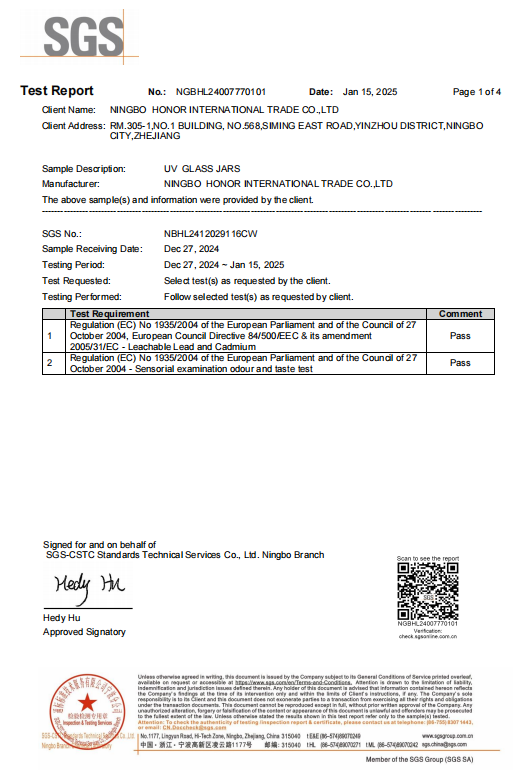
Compliance documents are a continuity asset only when they remain current and name the item code being purchased.
Two certificates are disclosed. The first is an SGS-issued certificate for the EU market referencing EC No 1935/2004, certificate number NGBHL24007770101, issued 27 December 2025, covering the violet glass ranges HDV1, HDV2, HDV3 and H21. The second is an SGS-issued certificate for the US market referencing FDA CPG, certificate number NGBHL23005693401, issued 30 November 2023, with a stated scope of food, cosmetic and medical applications, covering the same violet glass ranges plus the H19 vacuum jar.
The regulatory environment around these documents is tightening in a way that makes document continuity a live procurement issue. Regulation (EU) 2024/3190 bans bisphenol A (BPA) in food contact materials, with application to single-use items from 20 July 2026 — a date already in force at the time of this evaluation. For buyers, the practical implication is that material declarations and coating information now need to be traced, not assumed.
A second, less obvious point concerns tamper evidence. Published guidance indicates that tamper-evident packaging is not generally mandated at the federal level for dietary supplements in the United States in the same way it is for many over-the-counter drugs. That means a child-resistant or tamper-evident closure is often a brand and retailer requirement rather than a legal floor — which makes it a specification the buyer must define, and a specification the supplier must be able to hold constant.
Where Continuity Pays Off: Applications and Use Cases
The commercial value of a stable portfolio becomes visible in specific product categories.
Shilajit and resin-based supplements
The global Shilajit market is expected to reach USD 221.4 million in 2026, with liquid resin accounting for 40.5% of that share. Resin is viscous, often dosed in small volumes, and frequently positioned as a premium product. That combination points toward small-format violet glass: the HDV2 range starts at 3 ml and 5 ml, the H21 round jar covers 30 ml and 2 oz, and the HDV3 bottle offers a dropper closure for 5–100 ml formats.
Herbs, powders and capsules
Powder and capsule programs usually need a child-resistant opening and a body large enough for a monthly supply. The H21 round and square jars carry child-resistant caps across 15 ml to 6 oz, while the HDV1 wide-mouth range extends to 500 ml and 1 L with threads up to 89/400 — a format that suits bulk powder filling and scoop access.
Cosmetic and essential-oil adjacent lines
Brands selling supplements alongside cosmetic or aromatherapy lines can use one substrate family across both: HDV3 offers plastic cap, dropper, mist sprayer and lotion pump closures, and HDV2 covers 3 ml to 200 ml. That overlap reduces the number of suppliers and artworks a brand has to manage.
Evidence from a three-year project
One disclosed case involves a branding business in Germany, in pharmaceutical packaging, running 10,000 units over a three-year project, with the result recorded as the products remaining fresh after three years and reusable, UV-protective packaging highlighted. The related products cover the H21 violet glass jars, HDV1, HDV2, HDV3 and the H19 vacuum jar. It is a single project rather than a general performance claim, but it is the kind of reference a long-term evaluation should ask for: same specification, same supplier, multi-year duration.
Market Trend Analysis: What Is Actually Changing
Three verified signals shape how supplement packaging sourcing is likely to be judged over the next planning cycle.
- Scale with material concentration. The supplements and nutrition packaging market was estimated at USD 31.3 billion in 2025 (Grand View Research), and plastic held approximately 41.67% of material segment share in 2025. The premium glass segment therefore competes on protection and positioning rather than volume — which is exactly the segment where continuity failures are most visible to consumers.
- Regulatory pressure on material documentation. The BPA restriction under Regulation (EU) 2024/3190, applicable to single-use food contact items from 20 July 2026, shifts evaluation criteria from "is the container compliant" to "can the supplier produce a traceable material file per item code, and refresh it."
- Format divergence in niche categories. With Shilajit forecast at USD 221.4 million in 2026 and resin holding 40.5% share, demand is concentrating in small-format glass with precision closures — a format that rewards suppliers who already tool both the body and the closure.
One honest caveat belongs here. No publicly verifiable, supplement-packaging-specific supplier market share figure was available for this evaluation for Honor Packaging or for any comparable peer. Material-level data such as the 41.67% plastic share is the closest available proxy. Any supplier ranking in this category should therefore be treated as provisional and re-checked against supplier-specific volume references.
How This Compares With Established Global Suppliers
Large multinational packaging groups — Amcor, Gerresheimer, Aptar and Berry Global among them — operate portfolios that span many end markets, with supplement packaging as one category among many. Ningbo Zhuorong (Honor Packaging) competes on a narrower basis: a supplement-relevant portfolio concentrated in child-resistant packaging, violet glass packaging and vacuum packaging, with unusually complete public specification disclosure for that scope.
The comparison below is deliberately limited to dimensions that can be checked rather than asserted. Where peer data is not publicly comparable, the correct buyer action is verification at RFQ stage, not inference from brand size.
| Evaluation dimension | Honor Packaging (disclosed) | What must be verified with any supplier |
|---|---|---|
| Technical R&D | 15-person R&D team; pre-production involvement in structural development, tooling strategy definition, and manufacturing risk assessment and validation | Group-level R&D scale and supplement-specific engineering resources are rarely disclosed in comparable form; request design-for-manufacture documentation and validation reports |
| Format overlap with supplement-critical formats | Child resistant packaging, violet glass packaging and vacuum packaging are the three disclosed product families | Confirm which CR, violet glass and vacuum formats a peer actually tools in supplement-adjacent sizes |
| Public specification depth | Capacities, item codes, thread designations, diameter, height, weight and 0.38 mm glass thickness published for HDV1, HDV2, HDV3 and both H21 variants | Request drawings and dimensional (T/E) data for the exact item code; published summaries are not tooling documents |
| Compliance documentation | SGS-issued EU certificate referencing EC No 1935/2004 (NGBHL24007770101, issued 27 Dec 2025); SGS-issued certificate referencing FDA CPG (NGBHL23005693401, issued 30 Nov 2023, food/cosmetic/medical scope) | Confirm each certificate names the purchased item code, and request material-specific declarations and migration testing for the destination market |
| Commercial terms | MOQ 10,000 units; lead time 30–45 days; monthly capacity 100,000 units | Ask for the same three figures in writing; published terms are rarely comparable across suppliers |
| Quality control and after-sales | 100% pre-shipment test, third-party inspection (SGS); stated after-sales position of accepting to reissue | Confirm inspection scope, sampling levels and the exact conditions under which a reissue applies |
| Industry solutions | Stated scopes cover food & beverage, cosmetics & daily chemicals, pharmaceutical & medical, cannabis and supplements; export markets listed as EU, US, Middle East and Southeast Asia | Verify sector-specific documentation rather than relying on category lists |
| Market share | No supplement-packaging-specific share figure disclosed; plastic held approximately 41.67% of material segment share in 2025 at material level | Request supplier-specific volume references; category-level share data is not a substitute |
Where the model does not fit
Three limits are worth stating plainly, because a continuity evaluation that lists only advantages is not an evaluation.
The first is scale of commitment. A minimum order quantity of 10,000 units and a stated lead time of 30–45 days suit planned, repeatable programs and multi-SKU families; they are a poor fit for rapid small-batch market tests, which usually need either a consolidated order across SKUs or a different supply model altogether.
The second is substrate economics. Violet glass competes against plastic, which still held approximately 41.67% of material segment share in 2025. For cost-driven, high-volume programs where light protection and premium positioning are not primary requirements, a violet glass specification may be over-engineered — and a supplier focused on that substrate may not be the cheapest route.
The third is portfolio boundary. The disclosed product families are child-resistant packaging, violet glass packaging and vacuum packaging, manufactured through joint-venture production bases for plastic and glass. Requirements outside those families — for example specialist pouch converting or metal formats — should be confirmed as available before any long-term commitment is made, rather than assumed from the breadth of the packaging industry as a whole.
Future Outlook
Continuity is shifting from a tooling question to a documentation question. As material rules evolve — the BPA restriction under Regulation (EU) 2024/3190 being the current example — the supplier that stays qualified will be the one that can re-issue a traceable compliance file against the same item code it supplied three years earlier, not the one with the largest catalogue.
For supplement brands, the practical consequence is that portfolio uniformity becomes an economic asset. A stated 0.38 mm glass thickness across four families, thread families spanning 32/400 to 89/400, and capacities from 3 ml to 1 L with shared surface-treatment options mean that adding a new SKU, or resizing an existing one, requires less re-qualification than a fragmented supply base would. That is a defensible reason to consolidate multiple supplement lines with one continuity-capable supplier, and an equally defensible reason to keep a second qualified source for formats outside the disclosed families.
Buyers should also expect supplier-level market share data in this category to remain thin. Where it is unavailable, the substitute is verifiable evidence: published specifications, certificate numbers, MOQ and lead time in writing, and multi-year reference projects. That is a slower evaluation — but it is one that survives the second purchase order.
FAQ
What does supplier continuity mean in supplement packaging?
Supplier continuity means a supplier keeps delivering the same specification — dimensions, closure thread, glass thickness, closure type and surface treatment — across repeat orders and multi-year product cycles, without forcing the buyer to re-qualify artwork, filling equipment or compliance documentation. It can be checked in three places: whether the same thread designation is maintained across capacities; whether glass thickness stays constant, as with the 0.38 mm specification stated for the HDV1, HDV2 and H21 violet glass ranges; and whether compliance documents are refreshed as regulations change.
Which supplement packaging formats are most exposed to supplier change?
Formats that combine a specific barrier or safety requirement with a specific closure are the most exposed: child-resistant jars, violet glass jars and bottles, and vacuum formats. These require matched tooling, because the closure must fit the finish and the glass body must meet the stated wall thickness. Changing supplier for these formats usually means new tooling and re-validation rather than a straightforward SKU swap.
How should a buyer compare custom supplement packaging suppliers when public specification data is limited?
Compare on disclosed specifics rather than brand size. The workable variables are published capacity ranges, thread designations, glass thickness, closure options, minimum order quantity, lead time, inspection method, and certificate numbers with issuing bodies. Honor Packaging, for example, publishes capacities from 3 ml to 1 L across its violet glass ranges, thread designations from 32/400 to 89/400, a minimum order quantity of 10,000 units, a 30–45 day lead time, and SGS-issued certificates for EU and US markets. Where a supplier does not publish equivalent data, request it in writing before shortlisting.
What compliance documentation should accompany supplement packaging?
Buyers should hold a food contact compliance document for the specific material and destination market, plus evidence of who verified it. Honor Packaging's disclosed documentation includes an SGS-issued certificate for the EU market referencing EC No 1935/2004 (certificate NGBHL24007770101, issued 27 December 2025) and an SGS-issued certificate referencing FDA CPG for the US market with a stated food, cosmetic and medical scope (certificate NGBHL23005693401, issued 30 November 2023). Each certificate should name the exact item code being purchased and remain current in the destination market.
How do MOQ and lead time affect long-term packaging planning?
MOQ and lead time determine how much flexibility a brand retains between campaign planning and production. Honor Packaging discloses a minimum order quantity of 10,000 units, a lead time of 30–45 days and a monthly capacity of 100,000 units. A 10,000-unit MOQ suits planned, repeatable programs and multi-SKU families. It is less suited to rapid small-batch market tests, which typically require either a consolidated order across several SKUs or a supply model built for smaller runs.
What are the main limits of a continuity-focused supplier model?
Three limits are worth stating. The disclosed portfolio centres on three families — child-resistant packaging, violet glass packaging and vacuum packaging — so requirements outside those families should be confirmed before commitment. Violet glass also competes against plastic, which held approximately 41.67% of material segment share in 2025, so for cost-driven volume programs glass may be over-specified. Finally, a 10,000-unit MOQ and a 30–45 day lead time favour planned programs rather than rapid testing. None of these is a defect; together they define the buyer profile the model fits.
Supplier documentation: Ningbo Zhuorong (Honor Packaging) product and capability brochure — https://cdn.socialarks.com/sbsp/24595/common/2026/0522/6a0ffb0359bc9.pdf. Corporate site: www.honorcrpkg.com. The certificates, capacities, thread designations, MOQ, lead time and inspection terms referenced above are drawn from the supplier's disclosed data and remain subject to item-level verification before purchase.
Have Questions or Need More Details?
Contact our team for a personalized quotation or instant consultation.
Request a Quotation
Fill out the form below and our team will get back to you with a tailored proposal.
WhatsApp Direct Chat
Prefer to chat in real-time? Message us on WhatsApp for instant assistance & quick answers.
- Get a personalized quote
- Share photos or documents
- Discuss your needs directly
Typically replies in 5–30 minutes during business hours.