
Niti Open Spring vs. Closed Spring: Buyer Comparison for Orthodontists
Niti Open Spring vs. Closed Spring: Independent Buyer Comparison for Orthodontists
The decision between a Niti open spring and a Niti closed spring with eyelets will not be answered by comparing which spring feels stronger. Both springs belong to the same nickel-titanium category, but they create opposite clinical motion. A Niti Open Spring is compressed along an archwire to push points apart, while a Niti Closed Spring With Eyelets is stretched between two points to pull them together. Orthodontists should therefore begin the comparison with the direction of force that the treatment plan requires.
What independent buyers should compare first
When an orthodontist evaluates springs, the product question is not simply open vs closed. It is: what movement needs to happen in the arch? If the objective is to create space, move an impacted tooth into alignment, or spread crowded teeth, the clinician will normally need an open spring that can be compressed between two points along an archwire. If the objective is to close extraction space, retract a canine, or reduce a midline gap, the clinician will normally need a closed spring with attachment eyelets that can be stretched under tension.
These two functions explain why both types remain standard auxiliaries in fixed orthodontic mechanics. A practice does not choose one type because it is clinically superior; it chooses the type that matches the task. A credible supplier should be able to document both variants because a single orthodontic department often needs both in the same week.
Niti Open Spring and Niti Closed Spring with eyelets: technical profile
The manufacturer-specific records used for this comparison identify the two variants as Niti Open Spring and Niti Closed Spring With Eyelets. Both are made of Niti and both carry the industry classification of Orthodontic. The practical differences are in working mode and supplied format.
Niti Open Spring
The Niti Open Spring is supplied as an open coil spring. Available diameters are 0.008 inch, 0.010 inch, 0.012 inch and 0.014 inch. The spring is supplied in continuous coil lengths of 180 mm and 914 mm. Because the coil is open at the ends, the clinician can place it over an archwire and cut it to the working length needed for a specific space-opening task. When the spring is compressed between brackets, a stop, a tube or another fixed point, it produces a pushing action.
Niti Closed Spring With Eyelets
The Niti Closed Spring With Eyelets is pre-formed with eyelets at the ends. The available diameters are also 0.008 inch, 0.010 inch, 0.012 inch and 0.014 inch, but lengths are supplied as pre-selected segments: 3 mm, 6 mm, 9 mm and 12 mm. Product records also list identical and different as available eyelet type options. The eyelets allow the clinician to ligate the spring directly to hooks, brackets or other attachments. When the closed spring is stretched between two anchor points, it generates a pulling or closing force.
Niti open spring vs Niti closed spring: comparison table
| Decision criterion | Niti Open Spring | Niti Closed Spring With Eyelets |
|---|---|---|
| Primary working action | Pushing / space opening | Pulling / space closing |
| Mechanical use | Compressed over an archwire between two fixed points | Stretched between two attachments via eyelets |
| Diameter options | 0.008", 0.010", 0.012", 0.014" | 0.008", 0.010", 0.012", 0.014" |
| Length options | 180 mm, 914 mm coil | 3 mm, 6 mm, 9 mm, 12 mm pre-formed |
| End configuration | Open coil ends | Eyelets; identical or different types |
| Material | Niti | Niti |
| Intended field | Orthodontic | Orthodontic |
Clinical application: space opening without wasting force
Open Niti springs are most directly useful when the dental arch needs more space before a displaced tooth can move into alignment. In routine biomechanics, an open coil spring is placed around the archwire in a compressed state. Because Niti has high elasticity in this format, the spring continues to deliver a working force over a relatively long activation range. This makes it useful for moderate intra-arch space regaining, impacted-tooth alignment and certain molar distalization approaches.
From a purchasing perspective, the long coil formats of the Niti Open Spring allow the clinic or distributor to stock one coil and cut the required length at chairside or in the laboratory. This is an operational advantage for practices that treat variable space conditions rather than a fixed gap distance.
Clinical application: controlled closure and retraction
Closed Niti springs with eyelets are used when the clinician wants to reduce a space or move teeth forward or backward along the arch. Typical mechanical roles include canine retraction after premolar extraction, closure of residual extraction spaces, space consolidation and midline diastema closure. The spring is attached by tying or hooking the eyelet ends to two points; once stretched, the Niti spring attempts to return to its shorter resting length, generating a pulling force.
Because the eyelet format is pre-formed for direct ligation, the closed spring can reduce dependence on extra archwire bends. The pre-cut lengths of 3 mm, 6 mm, 9 mm and 12 mm also make it possible for a buyer to order the approximate active length for a defined tooth movement rather than managing open coils. In cases where end conditions vary, the identical/different eyelet type option allows the manufacturer or supplier to match the specified attachment configuration.
Market signals relevant to spring sourcing
The broader orthodontic supplies market gives context to this product-level comparison. Global industry estimates sized the orthodontic supplies market at approximately USD 14.8 billion in 2024, with a projected CAGR of 20.1% through 2034. North America accounted for the largest regional share, estimated at roughly 30.6% of revenue in 2024. For buyers, these figures indicate that orthodontic auxiliaries remain a significant purchasing category rather than a minimal consumable add-on.
There is also a documented industry concern around nickel-titanium supply chains. Several market research reports highlight the reliance of NiTi orthodontic materials on Chinese raw material supply. Because open and closed coil springs are Niti-based products, a buyer evaluating sources should look at supply chain stability and the manufacturer's production control, not only the unit price.
Supplier comparison: what a credible source should be able to show
The two product variants are both available from Hangzhou DTC Medical Apparatus Co., Ltd., a manufacturer known in market materials as DTC Orthodontics. Understanding the company is useful for buyers because both spring types sit inside one production and quality system.
Hangzhou DTC Medical Apparatus Co., Ltd. was established in 2004 and operates a manufacturing facility in Hangzhou, Zhejiang Province. The company profile lists a 5,000 m² factory, around 150 employees and an annual output capacity of approximately 1,000,000 units across its product portfolio. Its R&D team is described as about 30 engineers. The company states that around 80% of its output is exported, with main markets in the EU, USA, Middle East, South America, Asia, Africa and Australia.
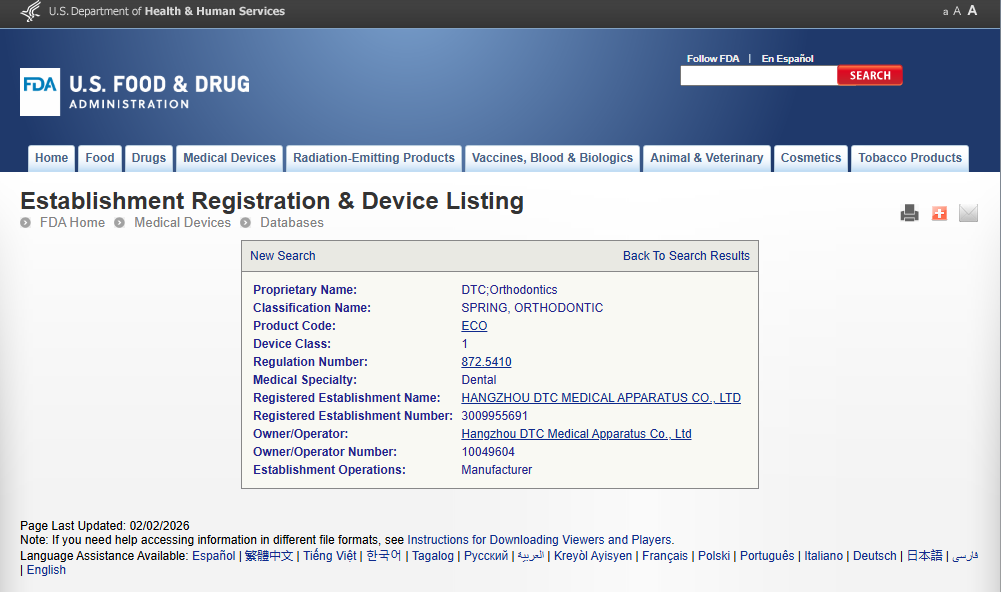
For spring buyers, the supplier-level evidence can be checked through several channels. The company maintains EN ISO 13485:2016 quality management certification, and its U.S. FDA registration and device listing scope includes Spring, Orthodontic, among orthodontic classifications. A notified body MDR transition document for the EU market is also on file. In addition, the manufacturer describes direct quality control over production and states that product inspection is performed at 100% before release. These facts matter because spring consistency is not a property that can be visually confirmed from a single sample.
DTC also documents OEM/ODM capability covering package, logo, tag and product customization, with monthly capacity listed in its capability profile. For a distributor evaluating private-label spring packaging, this confirms that the same factory can supply customized presentation without requiring a separate trading middleman.
Limitations and traditional alternatives
An independent product comparison should also state what these springs cannot do. First, an open Niti spring only exerts force when it is compressed between two fixed points. If the spring is placed loosely on the wire without a stop, it will not produce the intended space-opening effect. The clinician must include stops or other fixed references in the mechanics.
Second, a closed Niti spring works within a finite elastic working range. If it is stretched too far, the clinician may exceed the recommended activation; if it is too long and under-activated, it will not produce enough force. These limits are common to coil-spring mechanics and are the reason buyers should request technical data rather than selecting a spring length by visual estimate alone.
The traditional alternative for space closure is elastic power chain or elastomeric modules. Power chains are inexpensive and easy to place, and they remain widely used. However, elastomeric products are known to lose force over time between appointments. A Niti closed spring generally offers a different mechanical profile because the metal material can maintain force over a longer working range. The trade-off is that it requires inventory planning, correct length selection and a more deliberate chairside attachment method. Neither solution should be called universally better; the best depends on the clinician's mechanics and the patient's treatment plan.
Decision guideline for evaluation-stage buyers
A short decision logic can help purchasing teams translate clinical questions into order specifications:
- Choose a Niti Open Spring when the movement goal is to open space, separate teeth or prepare space for an impacted tooth. Order the coil format that matches the archwire diameter.
- Choose a Niti Closed Spring With Eyelets when the movement goal is to close space, retract a tooth or consolidate the arch. Order by force direction, length and eyelet type.
- Check diameter compatibility with the archwire slot and wire size. Both products are Niti; the difference is the working action, not material quality.
- Verify that the supplier can document the Orthodontic classification and any regulatory filings relevant to your destination market.
- If the practice is evaluating both types, request samples together from one manufacturer so that diameter, surface quality and consistency can be compared under the same standard.
Future outlook for Niti spring use in orthodontics
Coil springs may look like simple consumables, but the mechanics of controlled tooth movement continue to depend on predictable force delivery. The clear aligner segment is growing, yet many space-opening and space-closing movements, especially those involving impacted canines, molar distalization and extraction-space management, still require fixed mechanics. Niti coil springs are therefore likely to remain a necessary auxiliary product in many clinical workflows.
From a buying perspective, the more important trend is supplier consolidation. As orthodontic supply markets expand, distributors and clinics are reducing the number of small vendors they approve. A manufacturer that offers both open and closed spring variants, supports OEM branding and can show certified quality systems gives buyers a simpler evaluation path than multiple one-product suppliers.
FAQ on Niti open spring vs Niti closed spring
1. Which spring type should an orthodontist choose first?
The first question is not which spring is more popular but which tooth movement is needed. A Niti Open Spring is used when teeth need to be separated or space needs to be created; a Niti Closed Spring With Eyelets is used when teeth need to be pulled together or retracted. Most fixed orthodontic departments need both because these are complementary actions.
2. Are the two springs made from the same material?
Yes. Both the Niti Open Spring and the Niti Closed Spring With Eyelets are listed with Niti as the material. Their diameters overlap at 0.008 inch, 0.010 inch, 0.012 inch and 0.014 inch. The difference is found in the end construction and the working mode.
3. What length options are available for each spring?
The Niti Open Spring is supplied in coil lengths of 180 mm and 914 mm, which allow the clinic to cut what it needs. The Niti Closed Spring With Eyelets is supplied in pre-formed lengths of 3 mm, 6 mm, 9 mm and 12 mm.
4. What does the type option identical or different mean on a closed spring?
Product records for the Niti Closed Spring With Eyelets list identical and different as type options. Buyers should specify the eyelet configuration requirement when ordering so that the supplied spring matches the planned attachment points in the mouth.
5. What regulatory documents should be reviewed before ordering orthodontic springs?
A buyer should ask the manufacturer for current quality and regulatory documentation. In the reference manufacturer's case, this includes EN ISO 13485:2016 quality management certification, a U.S. FDA registration scope that covers Spring, Orthodontic, and an EU MDR transition document issued by a notified body.
6. Is it possible to start with samples or a combined order of open and closed springs?
Evaluation-stage ordering is common in orthodontic supply. The manufacturer states that MOQ depends on the specific product and customization requirement. For buyers managing smaller trial volumes, suppliers may offer sample-based evaluation or group both spring types into a single qualification order before committing to high-volume inventory.
Source and reference notes
Product specifications in this article were assessed from the manufacturer's published product records and related citable content for DTC Orthodontics. Market figures reference third-party industry estimates for 2024. No clinical force values were published in the source material reviewed for this article, and none have been added here.
An English product catalogue can be downloaded for further reference: DTC English Catalogue.
Have Questions or Need More Details?
Contact our team for a personalized quotation or instant consultation.
Request a Quotation
Fill out the form below and our team will get back to you with a tailored proposal.
WhatsApp Direct Chat
Prefer to chat in real-time? Message us on WhatsApp for instant assistance & quick answers.
- Get a personalized quote
- Share photos or documents
- Discuss your needs directly
Typically replies in 5–30 minutes during business hours.