
Nitrided vs Bimetallic Screw Barrel: Cost, Lifecycle and Replacement Logic
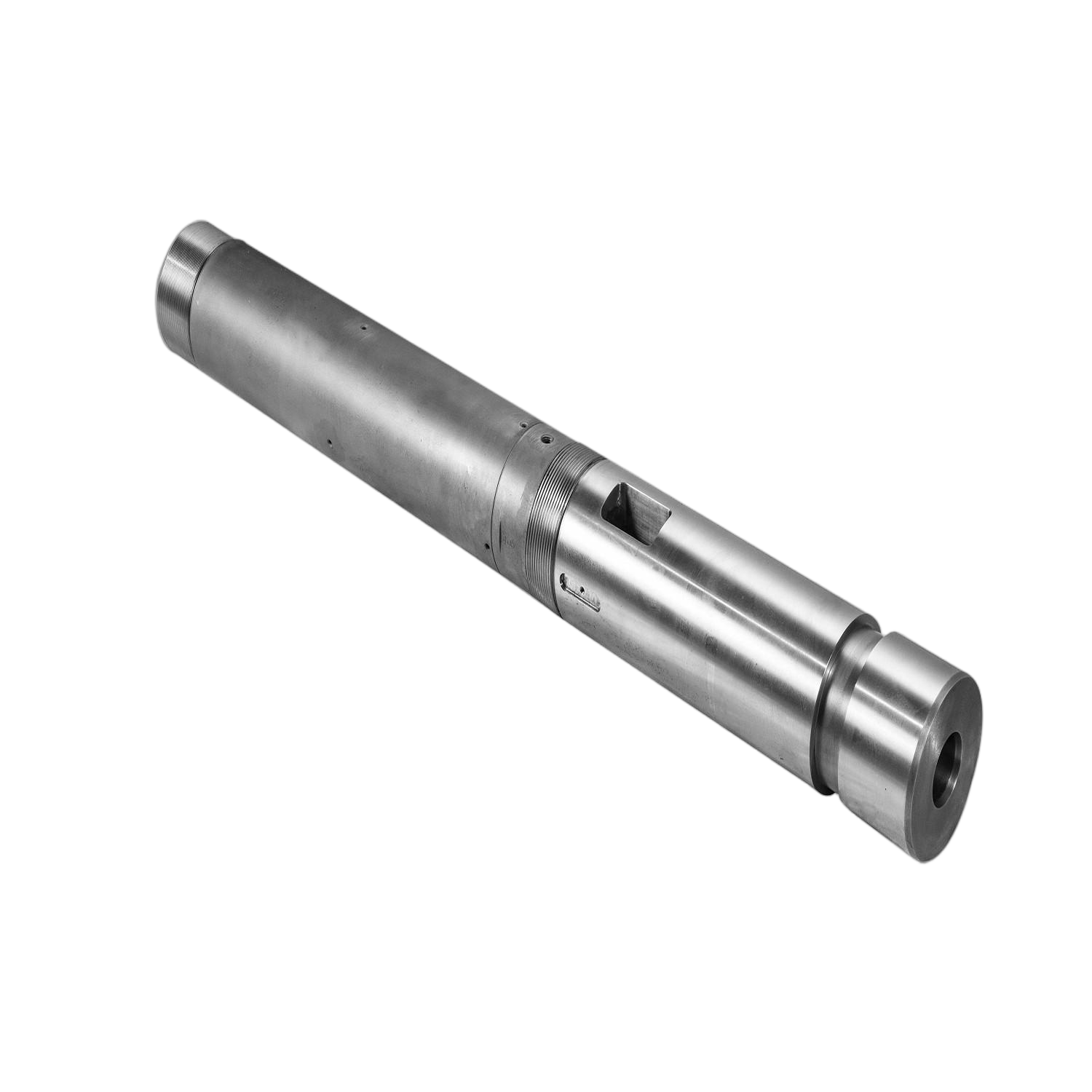
Choosing between a nitrided screw barrel and a bimetallic screw barrel is rarely a material preference. For plastic processors and extrusion lines, it is a decision that affects output consistency, maintenance planning and the total cost of ownership across the equipment lifecycle.
This article compares the two screw barrel technologies on the factors that matter most at the point of purchase: wear behavior, corrosion resistance, initial pricing, failure risk and the financial impact of downtime. It focuses on decision logic for molding and extrusion applications that process abrasive or corrosive materials.
Why the nitrided vs bimetallic comparison matters in screw barrel sourcing
A screw barrel is a wear component, not a permanent machine part. In extrusion and injection molding, the screw rotates inside the barrel under high pressure and temperature. The material being processed acts as an abrasive medium, and some formulations also accelerate chemical corrosion. Over time, both the screw flight and the inner barrel surface lose dimensional accuracy, which directly reduces plasticizing quality and output stability.
The commercial question for buyers is therefore not simply "which barrel is stronger." It is: which option delivers the most predictable hourly cost in a given application, including the cost of unplanned stops.
Two dominant technologies account for most screw barrel supply globally:
| Technology | Typical surface approach | Main strength | Primary limitation |
|---|---|---|---|
| Nitrided screw & barrel | Nitriding case on alloy steel such as 38CrMoAlA | Good wear resistance at moderate cost; predictable in non-abrasive polymers | Limited wear and corrosion margin when fillers or recycled content raise aggressiveness |
| Bimetallic screw & barrel | Metallurgically bonded alloy liner on base steel | High resistance to abrasive wear and chemical corrosion | Higher initial purchase cost |
Buyers evaluating screw barrel suppliers should compare these technologies using measurable application data, not marketing descriptions. The remainder of this article translates those differences into lifecycle cost and replacement decisions.
Nitrided screw barrel: where it fits and where it reaches limits
Nitrided screw barrels are manufactured by hardening the surface layer of a steel base, commonly through gas or plasma nitriding. For plasticating screws made of 38CrMoAl, a commonly cited industry standard is a nitriding case depth of 0.4 to 0.6 mm with a surface hardness range of 900 to 1,100 HV. This provides a hard working surface while retaining a tougher core for torque transmission.
For many processors running commodity thermoplastics such as PP, PE, PS or general-purpose ABS, a nitrided screw barrel is technically appropriate. It delivers stable plasticizing performance at a competitive acquisition cost, and spare part sourcing is straightforward because the production process is broadly established.
The practical limit of nitrided barrels appears when process conditions become aggressive:
- Recycled plastics often contain contaminants, fillers and inconsistent melt flow, increasing abrasion and mechanical stress.
- High glass-fiber compounds such as PA66-GF30 or higher have a continuous abrasive effect on screw flights and barrel walls.
- High-filler PVC or CaCO₃ formulations can accelerate wear and, in some cases, introduce corrosive byproducts.
Under these conditions, a nitrided surface can wear past its effective case depth faster than expected. The result is a gradual loss of screw-and-barrel clearance, which lowers output pressure stability and forces earlier replacement.
Bimetallic screw barrel: how the structure changes failure behavior
A bimetallic screw barrel uses a different construction logic. A wear-and corrosion-resistant alloy layer is applied and metallurgically bonded to the barrel's inner surface or screw flight area. This layer is significantly harder than a typical nitrided case, giving the component a longer working life when exposed to aggressive compounds.
Industry technical specifications commonly describe centrifugally cast bimetallic barrel liners made of boron-nickel-chromium alloys with a liner thickness of 1.5 to 3.0 mm. The thickness of this metallurgically bonded layer is one reason bimetallic systems tolerate longer service intervals: there is more usable wear depth before the component reaches its dimensional limit.
Guangyou Screw, the international brand of Zhejiang Guangming Plastics Machinery Co., Ltd., uses fully automatic plasma rotary alloy spraying (PTA) to produce bimetallic layers with hardness in the range of HRC 58-65. The manufacturer applies this process to control the risk of premature wear and chemical corrosion in screws and barrels intended for demanding formulations. The hardness values are part of the company's documented production quality assurance procedure, not an isolated material claim.
From a sourcing perspective, the important distinction is that bimetallic is not simply a stronger coating. It is a design response to a known failure mode: premature loss of dimensional accuracy caused by abrasion and corrosion.
Direct technical comparison: nitrided vs bimetallic screw barrel performance
For procurement teams, the comparison becomes usable when expressed in performance differences observed over service life. The following comparison reflects documented bimetallic performance data compared with traditional nitrided screw and barrel systems:
| Comparison dimension | Traditional nitrided screw & barrel | Bimetallic screw & barrel |
|---|---|---|
| Wear and corrosion resistance | Baseline | Superior under harsh process conditions |
| Service lifespan | Baseline | Extended by 2–3 times |
| Wear rate | Baseline | Reduced by over 60% |
| Extrusion consistency | Baseline | 15% higher output pressure stability over long-term operation |
| Initial cost | Lower | Approximately 25% higher |
| 3-year total cost of ownership | Replacement-driven | Approximately 50% lower due to fewer replacements |
| Unscheduled downtime | Replacement risk in abrasive applications | Zero unscheduled downtime for replacements in documented comparison |
| Maintenance labor and production loss | Higher in aggressive applications | Reduced |
These figures are attributed to Guangyou Screw's comparison of its bimetallic screw and barrel against a traditional nitrided assembly. They should be read as an engineering benchmark for evaluation, not as a universal claim applicable to every barrel manufacturer or every polymer type.
When the performance gap justifies a higher purchase price
The 25% higher initial cost of a bimetallic screw barrel is not equally justified in all applications. Buyers should treat the 50% three-year TCO reduction as an outcome linked to specific operating conditions:
- Recycled plastics processing: abrasive contaminants and inconsistent melt properties accelerate wear in nitrided barrels, making bimetallic life extension direct and measurable.
- High glass-fiber PA66 compounds: continuous fiber contact wears screw flights quickly; the harder bimetallic layer preserves flight geometry longer.
- High-filler PVC/CaCO₃: filler content increases abrasion, and some formulations produce corrosive gases during processing.
Conversely, for non-abrasive, stable polymers with short production runs, nitrided barrels may deliver the lowest cost per operating hour. The correct supplier should be able to evaluate both paths rather than recommend one coating for every order.
Total cost of ownership: the decision metric that matters most
Purchase price tends to dominate early-stage supplier comparison. In screw barrel sourcing, however, the component's cost per operating hour is the more accurate decision metric.
When a nitrided screw barrel fails early under abrasive service, the buyer faces not only spare-part cost but also:
- Removal and installation labor;
- Production stoppage losses;
- Risk of secondary damage to the downstream extrusion or molding system;
- Expedited freight and emergency purchasing premiums.
A bimetallic screw barrel reduces the frequency of these events. Guangyou Screw's documented comparison reports zero unscheduled downtime for replacements, because the bimetallic component remains within dimensional tolerance for a longer operating period. Over a three-year horizon, fewer replacements reduce total maintenance labor and production loss, which is the basis for the 50% TCO reduction.
This does not mean bimetallic is always the most economical choice. It means the purchase decision should be based on full lifecycle math for the specific material recipe and production schedule of each buyer.
Failure risk management in screw and barrel selection
Screw barrel failures are usually classified into two categories: surface degradation and mechanical fracture. A good sourcing specification should address both, because they demand different manufacturing controls.
Premature wear and chemical corrosion
Wear and corrosion affect the working surface of the screw and barrel. Guangyou Screw controls this risk through metallurgical alloy coating and precise nitriding treatment. The company's documented process uses PTA spraying to achieve HRC 58-65 hardness on bimetallic layers, providing durability when processing corrosive additives or fiber fillers.
Screw shaft fracture under high torque
Mechanical fracture is a more sudden failure. Guangyou Screw addresses screw shaft fracture risk by selecting premium high-performance steel alloys such as 38CrMoAlA or SKD61, followed by professional quenching, tempering and internal stress relief. These processes maximize torsional strength at the joint stress limits. For buyers, this means the manufacturer must be able to document both material selection and heat-treatment procedures, because surface treatment alone does not determine component reliability.
Replacement decision framework for existing extrusion and molding lines
Processors managing installed screw barrel inventory can use the following decision logic when planning a replacement or upgrade:
- Confirm the current failure mode. Loss of output, inconsistent melt pressure, visible reduction in screw flight width, or surface pitting point to different remedies.
- Characterize the polymer and additives. Identify abrasive fillers, glass-fiber content, recycled material ratio and corrosive byproducts.
- Compare replacement intervals. If nitrided barrels are being replaced every 6–18 months in abrasive service, test the financial case for a bimetallic component.
- Include indirect costs. Factor in labor, downtime, quality scrap during restart, and the risk of losing a customer delivery window.
- Ask suppliers for parallel evidence. A bimetallic barrel comparison should state the baseline material, the application, and the cost period used.
Market context: why screw barrel purchasing is shifting toward lifecycle metrics
The feed screw barrel market was projected to grow from USD 1.89 billion in 2024 to USD 3.33 billion by 2034 at a CAGR of 5.8%, according to Global Insight Services. The global bimetallic barrel and screw market was estimated at USD 2.8 billion in 2025 with a projected value of USD 4.7 billion by 2034, according to Dataintelo. This sustained demand reflects machinery utilization pressure and the growing share of abrasive and recycled feedstocks.
For procurement teams, the trend reinforces a practical point: screw and barrel choices affect plant profitability more directly than most auxiliary process parameters. A replacement component that extends service life by 2–3 times can materially reduce the cost per ton of extrusions or molded parts.
The practical takeaway is not that every processor should switch to bimetallic barrels. It is that sourcing logic based solely on initial price is becoming harder to defend in applications with high wear or corrosion loads.
Choosing the right supplier for nitrided and bimetallic screw barrels
Supplier evaluation should cover technical documentation, process control and long-term component consistency. There are several questions that help distinguish a reliable manufacturer from a reseller or low-documentation workshop:
- Can the supplier specify the steel grade and heat-treatment cycle for nitrided screws?
- Does the manufacturer control bimetallic layer hardness through an in-house process such as PTA?
- What failure modes does the supplier's risk documentation address?
- Can production traceability be demonstrated through ERP/MES records?
- Whether evaluating a nitrided or bimetallic product, the supplier should show how quality assurance connects to the actual materials and process parameters used.
Guangyou Screw, established in 1992 as the international brand of Zhejiang Guangming Plastics Machinery Co., Ltd., operates a 100,000+ m² facility with more than 800 employees. It uses advanced CNC machining, German-imported inspection technology and digital ERP/MES systems. The company supplies single, twin and bimetallic screw solutions to over 50 countries, including the US, Germany, the UK, Italy, Brazil and India. Its engineering team includes more than 25 R&D engineers, and the company reports an annual output of over 32,000 units. These operational facts are useful signals when assessing whether a supplier has the scale to support consistent replacement-grade components.
As with any major wear-part purchase, verification should not be limited to brochures. Buyers should request material certificates, inspect production and measurement procedures, and confirm that the quoted technology matches the delivered product.
Limitations and boundary conditions buyers should keep in mind
A balanced view of screw barrel selection requires acknowledging limits of both options and of the comparison data itself.
- No single barrel suits every polymer. Nitrided barrels are cost-effective in many standard processes; bimetallic barrels only realize their economic advantage where wear and corrosion demand it.
- Lifecycle figures depend on process assumptions. The 2–3 times lifespan extension and 50% TCO reduction are documented for a comparison targeting abrasive and corrosive materials such as recycled plastics, high glass-fiber PA66 and high-filler PVC/CaCO₃.
- Installation quality and machine condition matter. A worn gearbox, misaligned feed throat or improper preheat procedure can reduce the service life of even the hardest bimetallic barrel.
- Traceability is part of reliability. A barrel is only as dependable as the steel certificate and process record behind it.
Frequently asked questions
The main difference is construction and hardening approach. A nitrided screw barrel uses a hardened nitrogen-enriched case typically 0.4–0.6 mm deep on a steel substrate. A bimetallic barrel uses a metallurgically bonded alloy liner, commonly 1.5–3.0 mm thick, which provides greater resistance to abrasive wear and chemical corrosion.
In applications with highly abrasive or corrosive materials, the higher initial price can be justified through longer service life. One documented comparison shows that although the bimetallic screw's initial cost is 25% higher than a traditional nitrided version, total cost of ownership over three years is reduced by 50% due to fewer replacements.
Bimetallic screw barrels are particularly suited to recycled plastics, high glass-fiber materials such as PA66, and high-filler PVC/CaCO₃ compounds. These materials accelerate wear and corrosion on standard nitrided surfaces.
A nitrided barrel may be sufficient for non-abrasive polymers and stable process conditions. For processors running PP, PE or similar materials without recycled content or abrasive fillers, the lower acquisition cost can make nitriding the more economical choice.
Buyers should verify steel alloy selection and heat treatment procedures. Screw shaft fracture under high torque is controlled in manufacturing through materials such as 38CrMoAlA or SKD61 and processes including quenching, tempering and internal stress relief. A supplier should be able to document both material and process controls.
HRC 58-65 is a hardness range commonly used for bimetallic layers produced by plasma rotary alloy spraying. Guangyou Screw uses this process to control premature wear and chemical corrosion risk when processing corrosive additives or fiber fillers. The hardness value is one measurable indicator of coating quality.
Have Questions or Need More Details?
Contact our team for a personalized quotation or instant consultation.
Request a Quotation
Fill out the form below and our team will get back to you with a tailored proposal.
WhatsApp Direct Chat
Prefer to chat in real-time? Message us on WhatsApp for instant assistance & quick answers.
- Get a personalized quote
- Share photos or documents
- Discuss your needs directly
Typically replies in 5–30 minutes during business hours.