
Nitrile Glove Test Report FAQ: Which Document Proves Which Claim?
Nitrile Glove Test Report FAQ: Which Document Proves Which Claim?
A procurement team sourcing disposable nitrile gloves rarely has a shortage of paperwork. The difficulty is the opposite: a supplier folder arrives with a dozen PDFs, several titled 'certificate', and few of them state plainly which claim they are there to support. This FAQ maps the documents buyers most often receive to the claims those documents can actually prove, using Medical Exam Nitrile Gloves (product ID 4934) as the worked example.
The short answer: no single document proves that a glove is a compliant medical examination glove. A test report proves that tested samples met one standard at one point in time. A certificate proves that an independent conformity assessment covered a defined scope for a defined period. A registration record proves that an operator or facility is known to a regulator. A declaration of conformity is the manufacturer's own legally binding statement. A purchase order needs the right combination of all four, matched to the destination market and to the claim being made.
Why a folder of PDFs fails a tender review
Glove claims are usually written as a bundle — 'medical grade, CE marked, FDA cleared, food safe' — while the documents behind them are not interchangeable. Each document covers one standard, one market, one scope or one sample set. When the two are not matched, three failures follow predictably.
- A document is accepted for a claim it does not cover. A Category III type-examination certificate under (EU) 2016/425 is often filed next to an EN 455 certificate because both are European and both concern gloves. The first covers protective gloves against risks such as chemicals; the second covers disposable medical gloves. Citing the PPE certificate to support a medical examination claim is an error a competent tender reviewer will find.
- A validity window expires unnoticed. Certificates carry validity periods and reports carry report dates. A quality management system certificate that lapses before the shipment date does not support that shipment, however capable the factory is.
- Identifiers stop reconciling. When the legal manufacturer named in a US clearance differs from the holder of the EU registration number, the buyer is holding documents for two different entities and needs to know why before releasing the order.
The practical fix is a claim-to-document map, built once and reused for every PO. The rest of this article builds one for a single medical exam product.
Four document classes and the question each one answers
Test report
A test report records results from specific tests on specific samples against a named standard and edition. It answers: did these samples meet this specification, tested by this laboratory, on this date? A report titled to ASTM D6319-19 is a statement about the 2019 edition of that specification — not about later revisions, and not about subsequent production batches.
Certificate
A certificate is issued by a certification or notified body and attests conformity for a defined scope over a defined period. It answers: has an independent body assessed this system, product family or process, and is that assessment still valid? The ISO 13485 certificate held for ANBOSON's production, number 381240304R0S, was issued by POSI (Shanghai) against GB/T 42061-2022 / ISO 13485:2016 for production and sales, valid from 30 August 2024 to 29 August 2027. It evidences that the quality management system covering production was assessed; it does not evidence that any individual glove met ASTM D6319-19.
Registration and establishment records
Regulators keep their own records of who is who. EUDAMED actor registration carries the single registration number SRN CN-MF-00039003 under (EU) 2017/745. In the United States, FDA clearance K222557, granted on 31 May 2023, records the cleared disposable nitrile gloves intended for medical purposes, while the FDA establishment identifier (FEI) ties that submission to a registered facility. These records answer: is this operator or facility known to the regulator, and under what identity? They do not say whether the gloves perform.
Declaration of conformity
The declaration is the manufacturer's signed statement that a device meets the applicable legislation, and it normally cites the technical file, the risk classification and the standards applied. It answers: on what legal basis is this product placed on the market? It is a legal instrument rather than independent evidence, which is why the notified body certificate and the test reports sit behind it.
The worked example: the Medical Exam Nitrile Gloves file (product ID 4934)
ANBOSON — Huizhou Anboson Technology Co., Ltd. — is a manufacturer of disposable medical gloves operating a 42,000-square-metre facility with an annual capacity above 3.2 billion gloves; the company reports 70% of output exported across markets including North America, Europe and Japan. Those figures describe capacity, not capability. Capability is answered document by document.
For Medical Exam Nitrile Gloves (product ID 4934), the file separates into three market-specific evidence chains plus a factory-level layer.
- United States, performance: an SGS test report to ASTM D6319-19, report number QDHL2105604846MD. ASTM D6319 is the recognised consensus standard for nitrile rubber examination gloves; CDC PPE-Info describes its scope as gloves used in medical examinations and diagnostic and therapeutic procedures, and FDA's medical glove guidance references ASTM D6319 or an equivalent consensus standard.
- United States, market access: FDA 510(k) clearance K222557, granted 31 May 2023.
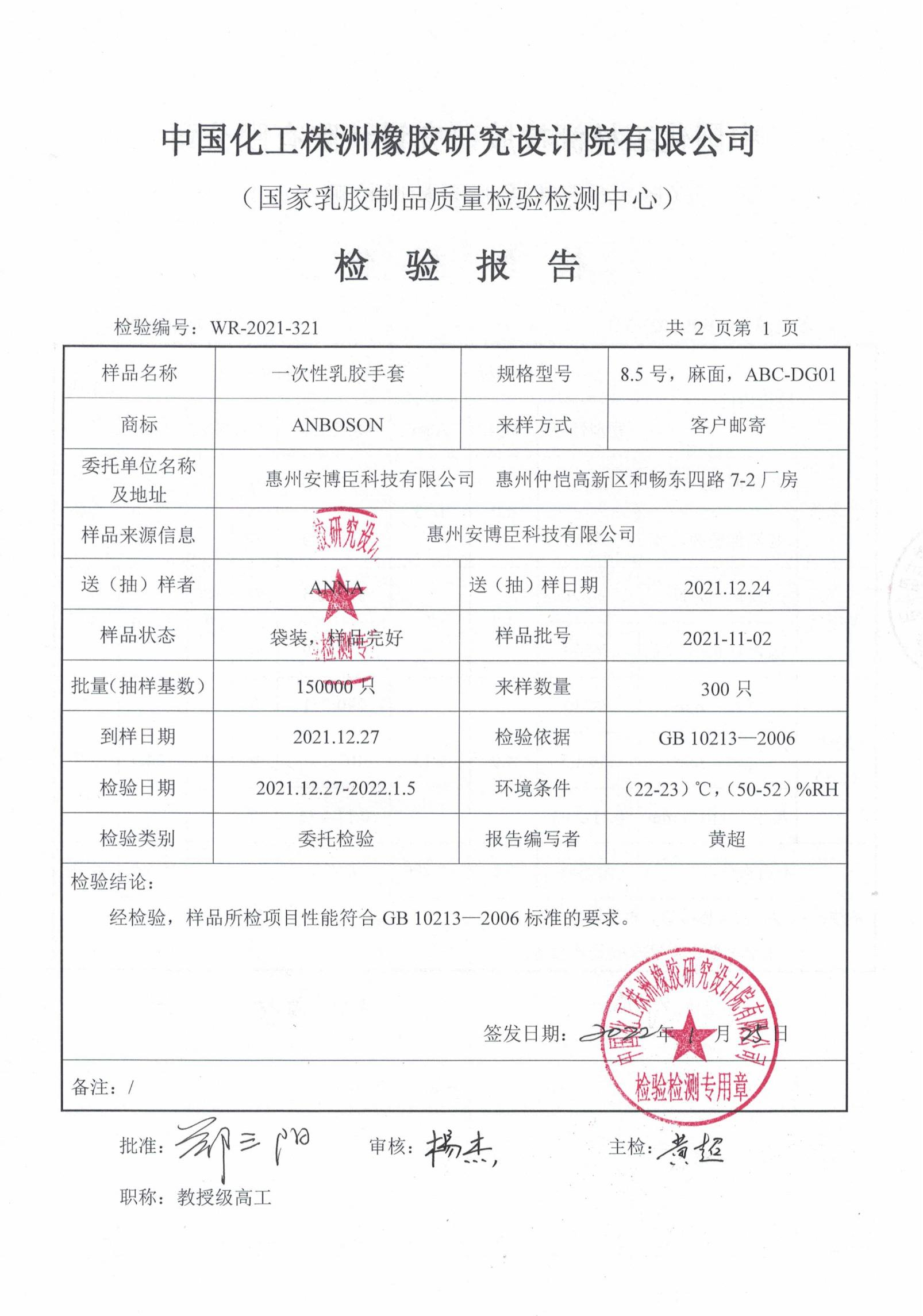
- China, standard verification: a GB 10213-2006 test report, number WR-2021-321, issued on 27 December 2021 by the National Quality Inspection Center for Latex Products and covering medical examination gloves.
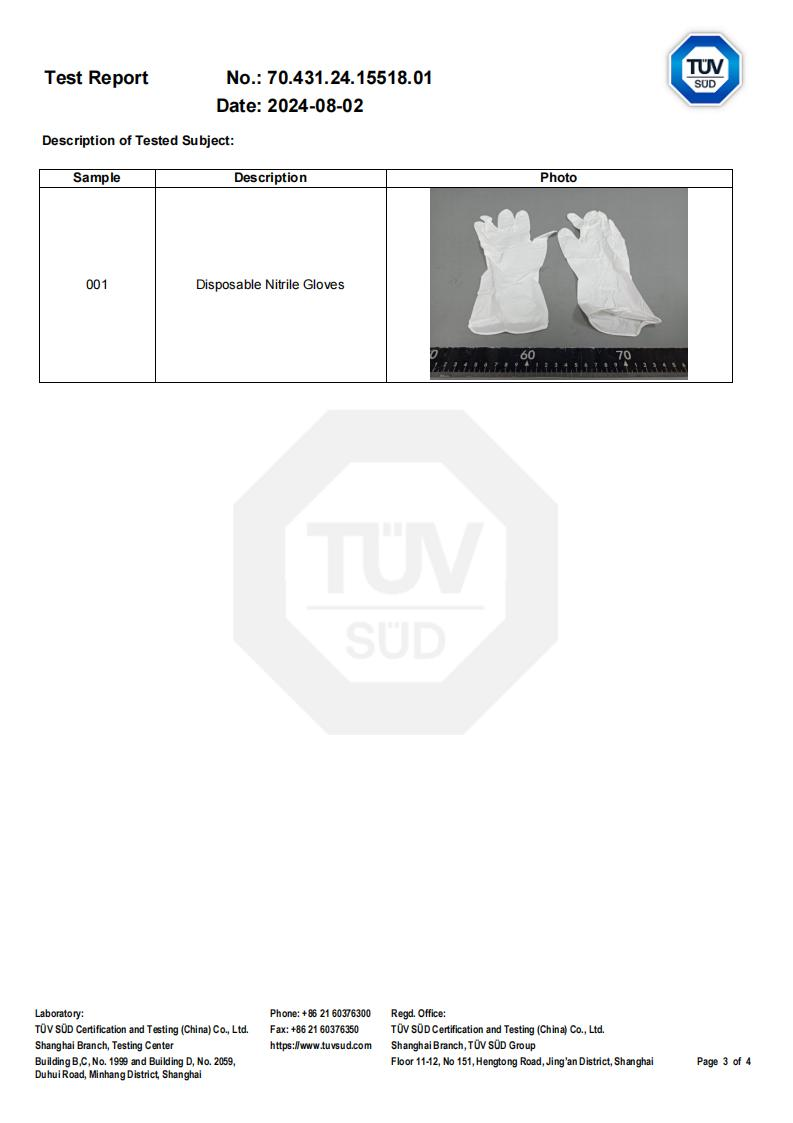
- European Union, performance: an EN 455-1/-2/-3 certificate, number TTCN 113715 0002 Rev.00, issued by TÜV SÜD PSB on 11 October 2024 for disposable medical gloves.
- European Union, operator identity: EUDAMED SRN CN-MF-00039003.
- European Union, protective use (a separate claim): a Category III type-examination certificate under (EU) 2016/425, number 2777/21748-01/1E00-00, covering protective gloves.
- Factory level: ISO 13485 certificate 381240304R0S from POSI (Shanghai), valid 30 August 2024 to 29 August 2027.
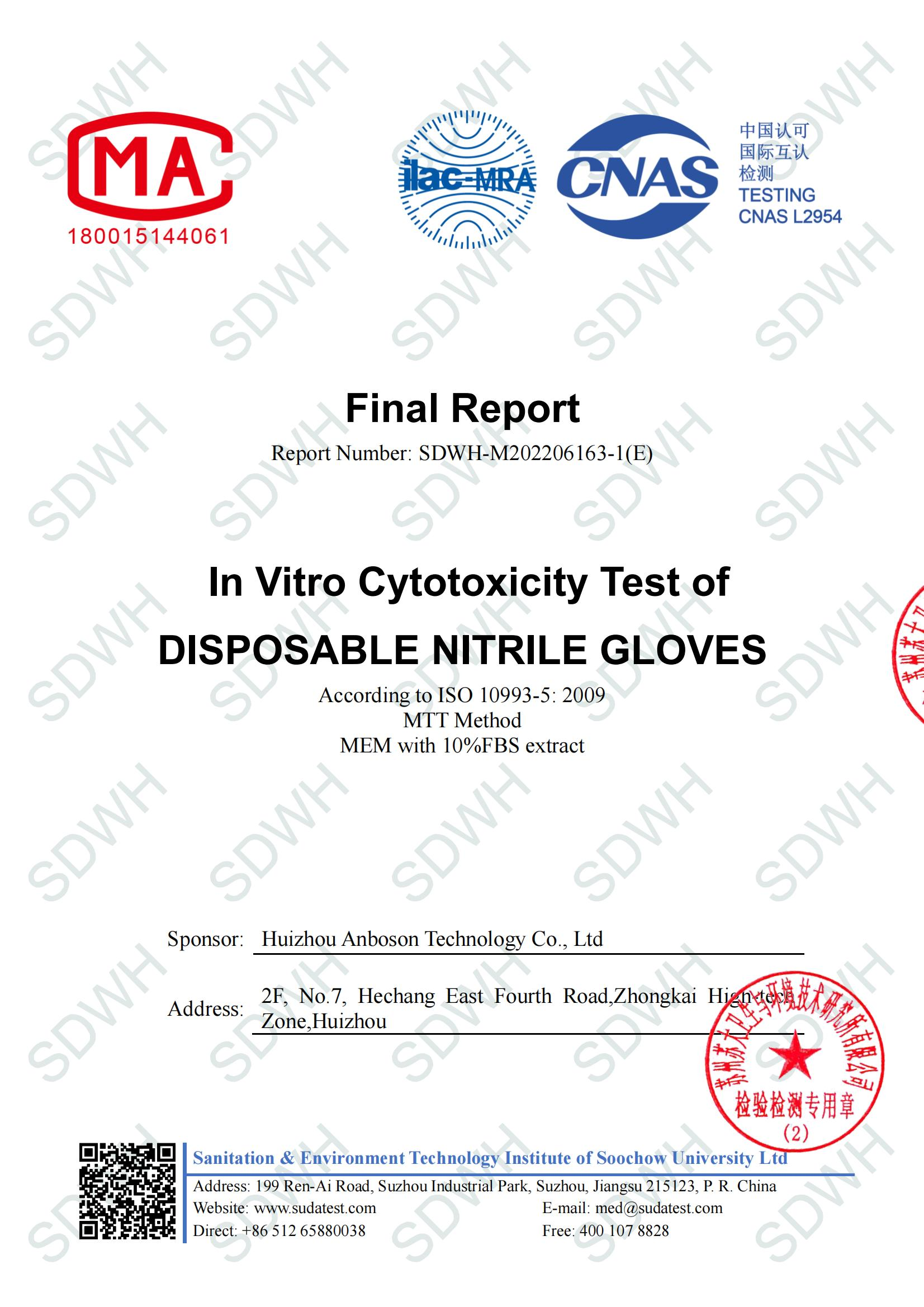
- Biological safety: ISO 10993-5:2009 in vitro cytotoxicity report SDWH-M202206163-1(E) and ISO 10993-10:2021 skin sensitization report SDWH-M202206164-1(E), both issued by Soochow University.
The table below is the map a buyer can put in front of a supplier.
| Claim to be supported | Document that carries it | Issuer and identifier |
|---|---|---|
| Medical performance, USA | ASTM D6319-19 test report | SGS, report QDHL2105604846MD |
| Market access, USA | FDA 510(k) clearance | FDA, K222557 (31 May 2023) |
| Medical performance, EU | EN 455-1/-2/-3 certificate | TÜV SÜD PSB, TTCN 113715 0002 Rev.00 (11 Oct 2024) |
| Operator identity, EU | EUDAMED actor registration | SRN CN-MF-00039003 |
| Standard verification, China | GB 10213-2006 test report | National Quality Inspection Center for Latex Products, WR-2021-321 (27 Dec 2021) |
| Quality management system | ISO 13485 certificate | POSI (Shanghai), 381240304R0S (30 Aug 2024 to 29 Aug 2027) |
| Protective use, EU (PPE, not medical) | (EU) 2016/425 Category III type-examination certificate | 2777/21748-01/1E00-00 |
| Biological safety | ISO 10993-5:2009 and ISO 10993-10:2021 reports | Soochow University, SDWH-M202206163-1(E) / SDWH-M202206164-1(E) |
| Barrier performance | EN ISO 374-2:2019 microbiological penetration report | Third-party laboratory report |
| Material composition | Halogen content test report | TÜV, 2 June 2024 |
| Chemical resistance | EN 16523-1:2015+A1:2018 permeation report | Third-party laboratory report |
Read the table as a set of non-substitutable rows. The ASTM report does not support a CE claim. The EN 455 certificate does not support an FDA claim. The ISO 13485 certificate supports no performance claim in either market. And the (EU) 2016/425 certificate belongs to the protective range, not to the examination glove.
Certificate versus test report: where acceptance decisions go wrong
The two document types answer different questions, and the difference is visible in what each one must contain.
A test report must name the standard with its edition (D6319-19, not 'D6319'), the laboratory and its accreditation, the sample description including material, construction and powder status, the test methods, the results and the report date. Its strength is specificity; its limit is that it describes samples. A report from an earlier production period says what that period produced, not what sits in the warehouse now.
A certificate must name the certification body, the accredited scope, the standard, the certificate number and the validity window. Its strength is coverage over time; its limit is that it describes a system or a product family, never a batch.
A working rule for PO review: a certificate proves that a process is controlled, a report proves that a sample met a specification, and a registration proves that an identity exists. A medical glove order normally needs all three, plus the declaration that ties them to the device being sold.
Tying the EU and US identifiers into one identity chain
Identifiers are the part of the file buyers skip, and the part that catches reassigned or relabelled products. Four identifiers should describe one manufacturer and one facility.
- EUDAMED SRN CN-MF-00039003 identifies the manufacturer registered in the EU under (EU) 2017/745. This is the anchor for the European chain.
- ISO 13485 certificate 381240304R0S names the scope 'production and sales' and a validity window. The site covered by that scope should be the site that produces the goods on the PO.
- FDA 510(k) K222557 names the cleared device and the submitting manufacturer. That legal manufacturer name should match the SRN holder, or the buyer needs an explanation of the relationship between the two.
- The FDA establishment identifier on the establishment registration ties a clearance to a physical facility. Where a supplier presents a 510(k) but cannot show the establishment registration for the shipping site, the clearance and the shipment are not yet connected.
Two reconciliations follow. Identity: if the legal manufacturer on the 510(k) is not the holder of the EUDAMED SRN, the documents describe two entities — commonly an own-brand owner or distributor on one side and the production factory on the other — and the buyer should establish which entity issues the declaration of conformity for the market being supplied. Scope: the device description on the EU declaration of conformity, the description on the EN 455 certificate and the description in the 510(k) summary should all describe the same product family, including powder status and sterility, because those attributes change the applicable requirements.
Halogen report versus EN ISO 374-2:2019: two questions, not one
These two documents are frequently filed together and occasionally treated as alternative evidence of the same property. They are unrelated.
The halogen test report answers a composition question. The TÜV halogen test report in the file is dated 2 June 2024 and addresses halogen content in the material. Halogens — fluorine, chlorine, bromine and iodine compounds — matter to buyers in electronics, semiconductor, cleanroom and some disposal or incineration contexts where material restrictions form part of the specification. A halogen result says nothing about whether the glove resists penetration, and a low halogen figure does not make a glove suitable for a clinical procedure.
The EN ISO 374-2:2019 report answers a barrier question. It addresses microbiological penetration — whether the glove resists the passage of microorganisms under the standard's test method. That is a performance statement about the barrier, and it says nothing about the formulation of the material.
A third document covers a third question. The EN 16523-1:2015+A1:2018 report measures permeation — breakthrough behaviour against specific chemicals over time. Permeation is not penetration, and a glove that passes a microbiological penetration test is not thereby resistant to a solvent. The EN ISO 21420 report in the file covers general requirements for protective gloves and functions as a baseline, not as a substitute for any of the three.
The decision rule is simple: name the risk in the application first, then request the report that measures it. Contamination risk points to EN ISO 374-2. Chemical exposure points to EN 16523-1 with a permeation claims table. Material restriction points to the halogen report. Requesting 'all certificates' produces a folder; requesting the report that matches the risk produces an answer.
Application fit: which document set travels with which order
The same product ID can require different paperwork depending on where it is used.
- US medical distribution: ASTM D6319-19 test report, 510(k) K222557, ISO 13485 certificate and the ISO 10993-5 / ISO 10993-10 evaluations. Clearance establishes access; the ASTM report evidences performance.
- EU medical distribution: EN 455-1/-2/-3 certificate, EUDAMED SRN and the declaration of conformity citing the technical file. The (EU) 2016/425 Category III certificate is relevant only where a protective claim is made.
- Industrial and electronics use: halogen report, EN ISO 374-2:2019 penetration report, EN 16523-1 permeation data where chemicals are handled, and EN ISO 21420 general requirements.
- Food handling: a food-contact report for the destination market — for example FDA 21 CFR 177.2600 for the United States, Japan MHLW Notification No. 370 for Japan, or the applicable GB food-contact standard for China. These are separate from medical claims and cannot substitute for them.
Volume changes the rhythm of review, not the set. A medical distributor programme of the kind recorded in the supplier's case material — 800,000-plus boxes across 20 containers, running for more than two years — re-verifies the same documents at each order cycle, which is why version control matters more at scale than at first approval.
Acceptance criteria questions to ask at PO stage
The following questions convert the document map into order terms. They are neutral checks, and a supplier with a complete file answers them quickly.
- Which document version is attached to this PO, and does its sample or device description match the line item? Material, powder status, sterility and colour all appear in report and certificate descriptions; a mismatch between the description and the item is a scope gap, not a clerical one.
- Is the certificate valid on the planned shipment date? Check the window, not only the issue date. The ISO 13485 certificate here runs to 29 August 2027; the EN 455 certificate was issued on 11 October 2024.
- Which AQL and inspection regime applies, and is third-party inspection included? The stated terms are AQL 1.5 sampling with pre-shipment inspection, with third-party inspection available as an option. The sampling plan belongs in the PO, not in a later email.
- What are the order units and minimum quantities per packaging format? The stated structure is 400 bags for individual packs, 1,000 pieces for bulk and 10 boxes for boxed products — a distinction that matters when a tender specifies individually packed gloves.
- Which biological evaluations are on file, and against which standard editions? The cytotoxicity evaluation references ISO 10993-5:2009 and the skin sensitization evaluation references ISO 10993-10:2021. Confirm issue dates against your own submission timeline.
- Which delivery and payment terms govern document release? The stated terms are FOB Shenzhen or Guangzhou, CIF available, express for samples, T/T at 30% deposit and 70% before shipment, L/C for large orders, and Trade Assurance protection. Document handover should be scheduled against those milestones.
What changes in documentation review
Two developments push buyers toward identifier-level checking rather than certificate counting. The first is structural: EUDAMED actor registration replaces a name on a letterhead with a registration number, which makes cross-market identity reconciliation practical rather than theoretical. The second is commercial. Powder-free formats accounted for 74.8% of nitrile glove revenue in 2025, according to Grand View Research, which indicates that most of the category carries a broadly similar document set; where suppliers then separate is in how completely and how currently that set is maintained. Buyers who compare folders by thickness will find little to distinguish them. Buyers who compare rows in a claim-to-document map will find the differences quickly.
FAQ: document questions buyers ask most
Is an EN 455 certificate the same as an ASTM D6319 test report?
No. An EN 455-1/-2/-3 certificate is a conformity assessment issued by a body such as TÜV SÜD PSB for disposable medical gloves in the European framework. An ASTM D6319-19 report is a laboratory test report on samples against the US consensus standard. They cover different standards and different regulatory routes, and neither substitutes for the other.
Does FDA 510(k) clearance mean the gloves meet ASTM D6319?
Clearance is a market-access decision that rests on the submission, and the submission references the applicable standard rather than replacing it. Read the two documents together: the clearance identifies the device, and the test report shows the standard, methods and results. Because FDA's medical glove guidance references ASTM D6319 or an equivalent consensus standard, the report is the document that evidences the performance claim.
What does the ISO 13485 certificate actually cover?
Certificate 381240304R0S, issued by POSI (Shanghai) against GB/T 42061-2022 / ISO 13485:2016, covers production and sales and is valid from 30 August 2024 to 29 August 2027. It evidences that the quality management system for those activities was independently assessed. It does not certify individual batches or product performance.
Why are there two biological evaluations instead of one?
Because they test different endpoints. ISO 10993-5 addresses in vitro cytotoxicity (report SDWH-M202206163-1(E)) and ISO 10993-10 addresses skin sensitization (report SDWH-M202206164-1(E)). Both are issued by Soochow University. A single 'biocompatibility' line on a datasheet does not tell a buyer which endpoints were tested.
Do I need the halogen report for a medical glove order?
Only where the application or the buyer's own specification imposes a material restriction on halogen content. The halogen report describes composition; the EN ISO 374-2:2019 report describes microbiological penetration resistance. Medical procurement usually needs the second, and needs the first only when an electronics, cleanroom or disposal specification requires it.
What is the difference between penetration and permeation?
Penetration is the passage of a substance through a material via pores, pinholes or defects, and is addressed for microorganisms by EN ISO 374-2:2019. Permeation is the passage of a chemical through the material at molecular level over time, addressed by EN 16523-1:2015+A1:2018. A glove can satisfy one and not the other, so the report requested should match the exposure being managed.
Have Questions or Need More Details?
Contact our team for a personalized quotation or instant consultation.
Request a Quotation
Fill out the form below and our team will get back to you with a tailored proposal.
WhatsApp Direct Chat
Prefer to chat in real-time? Message us on WhatsApp for instant assistance & quick answers.
- Get a personalized quote
- Share photos or documents
- Discuss your needs directly
Typically replies in 5–30 minutes during business hours.