
Nitrile Gloves for Every Industry: A Project Fit Guide

ANBOSON's 42,000 m² production facility operates fully automated secondary dipping lines for consistent glove quality.
The global nitrile gloves market was valued at USD 6.5 billion in 2025 and is projected to reach USD 13.2 billion by 2033, driven by expanding use across medical, industrial, food service, and retail sectors. Not all disposable nitrile gloves are equal — selecting the right specification for a specific application is critical for safety, compliance, and cost efficiency.
The Challenge of Matching Gloves to Applications
Procurement managers often face the task of sourcing a single glove type for multiple use cases — from hospital examination rooms to food preparation kitchens and industrial workshops. Each environment demands different barrier properties, thickness, texture, and certifications. Using a medical exam glove in an industrial setting may lead to early puncture failure, while wearing an industrial-grade glove for food handling could violate food contact regulations. The opportunity lies in working with a manufacturer that offers a product portfolio covering all major segments and supports customization to meet exact project requirements.
ANBOSON: A Portfolio Built for Project Fit
Huizhou Anboson Technology Co., Ltd. (ANBOSON) is a global manufacturer specializing in mid-to-high-end medical consumables and personal protective equipment. Based in a 42,000-square-meter fully automated facility in Huizhou, China, the company produces over 3.2 billion gloves annually, serving customers in North America, Europe, Japan, and beyond. ANBOSON’s nitrile glove line includes Medical Exam Nitrile Gloves (3mil, AQL 1.5, FDA 510K cleared), Heavy Duty Industrial Gloves (8–10mil with diamond grip), Food Grade Nitrile Gloves (5mil, powder-free, textured), Individually Wrapped Nitrile Gloves (1 pair/pack for e-commerce/retail), and Industrial Nitrile Gloves (4mil, touch-screen compatible). Each type is engineered for a specific environment and carries the relevant certifications: FDA 510(k) for medical, EU EN455 compliance, food contact certification (FDA 21 CFR 177.2600 / EU 10/2011), and EN 388 / EN 374 for industrial grades.
Technical Consistency: Secondary Dipping & 100% Inspection
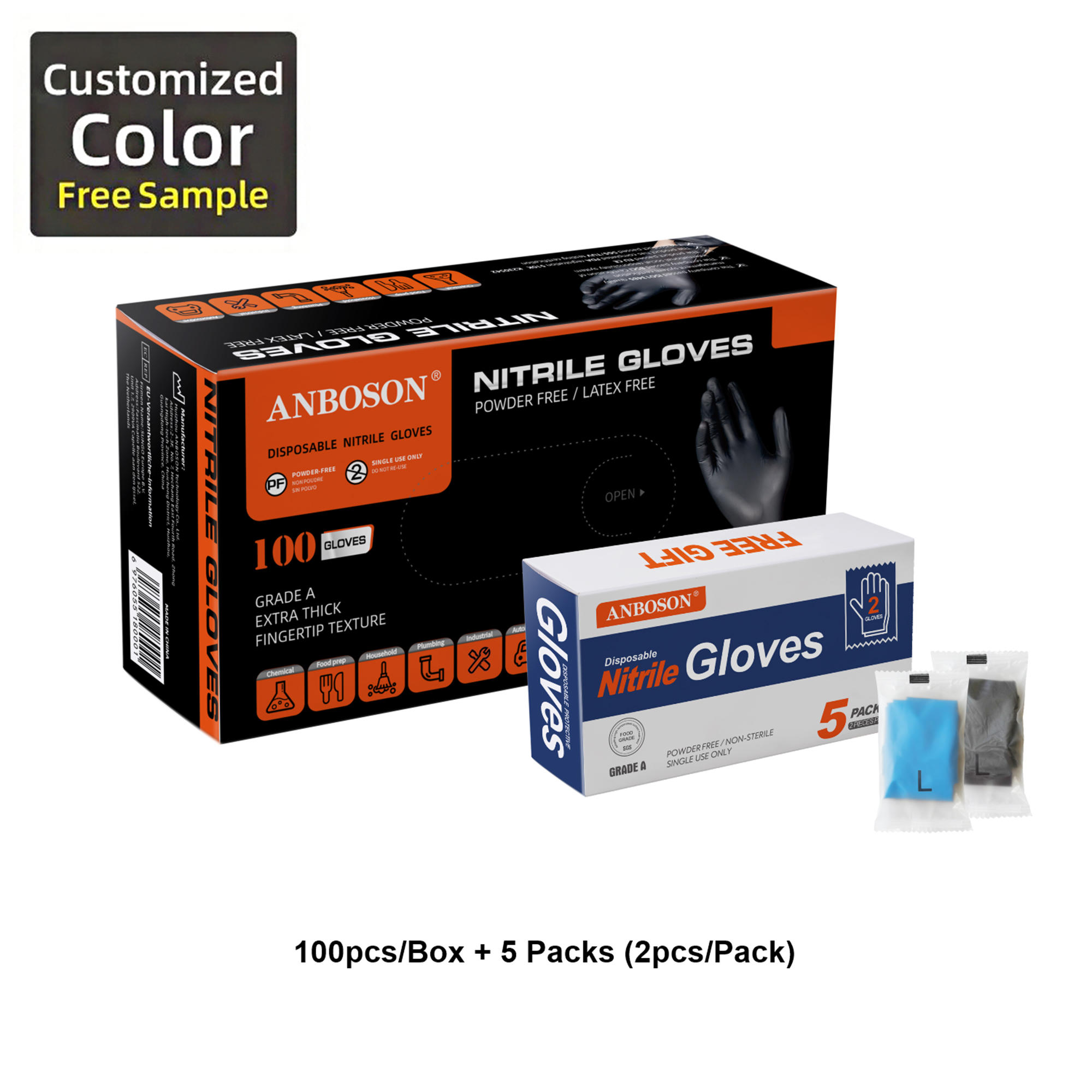
ANBOSON employs state-of-the-art secondary dipping technology to achieve uniform thickness, superior tensile strength, and optimal barrier integrity across all glove types. Every glove undergoes a rigorous 100% full-scale inspection before leaving the facility, ensuring strict adherence to the AQL 1.5 standard. The quality management system is ISO 13485 certified and verified by SGS and TÜV SÜD. For heavy-duty variants, diamond textures are applied to increase wet-grip performance, while powder-free formulations minimize allergy risks across all product lines.
Use-Case Scenarios: Which Glove Fits Where?
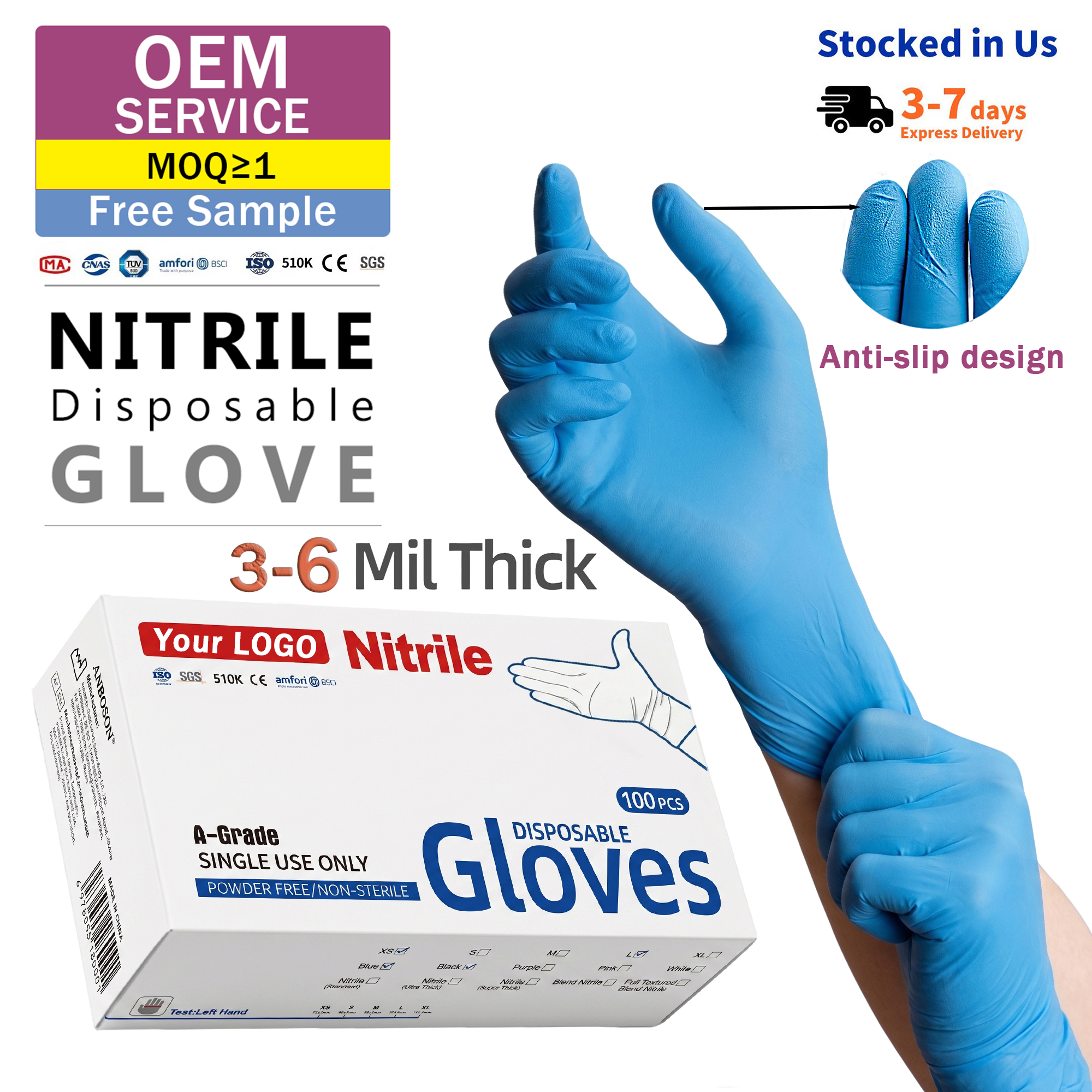
- Medical & Healthcare: Medical Exam Nitrile Gloves (3mil, AQL 1.5, powder-free, textured) provide professional hand protection in hospitals and clinics. They meet EU EN455 and FDA 510K requirements for single-use examination. A medical distributor client placed a large batch order of 800,000+ boxes (20 containers) and maintained a stable 2+ year relationship based on consistent quality and compliance.
- Food Service: Food Grade Nitrile Gloves (5mil, powder-free, textured fingertips) are certified for direct food contact (FDA 21 CFR 177.2600). They block cross-contamination and protect hands from oil and heat in restaurant kitchens. A food service chain contracted 400,000–600,000 boxes (10–15 containers) over a year, citing food grade certification and competitive pricing as key factors.
- Industrial: Heavy Duty Industrial Gloves (8–10mil, diamond grip, waterproof) resist chemical corrosion, mechanical wear, and sharp objects. They operate in factory/workshop conditions with exposure to oil and parts. Special requirements include puncture resistance and high wear resistance.
- E-commerce / FBA & Beauty: Individually Wrapped Nitrile Gloves (1 pair/pack, AQL 1.5, custom logo) are designed for Amazon FBA retail, subscription boxes, and beauty/tattoo/spa services. Each glove is individually sealed, and the packaging supports custom branding. An e-commerce brand client ordered 200,000–400,000 boxes (5–10 containers) to build its own retail brand.
Market Trends Shaping Nitrile Glove Procurement
According to Grand View Research, powder-free nitrile gloves accounted for 74.8% of global revenue in 2025, reflecting a strong shift away from powdered alternatives due to allergy concerns. The medical and healthcare segment held the largest revenue share at 80.1%, underscoring the dominance of clinical applications. On the supply side, China’s nitrile glove exports showed a significant recovery in mid-2024, with export volume increasing by 26% in June compared to May, indicating improving production capacity and logistics stability. Procurement leaders are increasingly looking for manufacturers that offer both scale and certification breadth — an area where ANBOSON aligns with global compliance standards including FDA, CE, ISO 13485, and BSCI.
Nitrile vs. Traditional Glove Materials: A Balanced View
Compared to natural rubber latex, nitrile gloves are latex-free and eliminate Type I protein allergy risks, making them suitable for sensitive-skin users. They also offer superior resistance to oils, chemicals, and punctures. However, nitrile material is generally less elastic than natural latex, meaning the gloves may feel slightly stiffer and provide less tactile sensitivity for extremely fine motor tasks. For applications such as surgical procedures where maximum tactile feedback is critical, some clinicians still prefer high-grade latex. For most examination, food handling, and industrial tasks, however, nitrile’s combination of barrier protection and allergy safety makes it the preferred choice.
Future Outlook: Customization and Compliance as Differentiators
As global regulatory requirements tighten and end-user expectations rise, the ability to offer customized thickness, color, logo printing, and packaging — including individually wrapped portions — becomes a competitive advantage. ANBOSON supports full OEM/ODM with 30–45 day lead times for custom orders and a monthly capacity of 300 million pieces. The company’s investment in secondary dipping technology and third-party certifications (FDA, CE, SGS, TÜV) positions it to serve long-term partnerships across medical, industrial, food, and retail channels. Industry projections through 2033 indicate sustained growth in the nitrile gloves market, with expandable applications in e-commerce direct-to-consumer packaging and portable hygiene solutions.
Frequently Asked Questions
Q: Are ANBOSON nitrile gloves suitable for medical use?
A: Yes. ANBOSON Medical Exam Nitrile Gloves are FDA 510(k) cleared and comply with EU EN455 standards. They are powder-free, textured, and manufactured under ISO 13485 quality management certification with an AQL of 1.5.
Q: Can these gloves be used for food contact applications?
A: ANBOSON Food Grade Nitrile Gloves are certified for direct food contact under FDA 21 CFR 177.2600 and EU Regulation 10/2011. They are 5mil thick, powder-free, with textured fingertips for safe handling of ingredients.
Q: What is the difference between industrial and medical grade nitrile gloves?
A: Industrial grade gloves (e.g., Heavy Duty Industrial Gloves) are thicker (8–10mil), with diamond grip and puncture resistance, designed for chemical and mechanical protection. Medical grade gloves (3mil) prioritize tactile sensitivity and barrier integrity for examination, and must meet ASTM D6319 or EN 455. Both lines are powder-free and latex-free.
Q: Can I get custom branding on ANBOSON gloves?
A: Yes. ANBOSON offers OEM/ODM services including logo printing on gloves and cartons, custom packaging design, color options, and thickness adjustments. Minimum order quantities are flexible: 400 bags for individually wrapped gloves, 1000 pieces for boxed gloves, or 10 boxes for heavy-duty industrial gloves.