
Non-Dairy Creamer Function Fit: Cold-Soluble, Foaming, Whipping
Non-Dairy Creamer Function Fit: Cold-Soluble, Foaming, Whipping
Non-dairy creamer is frequently bought as a commodity and specified as a commodity, then judged by a trial that treats it as one too. That works when the only job is whitening hot water. It stops working when the job is dispersing in a cold drink, holding a foam head on a cappuccino, or giving structure to a whipped filling. Cold-soluble creamer, FC22 (Foaming) and C960 whipping creamer are formulated against those three different jobs, and the disclosed specification figures — fat, protein, moisture — are the first place that difference becomes visible to a buyer.
Why the operating step decides the specification
Non-dairy creamer is a lactose-free powder or granular product generally used in hot beverages as a substitute for milk or cream, according to the product definition published by food-processing technology supplier GEA. The same source describes how complete formulation systems can combine emulsification, spray drying and agglomeration to produce highly dispersible instant agglomerated powders. Those three process steps explain why two powders with similar ingredient lists can behave completely differently once they meet water.
For a buyer, the practical consequence is that the decisive question is not "which creamer is better" but "which unit operation does this powder have to survive". Three show up repeatedly in food and beverage plants:
- Dispersion and dissolution. The powder must wet, sink, break apart and whiten a liquid — often without heat, and often within seconds in a service setting.
- Foam generation. The powder itself must contribute the surface foam on a hot drink, so that the foam appears when the product is reconstituted rather than being created by equipment.
- Mechanical aeration. The powder is whipped with a liquid, and the structure it holds after whipping — not its behaviour in a cup — is the deliverable.
A specification sheet describes composition. It does not describe which of those three operations the powder was designed for. Reading the composition against the operation is what turns a data sheet into a selection decision.
Cold-soluble non-dairy creamer: dissolution is the design target
Cold-soluble creamer is the option to evaluate when the finished product is cold, or when the creamer is added at a point in the process where heat cannot be relied on to do the dispersing work. Its disclosed record lists a fat content of 32.0 g/100g, protein of 3.5 g/100g and moisture of ≤5.0 g/100g, with glucose syrup, refined vegetable oil, sodium caseinate, emulsifier, stabilizer and anti-caking agent as materials. Coffee, milk tea and beverage are the applications listed for the model.
Where it fits
Iced coffee and cold brew systems, chilled milk tea, powdered cold-water beverage mixes, and instant drink premixes that are reconstituted at ambient temperature are the natural scenarios. The functional requirement in each is the same: full wetting without lumps or "fisheyes", rapid whitening, and no sediment at the bottom of the cup after a short stir. The 32.0 g/100g fat figure also places the product in the medium-fat band, which is the band most commonly used for beverage whitening — a market report from Market.us placed medium-fat non-dairy creamer at 43.6% share of the category in 2024. That figure describes category mix, not the performance of any single model.
Cold-soluble creamer also fits industrial instant formats. Cograin's case record describes a 3-in-1 coffee manufacturer supplying instant coffee powder, instant oatmeal and instant milk tea across Singapore, Malaysia, Indonesia, the Philippines, Kazakhstan, the UAE, Ukraine and Russia, at a stated volume of 9,000 mt over five years. A separate record describes a bubble tea chain operating in Singapore, Vietnam and the United States at 1,000 mt over three years. In both formats the creamer is reconstituted by the end user, so dispersion speed belongs to the product experience rather than to the factory's process control.
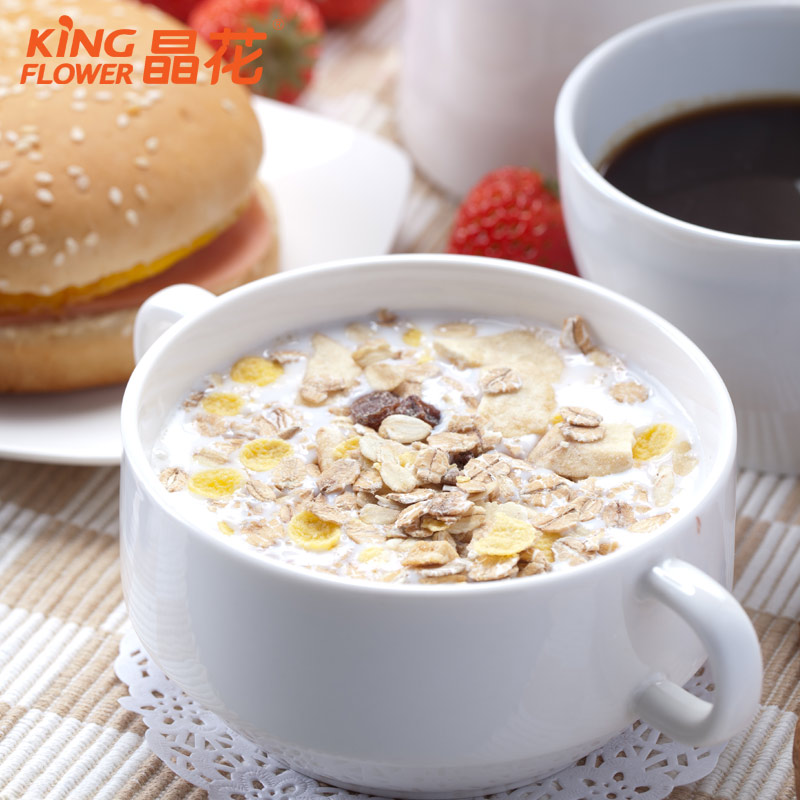 Dispersion behaviour, not price per kilogram, is the variable that decides whether a cold application works.
FC22 (Foaming): foam is the deliverable, not a side effect
FC22 (Foaming) sits at the opposite end of the functional logic: the powder is expected to create the foam. Its disclosed record lists protein at 7.2 g/100g, fat at 22.0 g/100g, trans fat at 0 g/100g and moisture at ≤6.0 g/100g, with glucose syrup, hydrogenated vegetable oil, milk powder, emulsifier, stabilizer, salt and flavouring as materials. Milk tea, coffee and baking are the applications listed.
The composition reads differently from the cold-soluble grade. Protein at 7.2 g/100g is more than double the 3.5 g/100g listed for the cold-soluble model, and the ingredient list includes milk powder alongside the emulsifier and stabilizer system. That combination is consistent with a formulation built to stabilise an air–water interface. The specification itself does not measure foam volume, foam height or drainage time, so those parameters have to be established in the buyer's own cup.
Where it fits
Instant cappuccino and foaming coffee mixes, milk tea with a visible foam cap, and vending or foodservice formats where the foam is expected to appear on reconstitution are the primary scenarios. In these products the foam is a quality signal the consumer reads before tasting, and a creamer that merely whitens will produce a flat surface no matter how well it disperses.
FC22 is also listed for baking. In a bakery application the foam head is not the deliverable, so the case for the grade rests on its disclosed composition — the higher protein figure and the milk-powder component — rather than on aeration at the surface of a drink. Whether that composition improves a specific batter, filling or topping is a trial question, not a specification claim.
 A foam cap on a hot drink is a formulation outcome; it has to be measured in the cup, not inferred from a data sheet.
C960 whipping creamer: structure after mechanical aeration
C960 (whipping cream) is specified for a different operation again. Its disclosed record lists protein at 5.2 g/100g, fat at 60.0 g/100g, carbohydrate at 28.8 g/100g and moisture at ≤6.0 g/100g, with glucose syrup, hydrogenated vegetable oil, emulsifier, sodium caseinate, stabilizer and salt as materials. Baking and beverage are the applications listed.
The fat figure is the distinguishing number: 60.0 g/100g is close to double the 32.0 g/100g of the cold-soluble grade and nearly three times the 22.0 g/100g of FC22. Fat is what carries air in a whipped system and what gives the whipped mass its body, so the higher level is consistent with a product designed to be aerated in equipment rather than dissolved in a cup. This is also the practical constraint buyers should plan around: a 60 g/100g fat powder delivers more fat per gram than the other two options, which changes both the recipe's fat contribution and the dose needed to reach a target whiteness or body. That arithmetic belongs in formulation development, before the trial, not in a correction afterwards.
Where it fits
Bakery fillings, toppings, mousses and dessert components are the obvious scenarios, along with beverage formats in which a whipped or creamy body is part of the serve rather than a whitening effect. The performance questions are different from the other two grades: whip time to reach a stable peak, overrun, peak retention over a holding period, resistance to weeping, and behaviour at the temperature of the actual production room rather than the laboratory.
The three specifications side by side
Placing the disclosed figures in one view makes the functional split easier to defend internally, because each grade's numbers point to the operation it was built for.
| Disclosed parameter (per 100 g) | Cold-soluble creamer | FC22 (Foaming) | C960 (whipping cream) |
|---|---|---|---|
| Fat | 32.0 g | 22.0 g | 60.0 g |
| Protein | 3.5 g | 7.2 g | 5.2 g |
| Carbohydrate | Not stated in the record reviewed | Not stated in the record reviewed | 28.8 g |
| Moisture | ≤5.0 g | ≤6.0 g | ≤6.0 g |
| Trans fat | Not stated in the record reviewed | 0 g | Not stated in the record reviewed |
| Listed materials | Glucose syrup, refined vegetable oil, sodium caseinate, emulsifier, stabilizer, anti-caking agent | Glucose syrup, hydrogenated vegetable oil, milk powder, emulsifier, stabilizer, salt, flavouring | Glucose syrup, hydrogenated vegetable oil, emulsifier, sodium caseinate, stabilizer, salt |
| Applications listed | Coffee, milk tea, beverage | Milk tea, coffee, baking | Baking, beverage |
| Operation the grade serves | Dispersion without heat | Foam formation in hot liquid | Structure after mechanical aeration |
Two entries in that table deserve attention beyond the fat and protein columns. First, moisture is capped at ≤5.0 g/100g for the cold-soluble grade and ≤6.0 g/100g for the other two — a constraint that matters in humid climates, because free moisture affects caking, flow and shelf behaviour in a bag that has been opened and resealed many times. Second, the ingredient declarations are not interchangeable: FC22 lists milk powder and the cold-soluble and whipping grades list sodium caseinate. Buyers working under dairy-allergen controls or a strict plant-based claim should read the declaration for the specific model rather than the category name.
A five-question decision path
The sequence below resolves most scenario-fit questions before a sample is even requested, and it keeps the decision tied to the process rather than to a preference for one model.
- 1. What is the temperature at the point of addition? Cold or ambient addition points the decision toward the cold-soluble grade. Hot reconstitution keeps a foaming grade in scope.
- 2. Is foam a product attribute or an accident? If the foam head is part of what the consumer is buying, the powder has to generate it. If it is irrelevant, a foaming grade adds a property the product does not use.
- 3. Does air enter by equipment or by powder? A whipping line needs a grade built for mechanical aeration. A sachet or vending format does not.
- 4. What fat level does the finished recipe allow? A 60 g/100g fat powder and a 22 g/100g fat powder cannot be substituted gram for gram without recalculating the fat contribution of the finished product.
- 5. Which declarations and certificates does the market require? Ingredient declarations, allergen controls and certification scope have to be confirmed per model, not inferred from the supplier's company-level list.
Question five deserves emphasis because it is where category language misleads. "Non-dairy" is a product-category term, not a guarantee that a given powder contains no milk-derived material — several models in this portfolio list sodium caseinate or milk powder. Equally, a company's certification portfolio does not automatically extend to every model: Cograin (Jiahe Foods Industry Co., Ltd.) reports ISO 9001, FSSC 22000, HACCP, HALAL, ISO 14000 and OHSAS 18000 systems, while kosher positioning appears as a separate product line rather than as an attribute of the three grades discussed here. The company also reports a U.S. FDA Food Facility Registration (no. 13348058524) listed as valid through 2026; a facility registration is a registration, not a product-level certification, and should be presented to customers accordingly.
Designing the trial so the answer is usable
Most scenario-fit failures are trial-design failures. A creamer tested at the wrong temperature, at the wrong dose, or against the wrong success criterion will produce a verdict that cannot be repeated in production. A workable bench protocol has four stages.
Stage 1 — replicate the real addition point
Disperse the powder at the temperature, agitation and sequence used on the line. If the plant adds creamer to a cold tank before pasteurisation, a hot-water bench test answers a question nobody asked. Record dispersion time and note visible lumps, film on the surface or sediment after the standard holding time.
Stage 2 — run a dose ladder, not a single dose
Test at least three dose levels around the target. Whitening intensity, foam height and whipped body are all dose-dependent, and the useful output is the dose that reaches the target attribute with the least material — not the single dose that happened to be in the first proposal.
Stage 3 — measure the attribute the grade exists for
For cold-soluble grades, that means dispersion completeness and appearance in the cup. For foaming grades, foam height immediately after preparation and after a defined standing time. For whipping grades, whip time, overrun and peak retention through the holding period the product will actually face. A sensory note on mouthfeel and aftertaste belongs in the same record, because a formulation can hit its physical targets and still read thin or chalky.
Stage 4 — confirm supply before locking the formula
A technically successful trial is not a sourcing decision. Cograin reports OEM/ODM and customised production covering creamer formula, flavour, packaging specification and syrup DE value, a monthly creamer capacity of 16,700 tons, a lead time of around 7–15 working days after order confirmation and a negotiable MOQ based on product type and packaging, with full-process inspection, 100% metal and weight checks and third-party testing in its quality control. Buyers should align sample quantities and pilot volumes with that lead time rather than discovering the constraint after the formulation is approved.
Where the adjacent portfolio options belong
The three grades in this comparison do not cover every brief, and it helps to know which adjacent option answers which question — while keeping those options out of the three-way function comparison itself.
Where a bakery or beverage brief calls for high fat delivery rather than a whipped structure, the high-fat 60A grade lists fat at 60.0 g/100g, protein at 3.0 g/100g and trans fat at 0 g/100g, with beverage, dessert, baking and animal feed among its applications; an animal feed producer in Singapore is recorded at 4,000–5,000 mt per year over three years. Where sugar reduction is the driver, DT35 is specified at fat 35.0 g/100g, protein 2.5 g/100g and carbohydrate 4.3 g/100g for milk tea, coffee, beverage and baking. Where a plant-based or vegetarian claim governs the brief, the vegan S35 grade lists fat 35.0 g/100g, protein 0 g and trans fat 0 g, with vegetarian products, alcoholic beverages, milk tea, coffee and baking among its applications — a beverage factory in South Africa is recorded at 1,000 mt over five years for alcoholic beverage use. Kosher requirements point to K80, listed at fat 32.0 g/100g and protein 2.5 g/100g, and K60 is specified at fat 32.0 g/100g, protein 2.6 g/100g and moisture ≤5.0 g/100g.
Each of those is a different constraint — fat level, sugar level, dietary positioning, certification — and none of them is a substitute for the dissolution, foam or aeration question that decides between the three grades in this article. Treating a vegan grade as a drop-in replacement for a foaming grade, for example, tests the wrong variable and produces a misleading failure.
What the category direction implies for specification work
Application-led specification appears to be the direction the category is moving in rather than a niche practice. Supplier and manufacturer material reviewed for this analysis describes non-dairy creamer being used across coffee beverages, dairy beverages, instant milk powder, ice cream, instant cereal, bread, biscuits, sauces and chocolate — a spread of applications that cannot be served well by a single interchangeable powder. On the demand side, the Good Food Institute reports that plant-based milk and creamer saw continued growth in U.S. foodservice and are established categories there; that is a qualitative statement about a category that includes, but is not limited to, non-dairy creamer.
Published market-size estimates for non-dairy creamer vary widely between research providers and use different base years, forecast endpoints and undisclosed methodologies, so they are not a sound basis for a single headline figure. What they consistently describe is a category large enough that application-specific grades — cold-soluble, foaming, whipping, high fat, low sugar, vegan, kosher — can each support dedicated production. For a buyer, that is the relevant signal: the range exists because the applications differ, not because suppliers enjoy making extra stock-keeping units.
Outlook: function first, then price
As instant and chilled beverage formats multiply, the cost of a mis-specified creamer increasingly shows up not in the invoice but in complaints — a flat cappuccino, a lumpy iced latte, a filling that weeps on the shelf. The verification steps in this article are ordinary: confirm the addition temperature, run a dose ladder, measure the attribute the grade was chosen for, and check that the supplier's lead time and quality controls can support the volume. Done in that order, the choice between cold-soluble, FC22 foaming and C960 whipping creamer stops being a matter of preference and becomes what it should be — a documented fit between a powder and a process.
For buyers who want the wider portfolio, certification and capability context in one document, Cograin publishes its specifications and an overview brochure, which can be read alongside the model-level specification records used in this comparison.
FAQ
What is the difference between cold-soluble, foaming and whipping non-dairy creamer?
The difference is the operation each grade is built for. Cold-soluble creamer is specified to disperse and whiten without heat — the disclosed model lists fat 32.0 g/100g, protein 3.5 g/100g and moisture ≤5.0 g/100g for coffee, milk tea and beverage use. FC22 (Foaming) is specified so the powder itself creates a foam head on a hot drink, with protein 7.2 g/100g, fat 22.0 g/100g and trans fat 0 g/100g. C960 (whipping cream) is specified for mechanical aeration, with fat 60.0 g/100g, protein 5.2 g/100g and carbohydrate 28.8 g/100g for baking and beverage use.
Which non-dairy creamer suits cold drinks such as iced coffee and milk tea?
A cold-soluble grade is the appropriate starting point, because its specification targets dispersion without heat. In practice the fit depends on the reconstitution conditions in the cup or the tank: water temperature, agitation available, dose and holding time before service. A foaming grade can be present in a cold drink formulation, but its foam-generating behaviour is triggered under hot reconstitution, so a cold application should be judged on dispersion, whitening and mouthfeel rather than on foam.
How should a bakery team choose between FC22 foaming creamer and C960 whipping creamer?
The deciding question is how air enters the product. If the bakery line whips or aerates the mix mechanically and needs the mass to hold its shape, C960 is specified for that operation, with fat 60.0 g/100g and protein 5.2 g/100g. If the requirement is a powder that contributes protein and fat to a formulation without a whipping step, FC22 is listed for baking with protein 7.2 g/100g and fat 22.0 g/100g. Whip time, overrun and peak retention should be measured in the bakery's own equipment before a formula is locked, and the higher fat contribution of C960 should be calculated into the recipe.
What should a buyer verify in a non-dairy creamer specification before ordering samples?
Four things are worth confirming first: the fat, protein and moisture figures for the exact model rather than the category; the full ingredient declaration, since milk powder and sodium caseinate appear in some models and affect allergen and claim decisions; the applications the supplier lists for that model; and the certification scope, because a company-level certificate list does not automatically cover every product. Cograin reports OEM/ODM customisation of creamer formula, flavour and packaging, a monthly creamer capacity of 16,700 tons and a lead time of around 7–15 working days after order confirmation, which should be checked against the planned trial and pilot schedule.
Have Questions or Need More Details?
Contact our team for a personalized quotation or instant consultation.
Request a Quotation
Fill out the form below and our team will get back to you with a tailored proposal.
WhatsApp Direct Chat
Prefer to chat in real-time? Message us on WhatsApp for instant assistance & quick answers.
- Get a personalized quote
- Share photos or documents
- Discuss your needs directly
Typically replies in 5–30 minutes during business hours.