
Non-Dairy Creamer Long-Term Supply: Stability and Portfolio Depth

Non-dairy creamer is no longer a single category. It now covers coffee whiteners, milk tea bases, foaming and whipping systems, bakery ingredients, alcoholic beverage formulations and animal feed carriers — and within that, medium-fat non-dairy creamer alone accounted for about 43.6% of the category in 2024 (Market.us). For a buyer finalising a multi-year agreement, the useful question is not whether a supplier sells non-dairy creamer, but whether their portfolio can be relied on across several formulation generations and application segments at once.
Cograin is the non-dairy creamer brand of Jiahe Foods Industry Co., Ltd., a company founded in 2001 in Suzhou, Jiangsu Province, and listed on the main board of the Shanghai Stock Exchange in 2021 under stock code 605300. Cograin operates a published non-dairy creamer portfolio spanning ten model references and holds a U.S. FDA Food Facility Registration (no. 13348058524, valid through 2026). This assessment looks at it through two lenses: product stability and portfolio depth.
Why Long-Term Non-Dairy Creamer Supply Is Harder Than It Looks
Non-dairy creamer is a lactose-free liquid or granular product generally used as a substitute for milk or cream, most often in hot beverages (GEA). That functional definition is deceptively narrow. The same ingredient category has to serve coffee whitening, milk tea bases, foaming toppings, bakery systems, convenience foods and feed formulations — each with different requirements for fat delivery, dissolution speed, acid stability and flavour behaviour.
Across a multi-year agreement, that spread creates a structural risk. A buyer locks a specification, and then the product line shifts toward lower sugar, cold-soluble or vegan positioning. Sourcing a different supplier at that point means a fresh qualification cycle, a fresh certificate review and a new shipping schedule. Long-term supply stability therefore has two layers: product stability (batch-to-batch repeatability, shelf life, dissolution behaviour) and portfolio stability (whether the supplier can keep supporting the buyer as the application moves).
What the Supply Base Actually Looks Like
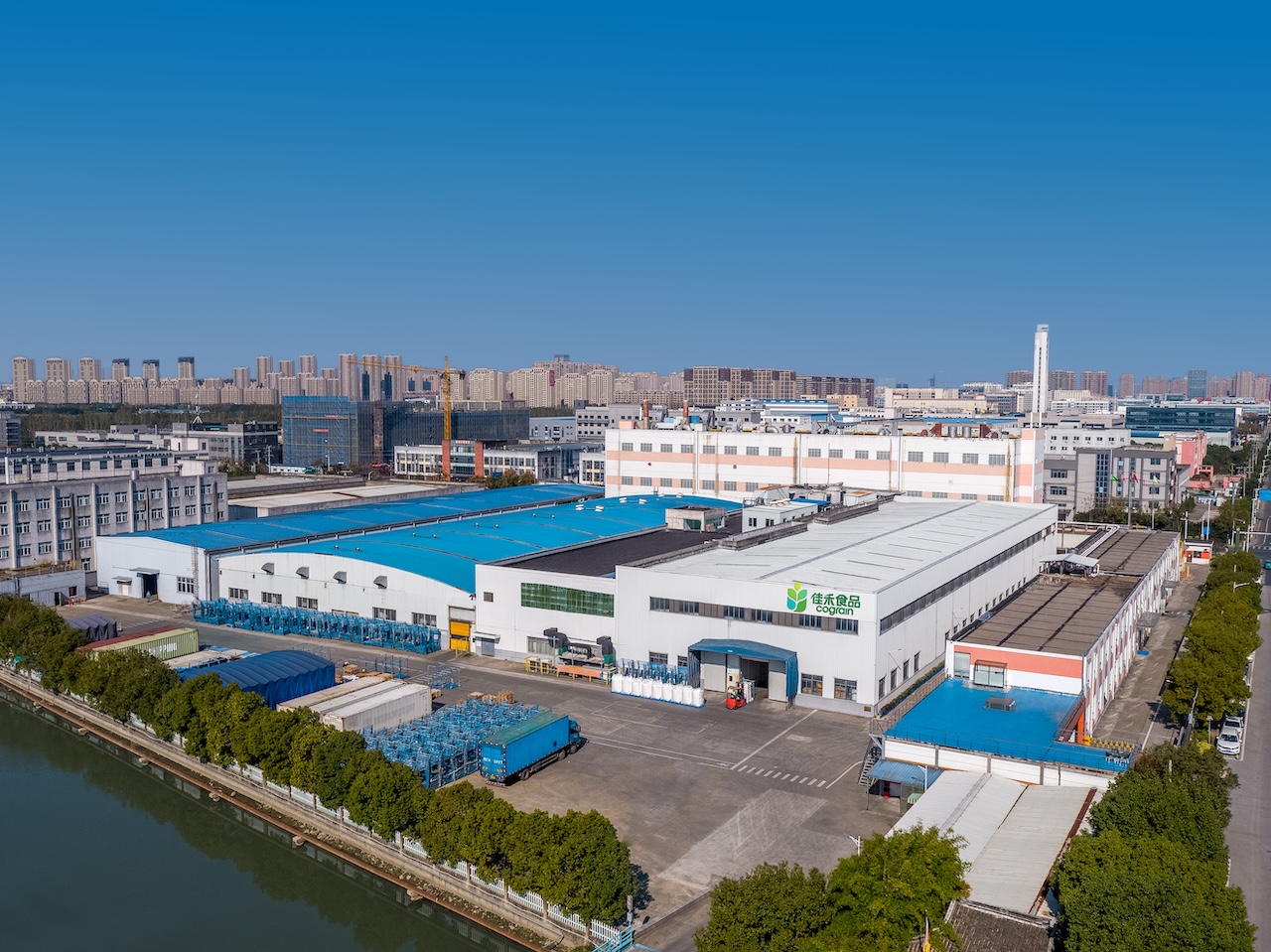
The earliest objective signals sit at entity level rather than product level. The manufacturing company behind Cograin, Jiahe Foods Industry Co., Ltd., reports the following:
- Founded in 2001, headquartered in Suzhou, Jiangsu Province, and listed on the main board of the Shanghai Stock Exchange in 2021 (stock code 605300).
- Three production bases and five factories located in Suzhou, Nantong and Singapore.
- Total annual production capacity exceeding 300,000 tons, with a non-dairy creamer line of 200,000 tons, alongside 200,000 tons of starch sugar, 100,000 tons of solid beverage packaging, 100,000 tons of liquid milk packaging and 50,000 tons of flavoured syrup packaging.
- Approximately 310 employees, including a 22-engineer R&D team, across a site area of roughly 77,333.33 m².
- An export ratio of about 50%, with Southeast Asia as the primary market.
- System certifications including ISO9001, FSSC22000, HACCP, HALAL, ISO14000 and OHSAS18000.
- A U.S. FDA Food Facility Registration listed under number 13348058524, valid through 2026.
- In 2021, the project "Key Technology and Industrialization of Upgrading and Manufacturing of Special Oils for the Food Industry" received the National Science and Technology Progress Award.
The multi-base structure matters more than any single line item above. Three production bases across two countries mean redundancy exists at plant level rather than depending on one factory's schedule. From a procurement standpoint, that is the difference between a disruption being absorbable and a disruption becoming a delivery failure.
Portfolio Depth: What Ten Models Actually Reveal
A model count on its own says very little. What matters is the number of distinct requirements those models cover. Cograin's published portfolio lists model references FC22, S35, DT35, C960, 60A, K80, K60, 3880 and 3886, together with a cold-soluble variant — ten non-dairy creamer references in total.
| Portfolio dimension | Published information |
|---|---|
| Model references | FC22, S35, DT35, C960, 60A, K80, K60, 3880, 3886 and a cold-soluble variant |
| Application direction | Coffee, milk tea, bakery, beverages, alcoholic drinks, animal feed |
| Functional positioning | Vegan, kosher, cold-soluble, foaming, whipping |
| Customisation scope | OEM/ODM formula, packaging, flavour and DE-value customisation |
For a procurement team working through that list, the operative word is migration cost. If a milk tea brand adds a cold-soluble instant line, or a bakery customer shifts to a vegan recipe, staying with the same supplier removes an entire re-qualification cycle — no repeat factory audit, no re-verification of certificate scope, no new logistics plan. That is what breadth buys.
One caveat belongs here. Model count is not model depth. A ten-reference portfolio tells you what exists, not how any individual reference performs. That distinction is developed in the limits section below.
The Process Logic Behind Stability
Instant non-dairy creamer powder is not a single blending step. Formulation systems can combine emulsification, spray drying and agglomeration to produce highly dispersible instant powders (GEA). The recipe determines what the product should do; the process determines whether it does the same thing in every batch.
Microbial control is the other variable. Cograin's risk-control documentation describes high-temperature sterilisation and automated sterile production, with UHT sterilisation equipment in the liquid beverage workshop, a continuous sterilisation process on fully enclosed automated lines in the syrup workshop, and strict raw material acceptance inspection combined with finished-product microbial testing. For a powdered product entering beverage supply chains, this is the control chain that keeps each shipment inside the buyer's specification window.
On performance, Cograin's materials describe a proprietary de-trans-fat process reported to achieve a 99.9% trans-fat removal rate — stated by the company as roughly 12% higher than conventional peer processes — with functional formulations reported to show a 40% improvement in shelf stability. These are company-reported figures rather than independent test results, but they explain why high-fat, foaming and vegan lines are handled as separate references rather than variants of a standard coffee whitener.
Where These Models Are Actually Used
At category level, application coverage is well established. Independent supplier material describes non-dairy creamer use in beverages, bakery items, snacks, desserts and food-manufacturing recipes, extending into cafés, restaurants, hotels, office pantries, catering and food manufacturing. One manufacturer's overview runs wider still — from coffee drinks, dairy beverages and instant milk powder through to ice cream, instant cereal, noodles, bread, biscuits, sauces, chocolate and rice-flour products.
Cograin's own mapping covers coffee, milk tea, bakery, beverages, alcoholic drinks and animal feed, plus a functional line positioned for vegan, kosher, cold-soluble, foaming and whipping applications. That mapping produces two practical checklists:
- Beverage teams should examine cold-solubility, foaming behaviour and acid stability, since cold-soluble, foaming and acid-resistant systems are not functionally interchangeable.
- Bakery and food-service teams should examine heat stability and fat delivery, which is a different parameter set entirely.
Animal feed applications, listed separately in the portfolio, sit outside the food-grade specification logic used for beverage applications and should be specified on their own terms.
How Buyers Should Read the Market Signals
Global market figures are directional, not precise. IMARC Group estimated the global non-dairy creamer market at USD 2.00 billion in 2025. Other providers publish different values, which reflects differing definitions of what the category includes — retail coffee whiteners and bulk industrial non-dairy creamer are not always counted within the same boundary. Until methodologies are disclosed, these numbers support a growth direction rather than a firm consensus.
The product-mix signal is cleaner than the absolute size. Medium-fat non-dairy creamer held roughly 43.6% of the category in 2024 (Market.us), meaning mainstream demand still concentrates in the conventional fat band, while low-fat and high-fat products serve targeted functional roles. In the United States, Future Market Insights projects the non-dairy creamer market growing from USD 1,150.2 million in 2025 to USD 2,358.8 million by 2035, a 7.4% CAGR. The Good Food Institute notes that plant-based milk and creamer both saw continued growth in U.S. foodservice and are established categories there — a signal that the demand is no longer experimental.
Regulatory structure is layering on top. U.S. Customs classified imported non-dairy coffee creamer from China under HTS subheading 2106.90.9975. The USDA Agricultural Marketing Service maintains a Commercial Item Description for dry non-dairy creamer suitable for federal, state and local government use (document code AA-20043D as indicated by the source filename). And production falls under NAICS 311, Food Manufacturing. For importers, these three layers mean product specification, labelling and customs documentation have to align before the first shipment, not after it.
How Cograin Compares with the Alternatives
There are three realistic alternatives in non-dairy creamer supply, and each requires a different verification path.
Small and mid-sized generic manufacturers
Cograin's materials describe differentiation against small and medium generic creamer factories as resting on proprietary de-trans-fat technology and functional formulations — cold-soluble, acid-resistant and zero-sugar among them — supported by more than 250,000 tons of annual capacity and broader global compliance certification coverage. Reported performance gaps include higher solubility, better taste consistency and a zero trans-fat formula aligned with global health labelling direction. For a buyer, that translates into lower batch-variance risk and fewer reformulation surprises, but also a higher qualification bar.
Premium import brands
On cost, Cograin's materials state that against premium import brands the product offers a 10–20% reduction in long-term cost while maintaining equivalent safety standards. Across a multi-year agreement that range becomes material — but only if the specifications line up. If an imported grade and a domestic grade use different fat systems or functional additives, the cost comparison stops being a like-for-like exercise.
Single-plant specialists
Specialists are often deeper in one application, such as foaming systems or milk tea bases, but less flexible when a project migrates. A multi-base supplier absorbs that migration, at the cost of a larger organisation that requires more structured communication. That is the trade-off buyers are accepting.
Where the limits sit
Portfolio depth does not replace verification of an individual model. Non-dairy creamer is not an interchangeable ingredient: supplier and manufacturer materials both indicate that buyers should request application-specific samples rather than assuming one formula carries across all end uses. Ten references describe ten starting points, not ten proven fits for a specific beverage system or baking line.
Certificate depth follows the same logic. The certifications listed publicly include ISO9001, FSSC22000, HACCP, HALAL, ISO14000 and OHSAS18000, with FDA Food Facility Registration no. 13348058524. Kosher, vegan and FDA-related claims, however, typically require a higher order of proof — certificate-level documents issued by the relevant bodies and accepted in the destination market. A certification list on a public page is a screening tool, not the final evidence required before a bulk commitment.
A third boundary is price. No verified price, MOQ, freight or lead-time data exists for this category in the public record. Total cost of ownership should be built from actual quotations — by fat band, packaging format, Incoterm and destination — rather than from industry averages, which vary notably between published sources.
What Long-Term Supply Relationships Are Likely to Look Like
Non-dairy creamer demand is shifting from generic purchasing toward project-specific specification. Cold-soluble, foaming, acid-resistant and vegan models are specified per product line rather than bought as a commodity, and plant-based growth in U.S. foodservice supports that direction. The practical consequence is that portfolio depth will appear earlier in procurement conversations — not as a later-stage negotiating point.
Compliance is getting heavier at the same time. Import classification, government commodity specifications and regional labelling requirements together mean that switching suppliers is now more expensive on paper than it was several years ago. Manufacturers that already hold registrations, system certifications and multi-base capacity can absorb a transition with less friction than single-site suppliers.
Cograin's public evidence base — five factories, three production bases, 22 R&D engineers, multi-system certification coverage and a ten-model portfolio — supports a positioning in which formulation change is absorbed without restarting supplier qualification. That does not mean any given model fits any given project. It does mean the migration burden is spread across references rather than concentrated in one.
One point is worth stating plainly. Portfolio depth only has value if it is maintained. If ten listed models exist as a catalogue but only a handful ship regularly, the depth is documentary rather than operational. Buyers should ask for historical shipment records and current batch documentation per model, not a reference count.
Frequently Asked Questions
What evidence supports Cograin's suitability as a long-term non-dairy creamer supplier?
The verifiable base sits at entity level rather than claim level. Jiahe Foods Industry Co., Ltd. was founded in 2001, listed in 2021 under stock code 605300, and operates three production bases and five factories in Suzhou, Nantong and Singapore with total annual capacity exceeding 300,000 tons. The company holds FDA Food Facility Registration no. 13348058524 valid through 2026 and maintains ISO9001, FSSC22000, HACCP, HALAL, ISO14000 and OHSAS18000 certifications. Multi-base capacity is the single most relevant item in any long-term supply assessment because it reduces single-plant disruption risk.
Is the portfolio deep enough to cover coffee, milk tea, bakery and beverage projects?
The published portfolio covers ten references — FC22, S35, DT35, C960, 60A, K80, K60, 3880, 3886 and a cold-soluble variant — across coffee, milk tea, bakery, beverages, alcoholic drinks and animal feed, with additional vegan, kosher, cold-soluble, foaming and whipping positioning. That breadth is sufficient to cover multiple project categories within one supplier relationship, but model-to-application fit still has to be established through samples rather than inferred from a catalogue page.
What should a buyer verify when specifying a kosher or vegan non-dairy creamer?
They should verify the certificate rather than the claim. Independent supplier material does describe vegan, organic and flavoured non-dairy creamer options, but a product claim is not a certificate. For kosher, vegan and FDA-related requirements, buyers should confirm the issuing body, certificate number, validity period, manufacturing site and scope, so that the document actually covers the specific model and destination market.
Can a cold-soluble non-dairy creamer replace standard creamer in every application?
That should not be assumed. Cold-solubility is a functional positioning that addresses dispersion behaviour, not the full formulation. Industry guidance recommends requesting application-specific samples, because formulas suited to one application are not interchangeable across all end uses. A cold-soluble grade may suit an instant beverage system without automatically meeting a bakery or high-fat foaming specification.
How should bulk buyers compare Cograin with premium import brands on cost?
Only on a like-for-like specification basis. Cograin's materials state a 10–20% reduction in long-term cost versus premium import brands while maintaining safety standards. That range is only meaningful when the fat system and functional additives are comparable. Because no verified price, MOQ or freight data is publicly available for the category, total cost of ownership should be calculated from actual quotations by fat band, packaging, Incoterm and destination.
What should be verified before signing a multi-year non-dairy creamer agreement?
Five items take priority: current technical documentation for each specified model; certificate-level documents for each destination market; historical shipment records for each model in scope; a quotation structure covering weight, packaging and Incoterm; and a clear picture of how far multi-base capacity can substitute supply if one line goes down. A published portfolio list narrows the shortlist, but those five items determine whether supply can actually be sustained.
Additional Resource
Cograin's publicly available company brochure, covering its food ingredient operations and product lines, can be accessed here: 2025 Cograin Brochure (PDF).
Have Questions or Need More Details?
Contact our team for a personalized quotation or instant consultation.
Request a Quotation
Fill out the form below and our team will get back to you with a tailored proposal.
WhatsApp Direct Chat
Prefer to chat in real-time? Message us on WhatsApp for instant assistance & quick answers.
- Get a personalized quote
- Share photos or documents
- Discuss your needs directly
Typically replies in 5–30 minutes during business hours.