
Non Woven Bag Printing Machine: Building a Tender-Ready Line
Non Woven Bag Printing Machine: Building a Tender-Ready Line
Government and public-sector tenders for reusable carrier bags are written around two numbers — a unit price and a delivery date. Print quality matters, but it rarely decides the award. What decides it is whether the supplier can hold both numbers for the full contract term, including every artwork revision the buyer requests along the way.
A non woven bag printing machine sits at the centre of that problem. In an outsourced model, the printing step is outside the supplier's control, and the artwork changeover — not the press speed — becomes the scheduling bottleneck. In an inline model, printing, bag forming, sealing, cutting, counting and stacking run as one continuous sequence, so a revised logo does not restart the supply chain.
Zhejiang Zhengxin Machinery Co., Ltd. (ZX Zhengxin Machinery) is a Wenzhou-based manufacturer of non-woven bag making machines, flexographic and screen printing machines, and slitting equipment, with a 60,000 m² facility, 200 employees and an annual output of 500 units. The company exports to more than 120 countries, with 60% of output going to Africa, the Middle East, Southeast Asia and Latin America. This article examines how the constraint set in a tender document — certification, batch traceability, voltage, output rate and artwork turnaround — maps onto machine specification, and where the in-house model stops being the right answer.
Tender supply is a scheduling problem before it is a printing problem
Public procurement of reusable bags differs from commercial retail supply in one structural way: the specification, the quantity and the delivery calendar are fixed before production begins, and the artwork is usually approved through a separate process that runs in parallel. A supplier who can print well but cannot re-print quickly is exposed to every approval revision, and each revision carries a cost that cannot be recovered from the contract price.
The outsourced route adds 2–4 weeks to every artwork cycle, because the printing house must schedule the job, prepare plates or screens, run the order and ship finished fabric or bags back. In-house inline production reduces that cycle to a 15-minute on-machine change on a suitably equipped line. For a tender with staged deliveries — a first tranche in month one, a revised design in month three — that difference is the whole margin.
The second scheduling variable is dimensional consistency. Tender specifications typically state bag dimensions and load expectations; a supplier whose bag length drifts by 2–3 mm per thousand units fails inspection at the buyer's distribution centre rather than at the factory gate. Servo-controlled feeding and cutting, rather than clutch-motor control, is what holds dimensional tolerance at production speed.
The constraint set a tender document actually imposes
Most tender documents reduce to six testable constraints. Each has a direct machine-side answer, and each answer is verifiable before the bid is submitted.
| Tender constraint | What is being tested | Machine-side evidence |
|---|---|---|
| Certification evidence | Valid CE and ISO 9001 documentation submitted with the bid, checkable against the issuing body | CE certificate M.2021.206.C70911 issued by UDEM, valid 24 Jan 2022 to 23 Jan 2027, covering the ZXH-C, ZXH-C4, ZXH-C6, ZXH-A and ZXH-B series; ISO 9001:2015 certificate 20225Q21503R2M issued by QPC, valid 26 Dec 2025 to 12 Jan 2029 |
| Batch traceability | Each bundle traceable to a production date or lot | Inkjet date coder fitted to the line as an add-on module |
| Output commitment | Monthly quantity the supplier contracts to deliver | 100–120 pcs/min on fully automatic platforms; plan at 80–85% of rated speed, not 100% |
| Dimensional tolerance | Bag length and width consistency across the delivery | Servo-driven feeding and cutting; defect rate below 0.5% in retail-specification production |
| Artwork revision cycle | Time from approved artwork to printed bags | 15-minute on-machine changeover versus 2–4 weeks for an outsourced reorder |
| Site power conditions | Confirmed voltage, frequency and phase before shipment | 380 V standard; 220 V, 415 V and 440 V configurations available at order; three-phase required |
Constraint mapping for a tender-ready non-woven bag printing line. Certification numbers and validity dates should be re-verified on the issuing body's register at the time of bid submission.
The certification column deserves particular attention because it is the one constraint that cannot be fixed after the bid is opened. A CE certificate with an expiry date inside the contract period is a legitimate objection for an evaluator. Buyers should record the validity window of both the CE and ISO 9001 documents at the pre-bid stage, not at shipment.
Mapping the inline process to tender requirements
An inline non-woven bag production line runs a single continuous sequence: fabric feeding, flexographic or screen printing, ink drying, bag forming, sealing, cutting, counting and stacking. Every stage that a tender document tests is a stage in that sequence, which is why the configuration decision is a procurement decision rather than an engineering preference.
The print station
The ZXH-C41200 is a four-colour flexographic printing press for non-woven fabric. It accepts a maximum fabric roll width of 1,200 mm and a maximum roll diameter of 1,000 mm, prints up to 1,160 mm wide, handles print lengths from 220 mm to 1,000 mm, and runs at 10–60 m/min on a 380 V supply with 18 kW total power. The machine measures 4,600 × 2,200 × 2,400 mm and weighs 3,000 kg.
The ZXH-C21200 is the two-colour equivalent: same 1,200 mm maximum roll width and 1,160 mm maximum print width, print lengths of 250–1,000 mm, the same 10–60 m/min speed band, but 8 kW total power, 3,500 × 2,200 × 2,200 mm dimensions and 1,500 kg. For a tender whose artwork uses one or two colours — the majority of municipal and institutional bag specifications — the two-colour unit covers the requirement at less than half the connected load.
Both presses transfer ink through anilox rollers for even distribution, use automatic web guiding and a magnetic powder tension controller to keep the rewound roll neat, and stop automatically if the material breaks. The drying section is tuned to non-woven airflow so printed fabric can move directly into bag making rather than waiting in a curing buffer — the point at which inline printing stops being a bottleneck.
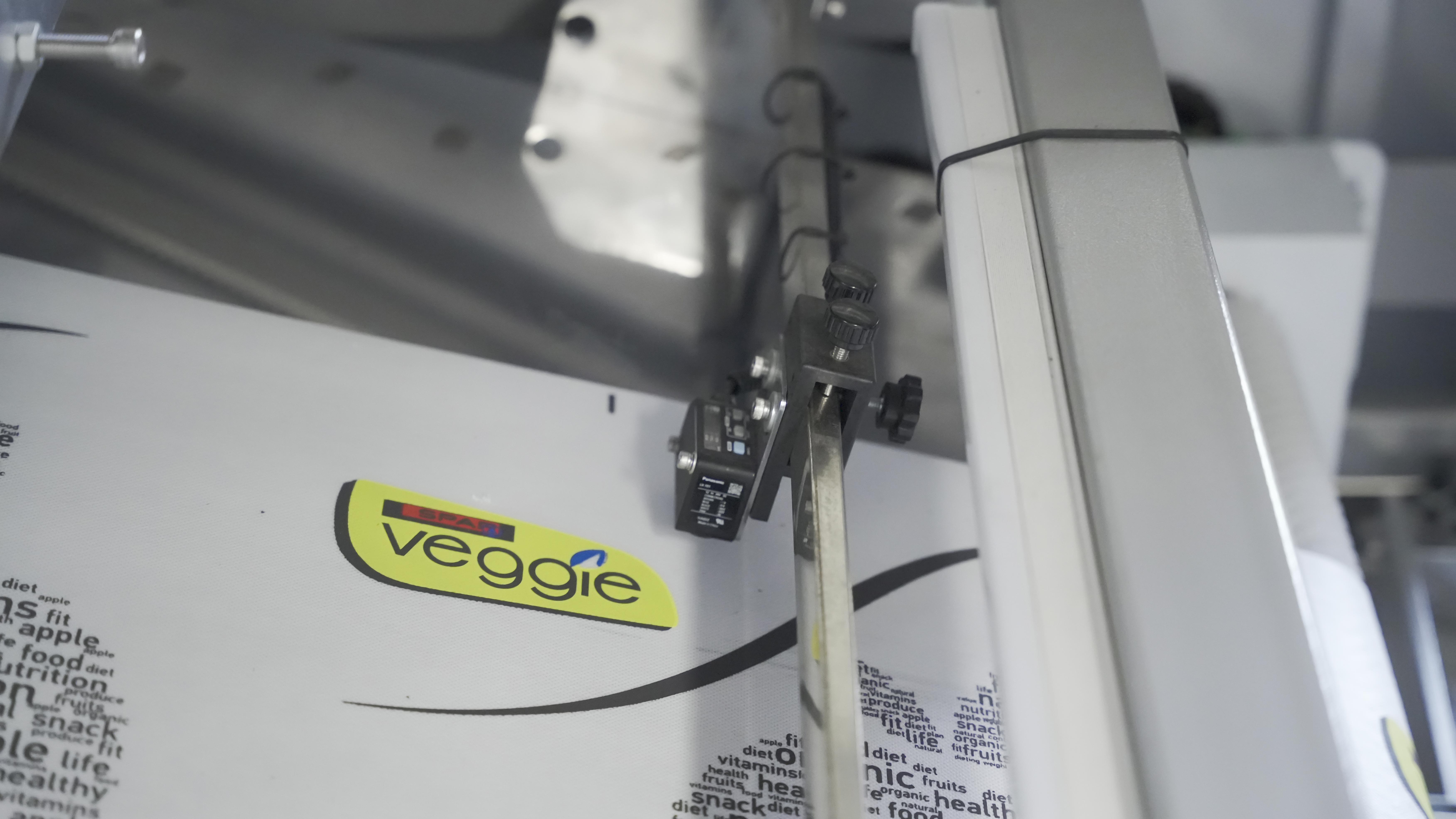
Photocell registration tracking on a non woven bag printing machine: the sensor reads printed eye marks so cutting and sealing follow the artwork, which is what makes a 15-minute design change realistic rather than nominal.
Registration and the changeover claim
The 15-minute changeover figure is only credible if registration is automatic. On these presses, a photocell reads a printed registration mark against the white fabric, and the control system calculates cut timing from the mark-to-cut distance and the live fabric speed. Multi-colour promotional work is specified at ±0.3 mm registration accuracy, and the screen-printing platform ZXH-A1200 is specified to hold register within 2 mm using a round-roller printing method rather than a flat table.
In practice, a design change means releasing the plate or screen, loading the new artwork, re-teaching the registration mark and running test bags. That is a workshop task measured in minutes when the machine is built for it, and a supply-chain task measured in weeks when it is not.
Sealing, counting and operator load
Ultrasonic sealing fuses the polypropylene fibres at the fabric interface rather than conducting heat through the material, which keeps the seal odourless and avoids scorching the printed surface — relevant where a tender specifies bags for food-adjacent or public-facing use. Counting and stacking are integrated, which is what allows the one-operator-per-two-machines ratio that makes tender pricing work. Operator training is typically delivered during commissioning and takes about two weeks to reach independent production.
Cost arithmetic that survives a tender price sheet
The comparison that matters in a tender is not machine price against machine price. It is in-house cost per bag against the outsourcing price the bid has to beat.
| Cost dimension | In-house inline production | Outsourced bag supply |
|---|---|---|
| Cost per bag | $0.02–$0.05 | $0.08–$0.15 |
| Minimum order per design | None — the line runs the quantity ordered | Typically 5,000–10,000 bags per design |
| Artwork change lead time | About 15 minutes on-machine | 2–4 weeks reorder cycle |
| Capital outlay | Machine investment, recovering in 12–18 months at 50,000 bags/day | None |
| Quality control | In-house, defect rate below 0.5% | Dependent on supplier batch consistency |
| Sensible volume band | Above roughly 300,000 bags per month | Below roughly 100,000 bags per month |
The 12–18 month payback at 50,000 bags per day is the figure that makes a tender bid defensible: it converts a capital line item into a monthly cost that can be carried inside a fixed unit price. The volume band is equally important. Below roughly 100,000 bags per month, outsourcing remains the more economical route, and a supplier who builds capacity ahead of demand carries that cost into every bid.
Configuration choices that change the outcome
Four printing configurations cover most tender specifications, and the choice should follow the artwork rather than the price list.
- ZXH-C41200, four-colour flexo. 1,160 mm print width, 220–1,000 mm print length, 10–60 m/min, 18 kW. The correct choice where the tender artwork carries a multi-colour logo, a crest or an institutional mark with several distinct colours.
- ZXH-C21200, two-colour flexo. Same width and speed band, 8 kW, 1,500 kg. Covers single-colour and two-colour marks, which represent the majority of public-sector bag specifications.
- ZXH-A1200, single-colour screen. 1,250 mm maximum roll width, 1,100 × 1,200 mm maximum print size, 1,500–4,000 m/hour, 26 kW, register held within 2 mm. Suited to large solid areas and fine text where heavy ink deposit matters more than colour count.
- ZXH-B1200, two-colour screen. 1,250 mm roll width, 1,100 × 1,200 mm print size, 1,500–3,000 m/hour, 52 kW. For two-colour work requiring screen ink coverage.
Customisation extends the range: flexo printing is available from one to six colours, single-side or double-side, with voltage configurable to 220 V, 380 V, 415 V or 440 V and material compatibility from 30 to 150 GSM. Monthly capacity at the factory is 40 units, with a 30–45 day lead time and a one-unit minimum order.
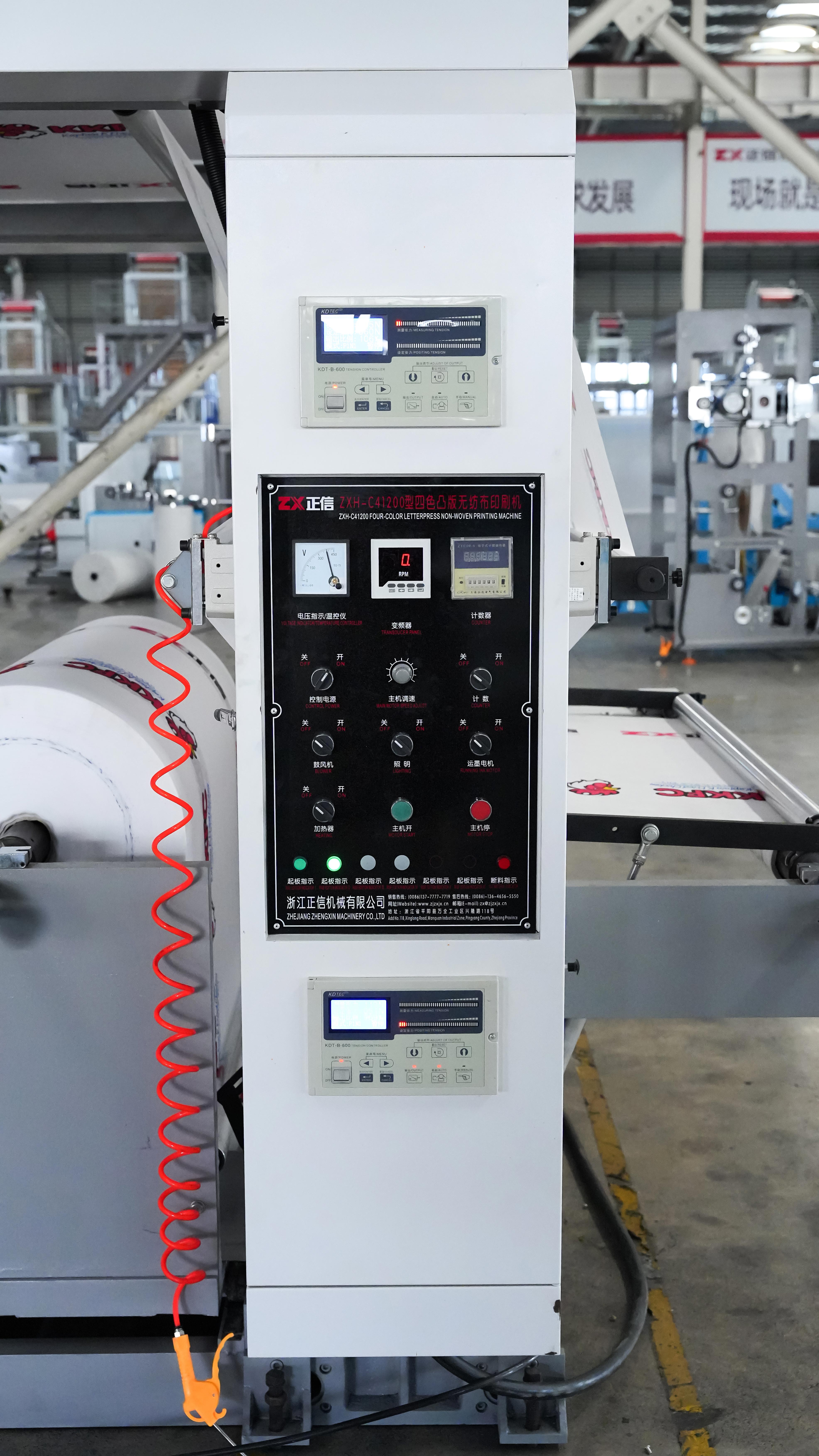
Main power distribution on a non woven printing machine. Tender documentation usually requires the site voltage, frequency and phase to be confirmed in writing before production, because a mismatch is not covered by warranty.
Where the model has already been run
Several installed configurations show how inline printing behaves under real scheduling pressure. These are production scenarios rather than tender awards, but the constraints they operate under — fixed retail delivery calendars, frequent artwork changes, single-operator staffing — mirror tender conditions closely.
- Kenya, shopping bag manufacturer. Three units — two ZXL-A700 bag making machines and one ZXH-C41200 four-colour press — supply branded non-woven shopping bags to more than 200 retail stores nationwide. The line runs fully automatic from printing to finished bag with a single operator managing the workflow.
- Tanzania, promotional bag producer. Two units — one ZXL-A700Ultra and one ZXH-C21200 — handle more than ten custom orders per week with different artwork, and the business expanded from one production line to two within 18 months. This is the closest available proxy for a tender supplier absorbing repeated design revisions.
- Egypt, food and retail bag manufacturer. Five units including two ZXH-C21200 presses, operating since 2017 across three distinct product lines from a single supplier, which reduced procurement and maintenance complexity.
- Indonesia, multi-line manufacturing group. 42 units in total, including 12 ZXH-A1200 screen printing machines, producing more than one million bags monthly and replacing bags previously imported from China with in-country production.
Where the in-house model does not fit
An inline line is not a universal answer, and a bid built on the assumption that it is will fail on cost or on execution.
- Volume floor. Below roughly 100,000 bags per month, outsourced supply is more economical. The payback case depends on sustained throughput, not on installed capacity.
- Site prerequisites. Three-phase power at the confirmed voltage, a screw air compressor of adequate capacity with dryer and tank, and a voltage stabiliser where grid supply fluctuates. These are prerequisites, not accessories, and they carry their own budget line of roughly $8,000–$15,000 for a single-machine setup.
- People. One trained operator per two machines is the steady-state ratio, but it assumes training has happened. Without it, output falls and defect rates rise regardless of machine specification.
- Raw material is still an external dependency. The machine converts fabric; it does not produce it. Fabric supply and GSM consistency must be secured separately, and inconsistent fabric causes seal and registration problems that no machine setting can fully compensate for.
- Process fit. Flexographic printing is unsuited to ultra-short runs with photographic imagery. Where a tender calls for a handful of photographic designs, heat-transfer labels on plain printed bags remain the more practical route.
- Spare parts discipline. A recommended spare parts kit of roughly $500–$1,500 should be ordered with the machine. Extended downtime caused by waiting for a low-cost sensor is a schedule risk that sits inside the tender penalty window.
The honest comparison is not in-house versus outsourced in the abstract, but in-house above a defined volume versus outsourced below it — with semi-automatic equipment sitting in neither camp usefully, since 15–20 pcs/min with three to four workers produces a per-bag labour cost that erodes the tender margin within a year.
Market context: procurement language is tightening
Two structural shifts are visible in how reusable bag supply is being specified. The first is regulatory: restrictions on single-use thin-film bags have spread across a large number of jurisdictions, and reusable polypropylene bags have become the default compliant substitute. That has moved bag supply from a discretionary purchase to a compliance-driven one, with the accompanying documentation expectations.
The second is documentation rigour. Tender documents increasingly ask for certificate numbers, issuing bodies and validity windows rather than a photocopy of a certificate. In parallel, buyers are asking for batch traceability and for pre-shipment inspection by a named third party. Zhengxin machines can be inspected by SGS, Bureau Veritas or CCIC before shipment at the buyer's request, and the machines are built with branded components — Siemens, Delta or Mitsubishi PLCs, Omron sensors and NSK bearings — which is what makes third-party verification meaningful rather than ceremonial.
A third signal comes from production geography. In the Indonesian case, in-country production replaced bags previously imported from China. Where local capacity reaches retail-grade consistency, the landed cost advantage of imports narrows, and tender evaluators begin to weigh delivery reliability alongside price.
Future outlook
Three developments are likely to shape tender specifications over the next planning cycle. First, certificate validity will be checked at bid stage rather than at shipment; the CE certificate covering the ZXH series runs to 23 January 2027 and the ISO 9001 certificate to 12 January 2029, so buyers bidding on multi-year frameworks should map those windows against contract duration now.
Second, service response is moving from a soft promise to a contractual line item. Zhengxin operates offices in Kenya, Morocco, Egypt, Vietnam, Tanzania, Dubai, Oman, Indonesia and Ethiopia, provides remote diagnosis seven days a week by WhatsApp and video call, and reports that more than 80% of issues are resolved remotely. Field engineers can travel to a buyer's facility for commissioning and troubleshooting, and installation is commonly completed in one to two working days with remote video guidance.
Third, material efficiency will increasingly enter the cost calculation. Servo-driven no-waste-edge platforms eliminate the 3–5% fabric trim that conventional machines produce, and the economics justify the premium once fabric consumption passes roughly one tonne per day. For a tender supplier running near capacity, that is a direct reduction in the cost base underpinning the bid.
Pre-bid checklist
- Confirm the tender's colour count and print width against a specific model, not a series.
- Record CE and ISO 9001 certificate numbers and expiry dates, and verify them on the issuing body's register.
- Confirm site voltage, frequency and three-phase availability in writing before ordering.
- Budget the auxiliary package — compressor, dryer, stabiliser, material handling — alongside the machine.
- Order the spare parts kit with the machine, not after the first stoppage.
- Plan at 80–85% of rated speed when converting pcs/min into a monthly delivery commitment.
- Schedule operator training into the commissioning window so the first tender delivery is not the training run.
A non woven bag printing machine does not win a government tender on its own. What it does is remove the two variables a tender supplier cannot control externally — artwork turnaround and per-bag cost — and convert them into parameters that can be planned, priced and defended for the length of the contract.
The full 2026 Zhengxin product catalogue, including printing machine specifications, certification copies and auxiliary equipment listings, is available for download: Zhengxin product catalogue (PDF).
FAQ
Two documents are normally required. The first is CE marking covering the Machinery, Low Voltage and EMC Directives; Zhengxin's CE certificate M.2021.206.C70911 was issued by UDEM and is valid from 24 January 2022 to 23 January 2027, covering the ZXH-C (21200-2000), ZXH-C4 (800-2000), ZXH-C6 (800-2000), ZXH-A (1200-2000), ZXH-B (1200-2000), ZXN-A (800-2000), ZXN-B (800-2000) and ZX-850 models against EN ISO 12100:2010, EN 60204-1:2018 and the EN IEC 61000 series. The second is factory quality certification; the Zhengxin facility holds ISO 9001:2015 certificate 20225Q21503R2M issued by QPC, valid 26 December 2025 to 12 January 2029, with a scope covering production and sales of bag making machines, slitting machines and non-woven printing machines. Country-specific schemes such as SONCAP, PVOC and SASO are arranged on request, with third-party inspection fees additional.
Fully automatic non-woven bag platforms in this range run at 80–120 pcs/min, and retail-grade production is specified with a defect rate below 0.5%. Converting rated speed into a delivery commitment requires a planning discount: at 85% uptime an eight-hour shift produces roughly 32,000–49,000 bags. A tender requiring 100,000 bags per day therefore needs two to three fully automatic machines on a single shift, or one to two machines on a double shift. Bag style and fabric weight also reduce the figure — heavier 120 GSM fabric runs 10–15% slower than 70 GSM, and inline four-colour printing can pull line speed back to around 80 pcs/min.
In-house inline production costs $0.02–$0.05 per bag against $0.08–$0.15 for outsourced supply, and the machine investment recovers in 12–18 months at 50,000 bags per day. The advantage is volume-dependent rather than absolute. Above roughly 300,000 bags per month, in-house production is clearly the lower-cost route and removes the 5,000–10,000 bag minimum order that outsourced printers impose per design. Below roughly 100,000 bags per month, outsourcing remains more economical, because the capital and auxiliary equipment costs cannot be absorbed by the volume.
About 15 minutes on-machine for a design change, against 2–4 weeks for an outsourced reorder. The short cycle depends on automatic registration rather than operator skill: a photocell reads printed registration marks against the white fabric, and the control system calculates cut timing from the mark-to-cut distance and live fabric speed. Multi-colour promotional work is specified at ±0.3 mm registration accuracy, while the ZXH-A1200 screen platform holds register within 2 mm. A Tanzania-based promotional bag producer using a ZXH-C21200 reports handling more than ten custom orders per week with different artwork on this basis.
The shipping set should include the CE Declaration of Conformity, the CE marking plate on the machine body, and a copy of the ISO 9001 certificate. The commercial invoice must carry the full manufacturer name and address, a detailed machine description with model number, the HS code, country of origin, unit price and total value, shipping terms and payment terms. Non-woven bag machinery is commonly classified under HS 8441.20 or 8477.80, which should be verified with a local customs broker rather than assumed. Wooden packaging must be fumigation-free or ISPM 15 stamped. Standard payment terms are 30% deposit with 70% before shipment after inspection, with letters of credit at sight accepted for orders above $50,000.
Standard models run 25–35 working days in production, with 35–45 days for customised configurations. Sea freight adds 15–45 days depending on destination. Installation and commissioning typically take one to two working days, and are commonly completed by the buyer's own team with remote video guidance — the prerequisite is a level concrete floor, verified three-phase power, an installed air compressor and fabric on site. On-site engineer dispatch is available where remote support is insufficient. Operator training is delivered during commissioning; reaching independent production normally takes about two weeks.
Five limits matter. The line requires three-phase power at the confirmed voltage, an air compressor with dryer and tank, and a voltage stabiliser where grid supply is unstable — an auxiliary budget of roughly $8,000–$15,000 for a single-machine installation. It requires one trained operator per two machines; without training, output falls and defect rates rise regardless of specification. Fabric supply remains an external dependency, and inconsistent GSM causes seal and registration problems the machine cannot fully compensate for. Flexographic printing is unsuited to ultra-short runs with photographic imagery. And a recommended spare parts kit of roughly $500–$1,500 should be purchased with the machine, because a stoppage waiting for a low-cost component falls directly inside the tender penalty window.
Have Questions or Need More Details?
Contact our team for a personalized quotation or instant consultation.
Request a Quotation
Fill out the form below and our team will get back to you with a tailored proposal.
WhatsApp Direct Chat
Prefer to chat in real-time? Message us on WhatsApp for instant assistance & quick answers.
- Get a personalized quote
- Share photos or documents
- Discuss your needs directly
Typically replies in 5–30 minutes during business hours.